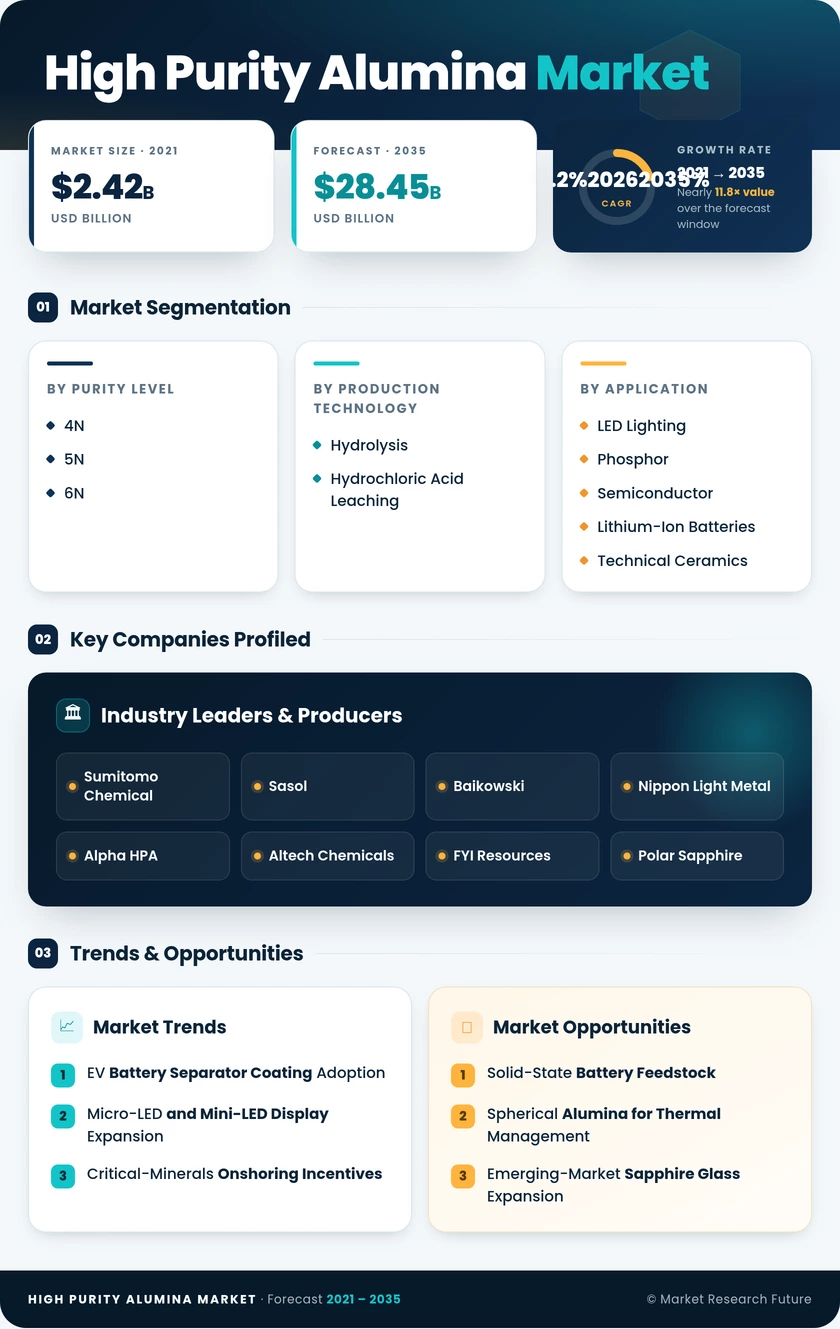
SEGMENTATION QUICK REFERENCE
| Dimension | Sub-Segments | Dominant Segment | Fastest Growing Segment |
| Purity Level | 4N, 5N, 6N | 4N (67.5% share, 2025) | 6N (24.1% CAGR) |
| Production High Purity Alumina Market | Hydrolysis, Hydrochloric Acid Leaching | Hydrolysis (81.2% share, 2025) | HCl Leaching (24.2% CAGR) |
| Application | LED Lighting, Phosphor, Semiconductor, Lithium-Ion Batteries, Technical Ceramics, Others | LED Lighting (50.7% share, 2025) | Lithium-Ion Batteries (52.4% CAGR) |
| End-User Industry | Electronics, Automotive, Others | Electronics (43.8% share, 2025) | Automotive (25.3% CAGR) |
| Region | Asia-Pacific, North America, Europe, South America, the Middle East & Africa | Asia-Pacific (70.1% share, 2025) | Asia-Pacific (21.2% CAGR) |
MARKET SEGMENTATION OVERVIEW
By Purity Level
| Sub-Segment | Key Trend |
| 4N (≥99.99%) | Volume anchor for LED and phosphor; commoditizing as capacity expands |
| 5N (≥99.999%) | Rising demand for sapphire growth and CMP slurries |
| 6N (≥99.9999%) | Premium tier for semiconductor and solid-state battery applications |
The 4N grade serves the broadest application base, from LED substrate fabrication to technical ceramics. As downstream industries demand tighter impurity specifications, the 5N and 6N segments are capturing an increasing share of capital investment and R&D spending, particularly for semiconductor and next-generation battery use cases.
By Production High Purity Alumina Market
| Sub-Segment | Key Trend |
| Hydrolysis | Dominant route using aluminum alkoxide precursors; mature cost curves |
| Hydrochloric Acid Leaching | Emerging kaolin-to-HPA route; lower feedstock costs but higher acid handling CAPEX |
Hydrolysis technology benefits from decades of commercial optimization and established supply chains for alkoxide precursors. HCl-leaching is gaining market share as Australian and Canadian developers prove the economics of processing abundant kaolin deposits into battery-grade and electronic-grade alumina.
By Application
| Sub-Segment | Key Trend |
| LED Lighting | Mature but stable; shifting toward micro-LED substrates |
| Phosphor | Steady demand from display and general illumination |
| Semiconductor | High-value, low-volume; stringent purity and particle-size requirements |
| Lithium-Ion Batteries | Fastest-growing; driven by EV separator coating mandates |
| Technical Ceramics | Industrial wear-resistance and thermal applications |
| Others | Biomedical, catalytic, and emerging niche uses |
LED lighting continues to consume the largest volume of high-purity alumina, though its growth rate is moderating as the market matures. Lithium-ion battery applications are the primary growth engine, with separator coating specifications increasingly mandating 4N-grade alumina as a baseline.
By End-User Industry
| Sub-Segment | Key Trend |
| Electronics | Largest consumer; spans LED, display, and semiconductor sectors |
| Automotive | Fastest-growing; EV battery and thermal-management demand |
| Others | Aerospace, medical devices, and specialty industrial uses |
The electronics industry's multifaceted consumption of alumina—from LED wafer growth to semiconductor CMP—anchors overall demand. Automotive end-use is accelerating as EV production scales, with battery separator coatings and power-module thermal compounds driving volume gains through 2035.