×
Hero Background
English
Chinese
French
Japanese
Korean
German
Spanish

High Purity Metal Organics Market Trends

ID: MRFR/CnM/2784-HCR
140 Pages
Priya Nagrale
October 2025

High Purity Metal Organics Market By Type (Trimethyl Aluminum, Trimethyl Gallium, Dimethyl Zinc, and Ferrocene, others), By Applications (Semiconductors, LED, Solar Cells Catalyst, Reagent, LASER, and others), By Region Till 2030

Share:
Download PDF ×

We do not share your information with anyone. However, we may send you emails based on your report interest from time to time. You may contact us at any time to opt-out.

High Purity Metal Organics Market Infographic
Purchase Options

Market Trends

Key Emerging Trends in the High Purity Metal Organics Market

The high purity metal organics (HPMO) market is now characterized by some important trends and dynamics as influenced by the semiconductor, electronic, and photovoltaic industry players. High-purity metal organics mean the organic compounds of metals which are special to use in the high-technology industry and the production of semiconductors and electronic devices. On the other hand, one of the significant tendencies is the growing need for HPMOs in the field of semiconductor production. They are important ingredients in the process of putting layers which is the deposition process for thin films and coatings. Semiconductor industry trends toward the smaller devices with greater power capability leads to the constant growth of metal organics of high purity which are critical for the guided and controlled material deposition.

Besides, the market is also witnessing a growing need for HPMOs, especially for LED production and photovoltaic cells. Metal organic structures occupy a vital place, among the sources for the materials made for LEDs, and determines the type and the efficiency of the emitted light. Besides, in the field of solar industry, they are employed in the process of the manufacture of thin-film solar cells and contribute to the advance in the performance of photovoltaic components. Ledding to the increase of adoption of LEDs and more renewable energy solutions, the demand for high-purity metal organics in the industry goes up.

Moreover, HPMO industry continues to develop new formulation to meet new challenges as technology improves. Companies are also doing research and development for manufacturing toxic free metal organics with better purity, stability and most importantly precision over deposit processes. This tendency is plate by the requirement of materials that can fulfill the strict demands of industries of semiconductor and electronics as they pursue higher performance and miniaturization of their products.

In this respect, increasing focus is being garnered on purity and safety standards of the materials used specifically in high-tech areas like HPMOs. Manufacturers have integrated those regulations into their workflows in areas such as chemical purity, environmental impact, and workplace safety. This practice shows that the industry is dedicated to the production of materials, which are the most reliable and secure and match the highest requirements to be used in an advanced manufacturing process.
Author
Priya Nagrale
Senior Research Analyst

With an experience of over five years in market research industry (Chemicals & Materials domain), I gather and analyze market data from diverse sources to produce results, which are then presented back to a client. Also, provide recommendations based on the findings. As a Senior Research Analyst, I perform quality checks (QC) for market estimations, QC for reports, and handle queries and work extensively on client customizations. Also, handle the responsibilities of client proposals, report planning, report finalization, and execution

Leave a Comment

FAQs

At what CAGR is the High Purity Metal Organics Market predicted to grow during the forecast period?

High Purity Metal Organics Market is predicted to grow at 4.20% CAGR through forecast period of 2025-2035

What is the forecast period of High Purity Metal Organics Market research report?

The forecast period for High Purity Metal Organics Market research report is 2025-2035.

Which region will lead the global High Purity Metal Organics Market?

High Purity Metal Organics Market is dominated by APAC region.

What are the key factors driving the High Purity Metal Organics Market?

Exponential rise in demand of semiconductors in the world is the most important factor

Who are the key players in the High Purity Metal Organics Market?

Azelis Electronics (France), The Dow Chemical Company (U.S.), Sigma-Aldrich Co. LLC (U.S.), Akzo Nobel N.V (Netherlands), American Elements (U.S.), Triveni Chemicals (India), Evans Fine Chem. (India), Albemarle Corporation (U.S.)

Market Summary

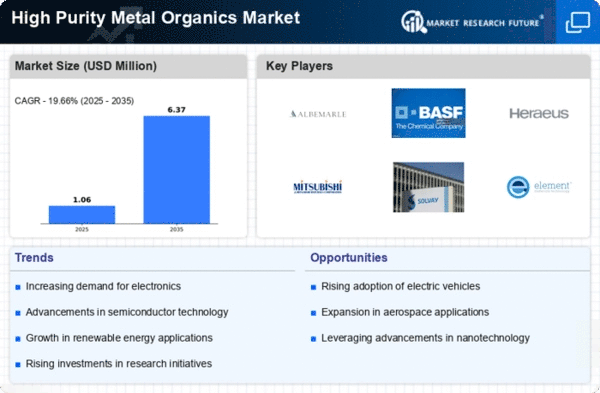
As per MRFR analysis, the High Purity Metal Organics Market Size was estimated at 0.885 USD Million in 2024. The High Purity Metal Organics industry is projected to grow from 1.06 in 2025 to 6.37 by 2035, exhibiting a compound annual growth rate (CAGR) of 19.66 during the forecast period 2025 - 2035.

Key Market Trends & Highlights

The High Purity Metal Organics Market is poised for robust growth driven by technological advancements and increasing demand across various sectors.

  • North America remains the largest market for high purity metal organics, primarily due to its strong semiconductor manufacturing sector.
  • Asia-Pacific is emerging as the fastest-growing region, fueled by rapid advancements in renewable energy technologies.
  • The semiconductor manufacturing segment dominates the market, while the catalysts segment is witnessing the fastest growth due to diverse application needs.
  • Rising demand in electronics and expansion in renewable energy technologies are key drivers propelling market growth.

Market Size & Forecast

2024 Market Size 0.885 (USD Million)
2035 Market Size 6.37 (USD Million)
CAGR (2025 - 2035) 19.66%
Largest Regional Market Share in 2024 North America

Major Players

<p>Albemarle (US), BASF (DE), Heraeus (DE), Mitsubishi Chemical (JP), Solvay (BE), American Elements (US), Strem Chemicals (US), KMG Chemicals (US)</p>

Market Trends

The High Purity Metal Organics Market is currently experiencing a notable evolution, driven by advancements in technology and increasing demand across various sectors. Industries such as electronics, pharmaceuticals, and renewable energy are increasingly relying on high purity metal organics for their applications. This reliance is largely due to the superior performance characteristics of these materials, which enhance product efficiency and reliability. As a result, manufacturers are focusing on improving production processes to meet the stringent quality standards required by end-users. Furthermore, the market landscape is becoming more competitive, with numerous players striving to innovate and differentiate their offerings. In addition to technological advancements, environmental considerations are shaping the High Purity Metal Organics Market. There is a growing emphasis on sustainable practices, prompting companies to explore eco-friendly alternatives and production methods. This shift not only aligns with global sustainability goals but also caters to the increasing consumer preference for environmentally responsible products. As the market continues to evolve, it appears poised for further growth, driven by both technological innovations and a commitment to sustainability.

Technological Advancements

The High Purity Metal Organics Market is witnessing rapid technological advancements that enhance production efficiency and product quality. Innovations in synthesis methods and purification techniques are enabling manufacturers to produce higher purity levels, which are crucial for applications in sensitive industries. This trend suggests a potential for improved performance and reliability in end products.

Sustainability Initiatives

There is a noticeable shift towards sustainability within the High Purity Metal Organics Market. Companies are increasingly adopting eco-friendly practices and exploring alternative materials that minimize environmental impact. This trend indicates a growing awareness of corporate responsibility and aligns with consumer demand for greener products.

Diverse Application Growth

The High Purity Metal Organics Market is expanding its reach across various sectors, including electronics, pharmaceuticals, and renewable energy. This diversification suggests that the materials are becoming integral to a wider range of applications, potentially driving demand and fostering innovation in product development.

High Purity Metal Organics Market Market Drivers

Rising Demand in Electronics

The Global High Purity Metal Organics Market Industry is experiencing a surge in demand driven by the electronics sector. High purity metal organics are essential in the production of semiconductors and advanced electronic components. As the global electronics market continues to expand, with projections indicating a market size of 3.5 USD Billion in 2024, the need for high purity materials is expected to grow. This trend is further supported by the increasing adoption of technologies such as 5G and IoT, which require advanced materials for efficient performance. Consequently, manufacturers are likely to invest in high purity metal organics to meet the evolving needs of the electronics industry.

Advancements in Chemical Manufacturing

The Global High Purity Metal Organics Market Industry benefits from advancements in chemical manufacturing processes. Innovations in synthesis and purification techniques have improved the quality and availability of high purity metal organics. These advancements enable manufacturers to produce materials that meet stringent quality standards required in various applications, including pharmaceuticals and electronics. As industries increasingly prioritize quality and performance, the demand for high purity metal organics is likely to rise. This trend is indicative of a broader shift towards high-quality materials in manufacturing, which could further bolster the market's growth trajectory in the coming years.

Growth in Renewable Energy Technologies

The Global High Purity Metal Organics Market Industry is poised for growth due to the rising focus on renewable energy technologies. High purity metal organics play a crucial role in the production of photovoltaic cells and other renewable energy components. As countries worldwide aim to transition to sustainable energy sources, the demand for these materials is expected to increase. The market is projected to reach 7.2 USD Billion by 2035, reflecting a significant investment in renewable energy infrastructure. This shift not only supports environmental goals but also drives the need for high purity materials that enhance the efficiency and longevity of renewable energy systems.

Regulatory Support for High Purity Standards

The Global High Purity Metal Organics Market Industry is influenced by regulatory support aimed at maintaining high purity standards across various sectors. Governments and regulatory bodies are increasingly implementing stringent guidelines to ensure the quality and safety of materials used in critical applications. This regulatory landscape encourages manufacturers to invest in high purity metal organics, as compliance with these standards is essential for market access. As industries such as pharmaceuticals and electronics prioritize quality assurance, the demand for high purity materials is expected to rise, further driving the growth of the market.

Increasing Investment in Research and Development

The Global High Purity Metal Organics Market Industry is witnessing increased investment in research and development activities. Companies are focusing on developing new applications and improving existing products to cater to diverse industrial needs. This investment is crucial for fostering innovation and enhancing the performance of high purity metal organics. As industries such as electronics and renewable energy evolve, the demand for specialized materials is likely to grow. The commitment to R&D not only supports market expansion but also positions companies to capitalize on emerging trends and technologies, ensuring their competitiveness in the global market.

Market Segment Insights

By Application: Semiconductor Manufacturing (Largest) vs. Catalysts (Fastest-Growing)

<p>Within the High Purity Metal Organics Market, the application segments exhibit distinct market share dynamics. Semiconductor Manufacturing holds the largest share, driven by the continual demand for advanced technologies such as 5G and AI, which necessitate high-performance materials. Following closely is the Catalysts segment, featuring significant growth potential as diverse industries increasingly seek sustainable and efficient processes, leveraging high purity materials to improve performance and reduce environmental impact.</p>

<p>Semiconductor Manufacturing (Dominant) vs. Catalysts (Emerging)</p>

<p>Semiconductor Manufacturing remains the dominant force in the application landscape of the High Purity Metal Organics Market. This segment thrives on escalating demand for integrated circuits and semiconductor devices across various sectors, including consumer electronics and automotive. In contrast, the Catalysts segment is emerging rapidly, attributed to the rising need for eco-friendly and efficient chemical processes. The shift towards greener chemistry and innovations in catalyst technology positions this segment for robust growth, appealing to industries seeking to enhance productivity and sustainability. Together, these segments reflect the evolving market demands for high purity materials.</p>

By End Use Industry: Electronics (Largest) vs. Aerospace (Fastest-Growing)

<p>In the High Purity Metal Organics Market, the end-use industry is dominated by the Electronics sector, which commands a significant share due to the increasing demand for superior quality materials in semiconductor manufacturing and circuit board production. This sector leverages high purity metal organics for applications such as photoresists, which are essential for modern electronics devices, thereby ensuring a robust market presence. Conversely, the Aerospace industry is emerging as the fastest-growing segment within this market. The reliance on high-performance materials for aircraft and satellite manufacturing is propelling demand for high purity metal organics. Increased investments in space exploration and the shifting focus towards advanced aerospace technologies are contributing to this segment's rapid expansion, highlighting the substantial opportunities it presents for market stakeholders.</p>

<p>Electronics: Dominant vs. Aerospace: Emerging</p>

<p>The Electronics sector is recognized as the dominant player in the High Purity Metal Organics Market, primarily due to its extensive applications in the production of semiconductors and electronic components. This sector's growth is fueled by innovations in technology and the increasing miniaturization of devices that necessitate high-purity materials. On the other hand, the Aerospace sector, while currently smaller, is characterized as an emerging force driven by advancements in aerospace engineering and a rising demand for lighter, more efficient materials. The integration of high purity metal organics into aerospace applications is crucial for improving performance and compliance with stringent regulations, suggesting a promising trajectory for this segment in the years to come.</p>

By Type: Aluminum Organics (Largest) vs. Gallium Organics (Fastest-Growing)

<p>In the High Purity Metal Organics Market, Aluminum Organics currently hold the largest market share due to their wide-ranging applications in electronics and semiconductors. This dominance is characterized by their essential role in enhancing the performance of various metal-organic frameworks, appealing to a myriad of industries. Gallium Organics, on the other hand, are rapidly gaining traction and are recognized as the fastest-growing segment. Their versatility and increasing deployment in advanced photovoltaic cells are pivotal to this surge.</p>

<p>Gallium Organics (Dominant) vs. Indium Organics (Emerging)</p>

<p>Gallium Organics represent a dominant force in the High Purity Metal Organics Market owing to their significant utilization in the production of LEDs and solar cells. Their unmatched efficiency and effectiveness make them a preferred choice in the technology sector. Conversely, Indium Organics, while currently categorized as an emerging segment, are poised for growth, primarily driven by their application in high-performance electronics and as an alloying agent in indium tin oxide. With advancements in technology and a push toward renewable energy solutions, Indium Organics are expected to capture market attention over the coming years.</p>

By Purity Level: 99.9999% (Largest) vs. 99.99999% (Fastest-Growing)

<p>In the High Purity Metal Organics Market, the purity levels play a crucial role in determining demand across various applications. The 99.9999% segment stands out as the largest, accounting for a substantial share of the market due to its widespread application in electronics and semiconductor industries. This purity level effectively meets the stringent requirements for high-performance components, showcasing a robust market presence. Meanwhile, the 99.99999% segment is emerging rapidly, driven by advancements in technology and increasing demand for ultra-high purity materials used in cutting-edge applications such as quantum computing and specialized medical devices.</p>

<p>99.9999% (Dominant) vs. 99.99999% (Emerging)</p>

<p>The 99.9999% purity level is currently the dominant force in the High Purity Metal Organics Market, providing well-established solutions for industries requiring high precision and reliability. It caters to electronics, aerospace, and renewable energy sectors, where quality is paramount. On the other hand, the 99.99999% segment is considered emerging, reflecting a shift towards more advanced technological applications that require unprecedented purity. Industries focusing on innovative material science, such as nanotechnology, benefit from this ultra-high purity level, enabling them to develop novel solutions that push the boundaries of existing technologies.</p>

By Form: Liquid (Largest) vs. Gas (Fastest-Growing)

<p>In the High Purity Metal Organics Market, the distribution of market share among the forms exhibits a clear dominance of the liquid segment, which is recognized for its extensive applications across various industries. The liquid form accounts for the largest share due to its ease of handling, storage, and versatility in various chemical processes, thereby becoming the preferred choice for manufacturers. In contrast, the gas form is garnering increasing attention, attributed to its advantages in specialized applications and growing demand from sectors focused on innovative technologies.</p>

<p>Liquid (Dominant) vs. Gas (Emerging)</p>

<p>The liquid form of high purity metal organics maintains a dominant position in the market, primarily due to its established applications and broad acceptance among users in electronic, pharmaceutical, and chemical sectors. Its physical properties allow for efficient usage in vapor deposition processes, making it indispensable for producing high-quality thin films and coatings. On the other hand, the gas form is an emerging segment, gaining traction due to increasing interest in applications like atomic layer deposition and other innovative manufacturing methods. As industries pivot towards more sustainable and efficient production techniques, the gas segment is expected to witness significant growth, providing unique benefits in terms of delivery efficiency and material efficiency.</p>

Get more detailed insights about High Purity Metal Organics (HPMO) Market Research Report - Global Forecast 2035

Regional Insights

North America : Market Leader in High Purity

North America is poised to maintain its leadership in the High Purity Metal Organics market, holding a significant market share of 45% in 2024. The region's growth is driven by increasing demand from the semiconductor and electronics industries, alongside stringent regulatory standards promoting high-quality materials. The presence of major players like Albemarle and American Elements further fuels market expansion, supported by robust R&D initiatives and technological advancements. The competitive landscape in North America is characterized by a concentration of key players, including BASF and KMG Chemicals, which are investing heavily in innovation and sustainability. The U.S. remains the largest market, benefiting from a strong manufacturing base and a favorable business environment. Regulatory frameworks are also evolving to support the growth of high-purity materials, ensuring compliance with international standards, which enhances market attractiveness.

Europe : Emerging Market with Potential

Europe is emerging as a significant player in the High Purity Metal Organics market, with a market share of 25% in 2024. The region's growth is driven by increasing investments in renewable energy and advanced manufacturing processes. Regulatory initiatives aimed at promoting sustainability and reducing environmental impact are also catalyzing demand for high-purity materials. Countries like Germany and France are leading this charge, supported by government policies that encourage innovation and technological advancements. The competitive landscape in Europe features key players such as BASF and Heraeus, who are focusing on expanding their product portfolios and enhancing production capabilities. The European market is characterized by a strong emphasis on quality and compliance with stringent regulations, which positions it well for future growth. As the region continues to invest in research and development, it is expected to capture a larger share of the global market.

Asia-Pacific : Emerging Powerhouse in Industry

Asia-Pacific is witnessing a gradual rise in the High Purity Metal Organics market, currently holding a market share of 10% in 2024. The region's growth is primarily driven by the rapid expansion of the electronics and automotive sectors, which are increasingly adopting high-purity materials for advanced applications. Additionally, government initiatives aimed at boosting manufacturing capabilities and technological advancements are expected to further enhance market growth in the coming years. Leading countries in this region include Japan and China, where major players like Mitsubishi Chemical are actively investing in production facilities and R&D. The competitive landscape is evolving, with a focus on meeting international quality standards and enhancing supply chain efficiencies. As demand for high-purity materials continues to rise, Asia-Pacific is positioned to become a key player in the global market.

Middle East and Africa : Resource-Rich Frontier

The Middle East and Africa region currently represents a nascent market for High Purity Metal Organics, with a market share of just 1% in 2024. The growth in this region is hindered by limited industrial infrastructure and a lack of awareness regarding high-purity materials. However, there is potential for growth as governments begin to recognize the importance of advanced materials in various sectors, including energy and electronics. Countries like South Africa and the UAE are gradually developing their capabilities in high-purity materials, but the competitive landscape remains sparse. Key players are yet to establish a strong presence, which presents both challenges and opportunities for market entry. As investments in infrastructure and education increase, the region may see a gradual shift towards adopting high-purity metal organics in various applications.

Key Players and Competitive Insights

The High Purity Metal Organics Market is currently characterized by a dynamic competitive landscape, driven by increasing demand for high-quality materials in various applications, including electronics, pharmaceuticals, and advanced manufacturing. Key players such as Albemarle (US), BASF (DE), and Heraeus (DE) are strategically positioned to leverage their extensive research and development capabilities, focusing on innovation and sustainability. These companies are actively pursuing partnerships and collaborations to enhance their product offerings and expand their market reach, thereby shaping a competitive environment that emphasizes technological advancement and operational efficiency.

In terms of business tactics, companies are increasingly localizing manufacturing to reduce lead times and optimize supply chains. The market appears moderately fragmented, with several players vying for market share. However, the collective influence of major companies like Mitsubishi Chemical (JP) and Solvay (BE) is notable, as they implement strategies that enhance their competitive edge through vertical integration and strategic sourcing.

In November 2025, Albemarle (US) announced a significant investment in a new production facility aimed at increasing its output of high purity metal organics. This strategic move is expected to bolster the company’s capacity to meet the growing demand in the semiconductor industry, thereby reinforcing its market position. The investment reflects a broader trend of companies prioritizing capacity expansion to capitalize on emerging market opportunities.

In October 2025, BASF (DE) launched a new line of high purity metal organics specifically designed for use in advanced battery technologies. This product introduction is strategically important as it aligns with the increasing focus on sustainable energy solutions and positions BASF as a key player in the rapidly evolving battery materials market. The company’s commitment to innovation in this area suggests a proactive approach to capturing market share in a sector poised for significant growth.

In September 2025, Heraeus (DE) entered into a strategic partnership with a leading technology firm to develop next-generation high purity metal organics for use in electronic applications. This collaboration is indicative of the growing trend towards digitalization and the integration of advanced technologies in product development. By leveraging the expertise of its partner, Heraeus aims to enhance its product portfolio and address the specific needs of the electronics sector, which is increasingly demanding higher purity levels.

As of December 2025, current competitive trends in the High Purity Metal Organics Market are heavily influenced by digitalization, sustainability, and the integration of artificial intelligence in manufacturing processes. Strategic alliances are becoming increasingly vital, as companies recognize the importance of collaboration in driving innovation and enhancing supply chain reliability. Looking ahead, the competitive differentiation is likely to evolve from traditional price-based competition to a focus on technological innovation and sustainable practices, reflecting a broader shift in market dynamics.

Key Companies in the High Purity Metal Organics Market market include

Industry Developments

Future Outlook

High Purity Metal Organics Market Future Outlook

<p>The High Purity Metal Organics Market is projected to grow at a 19.66% CAGR from 2024 to 2035, driven by advancements in semiconductor manufacturing and increasing demand for renewable energy technologies.</p>

New opportunities lie in:

  • <p>Development of customized high purity metal organic compounds for niche applications.</p>
  • <p>Expansion into emerging markets with tailored product offerings.</p>
  • <p>Investment in R&D for innovative synthesis methods to enhance product quality.</p>

<p>By 2035, the market is expected to achieve substantial growth, solidifying its position as a key player in advanced materials.</p>

Market Segmentation

High Purity Metal Organics Market Form Outlook

  • Liquid
  • Solid
  • Gas

High Purity Metal Organics Market Type Outlook

  • Aluminum Organics
  • Gallium Organics
  • Indium Organics
  • Zinc Organics
  • Tin Organics

High Purity Metal Organics Market Application Outlook

  • Semiconductor Manufacturing
  • Catalysts
  • Optoelectronics
  • Thin Film Deposition
  • Chemical Vapor Deposition

High Purity Metal Organics Market Purity Level Outlook

  • 99.99%
  • 99.999%
  • 99.9999%
  • 99.99999%

High Purity Metal Organics Market End Use Industry Outlook

  • Electronics
  • Aerospace
  • Automotive
  • Energy
  • Healthcare

Report Scope

MARKET SIZE 20240.885(USD Million)
MARKET SIZE 20251.06(USD Million)
MARKET SIZE 20356.37(USD Million)
COMPOUND ANNUAL GROWTH RATE (CAGR)19.66% (2024 - 2035)
REPORT COVERAGERevenue Forecast, Competitive Landscape, Growth Factors, and Trends
BASE YEAR2024
Market Forecast Period2025 - 2035
Historical Data2019 - 2024
Market Forecast UnitsUSD Million
Key Companies ProfiledAlbemarle (US), BASF (DE), Heraeus (DE), Mitsubishi Chemical (JP), Solvay (BE), American Elements (US), Strem Chemicals (US), KMG Chemicals (US)
Segments CoveredApplication, End Use Industry, Type, Purity Level, Form
Key Market OpportunitiesGrowing demand for high purity metal organics in advanced semiconductor applications presents significant market opportunities.
Key Market DynamicsRising demand for high purity metal organics driven by advancements in semiconductor and photovoltaic technologies.
Countries CoveredNorth America, Europe, APAC, South America, MEA

FAQs

At what CAGR is the High Purity Metal Organics Market predicted to grow during the forecast period?

High Purity Metal Organics Market is predicted to grow at 4.20% CAGR through forecast period of 2025-2035

What is the forecast period of High Purity Metal Organics Market research report?

The forecast period for High Purity Metal Organics Market research report is 2025-2035.

Which region will lead the global High Purity Metal Organics Market?

High Purity Metal Organics Market is dominated by APAC region.

What are the key factors driving the High Purity Metal Organics Market?

Exponential rise in demand of semiconductors in the world is the most important factor

Who are the key players in the High Purity Metal Organics Market?

Azelis Electronics (France), The Dow Chemical Company (U.S.), Sigma-Aldrich Co. LLC (U.S.), Akzo Nobel N.V (Netherlands), American Elements (U.S.), Triveni Chemicals (India), Evans Fine Chem. (India), Albemarle Corporation (U.S.)

  1. Executive Summary
  2. Scope of the Report
    1. Market Definition
      1. Research
      2. Assumptions & Limitations
    2. Scope of the Study
    3. Objectives
    4. Markets Structure
  3. Market Research Methodology
    1. Research Process
    2. Secondary Research
    3. Primary Research
    4. Forecast Model
  4. Market Landscape
    1. Five Forces Analysis
      1. Bargaining
      2. Threat of substitutes
      3. Segment rivalry
    2. Threat of New Entrants
    3. power of buyers
    4. Value Chain/Supply Chain of Global High Purity Metal Organics Market
  5. Industry Overview of Global High Purity Metal
    1. Organics Market
    2. Introduction
    3. Growth Drivers
    4. Impact analysis
    5. Market Challenges
    6. Impact analysis
    7. Market Trends
    8. Introduction
    9. Growth Trends
    10. Impact analysis
  6. Global
    1. High Purity Metal Organics Market by Region
    2. Global High Purity Metal Organics Market by product type (trimethyl
    3. aluminum (TMA), trimethyl gallium (TMGa), dimethyl zinc, and ferrocene, and others)
  7. Global High Purity Metal Organics Market by application
    1. (semiconductors, LED, catalyst, reagent, solar cells, LASER, and others)
  8. Company Landscape
  9. Company
    1. Profiles
    2. Azelis Electronics
      1. Product/Business Segment Overview
      2. Financial Updates
      3. Key Developments
    3. Company Overview
    4. The Dow Chemical Company
      1. Company
      2. Product/Business Segment Overview
      3. Key Developments
      4. Company Overview
      5. Product/Business Segment Overview
      6. Key Developments
      7. Company Overview
      8. Financial
      9. Key Developments
    5. Overview
    6. Financial Updates
    7. Sigma-Aldrich Co. LLC
    8. Financial Updates
    9. Akzo Nobel N.V
    10. Product/Business Segment Overview
    11. Updates
    12. American
      1. Company Overview
      2. Financial
      3. Key Developments
    13. Elements
    14. Product/Business Segment Overview
    15. Updates
    16. Triveni
      1. Company Overview
      2. Financial
      3. Key Developments
    17. Chemicals
    18. Product/Business Segment Overview
    19. Updates
    20. Evans
      1. Company Overview
      2. Financial
      3. Key Developments
    21. Fine Chem.
    22. Product/Business Segment Overview
    23. Updates
    24. Albemarle
      1. Company Overview
      2. Product/Business
      3. Financial Updates
      4. Key Developments
    25. Corporation
    26. Segment Overview
  10. Conclusion
  11. LIST OF TABLES
  12. World Population by Major Regions (2020-2027)
  13. Global High Purity Metal Organics Market:
    1. By Region, 2020-2027
  14. North America High Purity
    1. Metal Organics Market: By Country, 2020-2027
  15. Europe
    1. High Purity Metal Organics Market: By Country, 2020-2027
    2. Table
  16. Asia-Pacific High Purity Metal Organics Market: By Country,
  17. Middle East & Africa High Purity
    1. Metal Organics Market: By Country, 2020-2027
  18. Latin
    1. America High Purity Metal Organics Market: By Country, 2020-2027
    2. Table
  19. Global High Purity Metal Organics by Applications Market: By
    1. Regions, 2020-2027
  20. North America High Purity
    1. Metal Organics by Applications Market: By Country, 2020-2027
    2. Table
  21. Europe High Purity Metal Organics by Applications Market:
    1. By Country, 2020-2027
    2. Table11 Asia-Pacific High Purity
    3. Metal Organics by Applications Market: By Country, 2020-2027
    4. Table13
    5. Middle East & Africa High Purity Metal Organics by Applications Market:
    6. By Country, 2020-2027
    7. Table12 Latin America High Purity
    8. Metal Organics by Applications Market: By Country, 2020-2027
    9. Table14
    10. North America High Purity Metal Organics for Type Market: By Country,
    11. Table13 Europe High Purity Metal Organics
    12. for Type Market: By Country, 2020-2027
    13. Table14 Asia-Pacific
    14. High Purity Metal Organics for Type Market: By Country, 2020-2027
    15. Table16
    16. Middle East & Africa High Purity Metal Organics for Type Market: By Country,
    17. Table15 Latin America High Purity Metal
    18. Organics for Type Market: By Country, 2020-2027
    19. Table23 Global
    20. Applications Market: By Region, 2020-2027
    21. Table24
    22. Global Type Market: By Region, 2020-2027
    23. Table25
  22. North America High Purity Metal Organics Market, By Country
    1. Table26
  23. North America High Purity Metal Organics Market, By Applications
    1. Table27 North America High Purity Metal Organics Market,
    2. By Type
    3. Table28 Europe : High Purity Metal Organics Market,
    4. By Country
    5. Table29 Europe : High Purity Metal Organics
  24. Market, By Applications
    1. Table30 Europe : High
  25. Purity Metal Organics Market, By Type
    1. Table31 Asia-Pacific:
  26. High Purity Metal Organics Market, By Country
    1. Table32 Asia-Pacific:
  27. High Purity Metal Organics Market, By Applications
    1. Table33
  28. Asia-Pacific: High Purity Metal Organics Market, By Type
    1. Table34
  29. Middle East & Africa: High Purity Metal Organics Market, By Country
    1. Table35 Middle East & Africa High Purity Metal Organics
  30. Market, By Applications
    1. Table36 Middle East
  31. & Africa: High Purity Metal Organics Market, By Type
    1. Table37
  32. Latin America: High Purity Metal Organics Market, By Country
    1. Table38
  33. Latin America High Purity Metal Organics Market, By Applications
    1. Table39 Latin America: High Purity Metal Organics Market, By
    2. Type
  34. LIST OF FIGURES
  35. Global High Purity Metal Organics Market segmentation
  36. Forecast Methodology
  37. Five
    1. Forces Analysis of Global High Purity Metal Organics Market
    2. FIGURE 4
    3. Value Chain of Global High Purity Metal Organics Market
    4. FIGURE 5
  38. Share of Global High Purity Metal Organics Market in 2020, by country (in
    1. %)
  39. Global High Purity Metal Organics Market, 2020-2027,
    1. (USD billion)
  40. Sub-segments of Type
    1. FIGURE 8
    2. Global High Purity Metal Organics Market size by Type, 2020
    3. FIGURE 9
    4. Share of Global High Purity Metal Organics Market by Type, 2020-2027
  41. Global High Purity
    1. Metal Organics Market size by Applications, 2020
  42. Share
    1. of Global High Purity Metal Organics Market by Applications, 2020-2027

High Purity Metal Organics (HPMO) Market Segmentation

Market Segmentation Overview

  • Detailed segmentation data will be available in the full report
  • Comprehensive analysis by multiple parameters
  • Regional and country-level breakdowns
  • Market size forecasts by segment
Infographic

Free Sample Request

Kindly complete the form below to receive a free sample of this Report

Get Free Sample

Customer Strories

Compare Licence

×
Features License Type
Single User Multiuser License Enterprise User
Price $4,950 $5,950 $7,250
Maximum User Access Limit 1 User Upto 10 Users Unrestricted Access Throughout the Organization
Free Customization
Direct Access to Analyst
Deliverable Format
Platform Access
Discount on Next Purchase 10% 15% 15%
Printable Versions