×
Request Free Sample ×

Kindly complete the form below to receive a free sample of this Report

* Please use a valid business email

Leading companies partner with us for data-driven Insights

clients tt-cursor
Hero Background

Honeycomb Packaging Market

ID: MRFR/PCM/3440-HCR
188 Pages
Pradeep Nandi
October 2025

Honeycomb Packaging Market Research Report Information By Packaging Type (Interior Packaging, Exterior Packaging, Pallets And Others), By End-User (Consumer Goods, Food and Beverages, Furniture, Industrial Goods, Automotive) And By Region (North America, Europe, Asia-Pacific, And Rest Of The World) –Market Forecast Till 2035

Share:
Download PDF ×

We do not share your information with anyone. However, we may send you emails based on your report interest from time to time. You may contact us at any time to opt-out.

Honeycomb Packaging Market Infographic
Purchase Options

Honeycomb Packaging Market Summary

As per MRFR analysis, the Honeycomb Packaging Market Size was estimated at 12.47 USD Billion in 2024. The Honeycomb Packaging industry is projected to grow from 13.08 USD Billion in 2025 to 21.15 USD Billion by 2035, exhibiting a compound annual growth rate (CAGR) of 4.92 during the forecast period 2025 - 2035.

Key Market Trends & Highlights

The Honeycomb Packaging Market is experiencing robust growth driven by sustainability and innovation.

  • The market is increasingly oriented towards sustainability, with a strong emphasis on eco-friendly materials.
  • Versatile applications across various industries are propelling the demand for honeycomb packaging solutions.
  • Technological advancements are enhancing the efficiency and effectiveness of honeycomb packaging designs.
  • Key drivers such as sustainability initiatives and the growth of e-commerce are significantly influencing market dynamics.

Market Size & Forecast

2024 Market Size 12.47 (USD Billion)
2035 Market Size 21.15 (USD Billion)
CAGR (2025 - 2035) 4.92%

Major Players

Smurfit Kappa (IE), Mondi Group (GB), Sealed Air Corporation (US), DS Smith (GB), WestRock Company (US), International Paper (US), Sonoco Products Company (US), Sappi Limited (ZA)

Honeycomb Packaging Market Trends

The Honeycomb Packaging Market is currently experiencing a notable transformation, driven by a growing emphasis on sustainability and eco-friendly materials. As consumers become increasingly aware of environmental issues, there is a rising demand for packaging solutions that minimize waste and utilize renewable resources. Honeycomb packaging, known for its lightweight yet sturdy structure, offers an appealing alternative to traditional materials. This shift towards sustainable practices is not merely a trend but appears to be a fundamental change in consumer preferences, influencing manufacturers to innovate and adapt their offerings accordingly. Moreover, the versatility of honeycomb packaging is becoming more apparent across various industries, including food and beverage, electronics, and cosmetics. Its ability to provide superior protection while being cost-effective makes it an attractive option for businesses looking to enhance their packaging strategies. As companies strive to differentiate themselves in a competitive market, the adoption of honeycomb packaging solutions is likely to increase, reflecting a broader movement towards efficiency and sustainability. This evolution suggests that the Honeycomb Packaging Market is poised for continued growth, as stakeholders recognize the benefits of integrating these innovative materials into their supply chains.

Sustainability Focus

The emphasis on sustainable packaging solutions is reshaping the Honeycomb Packaging Market. Companies are increasingly prioritizing eco-friendly materials, leading to a surge in demand for honeycomb packaging, which is recyclable and made from renewable resources.

Versatile Applications

Honeycomb packaging is gaining traction across diverse sectors, including food, electronics, and cosmetics. Its adaptability and protective qualities make it a preferred choice for businesses seeking efficient and reliable packaging solutions.

Technological Advancements

Innovations in manufacturing processes are enhancing the performance and design of honeycomb packaging. These advancements are likely to improve production efficiency and reduce costs, further driving market growth.

Honeycomb Packaging Market Drivers

E-commerce Growth

The rapid expansion of the e-commerce sector significantly impacts the Global Honeycomb Packaging Market Industry. With online shopping becoming increasingly prevalent, the demand for protective and lightweight packaging solutions rises. Honeycomb packaging, known for its strength and cushioning properties, is well-suited for shipping fragile items. This trend is expected to contribute to the market's growth, with projections indicating a value of 12.5 USD Billion by 2024. As e-commerce continues to flourish, the need for efficient packaging solutions that ensure product safety during transit will likely drive further adoption of honeycomb packaging.

Cost-Effectiveness

Cost-effectiveness is a crucial driver for the Global Honeycomb Packaging Market Industry. Honeycomb packaging provides an economical solution for businesses seeking to reduce packaging costs without compromising quality. Its lightweight nature reduces shipping expenses, while its durability minimizes product damage during transportation. As companies strive to optimize their supply chains, the adoption of honeycomb packaging is likely to increase. This trend may contribute to a compound annual growth rate of 5.84% from 2025 to 2035, reflecting the industry's potential for growth as businesses recognize the financial benefits of utilizing honeycomb packaging.

Regulatory Compliance

Regulatory compliance is becoming increasingly important in the Global Honeycomb Packaging Market Industry. Governments worldwide are implementing stricter regulations regarding packaging materials and waste management, pushing companies to adopt sustainable and compliant packaging solutions. Honeycomb packaging, often made from recyclable materials, aligns well with these regulatory requirements. As businesses seek to avoid penalties and enhance their market positioning, the adoption of honeycomb packaging is likely to rise. This trend may contribute to the industry's growth trajectory, as companies prioritize compliance while also appealing to environmentally conscious consumers.

Sustainability Trends

The Global Honeycomb Packaging Market Industry is increasingly influenced by sustainability trends as consumers and businesses prioritize eco-friendly packaging solutions. Honeycomb packaging, made from recycled materials, offers a biodegradable alternative to traditional packaging options. This shift towards sustainable practices is not only driven by consumer demand but also by regulatory pressures aimed at reducing plastic waste. As a result, companies are adopting honeycomb packaging to enhance their environmental credentials, which may lead to a projected market value of 12.5 USD Billion in 2024. The emphasis on sustainability is likely to continue shaping the industry, attracting investments and innovations.

Technological Advancements

Technological advancements play a pivotal role in shaping the Global Honeycomb Packaging Market Industry. Innovations in manufacturing processes and materials have led to the development of more efficient and versatile honeycomb packaging solutions. These advancements enhance the structural integrity and customization options available to businesses, allowing for tailored packaging solutions that meet specific needs. As technology continues to evolve, the market is expected to witness increased adoption of honeycomb packaging, potentially reaching a value of 23.3 USD Billion by 2035. The integration of smart technologies may further enhance the functionality and appeal of honeycomb packaging.
Market Segment Insights

By Application: Protective Packaging (Largest) vs. Transport Packaging (Fastest-Growing)

In the Honeycomb Packaging Market, the application segment is broadly categorized into protective packaging, transport packaging, retail packaging, and industrial packaging. Protective packaging holds the largest share, thanks to its crucial role in safeguarding products during transit and storage. Its effective cushioning and shock-absorbent qualities make it indispensable across various industries, driving solid demand. Meanwhile, transport packaging is gaining momentum, as it adapts to the growing e-commerce space and the need for efficient, cost-effective shipping solutions.

Protective Packaging (Dominant) vs. Transport Packaging (Emerging)

Protective packaging, being the dominant segment, emphasizes the significance of safeguarding items against physical damage and environmental factors. Its versatile applications span electronics, fragile goods, and perishables, enhancing product durability and customer satisfaction. Conversely, transport packaging is emerging rapidly in line with rising logistics and shipping needs. It focuses on optimizing shipping costs while ensuring product safety, leading to innovative designs tailored for bulk shipments and lighter loads. Manufacturers are increasingly adopting honeycomb structures in transport packaging due to their lightweight nature and strength, responding to market demands for sustainability and efficiency.

By Material Type: Paper (Largest) vs. Plastic (Fastest-Growing)

In the Honeycomb Packaging Market, the material type segment is characterized by a diverse distribution among four main categories: paper, plastic, metal, and composite. The paper segment holds the largest market share due to its sustainability and recyclability attributes, which appeal to environmentally conscious consumers. Following paper, plastic has become increasingly popular for its versatility and light weight, but it is the fastest-growing segment as companies innovate in biodegradable plastic alternatives, catering to changing preferences towards eco-friendly options.

Paper (Dominant) vs. Plastic (Emerging)

The paper segment in the Honeycomb Packaging Market is viewed as the dominant material due to its inherent sustainability and the growing demand for recyclable packaging solutions. It offers excellent protection and cushioning for products, making it a favored choice among consumers and manufacturers alike. Meanwhile, the plastic segment has emerged as a significant player, experiencing rapid growth owing to technological advancements that have led to the development of lighter yet durable packaging. Brands are exploring innovative plastic types that support eco-friendliness, contributing to their rising popularity within the market. Both segments have unique attributes that cater to differing consumer preferences and encourage further developments.

By End Use Industry: Food and Beverage (Largest) vs. Cosmetics (Fastest-Growing)

In the Honeycomb Packaging Market, the Food and Beverage segment holds the largest market share due to its extensive use in packaging a variety of products including snacks, beverages, and perishable goods. This segment benefits from the increasing demand for sustainable and protective packaging solutions which honeycomb structures provide, as they offer excellent strength-to-weight ratios and cushioning properties. The Electronics and Pharmaceuticals segments also play a significant role, but their share is smaller compared to that of Food and Beverage.

Food and Beverage (Dominant) vs. Pharmaceuticals (Emerging)

The Food and Beverage segment remains dominant in the Honeycomb Packaging Market due to the growing consumer preference for eco-friendly packaging solutions that are lightweight and durable. Its extensive application across snacks, beverages, and prepared foods drives consistent demand, positioning it as a staple in various retail formats. Meanwhile, the Pharmaceuticals segment is emerging as a noteworthy contender, fueled by the rising need for safe and protective packaging solutions that preserve the efficacy of medical products. This sector is increasingly adopting honeycomb packaging due to its ability to minimize spoilage and damage, thereby enhancing the overall safety and reliability of pharmaceutical shipments.

By Design Type: Custom Design (Largest) vs. Eco-Friendly Design (Fastest-Growing)

In the honeycomb packaging market, the design type segment is characterized by varying preferences among consumers, with Custom Design leading in market share due to its tailored solutions that meet specific customer needs. Following closely, Standard Design maintains a steady demand, appealing to businesses looking for cost-effective yet functional packaging solutions. Meanwhile, Eco-Friendly Design is quickly gaining traction as sustainability becomes a significant factor in consumer decision-making.

Custom Design (Dominant) vs. Eco-Friendly Design (Emerging)

Custom Design in the honeycomb packaging market is distinguished by its ability to provide tailored solutions that cater to diverse industry requirements. This segment is widely appreciated for its flexibility and ability to enhance branding through unique packaging. On the other hand, Eco-Friendly Design is emerging as a crucial player as companies increasingly prioritize sustainable practices and materials. This segment's growth is motivated by consumer demand for environmentally responsible products, thereby driving innovation and attracting businesses looking to align with green initiatives. As such, while Custom Design remains dominant, Eco-Friendly Design is rapidly establishing its footprint in the market.

By Thickness: Medium (Largest) vs. Thin (Fastest-Growing)

In the Honeycomb Packaging Market, the thickness segment is characterized by the distribution of thin, medium, and thick options. Among these, medium thickness holds the largest market share, appreciated for its optimal balance of strength and lightweight characteristics, making it a preferred choice for various packaging applications. On the other hand, the thin segment, while currently smaller in terms of market share, is rapidly gaining traction, particularly in e-commerce and retail sectors looking for efficient, lightweight solutions without compromising on durability.

Medium (Dominant) vs. Thin (Emerging)

The medium thickness segment is widely recognized as the dominant player in the Honeycomb Packaging Market, offering a robust solution that meets the demands of various industries needing a balance of protection and cost-effectiveness. In contrast, the thin thickness segment is emerging as a popular choice, especially due to its lightweight nature which appeals to environmentally conscious companies seeking to reduce material usage while maintaining product protection. The trend toward sustainable packaging has further fueled the demand for thin options, as businesses strive to lower their carbon footprint. Together, these segments represent a dynamic landscape, with medium thickness serving as a reliable standard while thin thickness captures innovative market shifts.

Get more detailed insights about Honeycomb Packaging Market

Regional Insights

North America : Market Leader in Honeycomb Packaging

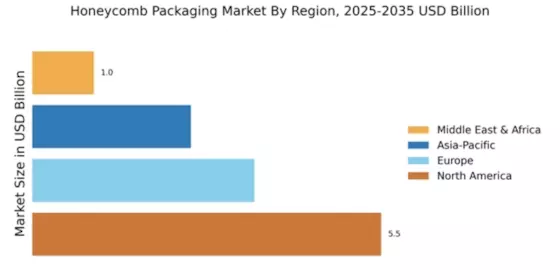
North America is poised to maintain its leadership in the honeycomb packaging market, holding a significant market share of 5.0 in 2024. The region's growth is driven by increasing demand for sustainable packaging solutions, stringent regulations promoting eco-friendly materials, and a robust e-commerce sector. Companies are investing in innovative technologies to enhance product performance and reduce environmental impact, further fueling market expansion. The United States stands out as the leading country in this region, with major players like Sealed Air Corporation, WestRock Company, and International Paper driving competition. The presence of these key players fosters innovation and ensures a diverse range of products. Additionally, the region benefits from a well-established supply chain and logistics network, enabling efficient distribution and meeting the growing consumer demand for sustainable packaging solutions.

Europe : Emerging Market with Growth Potential

Europe's honeycomb packaging market is on the rise, with a market size of 3.5 in 2024. The region is witnessing a shift towards sustainable packaging solutions, driven by consumer preferences and regulatory frameworks aimed at reducing plastic waste. The European Union's Green Deal and various national initiatives are catalyzing investments in eco-friendly packaging technologies, which are expected to boost market growth significantly. Leading countries in this region include Germany, the UK, and France, where companies like Mondi Group and DS Smith are prominent. The competitive landscape is characterized by a focus on innovation and sustainability, with key players investing in R&D to develop advanced honeycomb packaging solutions. This focus on sustainability aligns with consumer demand, positioning Europe as a key player in The Honeycomb Packaging.

Asia-Pacific : Rapidly Growing Packaging Sector

The Asia-Pacific honeycomb packaging market is projected to grow significantly, with a market size of 3.0 in 2024. The region's growth is fueled by increasing industrialization, urbanization, and a rising e-commerce sector. Governments are also implementing regulations to promote sustainable packaging, which is expected to drive demand for honeycomb solutions. The shift towards eco-friendly materials is becoming a key focus for manufacturers in the region. Countries like China, India, and Japan are leading the charge in this market, with key players such as Smurfit Kappa and Sonoco Products Company establishing a strong presence. The competitive landscape is evolving, with companies focusing on innovation and sustainability to meet the growing demand. As the region continues to develop, the honeycomb packaging market is set to expand, driven by both consumer and regulatory pressures for sustainable solutions.

Middle East and Africa : Emerging Market with Unique Challenges

The Middle East and Africa honeycomb packaging market is emerging, with a market size of 1.97 in 2024. The region is experiencing growth due to increasing demand for sustainable packaging solutions in various sectors, including food and beverage, electronics, and cosmetics. Regulatory initiatives aimed at reducing plastic waste are also encouraging the adoption of eco-friendly packaging materials, which is expected to drive market growth. Leading countries in this region include South Africa and the UAE, where companies like Sappi Limited are making significant strides. The competitive landscape is characterized by a mix of local and international players, with a focus on innovation and sustainability. As the market matures, opportunities for growth are expected to arise, particularly in sectors that prioritize environmentally friendly packaging solutions.

Key Players and Competitive Insights

The Honeycomb Packaging Market is currently characterized by a dynamic competitive landscape, driven by increasing demand for sustainable packaging solutions and innovations in material technology. Key players such as Smurfit Kappa (IE), Mondi Group (GB), and Sealed Air Corporation (US) are strategically positioning themselves through a combination of product innovation and regional expansion. For instance, Smurfit Kappa (IE) has focused on enhancing its product offerings with eco-friendly materials, while Mondi Group (GB) emphasizes its commitment to circular economy principles, thereby shaping a competitive environment that prioritizes sustainability alongside operational efficiency.

In terms of business tactics, companies are increasingly localizing manufacturing to reduce lead times and optimize supply chains. The market structure appears moderately fragmented, with several key players exerting influence through strategic partnerships and technological advancements. This collective approach not only enhances their market presence but also fosters a collaborative environment that encourages innovation and responsiveness to consumer demands.

In November 2025, Sealed Air Corporation (US) announced the launch of a new line of honeycomb packaging products designed specifically for the e-commerce sector. This strategic move is significant as it aligns with the growing trend of online shopping, providing tailored solutions that enhance product protection during transit while minimizing environmental impact. Such innovations are likely to strengthen Sealed Air's market position and appeal to eco-conscious consumers.

In October 2025, DS Smith (GB) expanded its production capabilities by investing in a new manufacturing facility in Eastern Europe. This expansion is crucial as it not only increases their production capacity but also allows for greater responsiveness to regional market demands. By enhancing local manufacturing, DS Smith (GB) aims to improve supply chain efficiency and reduce carbon emissions associated with transportation, thereby reinforcing its sustainability commitments.

In September 2025, International Paper (US) entered into a strategic partnership with a technology firm to integrate AI-driven analytics into its production processes. This initiative is indicative of a broader trend towards digital transformation within the industry, as companies seek to leverage technology for improved operational efficiency and product quality. The integration of AI could potentially streamline production workflows and enhance decision-making capabilities, positioning International Paper (US) as a leader in innovation.

As of December 2025, the competitive trends within the Honeycomb Packaging Market are increasingly defined by digitalization, sustainability, and the integration of advanced technologies. Strategic alliances are becoming more prevalent, enabling companies to pool resources and expertise to address evolving market challenges. Looking ahead, it is anticipated that competitive differentiation will shift from traditional price-based strategies to a focus on innovation, technological advancements, and supply chain reliability, reflecting a broader industry trend towards sustainable and efficient packaging solutions.

Key Companies in the Honeycomb Packaging Market market include

Industry Developments

May 2024 saw Cascades’ announcement of its investment in this sector, covering packaging for all of its operations and the development of new honeycomb packaging products to satisfy the increasing demand for ecological packing alternatives. With greater context, this was meant to accelerate their Green Packaging Portfolio expansion while simultaneously reducing their carbon footprint.

March 2024 witnessed DS Smith and Mondi signing a letter of understanding on a possible £5.14bn ($6.57bn) all-stock merger. The aim is for the merger to create a market leader in paper packaging with more than £10bn worth of combined sales value. If completed, Mondi shareholders would own 54% of the new entity, while DS Smith shareholders would possess the remaining 46%​

Smurfit Kappa unveiled new honeycomb buffers that are designed to provide ultra-light product protection whilst minimizing plastic packaging waste in March 2024 for UK customers. This innovative concept aims at providing durable goods transport solutions without compromising on environmental sustainability by ensuring they are environmentally friendly, fully recyclable and customizable, thus minimizing waste as well as cost.

Future Outlook

Honeycomb Packaging Market Future Outlook

The Honeycomb Packaging Market is projected to grow at a 4.92% CAGR from 2024 to 2035, driven by sustainability trends, e-commerce growth, and demand for protective packaging solutions.

New opportunities lie in:

  • Expansion into biodegradable honeycomb materials for eco-conscious brands.
  • Development of customized honeycomb packaging solutions for e-commerce logistics.
  • Integration of smart technology in honeycomb packaging for enhanced tracking.

By 2035, the Honeycomb Packaging Market is expected to solidify its position as a leader in sustainable packaging solutions.

Market Segmentation

Honeycomb Packaging Market Thickness Outlook

  • Thin
  • Medium
  • Thick

Honeycomb Packaging Market Application Outlook

  • Protective Packaging
  • Transport Packaging
  • Retail Packaging
  • Industrial Packaging

Honeycomb Packaging Market Design Type Outlook

  • Custom Design
  • Standard Design
  • Eco-Friendly Design

Honeycomb Packaging Market Material Type Outlook

  • Paper
  • Plastic
  • Metal
  • Composite

Honeycomb Packaging Market End Use Industry Outlook

  • Food and Beverage
  • Electronics
  • Cosmetics
  • Pharmaceuticals

Report Scope

MARKET SIZE 202412.47(USD Billion)
MARKET SIZE 202513.08(USD Billion)
MARKET SIZE 203521.15(USD Billion)
COMPOUND ANNUAL GROWTH RATE (CAGR)4.92% (2024 - 2035)
REPORT COVERAGERevenue Forecast, Competitive Landscape, Growth Factors, and Trends
BASE YEAR2024
Market Forecast Period2025 - 2035
Historical Data2019 - 2024
Market Forecast UnitsUSD Billion
Key Companies ProfiledSmurfit Kappa (IE), Mondi Group (GB), Sealed Air Corporation (US), DS Smith (GB), WestRock Company (US), International Paper (US), Sonoco Products Company (US), Sappi Limited (ZA)
Segments CoveredApplication, Material Type, End Use Industry, Design Type, Thickness
Key Market OpportunitiesGrowing demand for sustainable packaging solutions drives innovation in the Honeycomb Packaging Market.
Key Market DynamicsRising demand for sustainable packaging solutions drives innovation and competition in the honeycomb packaging market.
Countries CoveredNorth America, Europe, APAC, South America, MEA

Market Highlights

Author
Pradeep Nandi
Senior Research Analyst

I have a bachelor's degree in mechanical engineering and an MBA. I have more than two years of expertise in the retail, food, and beverage, chemical, and material industries, and hence have developed a sound cross-domain expertise. A firm believer in lifelong learning and sharing of knowledge. Having a proclivity for hatching ideas and trying to absorb as much information as possible in a short amount of time. Introducing corporates to the data and insight, which enables them to move from probability to possibility, has been my key areas of interest. 

Leave a Comment

FAQs

How much is the Honeycomb Packaging Market?

The Honeycomb Packaging Market size was valued at USD 12.47 Billion in 2024.

What is the growth rate of the Honeycomb Packaging Market?

Honeycomb Packaging Market is projected to register a CAGR of 4.92% from 2025-2035

Which region held the largest market share in the Honeycomb Packaging Market?

North America had the largest share in the Honeycomb Packagingmarket

Who are the key players in the Honeycomb Packaging Market?

The key players in the Honeycomb Packaging market are Packaging Corporation of America (U.S, Sealed Air Corporation (U.S), Sonoco Products Company (U S), Smurfit Kappa Group plc (Ireland) and WestRock Company. (U.S).

Which packaging type led the Honeycomb Packaging Market?

Exterior packaging category dominated the Honeycomb Packaging market in 2024.

Which end-user had the largest market share in the Honeycomb Packaging Market?

Furniture had the largest share in the Honeycomb Packagingmarket.

Download Free Sample

Kindly complete the form below to receive a free sample of this Report

Compare Licence

×
Features License Type
Single User Multiuser License Enterprise User
Price $4,950 $5,950 $7,250
Maximum User Access Limit 1 User Upto 10 Users Unrestricted Access Throughout the Organization
Free Customization
Direct Access to Analyst
Deliverable Format
Platform Access
Discount on Next Purchase 10% 15% 15%
Printable Versions