Segmentation Quick Reference
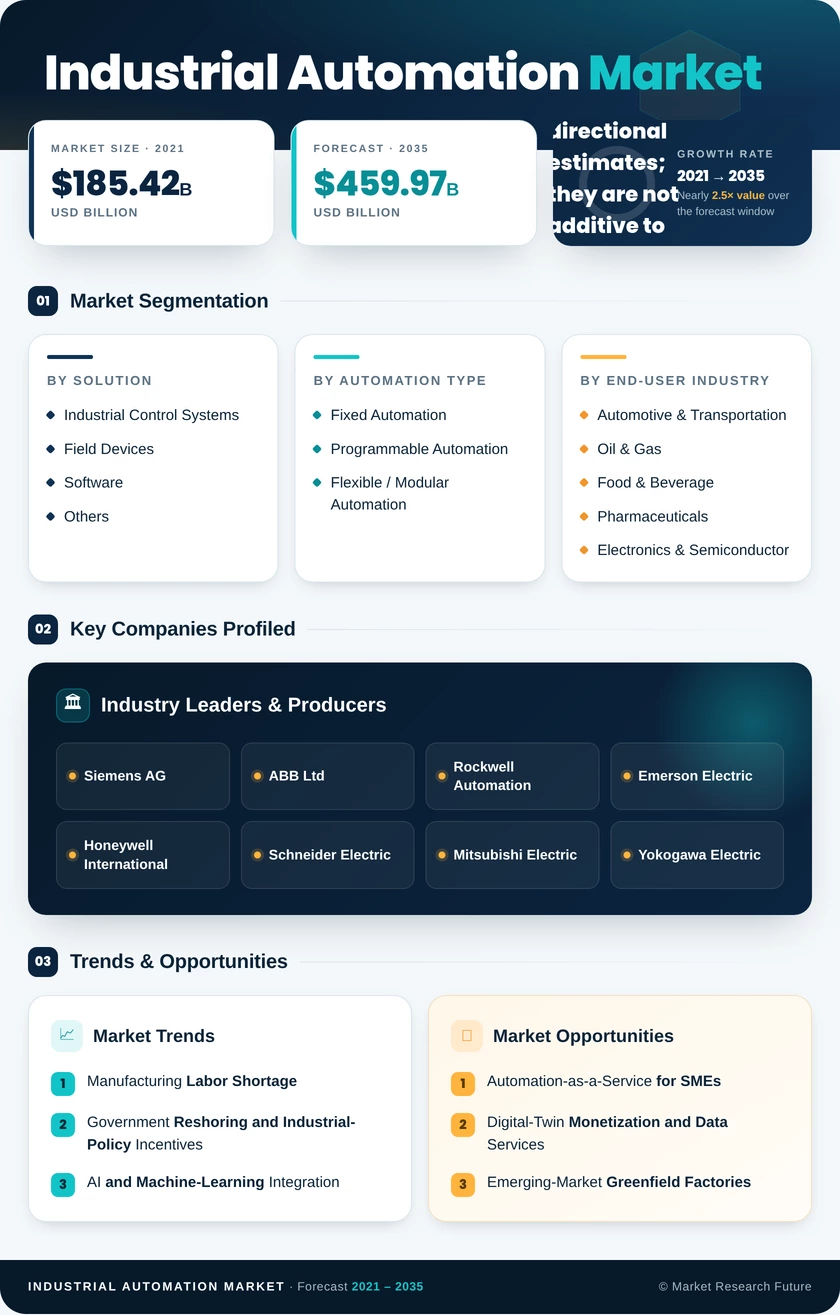
| Dimension | Sub-Segments | Dominant Segment | Fastest Growing Segment |
| By Solution | Industrial Control Systems; Field Devices; Software; Others | Industrial Control Systems (48.20% share, 2025) | Field Devices — Robotics (12.80% CAGR) |
| By Automation Type | Fixed Automation; Programmable Automation; Flexible / Modular Automation | Fixed Automation (39.30% share, 2025) | Flexible / Modular Automation (12.50% CAGR) |
| By End-User Industry | Automotive & Transportation; Oil & Gas; Food & Beverage; Pharmaceuticals; Electronics & Semiconductor; Others | Automotive & Transportation (27.80% share, 2025) | Pharmaceuticals (9.50% CAGR) |
| By Deployment Mode | On-Premises; Cloud-Based; Hybrid / Edge | On-Premises (69.10% share, 2025) | Cloud-Based (13.80% CAGR) |
Market Segmentation Overview
By Solution
| Sub-Segment | Key Trend |
| Industrial Control Systems (SCADA, DCS, PLC) | Migration to OPC UA-connected, cybersecurity-hardened platforms replacing legacy fieldbus architectures |
| Field Devices (Sensors, Actuators, Robots) | Collaborative and autonomous mobile robot adoption expanding into SME and logistics use cases |
| Software (MES, SCADA Analytics, Digital Twin) | Cloud-native analytics and generative-AI-assisted process optimization driving recurring revenue models |
| Others (Network Infrastructure, Safety Systems) | Industrial Ethernet and Time-Sensitive Networking (TSN) displacing legacy serial networks |
Industrial control systems and field devices together account for the majority of the Industrial Automation Market. The shift toward open, interoperable platforms is driving both upgrade cycles in installed control infrastructure and the integration of advanced robotics and sensor technologies into previously manual processes.
By Automation Type
| Sub-Segment | Key Trend |
| Fixed Automation | Sustained demand in high-volume automotive, beverage, and semiconductor manufacturing |
| Programmable Automation | Batch-process industries and aerospace adopting CNC and robot-cell reprogramming for low-to-medium volumes |
| Flexible / Modular Automation | Mass-customization and SKU proliferation driving investment in reconfigurable production cells |
The balance between fixed and flexible automation is shifting as consumer demand for customized products intensifies. Flexible and modular systems are commanding premium pricing and delivering faster ROI in industries where product changeovers occur frequently.
By End-User Industry
| Sub-Segment | Key Trend |
| Automotive & Transportation | EV platform retooling and autonomous-vehicle component lines driving large-scale automation orders |
| Oil & Gas | Digital oilfield initiatives and pipeline integrity monitoring expanding SCADA and remote-operations demand |
| Food & Beverage | Hygiene-compliance automation and traceability mandates pushing robotic pick-and-place and vision inspection |
| Pharmaceuticals | Serialization, continuous manufacturing, and biologics capacity expansion requiring modular automated lines |
| Electronics & Semiconductor | Advanced packaging and sub-3 nm fab construction demanding extreme-precision automation |
| Others (Mining, Utilities, Logistics) | Autonomous haulage, smart-grid infrastructure, and warehouse automation broadening the addressable market |
Automotive retains the largest share, but pharma and electronics are narrowing the gap as regulatory requirements and technology miniaturization raise the automation intensity of each production step.
By Deployment Mode
| Sub-Segment | Key Trend |
| On-Premises | Dominant for latency-sensitive, safety-critical control loops in process industries |
| Cloud-Based | Rapid growth driven by multi-site analytics, remote monitoring, and MES-as-a-service offerings |
| Hybrid / Edge | Emerging as the preferred architecture for AI inference locally with cloud-level data aggregation |
The deployment landscape is evolving from binary on-premises-vs-cloud decisions to layered hybrid architectures. Edge computing's ability to run real-time inference models while feeding aggregated insights to the cloud positions it as the default deployment strategy for new installations.