Industrial Automation Market (2026 - 2035)

Industrial Automation Market Size, Share and Research Report By Component (Hardware, Software, Services), by Type (Fixed Automation, Programmable Automation, Flexible Automation), by Technology (Industrial Robotics, Machine Vision Systems, Control Systems, Artificial Intelligence and Machine Learning, Industrial Internet of Things (IIoT), Advanced Process Control (APC), Human-Machine Interface (HMI), Others), by End-Use Industry (Automotive, Pharmaceutical, Food & Beverage, Chemicals, Packaging, Energy & Power, Aerospace & Defense, Mining & Metals, Electronics and Semiconductor, Others) and Region (North America, Europe, Asia-Pacific, South America, Middle East & Africa) - Industry Forecast Till 2035
ID: MRFR/SEM/1643-CR
189 Pages
Nirmit Biswas, Aarti Dhapte
Last Updated: July 08, 2026
Industrial Automation Market
Market Size
Forecast Period2026-2035
CAGR (2026-2035)6.96%
2026 Market SizeUSD 251.06 Billion
2035 Market SizeUSD 459.97 Billion
Key Players
Siemens AG
ABB Ltd
Rockwell Automation
Emerson Electric
Honeywell International
Schneider Electric
Opportunities
  • Automation-as-a-Service for SMEs
  • Digital-Twin Monetization and Data Services
  • Emerging-Market Greenfield Factories

Industrial Automation Market Summary

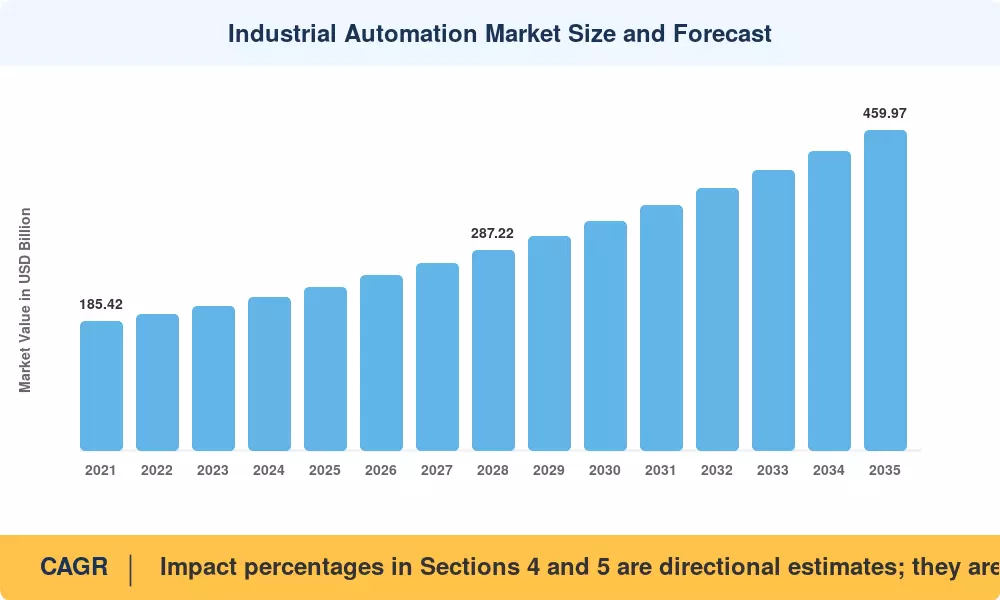
The Industrial Automation Market was valued at USD 234.72 Billion in 2025 and is projected to grow from USD 251.06 Billion in 2026 to USD 459.97 Billion by 2035, registering a CAGR of 6.96% during the forecast period (2026–2035). Smart-factory initiatives backed by government reshoring incentives across the United States and the European Union have been the primary demand catalysts, with an estimated USD 48 Billion in combined public-private automation investment pledged between 2023 and 2025 alone [1]. A widening skilled-labor gap in manufacturing economies — the U.S. National Association of Manufacturers projects 2.1 million unfilled factory jobs by 2030 — continues to push plant operators toward automated alternatives [2].

Technology-wise, legacy relay-based control architectures are giving way to cloud-connected SCADA, distributed control systems (DCS), and AI-enhanced programmable logic controllers. The IEC 62443 cybersecurity standard update in 2024 triggered a wave of brownfield retrofits, while the convergence of machine vision, edge computing, and digital twins slashed changeover times by up to 35% on pilot lines [3]. Capital spending on industrial robots reached a record 540,000 unit installations globally in 2023, according to the International Federation of Robotics [4].

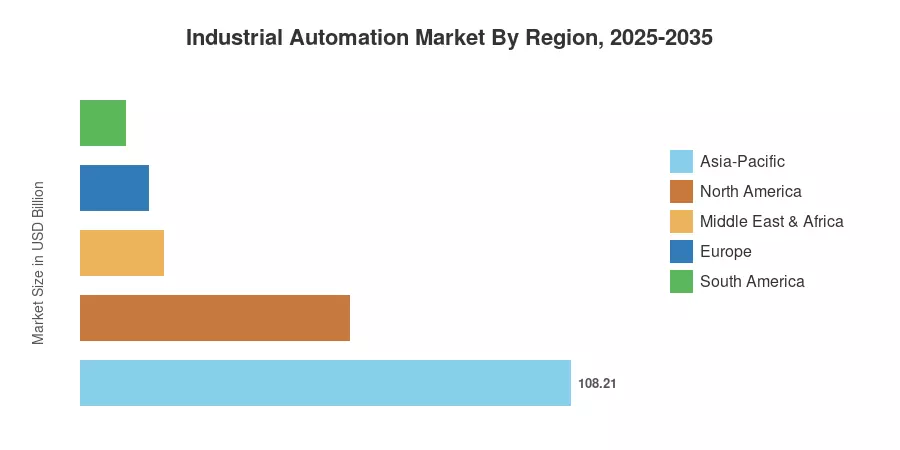
Asia-Pacific commanded an estimated 46.10% share of the Industrial Automation Market in 2025, fueled by China's "Made in China 2025" legacy programs and India's Production-Linked Incentive schemes. North America held the second-largest regional share at roughly 25.30%, driven by automotive and semiconductor reshoring. Europe accounted for about 20.40% of global revenue, with Germany's Industrie 4.0 framework anchoring demand. As energy-efficiency mandates tighten worldwide and robotics unit costs decline, the Industrial Automation Market is set for sustained multi-year expansion through 2035.


Key Report Takeaways

• By Solution

  • Industrial control systems captured approximately 48.20% of Industrial Automation Market revenue in 2025, reflecting persistent demand for SCADA, DCS, and PLC upgrades across process industries.
  • Robotics within the field devices segment is forecast to expand at a 12.80% CAGR through 2035, the fastest among solution categories, driven by collaborative and mobile robot adoption.

• By Automation Type

  • Fixed automation held a 39.30% revenue share in 2025, underpinned by high-throughput automotive and electronics assembly lines.
  • Flexible and modular automation is projected to register a 12.50% CAGR to 2035, as manufacturers invest in reconfigurable production cells.

• By End-User Industry

  • Automotive and transportation accounted for 27.80% of Industrial Automation Market value in 2025, supported by EV battery-line build-outs.
  • Pharmaceuticals is poised to grow at a 9.50% CAGR through 2035, catalyzed by serialization mandates and continuous manufacturing adoption.

• By Deployment Mode

  • On-premises systems held a 69.10% share of the Industrial Automation Market in 2025, favored for latency-sensitive and air-gapped operations.
  • Cloud-based deployments are expanding at a 13.80% CAGR, unlocking remote monitoring and analytics at scale.

• By Region

  • Asia-Pacific led the Industrial Automation Market with a 46.10% share in 2025 and remains the fastest-growing region at an 11.30% CAGR.
  • North America accounted for about 25.30% of global revenues, buoyed by CHIPS Act-adjacent factory construction.


Industrial Automation Market Size and Forecast (2021–2035)

Market Research Future employs a hybrid estimation methodology that triangulates vendor revenue disclosures, customs trade data, and bottom-up capacity analysis across more than 40 automation product categories. Historical figures (2021–2024) are anchored to audited annual reports and validated against IFR and IEC databases. The forecast (2026–2035) applies the calibrated 6.96% CAGR, adjusted for cyclical capex patterns, regional policy shifts, and technology adoption curves.
Industrial Automation Market Size and Forecast
Our Impact
Enabled $4.3B Revenue Impact for Fortune 500 and Leading Multinationals
Partnering with 2000+ Global Organizations Each Year
30K+ Citations by Top-Tier Firms in the Industry

Driver Impact Analysis

Driver ~% Impact on CAGR Geographic Relevance Impact Timeline
Widening manufacturing labor shortage +1.4% Global Short-term (≤2 yr)
Government reshoring and industrial-policy incentives +1.2% North America, Europe Medium-term (2–4 yr)
AI and machine-learning integration in process control +1.0% Global Medium-term (2–4 yr)
IIoT and 5G-enabled connectivity +0.8% Asia-Pacific, North America Medium-term (2–4 yr)
Energy-efficiency and decarbonization mandates +0.7% Europe, Asia-Pacific Long-term (≥4 yr)
EV and battery gigafactory build-out +0.6% North America, Europe, China Short-term (≤2 yr)
Declining robotics unit costs +0.5% Global Long-term (≥4 yr)


Manufacturing Labor Shortage

Plant operators are being forced toward automation more quickly than any other technological trend due to a structural personnel shortage in the global industrial sector. In late 2024, the U.S. Bureau of Labor Statistics reported 616,000 available manufacturing positions; in Germany, the VDMA claimed that 40% of Mittelstand companies were unable to fill crucial production roles [2]. In high-wage areas, this deficit has shortened robotic workcell payback periods from 36 months to less than 18 months, hence stimulating the industrial automation market.


Government Reshoring and Industrial-Policy Incentives

The U.S. CHIPS and Science Act allocated USD 52.7 billion to domestic semiconductor production between 2022 and 2025, a portion of which went toward automation-intensive cleanroom buildouts [1]. India's PLI scheme allocated INR 1.97 trillion for electronics and pharmaceutical production capacity, while the EU Chips Act allocated EUR 43 billion. The Industrial Automation Market has a stable multi-year demand floor because these programs need high levels of automation to satisfy yield and throughput requirements.


AI and Machine-Learning Integration

Real-time AI inference at the edge is transitioning from pilot installations to production-scale deployment. Siemens' Industrial Copilot and Rockwell's FactoryTalk Optix platform both launched generative-AI-assisted diagnostics modules in 2024, cutting unplanned downtime by 20–25% in early adopters [8]. The ability to embed predictive quality models directly into PLC firmware is collapsing the traditional IT-OT boundary and expanding the addressable scope of the Industrial Automation Market.

EV and Battery Gigafactory Build-Out

Over 300 GWh of new lithium-ion cell capacity was under construction across North America and Europe in 2024, with each gigafactory requiring USD 150–250 Million in automation equipment alone [17]. Electrode coating, cell stacking, and formation cycling all demand extreme precision that only automated systems can deliver. This single vertical is expected to contribute an incremental USD 18–22 Billion to the Industrial Automation Market by 2030.


Restraints Impact Analysis

The restraints estimates below quantify directional headwinds that moderate, but do not reverse, the overall growth trajectory. Each percentage represents an approximate dampening effect on the Industrial Automation Market CAGR, not a direct subtraction from revenue.

Restraint ~% Impact on CAGR Geographic Relevance Impact Timeline
High upfront capital expenditure −0.9% Global (SMEs especially) Short-term (≤2 yr)
Cybersecurity vulnerability in connected OT networks −0.6% North America, Europe Medium-term (2–4 yr)
Interoperability gaps across legacy and modern systems −0.5% Global Long-term (≥4 yr)
Skilled automation-workforce scarcity −0.4% Emerging markets Medium-term (2–4 yr)
Lithium-ion battery and semiconductor component shortages −0.3% Global Short-term (≤2 yr)


High Upfront Capital Expenditure

Depending on throughput and precision requirements, a fully automated discrete-manufacturing cell might cost USD 2–8 million, making such investments unaffordable for many small and mid-size businesses [18]. Despite the emergence of robotics-as-a-service (RaaS) models, their penetration is still less than 5% of all installations. The industrial automation market is divided due to the capital intensity of automation equipment, with Tier-1 OEMs automating quickly and smaller suppliers lagging behind, hence reducing the overall adoption velocity.


Cybersecurity Vulnerability in Connected OT

With plants connecting SCADA and DCS to cloud analytics layers, the typical air-gap in the Purdue Model has mostly disappeared. Industrial control system (ICS) alerts increased by 34% year over year in 2024, according to CISA, with ransomware attacks in energy and water utilities garnering public attention [3]. Every well-publicized hack reduces management's desire for digital transformation and raises compliance costs, which slows the Industrial Automation Market's growth.


Interoperability Gaps

OPC UA, MQTT, and numerous proprietary fieldbus protocols coexist on most brownfield shop floors, creating data silos that raise integration costs by 15–30% above greenfield benchmarks [19]. Until a genuinely universal connectivity standard achieves critical mass, integration friction will act as a persistent drag on the Industrial Automation Market expansion rate.


Industrial Automation Market Opportunities

Automation-as-a-Service for SMEs

The pay-per-use and RaaS model converts prohibitive capex into manageable opex, opening the Industrial Automation Market to hundreds of thousands of small manufacturers globally. Vendors such as Formic and FANUC's CRX leasing program have demonstrated 40–60% lower entry costs, and the model is projected to grow at twice the rate of outright equipment sales through 2035.

Digital-Twin Monetization and Data Services

Plant-level digital twins generate massive operational datasets. Vendors who package anonymized performance benchmarks, predictive-maintenance insights, and energy optimization scores into subscription analytics offerings can create recurring revenue streams worth an estimated USD 12–15 Billion by 2032 [12]. This data-monetization layer transforms the Industrial Automation Market from a hardware-centric business into a platform economy.

Emerging-Market Greenfield Factories

India, Vietnam, Indonesia, and Mexico are attracting manufacturing FDI at record levels as companies diversify supply chains away from single-country concentration. Greenfield sites in these markets specify modern automation from day one, eliminating legacy integration costs and enabling faster deployment of cloud-native architectures. India alone announced over USD 26 Billion in committed electronics-factory investment between 2023 and 2025 [1].

Sustainability-Driven Retrofit Demand

The EU's Corporate Sustainability Reporting Directive (CSRD) and the SEC's proposed climate-disclosure rules require manufacturers to quantify and reduce Scope 1 and 2 emissions. Upgrading to energy-efficient variable-frequency drives, smart compressors, and AI-optimized HVAC controls can cut plant energy use by 15–25% [11]. This regulatory pressure creates a multi-decade retrofit cycle that benefits the Industrial Automation Market across all regions.

Convergence of 5G and Edge Computing

Private 5G networks eliminate wired-network constraints on the factory floor, enabling mobile robots, wireless sensor meshes, and real-time video analytics at sub-10 ms latency. Over 450 private 5G industrial deployments were active globally by late 2024 [9]. The combined edge-5G stack is poised to unlock new automation use cases — from AGV swarm coordination to augmented-reality-assisted maintenance — that expand the addressable Industrial Automation Market significantly.


Industrial Automation Market Future Outlook

Autonomous and AI-Driven Operations

By the early 2030s, a growing number of production lines will operate with minimal human intervention. Generative AI agents will orchestrate scheduling, quality inspection, and predictive maintenance across entire factory networks. estimates that AI-enabled manufacturing could deliver USD 1.2–2.0 Trillion in annual value globally by 2035 [14]. For the Industrial Automation Market, this means a shift from selling discrete hardware to delivering outcome-based autonomous systems.

Platform Economics and Software-Defined Manufacturing

Industrial automation vendors are building open ecosystems — app stores for PLC logic, marketplace plug-ins for vision algorithms — that mirror the platform economics of consumer technology. Siemens' Xcelerator and Rockwell's FactoryTalk Hub exemplify this direction. The recurring revenue from software subscriptions and data services is expected to surpass one-quarter of total Industrial Automation Market revenue by 2033, transforming vendor margin profiles [16].

Electrification Supercycle

The global push to electrify transportation, heating, and industrial processes will require massive capacity additions in battery, power-electronics, and electric-motor manufacturing. The IEA projects that clean-energy manufacturing investment will exceed USD 200 Billion annually by 2030 [11]. Each gigawatt-hour of battery capacity, each megawatt of electrolyzer output, and each EV drivetrain assembly line demands specialized automation — creating a durable structural tailwind for the Industrial Automation Market.

ESG Reporting and Sustainability-Linked Automation

As CSRD, ISSB, and SEC disclosure rules mature, manufacturers will need granular, sensor-level energy and emissions data that only automated monitoring systems can provide cost-effectively. The integration of carbon-accounting layers into MES and SCADA platforms is already underway. By the mid-2030s, sustainability compliance will be as fundamental a driver of the Industrial Automation Market as productivity and quality are today [15].


Industrial Automation Market Segmentation

By Solution

Segment Key Metric Primary Demand Driver
Industrial Control Systems (SCADA, DCS, PLC) 48.20% share (2025) Process-industry upgrades and cybersecurity compliance
Field Devices (Sensors, Actuators, Robots) 12.80% CAGR Collaborative-robot adoption, vision-system integration
Software (MES, SCADA Analytics, Digital Twin) USD 38.62 Billion (2025) Cloud migration, AI-driven analytics
Others (Network Infrastructure, Safety Systems) 5.80% CAGR Industrial Ethernet and functional-safety upgrades


Industrial control systems remain the backbone of the Industrial Automation Market, generating nearly half of total revenue in 2025. Demand is sustained by replacement cycles in oil-and-gas, power generation, and water-treatment facilities where DCS and PLC reliability is non-negotiable. The ongoing migration from proprietary fieldbus protocols to OPC UA-over-Ethernet is prompting full-system upgrades rather than piecemeal component swaps.

Field devices — particularly industrial robots — represent the fastest-growing solution category. The proliferation of cobots, autonomous mobile robots, and machine-vision units is extending automation into previously manual tasks such as bin-picking, palletizing, and intralogistics. FANUC, ABB, and KUKA collectively shipped over 180,000 units in 2024, and average selling prices continue to decline at 3–5% annually, broadening the addressable Industrial Automation Market [4].

By Automation Type

Segment Key Metric Primary Demand Driver
Fixed Automation 39.30% share (2025) High-volume automotive and electronics assembly
Programmable Automation USD 56.84 Billion (2025) Batch-process industries, aerospace low-rate production
Flexible / Modular Automation 12.50% CAGR Mass-customization, SKU proliferation


Fixed automation dominates production environments where volumes justify purpose-built transfer lines — engine blocks, beverage filling, and semiconductor wafer handling are classic examples. However, the fastest growth belongs to flexible and modular automation, where reconfigurable cells allow manufacturers to switch product variants in minutes rather than days. This trend is especially pronounced in consumer electronics and pharmaceutical contract manufacturing, where product life cycles are compressing, and the Industrial Automation Market must respond with agile hardware.

By End-User Industry

Segment Key Metric Primary Demand Driver
Automotive & Transportation 27.80% share (2025) EV platform retooling, autonomous-vehicle component lines
Oil & Gas USD 28.17 Billion (2025) Upstream digitalization, midstream pipeline monitoring
Food & Beverage 7.85% CAGR Hygiene compliance, labor shortage, traceability
Pharmaceuticals 9.50% CAGR Serialization mandates, continuous manufacturing
Electronics & Semiconductor USD 26.40 Billion (2025) Fab expansion, miniaturization, precision
Others (Mining, Utilities, Logistics) 6.20% CAGR Autonomous haulage, smart-grid infrastructure


Automotive and transportation remain the single largest end-user of the Industrial Automation Market, though its dominance is gradually diluting as pharmaceutical, food-and-beverage, and electronics verticals invest aggressively. The EV transition has forced every major automaker to retool body-in-white and battery-pack assembly lines, driving multi-billion-dollar automation orders to Siemens, ABB, and Rockwell Automation.

Pharmaceuticals stands out as the fastest-growing end-user segment, propelled by FDA and EMA serialization requirements, continuous-manufacturing approvals, and the post-COVID expansion of vaccine and biologic production capacity. Contract development and manufacturing organizations (CDMOs) are specifying modular, single-use automated filling lines that can be redeployed across drug products — a use case that directly expands the Industrial Automation Market.

By Deployment Mode

Segment Key Metric Primary Demand Driver
On-Premises 69.10% share (2025) Latency, data sovereignty, air-gapped security
Cloud-Based 13.80% CAGR Remote monitoring, scalable analytics, multi-site visibility
Hybrid / Edge USD 18.74 Billion (2025) Real-time inference with cloud data aggregation


On-premises systems retain an overwhelming share in the Industrial Automation Market because process-critical control loops demand sub-millisecond determinism that current cloud architectures cannot guarantee. Cloud-based deployment, however, is growing rapidly as manufacturers layer analytics, reporting, and supply-chain visibility on top of on-premises control networks. Hybrid and edge deployments represent the emerging sweet spot — running inference models locally while synchronizing data to the cloud — and are expected to claim an increasing share through 2035.


Regional Market Share Analysis

Region Key Metric Primary Investment Themes
Asia-Pacific 46.10% share (2025) EV battery lines, semiconductor fabs, smart-factory rollouts
North America USD 59.39 Billion (2025) CHIPS Act, automotive reshoring, oil & gas digitalization
Europe 6.42% CAGR (2026–2035) Industrie 4.0, CSRD compliance, pharma serialization
South America USD 9.86 Billion (2025) Mining automation, food processing, automotive FDI
Middle East & Africa 7.80% CAGR (2026–2035) Oil & gas modernization, desalination, logistics hubs
Total USD 234.72 Billion (2025)

The Industrial Automation Market displays a pronounced concentration in Asia-Pacific, which serves as both the largest consumption hub and the fastest-growing region. North America and Europe follow, anchored by advanced automotive and process-industry demand. South America and the Middle East & Africa remain smaller but present high-growth greenfield opportunities.


North America

Country Key Metric Key Driver
United States 78.50% of regional share CHIPS Act, EV gigafactories, defense modernization
Canada 5.64% CAGR Mining automation, hydrogen economy, agri-food processing
Mexico USD 4.15 Billion (2025) Nearshoring FDI, automotive Tier-1 expansion


The United States remains the engine of North American Industrial Automation Market demand, with over USD 200 Billion in announced manufacturing construction between 2022 and 2025 — much of it in semiconductor, EV, and clean-energy sectors that mandate heavy automation. Canada's oil-sands operators are investing in autonomous haulage and remote operations centers, while Mexico's automotive corridor from Monterrey to Guanajuato attracted record automation imports in 2024 as Tier-1 suppliers localized EV component production [1][17].

Europe

Country Key Metric Key Driver
Germany 32.80% of regional share Industrie 4.0, automotive OEM retooling
United Kingdom USD 6.72 Billion (2025) Pharma advanced therapy manufacturing
France 6.18% CAGR Nuclear energy refurbishment, aerospace
Italy USD 5.14 Billion (2025) Packaging machinery, food processing
Spain 6.85% CAGR Renewable-energy manufacturing
Nordic Countries USD 3.92 Billion (2025) Pulp-and-paper, battery recycling
Russia 5.10% CAGR Import substitution, heavy industry modernization
Rest of Europe USD 5.48 Billion (2025) Diversified industrial base


Europe's Industrial Automation Market is shaped by the dual pressures of decarbonization regulation and demographic aging. Germany's VDMA reported a 7% increase in automation orders in 2024, driven by retooling for electric-vehicle platforms. The EU's CSRD timeline — phased reporting from 2025 onward — is accelerating investment in energy-management systems and smart utility monitoring across all member states [11][15].

Asia-Pacific

Country Key Metric Key Driver
China 52.40% of regional share Made in China 2025 legacy, EV supply chain
India 12.60% CAGR PLI schemes, electronics and pharma FDI
Japan USD 14.68 Billion (2025) Robot density leadership, aging workforce
South Korea 9.20% CAGR Semiconductor fabs, display manufacturing
ASEAN USD 8.74 Billion (2025) Electronics assembly, food processing FDI
Rest of Asia-Pacific 8.90% CAGR Emerging manufacturing hubs


Asia-Pacific dominates the Industrial Automation Market by a wide margin. China alone installed over 290,000 industrial robots in 2023, nearly half the global total [4]. India's electronics PLI attracted USD 8.2 Billion in committed investment across 2023–2024, creating greenfield smartphone and semiconductor packaging plants that embed advanced automation from inception. Japan and South Korea maintain the world's highest robot density per 10,000 workers, sustaining replacement and upgrade cycles that keep the region's Industrial Automation Market growth well above the global average.

South America

Country Key Metric Key Driver
Brazil 64.30% of regional share Automotive, mining, sugar-ethanol processing
Argentina 5.95% CAGR Lithium extraction, agriculture
Rest of South America USD 1.62 Billion (2025) Mining, food-and-beverage processing


Brazil anchors the South American Industrial Automation Market, with its automotive sector and Vale's autonomous-truck programs providing steady demand. Argentina's Lithium Triangle developments are attracting greenfield processing plants that require DCS-controlled chemical processes, while Chile and Peru continue to invest in autonomous mining equipment to address altitude and safety challenges [10].

Middle East & Africa

Country Key Metric Key Driver
Saudi Arabia 34.20% of regional share Vision 2030 industrialization, petrochemical modernization
UAE 8.45% CAGR Logistics hubs, smart-city infrastructure
South Africa USD 1.58 Billion (2025) Mining automation, automotive assembly
Egypt 7.60% CAGR Suez Canal Economic Zone, fertilizer plants
Rest of MEA USD 2.41 Billion (2025) Oil-and-gas, desalination


Saudi Arabia's Vision 2030 is channeling billions into non-oil manufacturing and logistics infrastructure, making it the largest Industrial Automation Market in the Middle East & Africa. The UAE's Jebel Ali Free Zone and Khalifa Industrial Zone are building automation-intensive warehousing and light-manufacturing clusters. South Africa's mining sector continues to deploy autonomous drilling and haulage systems, while Egypt's Suez Canal Economic Zone is attracting fertilizer and petrochemical plants that require full DCS integration [20].


Industrial Automation Market By Region, 2025-2035

Competitive Benchmarking

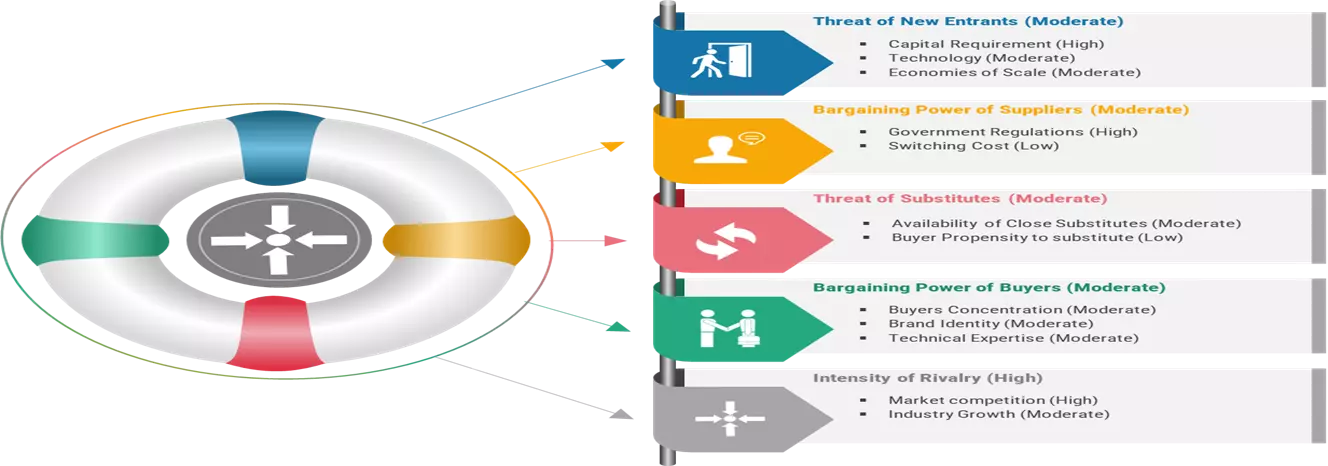
The Industrial Automation Market exhibits moderate concentration. The top five vendors — Siemens, ABB, Rockwell Automation, Emerson Electric, and Honeywell — collectively control an estimated 35–42% of global revenue. Below this tier, a large number of specialized robotics, sensor, and software firms compete for niche segments, keeping the broader market fragmented and innovation-intensive. Over 200 automation-focused M&A transactions closed in 2023, underscoring the competitive pressure for portfolio breadth [4].

Company Est. Revenue Share Range Key Offerings for Industrial Automation Market Strategic Positioning
Siemens AG ~8–11% TIA Portal, SIMATIC PLC, SINUMERIK CNC, Xcelerator platform Full-stack digital-industry leader; strongest in Europe and process industries
ABB Ltd ~7–10% ABB Ability, IRB robots, Freelance DCS, drives and motors Robotics-plus-electrification integrated play; strong in utilities and metals
Rockwell Automation ~5–8% FactoryTalk, Allen-Bradley PLC, Plex MES, Fiix CMMS Pure-play discrete-automation specialist; dominant in North American automotive
Emerson Electric ~5–7% DeltaV DCS, Plantweb digital ecosystem, Fisher valves Process-automation heritage; deep in oil-and-gas, chemical, life sciences
Honeywell International ~4–7% Experion PKS, Intelligrated warehouse automation, safety systems Diversified conglomerate with warehouse and process strengths
Schneider Electric ~4–6% EcoStruxure, Modicon PLC, AVEVA software Energy-management-plus-automation convergence; strong sustainability narrative
Mitsubishi Electric ~3–5% MELSEC PLC, MELFA robots, e-F@ctory Asia-Pacific-centric with deep automotive and semiconductor integrations
Yokogawa Electric ~2–4% CENTUM VP DCS, ProSafe-RS, OpreX platform Process-industry specialist; dominant in LNG, petrochemical, pharma
FANUC Corporation ~2–4% CNC systems, industrial robots, FIELD system IoT platform World's largest robot and CNC manufacturer by unit volume
Omron Corporation ~2–3% Sysmac platform, collaborative robots, vision systems Strong in electronics assembly and packaging automation across Asia


Recent News & Developments

  • March 2025: Schneider Electric pledged more than USD 700 million in March 2025 to expand into the United States, creating more than 1,000 jobs by 2027.
  • February 2025: In order to position Honeywell Automation to concentrate on digital industrial solutions, the company announced in February 2025 that it will split its Automation and Aerospace divisions into three public entities.
  • January 2025: To improve energy-efficient driving alternatives, ABB completed the acquisition of Siemens' low-voltage NEMA motor division.
  • May 2024: In order to incorporate multirobot optimization into automotive facilities, Mitsubishi Electric invested in Realtime Robotics in May 2024.


Industrial Automation Market Report Scope

Parameter Detail
Market Scope Global Industrial Automation Market covering solutions, automation types, end-user industries, deployment modes, and regions
Study Period 2021–2035
CAGR 6.96% (2026–2035)
Base Year 2025 — USD 234.72 Billion
2026 Forecast Start USD 251.06 Billion
2035 Forecast End USD 459.97 Billion
Fastest Growing Segment Cloud-based deployment (13.80% CAGR); Robotics in field devices (12.80% CAGR)
Companies Profiled Siemens, ABB, Rockwell Automation, Emerson Electric, Honeywell, Schneider Electric, Mitsubishi Electric, Yokogawa Electric, FANUC, Omron
Valuation Currency USD Billion
CAGR Driver Disclaimer Impact percentages in Sections 4 and 5 are directional estimates; they are not additive to the compound annual growth rate


FAQs

What is the projected value of the Industrial Automation Market by 2035?
The Industrial Automation Market is forecast to reach USD 459.97 Billion by 2035, growing at a 6.96% CAGR from a 2025 base of USD 234.72 Billion.
How is the Industrial Automation Market segmented by deployment mode?
On-premises systems held a 69.10% share in 2025, while cloud-based deployment is growing fastest at 13.80% CAGR. Hybrid and edge models are emerging as a practical middle ground.
Which end-user industry is growing fastest in the Industrial Automation Market?
Pharmaceuticals leads with a 9.50% CAGR through 2035, driven by serialization mandates and continuous-manufacturing approvals expanding capacity requirements.
What payback period should buyers expect for a robotic workcell investment?
In high-wage manufacturing regions, payback periods for collaborative-robot cells have compressed to 14–20 months thanks to declining unit costs and rising labor rates [18].
How do cybersecurity risks affect Industrial Automation Market adoption?
OT-network intrusions rose 34% year-on-year in 2024, adding compliance costs and slowing digital-transformation timelines, particularly in critical-infrastructure sectors [3].
Is Robotics-as-a-Service a viable alternative to outright equipment purchase?
RaaS models now cover cobots, AMRs, and welding systems, reducing upfront investment by 40–60%. Penetration remains below 5% of total installations but is accelerating [18].
What role does the EU Machinery Regulation play in the Industrial Automation Market?
Regulation (EU) 2023/1230, effective January 2027, mandates cybersecurity and AI-safety assessments for all machinery, creating new compliance demand for automation vendors [3].    
Author
Author
Author Profile
Nirmit Biswas LinkedIn
Senior Research Analyst
With 5+ years of expertise in Market Intelligence and Strategic Research, Nirmit Biswas specializes in ICT, Semiconductors, and BFSI. Backed by an MBA in Financial Services and a Computer Science foundation, Nirmit blends technical depth with business acumen. He has successfully led 100+ projects for global enterprises and startups, including Amazon, Cisco, L&T and Huawei, delivering market estimations, competitive benchmarking, and GTM strategies. His focus lies in transforming complex data into clear, actionable insights that drive growth, innovation, and investment decisions. Recognized for bridging engineering innovation with executive strategy, Nirmit helps businesses navigate dynamic markets with confidence.
Co-Author
Co-Author Profile
Aarti Dhapte LinkedIn
AVP - Research
A consulting professional focused on helping businesses navigate complex markets through structured research and strategic insights. I partner with clients to solve high-impact business problems across market entry strategy, competitive intelligence, and opportunity assessment. Over the course of my experience, I have led and contributed to 100+ market research and consulting engagements, delivering insights across multiple industries and geographies, and supporting strategic decisions linked to $500M+ market opportunities. My core expertise lies in building robust market sizing, forecasting, and commercial models (top-down and bottom-up), alongside deep-dive competitive and industry analysis. I have played a key role in shaping go-to-market strategies, investment cases, and growth roadmaps, enabling clients to make confident, data-backed decisions in dynamic markets.

Research Approach


Secondary Research

The secondary research process involved comprehensive analysis of regulatory databases, peer-reviewed engineering journals, industry publications, and authoritative manufacturing organizations. Key sources included the International Electrotechnical Commission (IEC), International Organization for Standardization (ISO), International Federation of Robotics (IFR), IEEE Robotics & Automation Society, VDMA (German Engineering Federation), National Institute of Standards and Technology (NIST), Occupational Safety and Health Administration (OSHA), European Committee for Standardization (CEN), International Labour Organization (ILO), European Commission's Digital Strategy Reports, Bureau of Labor Statistics (BLS) Occupational Outlook Handbook, International Trade Administration (ITA), Organisation for Economic Co-operation and Development (OECD) Industry Statistics, World Economic Forum (WEF) Advanced Manufacturing Reports, United Nations Industrial Development Organization (UNIDO) Manufacturing Statistics, and national manufacturing federation reports from key markets. These sources were used to collect automation adoption statistics, safety compliance data, industry 4.0 implementation rates, workforce development trends, and technology landscape analysis for industrial robotics, control systems, machine vision, artificial intelligence integration, and IIoT platforms.


Primary Research

To gather both qualitative and quantitative insights, supply-side and demand-side stakeholders were interviewed during the primary research phase. CEOs, CTOs, VPs of engineering, heads of product development, and chief digital officers from system integrators, industrial software developers, and manufacturers of industrial automation were examples of supply-side sources. CEOs, plant managers, directors of manufacturing engineering, vice presidents of supply chains, and procurement heads from automakers, pharmaceutical companies, food and beverage processors, chemical plants, and electronics assembly plants were among the demand-side sources. In addition to confirming digital transformation roadmaps and validating technology adoption timetables, primary research also provided information on workforce reskilling programs, interoperability issues, and CapEx allocation trends.

Primary Respondent Breakdown:

By Designation: C-level Primaries (28%), Director Level (35%), Others (37%)

By Region: North America (40%), Europe (25%), Asia-Pacific (28%), Rest of World (7%)


Market Size Estimation

Global market valuation was derived through revenue mapping and automation deployment analysis. The methodology included:

Identification of 60+ key manufacturers across North America, Europe, Asia-Pacific, and Latin America

Technology mapping across industrial robotics, control systems (DCS/PLC/SCADA), machine vision, AI/ML platforms, IIoT solutions, and HMI systems

Component segmentation across hardware (sensors, actuators, drives), software (MES, ERP integration, digital twins), and services (integration, maintenance, consulting)

Analysis of reported and modeled annual revenues specific to industrial automation portfolios

Coverage of manufacturers representing 75-80% of global market share in 2024

Extrapolation using bottom-up (equipment shipment volumes × ASP by technology and region) and top-down (manufacturer revenue validation and sector-specific CapEx analysis) approaches to derive segment-specific valuations

Cross-validation against IFR annual robotics statistics, national industrial production indices, and trade flow data for automation equipment

This methodology maintains the same rigorous structure as your dermal fillers example while adapting the sources and breakdowns to fit the industrial automation sector's unique characteristics and stakeholder ecosystem.

Download Free Sample

Kindly complete the form below to receive a free sample of this Report

Download PDF ×

We do not share your information with anyone. However, we may send you emails based on your report interest from time to time. You may contact us at any time to opt-out.