×
Request Free Sample ×

Kindly complete the form below to receive a free sample of this Report

* Please use a valid business email

Leading companies partner with us for data-driven Insights

clients tt-cursor
Hero Background

Industrial Waste Management Market

ID: MRFR/Equip/5027-HCR
100 Pages
Priya Nagrale
October 2025

Industrial Waste Management Market Research Report Information By Waste Type (Construction & Demolition Waste, Manufacturing Waste, Chemical Waste, Mining Waste, Oil & Gas Waste, Agriculture Waste, Nuclear Waste And Others), By Service (Landfill, Recycling, Incineration) And By Region (North America, Europe, Asia-Pacific, And Rest Of The World) –Market Forecast Till 2035

Share:
Download PDF ×

We do not share your information with anyone. However, we may send you emails based on your report interest from time to time. You may contact us at any time to opt-out.

Industrial Waste Management Market Infographic
Purchase Options

Industrial Waste Management Market Summary

As per Market Research Future analysis, the Industrial Waste Management Market Size was estimated at 981062.07 USD Billion in 2024. The Industrial Waste Management industry is projected to grow from 1006768.27 USD Billion in 2025 to 1303946.78 USD Billion by 2035, exhibiting a compound annual growth rate (CAGR) of 2.62% during the forecast period 2025 - 2035.

Key Market Trends & Highlights

The Industrial Waste Management Market is poised for substantial growth driven by technological advancements and increasing regulatory pressures.

  • Technological advancements in waste management are reshaping operational efficiencies across the sector.
  • North America remains the largest market, while Asia-Pacific is emerging as the fastest-growing region in industrial waste management.
  • The waste treatment segment continues to dominate, whereas the recycling segment is experiencing rapid growth.
  • Key market drivers include stringent regulatory frameworks and growing environmental awareness, which are propelling the adoption of sustainable practices.

Market Size & Forecast

2024 Market Size 981062.07 (USD Billion)
2035 Market Size 1303946.78 (USD Billion)
CAGR (2025 - 2035) 2.62%

Major Players

Veolia (FR), Waste Management (US), SUEZ (FR), Republic Services (US), Clean Harbors (US), Biffa (GB), Stericycle (US), Remondis (DE), GFL Environmental (CA)

Industrial Waste Management Market Trends

The Industrial Waste Management Market is currently experiencing a transformative phase, driven by increasing regulatory pressures and a growing awareness of environmental sustainability. Companies are now prioritizing waste reduction strategies and adopting innovative technologies to manage waste more effectively. This shift is not merely a response to regulations but also reflects a broader societal trend towards responsible consumption and production. As industries evolve, the focus on circular economy principles is becoming more pronounced, encouraging businesses to rethink their waste management practices and explore recycling and recovery options. Moreover, the integration of advanced technologies such as artificial intelligence and the Internet of Things is reshaping the landscape of waste management. These technologies facilitate real-time monitoring and data analysis, enabling companies to optimize their waste management processes. The emphasis on sustainability is likely to drive investments in research and development, leading to the emergence of new solutions that enhance efficiency and reduce environmental impact. As the Industrial Waste Management Market continues to evolve, stakeholders must remain agile and responsive to the changing dynamics of waste management practices.

Technological Advancements in Waste Management

The Industrial Waste Management Market is witnessing a surge in the adoption of advanced technologies. Innovations such as artificial intelligence, machine learning, and IoT are enhancing waste tracking and processing capabilities. These technologies enable companies to optimize their operations, reduce costs, and improve overall efficiency in waste management.

Regulatory Compliance and Sustainability Initiatives

Increasing regulatory frameworks are compelling industries to adopt more sustainable waste management practices. Companies are focusing on compliance with environmental regulations while also striving to meet corporate sustainability goals. This trend indicates a shift towards more responsible waste disposal and recycling methods.

Circular Economy Adoption

The concept of a circular economy is gaining traction within the Industrial Waste Management Market. Businesses are increasingly recognizing the value of reusing materials and minimizing waste generation. This approach not only reduces environmental impact but also creates new economic opportunities through resource recovery.

Industrial Waste Management Market Drivers

Market Growth Projections

The Industrial Waste Management Industry is projected to experience substantial growth, with estimates indicating a market size of 981062.1 USD Billion in 2024 and a remarkable increase to 1305969.9 USD Billion by 2035. This growth trajectory suggests a compound annual growth rate (CAGR) of 2.63% from 2025 to 2035. Such projections reflect the increasing demand for effective waste management solutions driven by regulatory pressures, technological advancements, and heightened sustainability awareness. The market's expansion underscores the critical role of waste management in supporting industrial growth while addressing environmental concerns.

Growing Awareness of Sustainability

The growing awareness of sustainability among consumers and businesses is a crucial driver for the Industrial Waste Management Market . As stakeholders become more conscious of their environmental footprint, there is a rising demand for sustainable waste management practices. Companies are increasingly adopting circular economy principles, which emphasize reducing waste and reusing materials. This shift is evident in various sectors, including manufacturing and construction, where firms are implementing comprehensive plastic waste management strategies. The heightened focus on sustainability is likely to propel the market, contributing to its projected growth to 1305969.9 USD Billion by 2035.

Economic Growth and Industrialization

Economic growth and industrialization are significant factors influencing the Industrial Waste Management Market . As countries develop, industrial activities tend to increase, leading to higher volumes of waste generation. Emerging economies, in particular, are experiencing rapid industrialization, which necessitates effective waste management solutions. For instance, nations in Asia-Pacific are witnessing a surge in manufacturing activities, resulting in increased waste production. This trend underscores the need for robust waste management systems to mitigate environmental impacts. Consequently, the market is expected to expand, reflecting the correlation between industrial growth and waste management demands.

Investment in Waste Management Infrastructure

Investment in waste management infrastructure is a driving force in the Global Industrial Waste Management Market Industry. Governments and private sectors are recognizing the necessity of developing efficient waste management systems to handle increasing waste volumes. Initiatives such as building modern landfills, recycling facilities, and waste Management plants are gaining traction globally. For example, the United States has allocated substantial funding for upgrading waste management infrastructure, aiming to enhance recycling rates and reduce landfill dependency. This focus on infrastructure development is likely to stimulate market growth, ensuring that waste management systems can keep pace with rising waste generation.

Technological Advancements in Waste Management

Technological advancements play a pivotal role in shaping the Industrial Waste Management Market. Innovations such as automated waste sorting systems, advanced recycling technologies, and waste-to-energy conversion processes are enhancing efficiency and effectiveness in waste management. For example, the integration of artificial intelligence in waste sorting has significantly improved the accuracy and speed of recycling operations. These technologies not only reduce operational costs but also minimize environmental impact, thereby aligning with global sustainability goals. As industries increasingly adopt these technologies, the market is anticipated to grow at a CAGR of 2.63% from 2025 to 2035.

Regulatory Compliance and Environmental Standards

The Industrial Waste Management Market is increasingly driven by stringent regulatory compliance and environmental standards. Governments worldwide are enacting laws that mandate proper waste disposal and management practices. For instance, the European Union's Waste Framework Directive emphasizes waste prevention and recycling, compelling industries to adopt sustainable waste management solutions. This regulatory landscape not only fosters environmental protection but also encourages innovation in waste management technologies. As a result, companies are investing in advanced waste treatment facilities, which is expected to contribute to the market's growth, projected to reach 981062.1 USD Billion in 2024.
Market Segment Insights

By Application: Waste Treatment (Largest) vs. Recycling (Fastest-Growing)

In the Industrial Waste Management Market, the application segment has distinct values, with Waste Treatment representing the largest share. This segment includes various methods and processes aimed at managing industrial waste effectively. On the other hand, Recycling is gaining significant attention and is poised to become a significant player due to increasing environmental awareness and regulatory pressure. The burgeoning demand for sustainable practices has made recycling an integral part of waste management strategies across various industries.

Waste Treatment (Dominant) vs. Recycling (Emerging)

Waste Treatment is firmly positioned as the dominant application in the industrial waste management sphere, characterized by its comprehensive processes that include treatment methods to ensure waste is safe for disposal or reuse. This segment encompasses various technologies such as biological treatment and chemical treatment that cater to industries with significant waste generation. Conversely, Recycling is emerging as a key focus area, driven by the rising demand for resource recovery and waste minimization. Businesses are increasingly investing in advanced recycling technologies to improve efficiency and reduce landfill dependency, making it a priority for future growth and innovation in waste management.

By End Use: Manufacturing (Largest) vs. Healthcare (Fastest-Growing)

In the Industrial Waste Management Market, the manufacturing sector holds the largest share, driven by the high volume of waste generated in production processes. This sector's substantial contribution to waste management practices emphasizes the importance of effective solutions tailored to its diverse waste types, including hazardous and non-hazardous materials. In comparison, the healthcare sector is rapidly gaining ground, propelled by rising awareness of waste management practices and regulatory pressures. The unique nature of healthcare waste necessitates specialized handling and disposal methods, creating a niche but growing demand.

Manufacturing (Dominant) vs. Healthcare (Emerging)

The manufacturing sector is characterized by its high waste generation rates, with several materials requiring precise management to mitigate environmental impacts. This dominance is attributed to the continuous advancement of production technologies and emphasis on sustainability, leading manufacturers to seek innovative waste management solutions. Conversely, the healthcare sector is recognized as an emerging player in waste management, driven by an increasing focus on sustainability and compliance with regulations. The waste produced in healthcare settings is often complex and hazardous, prompting the need for specialized services that can effectively handle and process various medical wastes. As these sectors continue to evolve, their waste management strategies will play a pivotal role in shaping environmental practices.

By Waste Type: Solid Waste (Largest) vs. Hazardous Waste (Fastest-Growing)

The Industrial Waste Management Market has a diverse distribution among waste types, with Solid Waste commanding the largest share. It typically includes non-hazardous organic and inorganic materials generated from industrial processes. Following closely, Hazardous Waste emerges as the fastest-growing segment, driven by increasing regulatory pressures and growing awareness of chemical safety among industries. Liquid Waste, E-Waste, and Industrial Sludge are also notable contributors, each playing a key role in the overall waste management landscape.

Solid Waste (Dominant) vs. Hazardous Waste (Emerging)

Solid Waste represents the dominant segment within the Industrial Waste Management Market, characterized by its steady generation from diverse industries such as manufacturing and construction. It includes various materials that are relatively easy to treat and recycle, making it a preferred option for management practices. On the other hand, Hazardous Waste is emerging rapidly due to a rise in stringent regulations and sustainability initiatives. It consists of toxic, reactive, or ignitable materials that require specialized management solutions. The growing emphasis on eco-friendly practices and innovation in waste processing technologies presents significant opportunities for both segments.

By Service Type: Collection Services (Largest) vs. Recycling Services (Fastest-Growing)

In the Industrial Waste Management Market, Collection Services dominate the segment, capturing a significant share due to their fundamental role in the waste management process. They encompass various forms of waste pickup and transportation, which are essential for ensuring compliance with local regulations. Following closely, Recycling Services have emerged as a vital contributor to the market, driven by increasing environmental awareness and the need for sustainable waste disposal practices. The rise in recycling initiatives has bolstered their position in the industry.

Collection Services (Dominant) vs. Recycling Services (Emerging)

Collection Services are characterized by their comprehensive approach to waste pickup and logistics, making them indispensable for industrial operations. They play a crucial role in ensuring regulatory compliance and facilitating the proper disposal of various waste materials. In contrast, Recycling Services are rapidly becoming an emerging player in the market, responding to heightened environmental concerns and the need for sustainable practices. The emphasis on reducing landfill waste and the push for circular economy initiatives have propelled Recycling Services into a prominent position, encouraging industries to adopt more eco-friendly waste management strategies all while contributing positively to the market growth.

By Technology: Incineration (Largest) vs. Anaerobic Digestion (Fastest-Growing)

In the Industrial Waste Management Market, the technology segment encompasses various processes, each holding significant market share. Incineration remains the largest technology utilized for waste disposal, effectively converting waste materials into ash and energy. Anaerobic digestion is on the rise, harnessing biological processes to break down organic matter, and is gaining traction due to its potential in renewable energy recovery.

Technology: Incineration (Dominant) vs. Anaerobic Digestion (Emerging)

Incineration is the dominant technology in the waste management sector, characterized by its ability to handle diverse types of waste and convert them into energy, reducing landfill dependency. On the other hand, anaerobic digestion is an emerging technology that has shown great promise for its capacity to manage organic waste and produce biogas, which can be an alternative energy source. The demand for sustainable waste management solutions is driving the growth of anaerobic digestion, making it an appealing choice for industries looking to enhance their environmental responsibility while managing waste efficiently.

Get more detailed insights about Industrial Waste Management Market

Regional Insights

North America : Market Leader in Waste Management

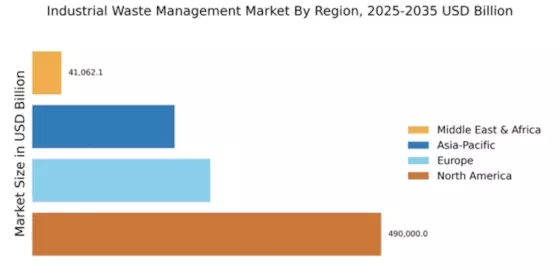
North America continues to lead the Industrial Waste Management market, holding a significant share of 490,000.0. The region's growth is driven by stringent environmental regulations, increasing industrial activities, and a rising focus on sustainable waste management practices. The demand for innovative waste treatment technologies is also on the rise, supported by government initiatives aimed at reducing landfill waste and promoting recycling. The competitive landscape is characterized by major players such as Waste Management, Republic Services, and Clean Harbors, which dominate the market. The U.S. is the largest contributor, with Canada also showing robust growth. These companies are investing in advanced waste processing technologies and expanding their service offerings to meet the growing demand for efficient waste management solutions.

Europe : Sustainable Practices on the Rise

Europe's Industrial Waste Management market is valued at 300,000.0, driven by a strong commitment to sustainability and circular economy principles. Regulatory frameworks such as the EU Waste Framework Directive are catalyzing the adoption of innovative waste management solutions. The region is witnessing increased investments in recycling technologies and waste-to-energy projects, which are essential for reducing landfill dependency and enhancing resource recovery. Leading countries like Germany, France, and the UK are at the forefront of this transformation, with key players such as Veolia and SUEZ leading the charge. The competitive landscape is marked by a mix of large multinationals and local firms, all striving to meet stringent EU regulations. The emphasis on reducing carbon footprints and enhancing waste management efficiency is shaping the market dynamics significantly.

Asia-Pacific : Emerging Market with Potential

The Asia-Pacific region, with a market size of 150,000.0, is experiencing rapid growth in the Industrial Waste Management sector. This growth is fueled by increasing industrialization, urbanization, and a growing awareness of environmental issues. Governments are implementing stricter regulations to manage industrial waste effectively, which is driving demand for advanced waste management solutions and technologies. Countries like China, India, and Japan are leading the charge, with significant investments in waste management infrastructure. The competitive landscape features both local and international players, including Biffa and Remondis, who are expanding their operations to cater to the growing demand. The region's focus on sustainable practices and waste reduction is expected to further enhance market growth in the coming years.

Middle East and Africa : Developing Market with Challenges

The Middle East and Africa region, with a market size of 41,062.07, is gradually developing its Industrial Waste Management capabilities. The growth is driven by increasing industrial activities and a rising awareness of environmental sustainability. Governments are beginning to implement regulations aimed at improving waste management practices, although challenges remain in enforcement and infrastructure development. Countries like South Africa and the UAE are taking the lead in establishing waste management frameworks. The competitive landscape is evolving, with both local firms and international players like GFL Environmental entering the market. The focus on improving waste management systems and promoting recycling initiatives is expected to drive growth in this region, despite existing challenges.

Key Players and Competitive Insights

The Industrial Waste Management Market is characterized by a dynamic competitive landscape, driven by increasing regulatory pressures and a growing emphasis on sustainability. Key players are actively pursuing strategies that enhance their operational efficiencies and market reach. For instance, Veolia (FR) has positioned itself as a leader in environmental services by focusing on innovation and digital transformation, which allows for improved waste processing and resource recovery. Similarly, Waste Management (US) emphasizes a comprehensive approach to waste management, integrating advanced technologies to optimize collection and recycling processes. These strategies collectively contribute to a moderately fragmented market structure, where the influence of major players is significant but not overwhelming, allowing for niche operators to thrive alongside industry giants.

In terms of business tactics, companies are increasingly localizing their operations to better serve regional markets and optimize supply chains. This localization not only enhances service delivery but also aligns with sustainability goals by reducing transportation emissions. The competitive structure of the market remains moderately fragmented, with several key players exerting considerable influence. The collective actions of these companies shape a landscape where innovation and operational efficiency are paramount, fostering a competitive environment that encourages continuous improvement.

In November 2025, SUEZ (FR) announced a strategic partnership with a leading technology firm to develop AI-driven waste sorting systems. This initiative aims to enhance recycling rates and reduce contamination in waste streams, reflecting a broader trend towards technological integration in waste management. The strategic importance of this partnership lies in its potential to significantly improve operational efficiencies and align with global sustainability targets, thereby reinforcing SUEZ's competitive position in the market.

In October 2025, Republic Services (US) launched a new initiative focused on expanding its renewable energy portfolio through the development of waste-to-energy facilities. This move not only diversifies their service offerings but also positions the company as a key player in the transition towards a circular economy. The strategic significance of this initiative is underscored by the growing demand for sustainable energy solutions, which could enhance Republic Services' market share and profitability in the long term.

In September 2025, Clean Harbors (US) completed the acquisition of a regional waste management company, thereby expanding its operational footprint and service capabilities. This acquisition is strategically important as it allows Clean Harbors to leverage synergies and enhance its service offerings, particularly in hazardous waste management. Such consolidation efforts are indicative of a trend where larger players seek to strengthen their market positions through strategic acquisitions, thereby reshaping the competitive landscape.

As of December 2025, the most pressing trends in the Industrial Waste Management Market include a pronounced shift towards digitalization, sustainability, and the integration of AI technologies. Strategic alliances are increasingly shaping the competitive landscape, enabling companies to pool resources and expertise to tackle complex waste management challenges. Looking ahead, competitive differentiation is likely to evolve from traditional price-based competition to a focus on innovation, technological advancements, and supply chain reliability. This shift underscores the importance of adaptability and forward-thinking strategies in maintaining a competitive edge in an ever-evolving market.

Key Companies in the Industrial Waste Management Market market include

Industry Developments

  • Q2 2024: Veolia to build new hazardous waste treatment facility in Germany Veolia announced the construction of a new hazardous industrial waste treatment plant in Germany, aiming to expand its capacity for processing chemical and pharmaceutical sector waste. The facility is expected to be operational by late 2025.
  • Q2 2024: Clean Harbors acquires Texas-based industrial waste recycler Clean Harbors completed the acquisition of a Texas-based industrial waste recycling company, strengthening its presence in the U.S. Gulf Coast and expanding its service offerings for petrochemical and manufacturing clients.
  • Q3 2024: SUEZ and BASF sign long-term industrial waste management partnership SUEZ and BASF entered a multi-year agreement for the management and recycling of hazardous and non-hazardous industrial waste at BASF’s European production sites, focusing on circular economy solutions.
  • Q2 2024: FCC Environment wins major UK government contract for industrial waste processing FCC Environment secured a multi-year contract from the UK government to manage and process industrial waste from several public sector manufacturing facilities, including new investments in advanced sorting technology.
  • Q1 2025: Stericycle appoints new CEO to drive industrial waste business expansion Stericycle announced the appointment of a new Chief Executive Officer, with a mandate to accelerate growth in its industrial waste management division and pursue strategic acquisitions in North America.
  • Q3 2024: GFL Environmental opens new industrial waste landfill in Alberta GFL Environmental inaugurated a new engineered landfill in Alberta dedicated to industrial waste, increasing its disposal capacity for oil sands and manufacturing sector clients in Western Canada.
  • Q2 2024: Covanta launches new waste-to-energy facility for industrial waste in New Jersey Covanta opened a new waste-to-energy plant in New Jersey designed to process non-recyclable industrial waste, converting it into electricity for local communities and reducing landfill use.
  • Q4 2024: Republic Services acquires Midwest industrial waste transporter Republic Services completed the acquisition of a regional industrial waste transportation company in the Midwest, expanding its logistics network and service reach for manufacturing clients.
  • Q1 2025: Remondis announces €100 million investment in new industrial waste recycling hub in Poland Remondis revealed plans to invest €100 million in a state-of-the-art industrial waste recycling facility in Poland, targeting increased recovery rates for metals, plastics, and hazardous materials.
  • Q2 2024: Waste Management, Inc. launches digital tracking platform for industrial waste streams Waste Management, Inc. introduced a new digital platform enabling real-time tracking and compliance reporting for industrial waste generators, aiming to improve transparency and regulatory adherence.
  • Q3 2024: Biffa opens new industrial waste transfer station in Northern England Biffa opened a new industrial waste transfer station in Northern England, enhancing its regional collection and pre-treatment capabilities for manufacturing and construction sector clients.
  • Q4 2024: DS Smith partners with Siemens to pilot AI-driven industrial waste sorting DS Smith and Siemens launched a pilot project using artificial intelligence to automate the sorting of industrial waste at DS Smith’s UK facilities, aiming to boost recycling rates and reduce landfill dependency.

Future Outlook

Industrial Waste Management Market Future Outlook

The Industrial Waste Management Market is projected to grow at a 2.62% CAGR from 2024 to 2035, driven by regulatory pressures, technological advancements, and increasing sustainability initiatives.

New opportunities lie in:

  • Development of advanced waste-to-energy conversion technologies.
  • Expansion of digital waste tracking and management platforms.
  • Investment in automated sorting and recycling systems for industrial waste.

By 2035, the market is expected to be robust, driven by innovation and sustainability efforts.

Market Segmentation

Industrial Waste Management Market End Use Outlook

  • Manufacturing
  • Construction
  • Healthcare
  • Energy
  • Agriculture

Industrial Waste Management Market Technology Outlook

  • Incineration
  • Anaerobic Digestion
  • Landfilling
  • Mechanical Biological Treatment
  • Chemical Treatment

Industrial Waste Management Market Waste Type Outlook

  • Solid Waste
  • Liquid Waste
  • Hazardous Waste
  • E-Waste
  • Industrial Sludge

Industrial Waste Management Market Application Outlook

  • Waste Treatment
  • Recycling
  • Waste-to-Energy
  • Landfill Management
  • Hazardous Waste Management

Industrial Waste Management Market Service Type Outlook

  • Collection Services
  • Disposal Services
  • Recycling Services
  • Consulting Services
  • Compliance Services

Report Scope

MARKET SIZE 2024 981062.07(USD Billion)
MARKET SIZE 2025 1006768.27(USD Billion)
MARKET SIZE 2035 1303946.78(USD Billion)
COMPOUND ANNUAL GROWTH RATE (CAGR) 2.62% (2024 - 2035)
REPORT COVERAGE Revenue Forecast, Competitive Landscape, Growth Factors, and Trends
BASE YEAR 2024
Market Forecast Period 2025 - 2035
Historical Data 2019 - 2024
Market Forecast Units USD Billion
Key Companies Profiled Veolia (FR), Waste Management (US), SUEZ (FR), Republic Services (US), Clean Harbors (US), Biffa (GB), Stericycle (US), Remondis (DE), GFL Environmental (CA)
Segments Covered Application, End Use, Waste Type, Service Type, Technology
Key Market Opportunities Integration of advanced recycling technologies enhances efficiency in the Industrial Waste Management Market.
Key Market Dynamics Rising regulatory pressures drive innovation and consolidation in the Industrial Waste Management sector.
Countries Covered North America, Europe, APAC, South America, MEA

Market Highlights

Author
Priya Nagrale
Senior Research Analyst

With an experience of over five years in market research industry (Chemicals & Materials domain), I gather and analyze market data from diverse sources to produce results, which are then presented back to a client. Also, provide recommendations based on the findings. As a Senior Research Analyst, I perform quality checks (QC) for market estimations, QC for reports, and handle queries and work extensively on client customizations. Also, handle the responsibilities of client proposals, report planning, report finalization, and execution

Leave a Comment

FAQs

How much is the Industrial Waste Management Market?

The Industrial Waste Management Market size was valued at USD 9,49,663.43 Billion in 2023.

What is the growth rate of the Industrial Waste Management Market?

The global market is projected to grow at a CAGR of 2.6% during the forecast period, 2024-2032.

Which region held the largest market share in the Industrial Waste Management Market?

North America had the largest share in the global market

Who are the key players in the Industrial Waste Management Market?

The key players in the market are SembCorp, Reclay Group, SA Waste Holding Pvt Ltd., Suez Environnement, Stericycle Inc., Himark BioGas Inc., and Clean Harbor.

Which service led the Industrial Waste Management Market?

The landfill category dominated the market in 2022.

Which waste type had the largest market share in the Industrial Waste Management Market?

The construction & demolition waste had the largest share in the global market.

Download Free Sample

Kindly complete the form below to receive a free sample of this Report

Compare Licence

×
Features License Type
Single User Multiuser License Enterprise User
Price $4,950 $5,950 $7,250
Maximum User Access Limit 1 User Upto 10 Users Unrestricted Access Throughout the Organization
Free Customization
Direct Access to Analyst
Deliverable Format
Platform Access
Discount on Next Purchase 10% 15% 15%
Printable Versions