Download Free Sample
Kindly complete the form below to receive a free sample of this Report
Intellectual Property (IP) Rights Protection Services Market Size, Share and Trends Analysis Research Report Information By End-Use (Entertainment Industry, Technology Sector, Pharmaceutical Industry, Manufacturing Sector), By Application (Trademark Protection, Copyright Protection, Patent Protection, Trade Secret Protection), By Client Type (Small Enterprises, Medium Enterprises, Large Corporations, Individual Creators), By Service Type (Monitoring Services, Enforcement Services, Consultation Services, Litigation Services), And By Region (North America, Europe, Asia-Pacific, And Rest Of The World) – Market Forecast Till 2035.
As per MRFR analysis, the Intellectual Property (IP) Rights Protection Services Market was estimated at 19.5 USD Billion in 2024. The Intellectual Property industry is projected to grow from 20.27 USD Billion in 2025 to 29.8 USD Billion by 2035, exhibiting a compound annual growth rate (CAGR) of 3.93% during the forecast period 2025 - 2035.
The Intellectual Property (IP) Rights Protection Services Market is experiencing robust growth driven by technological advancements and increasing global compliance demands.
| 2024 Market Size | 19.5 (USD Billion) |
| 2035 Market Size | 29.8 (USD Billion) |
| CAGR (2025 - 2035) | 3.93% |
WIPO (CH), USPTO (US), Dennemeyer (LU), Market Research Future (GB), IPR Center (US), Baker McKenzie (US), Marks & Clerk (GB), K&L Gates (US), Finnegan (US)
Our Impact
Enabled $4.3B Revenue Impact for Fortune 500 and Leading Multinationals
Partnering with 2000+ Global Organizations Each Year
30K+ Citations by Top-Tier Firms in the Industry
The Intellectual Property (IP) Rights Protection Services Market is currently experiencing a dynamic evolution, driven by the increasing recognition of intellectual property as a vital asset in various industries. As businesses expand globally, the need for robust protection mechanisms against infringement and counterfeiting becomes paramount. This market encompasses a range of services, including trademark registration, patent protection, copyright enforcement, and legal advisory, all aimed at safeguarding the rights of creators and innovators. The rise of digital technologies and e-commerce has further intensified the demand for these services, as companies seek to navigate complex legal landscapes and protect their innovations from unauthorized use. Moreover, the growing awareness of the economic value of intellectual property is prompting organizations to invest more in IP rights protection. This trend is particularly evident in sectors such as technology, pharmaceuticals, and entertainment, where the stakes are high, and the potential for loss due to infringement is significant. As a result, service providers are adapting their offerings to meet the evolving needs of clients, incorporating advanced technologies and strategic consulting to enhance their service delivery. The Intellectual Property (IP) Rights Protection Services Market appears poised for continued growth, reflecting the increasing importance of intellectual property in fostering innovation and economic development.
The surge in online business activities has led to an increased focus on digital intellectual property protection. Companies are recognizing the necessity of safeguarding their digital assets, including software, online content, and trademarks, from cyber threats and unauthorized use. This trend indicates a shift towards more comprehensive digital protection strategies.
The incorporation of advanced technologies, such as artificial intelligence and blockchain, is transforming the landscape of IP rights protection. These technologies offer innovative solutions for tracking and enforcing intellectual property rights, enhancing efficiency and accuracy in monitoring potential infringements.
As businesses operate in an increasingly interconnected world, there is a heightened emphasis on compliance with international IP laws and regulations. Organizations are seeking services that not only protect their rights domestically but also ensure adherence to global standards, reflecting a more holistic approach to intellectual property management.
The alarming rise in counterfeiting and piracy poses a substantial threat to businesses, thereby driving the demand for intellectual property protection services. The Intellectual Property (IP) Rights Protection Services Market Industry is significantly impacted by the increasing prevalence of counterfeit goods, which has been reported to cost businesses billions annually. This trend is particularly pronounced in sectors such as fashion, electronics, and pharmaceuticals, where brand integrity is paramount. As companies face mounting pressure to protect their trademarks and copyrights, the need for effective IP protection strategies becomes critical. Consequently, businesses are increasingly turning to specialized services to combat these threats, indicating a robust growth trajectory for the Intellectual Property (IP) Rights Protection Services Market Industry.
The strengthening of legal frameworks surrounding intellectual property rights is a significant driver for the Intellectual Property (IP) Rights Protection Services Market Industry. Governments worldwide are increasingly recognizing the importance of robust IP laws to foster innovation and economic growth. Recent legislative reforms have been introduced to enhance the enforcement of IP rights, providing a more secure environment for businesses. For instance, countries have adopted stricter penalties for infringement and streamlined processes for IP registration. This legal fortification not only instills confidence in businesses to invest in innovation but also amplifies the demand for professional IP protection services. As a result, the Intellectual Property (IP) Rights Protection Services Market Industry is poised for growth as companies seek to navigate the evolving legal landscape.
Technological advancements are reshaping the landscape of intellectual property protection, serving as a catalyst for growth in the Intellectual Property (IP) Rights Protection Services Market Industry. Innovations such as blockchain technology and artificial intelligence are being integrated into IP protection strategies, enhancing the efficiency and effectiveness of enforcement measures. For instance, blockchain can provide a secure and transparent method for tracking ownership and usage of intellectual assets, while AI can assist in identifying potential infringements more swiftly. As these technologies become more accessible, businesses are likely to adopt them to safeguard their intellectual property. This trend not only reflects a shift towards more sophisticated protection mechanisms but also suggests a promising future for the Intellectual Property (IP) Rights Protection Services Market Industry.
The rapid expansion of e-commerce and digital platforms has created a pressing need for robust intellectual property protection, significantly influencing the Intellectual Property (IP) Rights Protection Services Market Industry. As online businesses proliferate, the risk of IP infringement escalates, prompting companies to seek comprehensive protection strategies. Recent statistics indicate that e-commerce sales have surged, with projections estimating a growth rate of over 20 percent annually. This surge necessitates the implementation of effective IP protection measures to safeguard brands and innovations in the digital realm. Consequently, the demand for specialized IP protection services tailored to the unique challenges of the digital landscape is likely to increase, further driving the growth of the Intellectual Property (IP) Rights Protection Services Market Industry.
The rising awareness of intellectual property rights among businesses and individuals is a key driver for the Intellectual Property (IP) Rights Protection Services Market Industry. As companies recognize the value of their intellectual assets, they are more inclined to invest in protection services. This trend is evidenced by a reported increase in trademark registrations, which reached over 3 million in the last year alone. Furthermore, educational initiatives and campaigns aimed at informing stakeholders about the importance of IP rights have gained traction, leading to a more informed public. This heightened awareness not only fosters a culture of respect for IP but also stimulates demand for protection services, thereby propelling the growth of the Intellectual Property (IP) Rights Protection Services Market Industry.
In the Intellectual Property (IP) Rights Protection Services Market, Trademark Protection holds the largest market share, as businesses increasingly recognize the importance of safeguarding their brands and identities. This segment includes the registration of trademarks and enforcement against infringements, which have become essential in a competitive environment. Meanwhile, Copyright Protection is rapidly gaining traction, propelled by the surge in digital content creation and distribution. As more creators seek to protect their works, this segment is on an upward trend, becoming a critical component of the market.
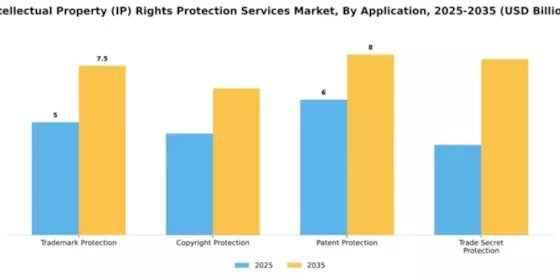
Trademark Protection: Dominant vs. Copyright Protection: Emerging
Trademark Protection remains the cornerstone of the IP Rights Protection Services, as it not only serves established businesses but also supports startups in differentiating their offerings. The widespread adoption of e-commerce and online branding has further galvanized the demand for trademark services. Conversely, Copyright Protection is emerging robustly due to the increasing reliance on digital content across various platforms. With the rise of social media and online publications, the need for effective copyright enforcement is becoming essential for artists and content creators. Together, these segments reflect a dynamic interplay where established interests meet the evolving needs of an increasingly digital world.
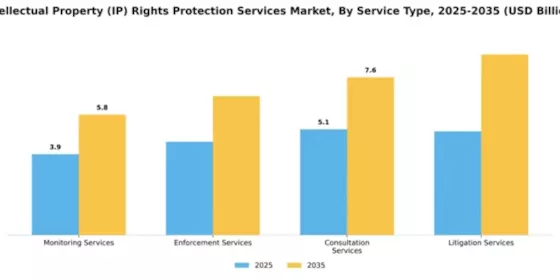
The Intellectual Property Rights Protection Services Market is witnessing significant dynamics, with Monitoring Services commanding the largest share. This segment encompasses a range of activities aimed at the continual observation of IP assets, thus enhancing proactive measures against infringement. Enforcement Services, although smaller in market share, are emerging rapidly due to increased awareness of IP rights and the necessity of legal action in case of violations.
Monitoring Services (Dominant) vs. Enforcement Services (Emerging)
Monitoring Services represent a dominant force in the IP Rights Protection Services landscape. These services provide ongoing watch and analysis of potential infringements, allowing businesses to preemptively address issues before they escalate. On the other hand, Enforcement Services are gaining traction as businesses recognize the importance of pursuing legal actions to safeguard their intellectual assets. As technology evolves and more firms turn to digital solutions for IP protection, the enforcement niche is expanding swiftly to meet rising demands for legal remedies.
The Intellectual Property (IP) Rights Protection Services Market exhibits a compelling distribution among key end-use sectors. The Entertainment Industry holds a significant market share, benefiting from a surge in digital content creation and distribution, thereby augmenting the need for effective IP protection. Meanwhile, the Pharmaceutical Industry is witnessing a robust growth trajectory, driven by innovations in drug development and a heightened emphasis on patent protection to safeguard new biopharmaceuticals. As digital transformation accelerates across all sectors, demand for IP protection services is imperative. The Technology Sector is an emerging player, bolstered by advancements in software and hardware developments, creating complexities in copyright and patent protections. Meanwhile, the Manufacturing Sector seeks to enhance its IP security in response to globalization and competition, further shaping the overall market landscape for IP Rights Protection Services.
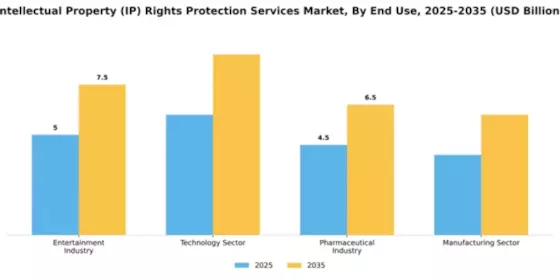
Entertainment: Industry (Dominant) vs. Pharmaceutical (Emerging)
The Entertainment Industry stands as a dominant force in the IP Rights Protection Services Market, characterized by a plethora of copyrights, trademarks, and licensing agreements. With the rise of streaming platforms and digital media consumption, this sector necessitates robust IP protection to combat piracy and unauthorized usage. Conversely, the Pharmaceutical Industry emerges as a critical sector, rapidly growing due to innovations in drug development and the necessity of patent law to secure competitive advantages. As biopharmaceuticals thrive, this industry motivates a strategic approach towards protecting intellectual assets, underlining the intrinsic value of IP rights in today's increasingly competitive arena.
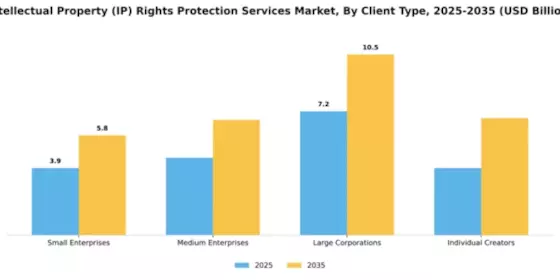
In the Intellectual Property (IP) Rights Protection Services Market, the distribution of market share among client types is diverse, with large corporations commanding the largest segment. Their substantial budgets enable them to invest heavily in comprehensive IP protection strategies, making them a key player in this market. Small enterprises, while currently holding a smaller market share, are rapidly gaining traction as they increasingly recognize the importance of safeguarding their intellectual assets, thus driving notable change within the landscape.
Large Corporations: Dominant vs. Small Enterprises: Emerging
Large corporations exhibit a dominant presence in the Intellectual Property (IP) Rights Protection Services Market due to their extensive resources and established legal frameworks for IP protection. They often engage in proactive IP management, employing specialized teams to navigate complex legal environments globally. On the other hand, small enterprises are emerging as a vital segment as they begin to leverage IP protection services tailored to their unique needs. This growth is fueled by increasing awareness of IP rights and the availability of affordable protection services, allowing smaller entities to compete effectively and innovate without the fear of infringement.
Get more detailed insights about Intellectual Property (IP) Rights Protection Services Market Request Free Sample
North America continues to lead the Intellectual Property (IP) Rights Protection Services Market, holding a significant market share of $9.75B in 2025. The region's growth is driven by robust demand for IP protection, fueled by innovation and a strong legal framework. Regulatory catalysts, including stringent enforcement of IP laws, further enhance market dynamics, ensuring a favorable environment for businesses seeking protection against infringement. The competitive landscape is characterized by the presence of key players such as USPTO, WIPO, and Baker McKenzie, which provide comprehensive services to clients. The United States remains the dominant country, with a well-established infrastructure for IP rights protection. As companies increasingly recognize the value of their intellectual assets, the demand for specialized services is expected to grow, solidifying North America's position as a market leader.
Europe's Intellectual Property (IP) Rights Protection Services Market is valued at $5.85B in 2025, reflecting a growing demand for IP services across various sectors. The region benefits from a unified regulatory framework that promotes innovation and protects creators' rights. Key drivers include the increasing number of startups and the digital transformation of businesses, which necessitate robust IP protection strategies to safeguard innovations. Leading countries such as Germany, France, and the UK are at the forefront of this market, supported by organizations like the European Patent Office (EPO) and the UK Intellectual Property Office (UKIPO). The competitive landscape features prominent players like Dennemeyer and Market Research Future, which offer tailored solutions to meet the diverse needs of clients. As the market evolves, collaboration among stakeholders will be crucial for enhancing IP protection across Europe.
The Asia-Pacific region is witnessing rapid growth in the Intellectual Property (IP) Rights Protection Services Market, valued at $3.9B in 2025. This growth is driven by increasing awareness of IP rights among businesses and consumers, alongside government initiatives aimed at enhancing IP protection. Countries like China and Japan are leading the charge, with regulatory frameworks evolving to support innovation and protect intellectual assets. The competitive landscape is becoming increasingly dynamic, with local and international players vying for market share. Key organizations such as WIPO and local IP offices are instrumental in promoting IP awareness and providing resources for businesses. As the region continues to develop, the demand for comprehensive IP protection services is expected to rise, making Asia-Pacific a significant player in the global market.
The Middle East and Africa (MEA) region, with a market size of $0.95B in 2025, is gradually developing its Intellectual Property (IP) Rights Protection Services Market. The growth is driven by increasing recognition of the importance of IP rights in fostering innovation and economic development. Governments are beginning to implement more robust regulatory frameworks to protect intellectual assets, which is essential for attracting foreign investment and supporting local businesses. Countries like South Africa and the UAE are taking the lead in establishing IP protection mechanisms, supported by initiatives from organizations such as the African Regional Intellectual Property Organization (ARIPO). The competitive landscape is still emerging, with a mix of local and international players entering the market. As awareness grows, the demand for IP protection services is expected to increase, positioning MEA as a developing frontier in the global IP landscape.
The Intellectual Property (IP) Rights Protection Services Market is characterized by a dynamic competitive landscape, driven by the increasing need for businesses to safeguard their innovations and brand identities. Key players such as WIPO (CH), USPTO (US), and Dennemeyer (LU) are at the forefront, each adopting distinct strategies to enhance their market presence. WIPO (CH) focuses on global outreach and capacity building, aiming to strengthen IP systems in developing countries, while USPTO (US) emphasizes technological advancements in patent processing to streamline operations. Dennemeyer (LU) is leveraging digital transformation to offer comprehensive IP management solutions, indicating a trend towards integrated service offerings that cater to diverse client needs.The market structure appears moderately fragmented, with a mix of established firms and emerging players. Key business tactics include localizing services to meet regional demands and optimizing supply chains to enhance service delivery. The collective influence of these major players shapes a competitive environment where innovation and customer-centric approaches are paramount.In November WIPO (CH) launched a new initiative aimed at enhancing IP education in developing nations, which underscores its commitment to fostering global IP awareness. This strategic move is likely to expand WIPO's influence and create new partnerships, thereby reinforcing its leadership position in the market. Similarly, in October 2025, USPTO (US) announced a collaboration with tech firms to develop AI-driven tools for patent examination, which could significantly reduce processing times and improve accuracy, reflecting a broader trend towards automation in IP services.In September Dennemeyer (LU) acquired a digital IP management platform, enhancing its service portfolio and positioning itself as a comprehensive provider of IP solutions. This acquisition is indicative of a strategic shift towards integrating technology with traditional IP services, potentially attracting a wider client base seeking efficiency and innovation.Current trends in the Intellectual Property (IP) Rights Protection Services Market are increasingly defined by digitalization, sustainability, and the integration of AI technologies. Strategic alliances among key players are shaping the landscape, fostering innovation and enhancing service capabilities. As competition evolves, the focus appears to be shifting from price-based strategies to differentiation through technology and reliable supply chains. This transition suggests that future competitive advantages will likely hinge on the ability to innovate and adapt to changing market demands.





The Intellectual Property (IP) Rights Protection Services Market is projected to grow at a 3.93% CAGR from 2025 to 2035, driven by increasing digitalization and global trade complexities.
New opportunities lie in:
By 2035, the market is expected to be robust, reflecting enhanced protection mechanisms and innovative service offerings.
| MARKET SIZE 2024 | 19.5(USD Billion) |
| MARKET SIZE 2025 | 20.27(USD Billion) |
| MARKET SIZE 2035 | 29.8(USD Billion) |
| COMPOUND ANNUAL GROWTH RATE (CAGR) | 3.93% (2025 - 2035) |
| REPORT COVERAGE | Revenue Forecast, Competitive Landscape, Growth Factors, and Trends |
| BASE YEAR | 2024 |
| Market Forecast Period | 2025 - 2035 |
| Historical Data | 2019 - 2024 |
| Market Forecast Units | USD Billion |
| Key Companies Profiled | WIPO (CH), USPTO (US), Dennemeyer (LU), Market Research Future (GB), IPR Center (US), Baker McKenzie (US), Marks & Clerk (GB), K&L Gates (US), Finnegan (US) |
| Segments Covered | Application, Service Type, End Use, Client Type |
| Key Market Opportunities | Growing demand for digital IP protection services amid increasing online content creation and distribution. |
| Key Market Dynamics | Rising demand for Intellectual Property Rights Protection Services driven by technological advancements and evolving regulatory frameworks. |
| Countries Covered | North America, Europe, APAC, South America, MEA |
The market valuation was 19.5 USD Billion in 2024.
The market is expected to reach 29.8 USD Billion by 2035.
The expected CAGR is 3.93% during the forecast period 2025 - 2035.
Patent Protection had the highest valuation at 6.0 USD Billion in 2024.
Trademark Protection is projected to reach 7.5 USD Billion by 2035.
Litigation Services, projected to reach 8.7 USD Billion by 2035, may experience significant growth.
The Technology Sector is expected to reach 9.0 USD Billion by 2035.
In 2024, large corporations had a market valuation of 7.2 USD Billion, compared to 3.9 USD Billion for small enterprises.
Key players include WIPO, USPTO, Dennemeyer, and Baker McKenzie, among others.
Enforcement Services are projected to reach 6.7 USD Billion by 2035.


Kindly complete the form below to receive a free sample of this Report

“This is really good guys. Excellent work on a tight deadline. I will continue to use you going forward and recommend you to others. Nice job”


“Thanks. It’s been a pleasure working with you, please use me as reference with any other Intel employees.”


“Thanks for sending the report it gives us a good global view of the Betaïne market.”


“Thank you, this will be very helpful for OQS.”


“We found the report very insightful! we found your research firm very helpful. I'm sending this email to secure our future business.”


“I am very pleased with how market segments have been defined in a relevant way for my purposes (such as "Portable Freezers & refrigerators" and "last-mile"). In general the report is well structured. Thanks very much for your efforts.”


“I have been reading the first document or the study, ,the Global HVAC and FP market report 2021 till 2026. Must say, good info! I have not gone in depth at all parts, but got a good indication of the data inside!”


“We got the report in time, we really thank you for your support in this process. I also thank to all of your team as they did a great job.”


“The Automotive 48V ECU Components Procurement Intelligence Study” was a complex project, but the Market Research Future (MRFR) team handled it with quality, agility, and customer-centricity. They delivered all requested data on time and within the agreed scope. The team, including Shubhendra Anand and Rahul Gotadki, was always readily available to clarify questions and swiftly implement necessary adjustments, driving the project to a successful conclusion within a very demanding timeframe.
I would also like to specifically commend Akshay Agarwal for his responsiveness and support at every stage—from our initial inquiry on May 6th through to final delivery on June 18th. His dedication made the entire process seamless.”



