Download Free Sample
Kindly complete the form below to receive a free sample of this Report
Licensing and Intellectual Property (IP) Transactions Services Market Research Report By End Use (Entertainment, Pharmaceuticals, Technology, Manufacturing, Consumer Goods), By Application (Licensing, Intellectual Property Transactions, Franchise Agreements, Technology Transfer, Copyright Management), By Client Type (Corporations, Small and Medium Enterprises, Startups, Research Institutions, Government Agencies), By Service Type (Consulting Services, Valuation Services, Legal Services, Compliance Services, Negotiation Services), By Intellectual Property Type (Patents, Trademarks, Copyrights, Trade Secrets, Industrial Designs) And By Region (North America, Europe, Asia-Pacific, And Rest Of The World) – Market Forecast Till 2035.
As per MRFR analysis, the Licensing and Intellectual Property Transactions Services Market was estimated at 24.0 USD Billion in 2024. The Licensing and Intellectual Property Transactions Services industry is projected to grow from 24.84 USD Billion in 2025 to 35.0 USD Billion by 2035, exhibiting a compound annual growth rate (CAGR) of 3.49% during the forecast period 2025 - 2035.
The Licensing and Intellectual Property Transactions Services Market is experiencing a dynamic evolution driven by digital transformation and regulatory changes.
| 2024 Market Size | 24.0 (USD Billion) |
| 2035 Market Size | 35.0 (USD Billion) |
| CAGR (2025 - 2035) | 3.49% |
WIPO (CH), USPTO (US), Deloitte (GB), KPMG (GB), PwC (GB), Baker McKenzie (US), Finnegan (US), Latham & Watkins (US), Jones Day (US)
Our Impact
Enabled $4.3B Revenue Impact for Fortune 500 and Leading Multinationals
Partnering with 2000+ Global Organizations Each Year
30K+ Citations by Top-Tier Firms in the Industry
The Licensing and Intellectual Property Transactions Services Market is currently experiencing a dynamic evolution, driven by the increasing importance of intellectual property rights in various industries. As businesses recognize the value of their intangible assets, there is a growing demand for services that facilitate the licensing and transaction of these rights. This market encompasses a wide range of activities, including patent licensing, trademark transactions, and copyright management, which are essential for companies seeking to protect their innovations and maintain competitive advantages. Furthermore, the rise of digital technologies and globalization has led to more complex licensing arrangements, necessitating specialized expertise in navigating the legal and regulatory landscapes. In December 2025, the market appears to be characterized by a heightened focus on strategic partnerships and collaborations. Companies are increasingly seeking to leverage their intellectual property through joint ventures and alliances, which may enhance their market positioning. Additionally, the ongoing evolution of technology, particularly in areas such as artificial intelligence and biotechnology, suggests that the Licensing and Intellectual Property Transactions Services Market will continue to expand. As organizations strive to adapt to these changes, the demand for comprehensive services that address the intricacies of intellectual property transactions is likely to grow, indicating a robust future for this sector.
The Licensing and Intellectual Property Transactions Services Market is witnessing a shift towards digital licensing models. As technology advances, businesses are exploring innovative ways to monetize their intellectual property through online platforms. This trend reflects a broader movement towards digital transformation, where traditional licensing practices are being redefined to accommodate the digital landscape.
In the current environment, compliance with intellectual property laws and regulations is becoming increasingly critical. Organizations are prioritizing risk management strategies to safeguard their intellectual assets. This trend indicates a shift towards more proactive approaches in managing potential legal challenges and ensuring adherence to evolving regulatory frameworks.
The Licensing and Intellectual Property Transactions Services Market is experiencing a rise in global licensing agreements. Companies are seeking to expand their reach by entering into international partnerships, which may enhance their market presence. This trend suggests a growing recognition of the value of cross-border collaborations in maximizing the potential of intellectual property.
The rapid evolution of technology appears to be a primary driver in the Licensing and Intellectual Property Transactions Services Market. Innovations such as blockchain and artificial intelligence are transforming how intellectual property is managed and licensed. For instance, blockchain technology facilitates secure and transparent transactions, which may enhance trust among stakeholders. Furthermore, the integration of AI in licensing processes can streamline operations, reduce costs, and improve decision-making. According to recent data, the adoption of these technologies is projected to increase efficiency in licensing agreements by up to 30 percent. This technological shift not only fosters a more dynamic market environment but also encourages companies to invest in licensing services, thereby propelling the growth of the industry.
The expansion of e-commerce and digital platforms is contributing to the growth of the Licensing and Intellectual Property Transactions Services Market. As online marketplaces proliferate, businesses are increasingly seeking to license their intellectual property to reach broader audiences. This trend is particularly pronounced in the fashion, gaming, and software industries, where digital distribution channels are essential for market penetration. Recent statistics suggest that e-commerce sales have surged, with projections indicating a potential increase of 20 percent in the next year. This surge necessitates robust licensing frameworks to ensure compliance and protect intellectual property rights, thereby driving demand for licensing services.
The escalating demand for content and brand protection is likely to drive the Licensing and Intellectual Property Transactions Services Market. As businesses increasingly recognize the value of their intellectual property, the need for effective licensing strategies becomes paramount. This trend is particularly evident in sectors such as entertainment, technology, and pharmaceuticals, where intellectual property assets are critical to competitive advantage. Data indicates that the market for brand protection services has grown by approximately 15 percent annually, reflecting a heightened awareness of the risks associated with IP infringement. Consequently, companies are investing more in licensing services to safeguard their assets, which in turn fuels the growth of the licensing market.
The emergence of new markets presents a plethora of licensing opportunities, thereby driving the Licensing and Intellectual Property Transactions Services Market. As economies in regions such as Asia and Africa continue to develop, businesses are increasingly looking to expand their licensing agreements to tap into these burgeoning markets. This trend is underscored by the fact that many companies are now prioritizing international licensing strategies to enhance their global footprint. Recent analyses indicate that licensing revenues from emerging markets could potentially increase by 25 percent over the next five years. This shift not only opens new avenues for revenue generation but also encourages innovation in licensing practices, further stimulating market growth.
The heightened regulatory scrutiny surrounding intellectual property rights is a significant driver of the Licensing and Intellectual Property Transactions Services Market. Governments and regulatory bodies are implementing stricter compliance measures to protect intellectual property, which necessitates that businesses adapt their licensing strategies accordingly. This trend is particularly relevant in industries such as pharmaceuticals and technology, where compliance with IP laws is critical. Data suggests that companies are allocating more resources to ensure adherence to these regulations, with compliance-related expenditures increasing by approximately 10 percent annually. As a result, the demand for specialized licensing services that can navigate these complex regulatory landscapes is likely to grow.
The 'Licensing and Intellectual Property Transactions Services Market' showcases significant diversity across its application segment. Licensing emerges as the dominant player, holding the largest share due to its widespread use across various industries, facilitating the monetization of intellectual property. Intellectual Property Transactions closely follow, reflecting the increasing significance of IP in today's economy. Franchise Agreements and Copyright Management hold substantial but comparatively smaller shares, while Technology Transfer, although currently less prevalent, is rapidly gaining traction as organizations increasingly seek to leverage academic and innovative advancements for commercial gain.
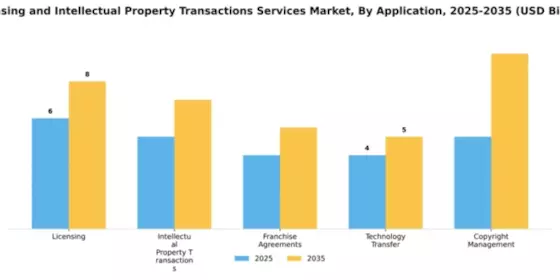
Licensing: Dominant vs. Technology Transfer: Emerging
Licensing is the dominant application within the Licensing and Intellectual Property Transactions Services Market, primarily due to its established framework that enables entities to generate revenue through licensing agreements. It plays a crucial role across sectors including technology, pharmaceuticals, and entertainment, as businesses look to protect and profit from their intellectual assets. In contrast, Technology Transfer is emerging, characterized by its focus on commercializing research outputs from universities and research institutions. This segment is gaining momentum as organizations seek partnerships that facilitate the transition of innovative ideas into market-ready products and services. With grants and collaborative efforts on the rise, Technology Transfer is poised for significant growth in the upcoming years.
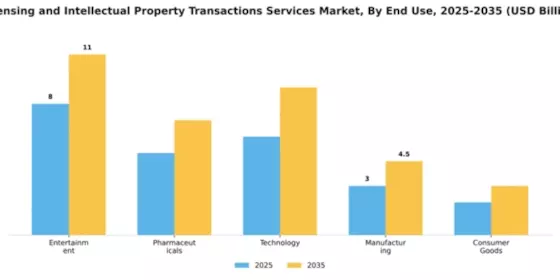
The Licensing and Intellectual Property Transactions Services Market exhibits a varied distribution of shares across different end uses. The Entertainment sector holds the largest share, driven by a surge in digital content consumption and the ongoing demand for creative intellectual properties. This sector thrives on revenue generated from licensing agreements related to films, music, and digital media, making it a critical component of market dynamics. Conversely, the Pharmaceuticals segment is witnessing rapid growth, fueled by increasing investments in research and development. Enhanced collaborations for drug development and patent licensing are propelling this sector's expansion, showcasing a shifting landscape in the licensing market.
Entertainment: Film & Music (Dominant) vs. Pharmaceuticals: Biotech Innovations (Emerging)
The Entertainment sector stands out as a dominant player in the Licensing and Intellectual Property Transactions Services Market, particularly through its focus on film and music rights. This area leverages vast creative assets, which are critical for content distribution and monetization in various forms. On the other hand, the Pharmaceuticals segment, particularly through biotech innovations, represents an emerging force within this landscape. Driven by technological advancements and the need for innovative treatments, this segment is rapidly establishing itself as essential for future growth. Companies in this sector are increasingly pursuing licensing agreements to capitalize on breakthroughs, making them pivotal in the evolution of intellectual property management.
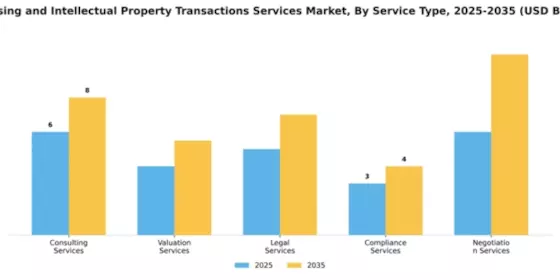
In the Licensing and Intellectual Property Transactions Services Market, the service type segment displays diverse contributions from various offerings. Legal Services hold the largest share, serving as the backbone of IP transactions, reflecting the vital need for legal compliance and protection. In contrast, Valuation Services, while smaller in comparison, are rapidly gaining traction as companies increasingly seek to understand the value of their intellectual properties in a competitive marketplace.
Legal Services: Dominant vs. Valuation Services: Emerging
Legal Services are recognized as the dominant force in the Licensing and Intellectual Property Transactions Services Market, providing essential legal frameworks and guidance that ensure compliance with intellectual property laws. Their stability reinforces their fundamental role in transactions. Conversely, Valuation Services are emerging rapidly, driven by the growing demand for accurate IP valuation in mergers, acquisitions, and investment scenarios. This trend is propelled by the expanding recognition of intellectual property as a valuable intangible asset, enabling companies to leverage their IP for funding and corporate strategies.
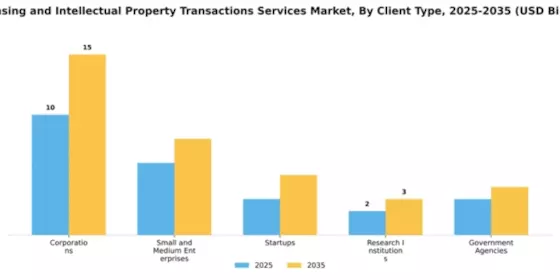
In the Licensing and Intellectual Property Transactions Services Market, Corporations hold a significant portion of the market share due to their extensive portfolios and the requirement for robust licensing agreements to protect their intellectual assets. Smaller client segments, such as Small and Medium Enterprises (SMEs) and Research Institutions, also contribute to the market dynamics, though to a lesser extent compared to Corporations, which dominate the sector. Government Agencies play a crucial role as well, particularly in regulatory frameworks and policies affecting licensing practices. As we analyze growth trends within this market, Startups are emerging as the fastest-growing segment, driven by increased innovation and the need for protection of novel ideas. Their agility and focus on intellectual property rights lead to a heightened demand for licensing services. Corporations, while the largest segment, are also investing in emerging technologies, ensuring they remain competitive through strategic partnerships and licensing agreements. Hence, the overall market is experiencing a shift where agility and innovation are becoming critical drivers of growth.
Corporations (Dominant) vs. Startups (Emerging)
Corporations represent the dominant client segment within the Licensing and Intellectual Property Transactions Services Market. They possess well-established resources and expertise, allowing for complex licensing scenarios and negotiations. This segment's ability to leverage extensive intellectual property portfolios positions them strategically in the market. Conversely, Startups, categorized as an emerging segment, are redefining market dynamics through their rapid growth and innovative approaches. These entities often require agile and customized licensing arrangements to protect their technological advancements and product ideas. The contrasting characteristics of Corporations with their robust frameworks and Startups with their flexible and innovative strategies highlight the diverse needs within the market, creating a balanced ecosystem that fosters growth and collaboration.
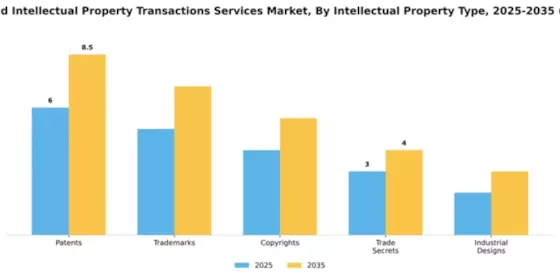
In the Licensing and Intellectual Property Transactions Services Market, Patents represent the largest segment, holding significant market share due to their vital role in protecting innovations and technological advancements. This dominance is driven by the increasing importance of intellectual property in various industries, including technology, pharmaceuticals, and manufacturing. On the other hand, Copyrights are the fastest-growing segment, primarily due to the expansion of digital content creation and distribution, as well as the rising awareness of copyright enforcement in the digital age.
Trademarks (Dominant) vs. Trade Secrets (Emerging)
Trademarks are a dominant force in the Licensing and Intellectual Property Transactions Services Market, as they are essential for brand identity and customer recognition. Companies invest significantly in trademark protection to secure their market position and ensure consumer trust. Conversely, Trade Secrets are considered an emerging segment within this market, driven by their growing importance in providing competitive advantages without the need for formal registration. The emergence of digital technologies has heightened awareness around safeguarding trade secrets, prompting businesses to focus on implementing robust internal controls and legal frameworks for protection.
Get more detailed insights about Licensing and Intellectual Property Transactions Services Market Request Free Sample
North America continues to lead the Licensing and Intellectual Property Transactions Services Market, holding a significant market share of 12.0 in 2024. The region's growth is driven by robust demand for IP protection, increased innovation, and favorable regulatory frameworks. The presence of major corporations and a strong legal infrastructure further catalyze market expansion, making it a hub for IP transactions. The competitive landscape is characterized by key players such as USPTO, Baker McKenzie, and Finnegan, which dominate the market. The United States, in particular, is a focal point for IP services, supported by a well-established legal system and a culture of innovation. This environment fosters collaboration between businesses and legal experts, ensuring effective management of intellectual property rights.
Europe's Licensing and Intellectual Property Transactions Services Market is valued at 6.0, reflecting a growing demand for IP services across various sectors. The region benefits from stringent IP regulations and a strong emphasis on innovation, which drive the need for effective licensing solutions. Countries like Germany and France are at the forefront, with increasing investments in technology and creative industries fueling market growth. The competitive landscape features prominent players such as Deloitte and PwC, which offer comprehensive IP services. The European market is characterized by its diversity, with varying needs across member states. This complexity presents opportunities for tailored solutions, enhancing the region's attractiveness for IP transactions. "The European Union is committed to fostering innovation through robust IP protection mechanisms," European Commission report, European Commission.
The Asia-Pacific region, with a market size of 4.5, is rapidly emerging as a powerhouse in the Licensing and Intellectual Property Transactions Services Market. The growth is driven by increasing economic development, a surge in technology adoption, and a growing awareness of IP rights among businesses. Countries like China and Japan are leading the charge, supported by government initiatives aimed at enhancing IP protection and enforcement. The competitive landscape is evolving, with both local and international players vying for market share. Key firms such as KPMG and Latham & Watkins are expanding their presence in the region, catering to the rising demand for IP services. The region's dynamic market environment presents significant opportunities for innovation and collaboration, making it a focal point for IP transactions.
The Middle East and Africa region, with a market size of 1.5, presents untapped potential in the Licensing and Intellectual Property Transactions Services Market. The growth is driven by increasing awareness of IP rights and the need for legal frameworks to support innovation. Countries like South Africa and the UAE are making strides in establishing robust IP regulations, which are essential for attracting foreign investment and fostering local innovation. The competitive landscape is still developing, with a mix of local firms and international players beginning to establish a foothold. The presence of organizations like WIPO is crucial in promoting IP education and awareness in the region. As the market matures, opportunities for growth and collaboration will expand, making it an attractive destination for IP services.
The Licensing and Intellectual Property Transactions Services Market is characterized by a dynamic competitive landscape, driven by the increasing importance of intellectual property in global commerce. Key players are actively engaging in strategies that emphasize innovation, digital transformation, and strategic partnerships. For instance, WIPO (CH) continues to enhance its global reach by promoting international cooperation in IP protection, while Deloitte (GB) focuses on integrating advanced analytics into its service offerings to provide clients with data-driven insights. These strategies collectively contribute to a competitive environment that is increasingly reliant on technological advancements and collaborative efforts.The market structure appears moderately fragmented, with a mix of established firms and emerging players vying for market share. Key business tactics such as localizing services and optimizing operational efficiencies are prevalent among major companies. This competitive structure allows for a diverse range of offerings, catering to various client needs while fostering innovation and responsiveness to market demands.In November Baker McKenzie (US) announced a strategic partnership with a leading technology firm to enhance its IP advisory services. This collaboration aims to leverage cutting-edge technology to streamline the patent application process, thereby improving client outcomes. The strategic importance of this move lies in its potential to position Baker McKenzie as a frontrunner in the integration of technology within IP services, aligning with broader industry trends towards digitalization.In October KPMG (GB) launched a new suite of services focused on sustainability in intellectual property management. This initiative is designed to assist clients in navigating the complexities of IP in the context of environmental regulations and sustainable practices. The significance of this development is underscored by the growing emphasis on sustainability across industries, suggesting that KPMG is strategically positioning itself to meet evolving client expectations.In September Latham & Watkins (US) expanded its global footprint by opening a new office in Asia, aimed at enhancing its IP services in emerging markets. This expansion reflects a strategic focus on tapping into high-growth regions, thereby diversifying its client base and service offerings. The implications of this move are profound, as it not only strengthens Latham & Watkins' market presence but also aligns with the increasing globalization of IP transactions.As of December current competitive trends indicate a pronounced shift towards digitalization, AI integration, and sustainability within the Licensing and Intellectual Property Transactions Services Market. Strategic alliances are increasingly shaping the landscape, enabling firms to pool resources and expertise to address complex client needs. Looking ahead, competitive differentiation is likely to evolve from traditional price-based competition to a focus on innovation, technological integration, and supply chain reliability, underscoring the necessity for firms to adapt to these emerging trends.






The Licensing and Intellectual Property Transactions Services Market is projected to grow at a 3.49% CAGR from 2025 to 2035, driven by digital transformation, globalization, and increased IP awareness.
New opportunities lie in:
By 2035, the market is expected to be robust, reflecting sustained growth and innovation.
| MARKET SIZE 2024 | 24.0(USD Billion) |
| MARKET SIZE 2025 | 24.84(USD Billion) |
| MARKET SIZE 2035 | 35.0(USD Billion) |
| COMPOUND ANNUAL GROWTH RATE (CAGR) | 3.49% (2025 - 2035) |
| REPORT COVERAGE | Revenue Forecast, Competitive Landscape, Growth Factors, and Trends |
| BASE YEAR | 2024 |
| Market Forecast Period | 2025 - 2035 |
| Historical Data | 2019 - 2024 |
| Market Forecast Units | USD Billion |
| Key Companies Profiled | WIPO (CH), USPTO (US), Deloitte (GB), KPMG (GB), PwC (GB), Baker McKenzie (US), Finnegan (US), Latham & Watkins (US), Jones Day (US) |
| Segments Covered | Application, End Use, Service Type, Client Type, Intellectual Property Type |
| Key Market Opportunities | Emergence of blockchain technology enhances transparency in Licensing and Intellectual Property Transactions Services Market. |
| Key Market Dynamics | Rising demand for digital assets drives innovation in Licensing and Intellectual Property Transactions Services, reshaping competitive landscapes. |
| Countries Covered | North America, Europe, APAC, South America, MEA |
The projected market valuation for the Licensing and Intellectual Property Transactions Services Market in 2035 is 35.0 USD Billion.
The overall market valuation for the Licensing and Intellectual Property Transactions Services Market was 24.0 USD Billion in 2024.
The expected CAGR for the Licensing and Intellectual Property Transactions Services Market during the forecast period 2025 - 2035 is 3.49%.
The market includes segments such as Licensing, Intellectual Property Transactions, Franchise Agreements, Technology Transfer, and Copyright Management.
Key players in the market include WIPO, USPTO, Deloitte, KPMG, PwC, Baker McKenzie, Finnegan, Latham & Watkins, and Jones Day.
The Licensing and Intellectual Property Transactions Services Market in the Entertainment sector was valued at 8.0 USD Billion in 2024 and is projected to reach 11.0 USD Billion.
The valuation range for Consulting Services in the Licensing and Intellectual Property Transactions Services Market is between 6.0 and 8.0 USD Billion.
The Pharmaceuticals sector is expected to grow from 5.0 USD Billion in 2024 to 7.0 USD Billion by 2035.
Corporations were valued at 10.0 USD Billion in 2024, with projections indicating growth to 15.0 USD Billion by 2035.
The projected valuation for Copyright Management is expected to rise from 5.0 USD Billion in 2024 to 9.5 USD Billion by 2035.


Kindly complete the form below to receive a free sample of this Report

“This is really good guys. Excellent work on a tight deadline. I will continue to use you going forward and recommend you to others. Nice job”


“Thanks. It’s been a pleasure working with you, please use me as reference with any other Intel employees.”


“Thanks for sending the report it gives us a good global view of the Betaïne market.”


“Thank you, this will be very helpful for OQS.”


“We found the report very insightful! we found your research firm very helpful. I'm sending this email to secure our future business.”


“I am very pleased with how market segments have been defined in a relevant way for my purposes (such as "Portable Freezers & refrigerators" and "last-mile"). In general the report is well structured. Thanks very much for your efforts.”


“I have been reading the first document or the study, ,the Global HVAC and FP market report 2021 till 2026. Must say, good info! I have not gone in depth at all parts, but got a good indication of the data inside!”


“We got the report in time, we really thank you for your support in this process. I also thank to all of your team as they did a great job.”


“The Automotive 48V ECU Components Procurement Intelligence Study” was a complex project, but the Market Research Future (MRFR) team handled it with quality, agility, and customer-centricity. They delivered all requested data on time and within the agreed scope. The team, including Shubhendra Anand and Rahul Gotadki, was always readily available to clarify questions and swiftly implement necessary adjustments, driving the project to a successful conclusion within a very demanding timeframe.
I would also like to specifically commend Akshay Agarwal for his responsiveness and support at every stage—from our initial inquiry on May 6th through to final delivery on June 18th. His dedication made the entire process seamless.”



