IoT Integration Market (2025 - 2035)

ID: MRFR/ICT/5843-HCR
100 Pages
Ankit Gupta
Last Updated: July 08, 2026
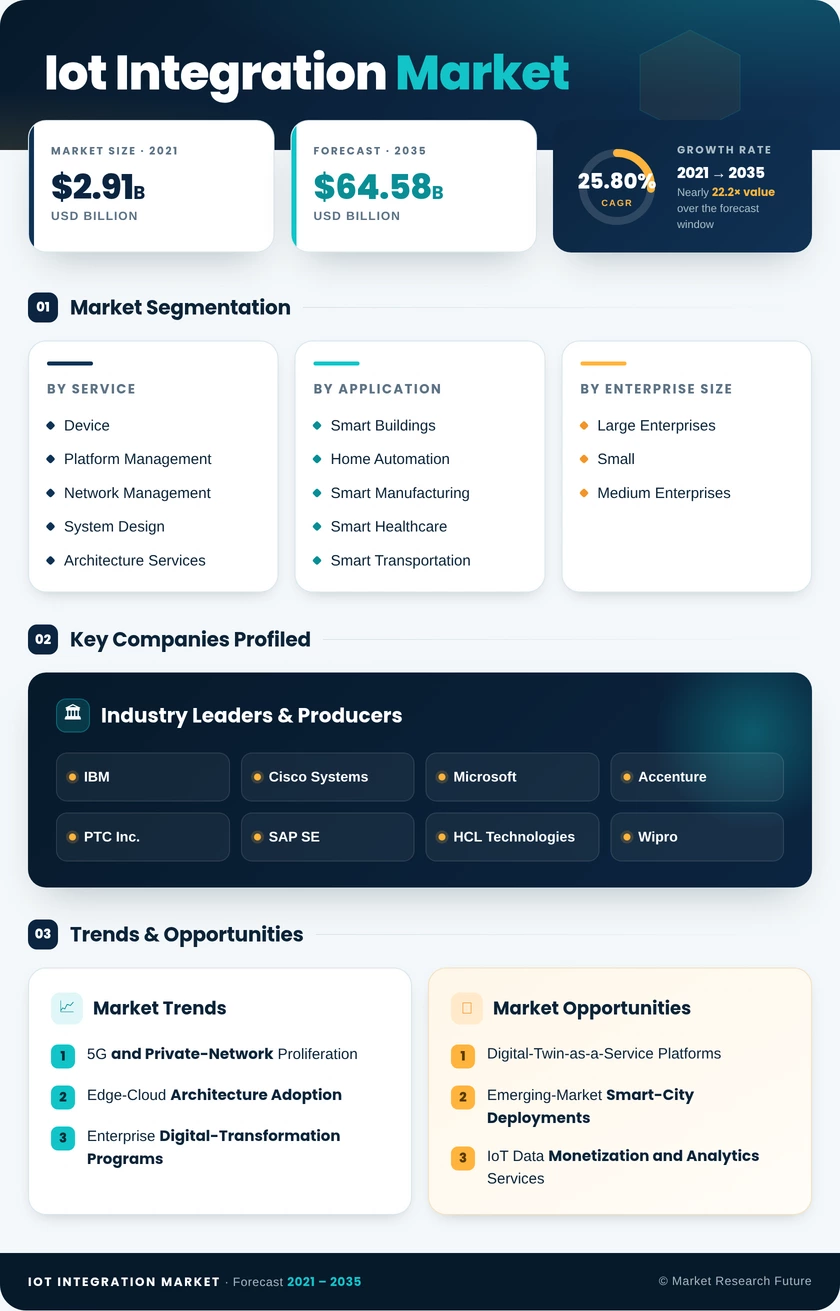
IoT Integration Market Size, Share and Research Report By Service (Device and Platform Management, Network Management, System Design and Architecture Services, Application Management and Analytics), By Application (Smart Buildings and Home Automation, Smart Manufacturing, Smart Healthcare, Smart Transportation and Logistics), By Enterprise Size (Large Enterprises, Small and Medium Enterprises), By End-User Industry (Manufacturing, Healthcare and Life Sciences, Retail and Consumer Goods, Energy and Utilities) and By Regional (North America, Europe, South America, Asia Pacific, Middle East and Africa) - Industry Forecast to 2035.
IoT Integration Market
Market Size
Forecast Period2025-2035
CAGR (2025-2035)25.80%
2025 Market SizeUSD 6.50 Billion
2035 Market SizeUSD 64.58 Billion
Key Players
IBM
Cisco Systems
Microsoft
Accenture
PTC Inc.
SAP SE
Opportunities
  • Digital-Twin-as-a-Service Platforms
  • Emerging-Market Smart-City Deployments
  • IoT Data Monetization and Analytics Services
  1. 1 Market Overview |
    1. 1.1 Study Assumptions & Market Definition |
    2. 1.2 Scope of the Study |
    3. 1.3 Research Methodology
  2. 2 Market Summary & Key Takeaways
  3. 3 Market Dynamics |
    1. 3.1 Market Drivers Analysis | |
      1. 3.1.1 5G & Private-Network Proliferation | |
      2. 3.1.2 Edge-Cloud Architecture Adoption | |
      3. 3.1.3 Enterprise Digital-Transformation Programs | |
      4. 3.1.4 AI/ML Integration in IoT Pipelines | |
      5. 3.1.5 Government Smart-City & Industry
    2. 4.0 Policy | |
      1. 3.1.6 Cybersecurity Compliance Mandates | |
      2. 3.1.7 Healthcare Remote-Monitoring Regulation |
    3. 3.2 Market Restraints Analysis | |
      1. 3.2.1 Fragmented Standards & Protocols | |
      2. 3.2.2 Cybersecurity & Data-Privacy Risks | |
      3. 3.2.3 Skilled-Talent Shortage | |
      4. 3.2.4 High Upfront Integration Costs | |
      5. 3.2.5 Vendor Lock-In Concerns |
    4. 3.3 Market Opportunity Analysis | |
      1. 3.3.1 Digital-Twin-as-a-Service Platforms | |
      2. 3.3.2 Emerging-Market Smart-City Deployments | |
      3. 3.3.3 IoT Data Monetization and Analytics Services | |
      4. 3.3.4 Sustainability and ESG Reporting Integration | |
      5. 3.3.5 Managed Security Services for IoT Estates |
    5. 3.4 Industry Value Chain Analysis |
    6. 3.5 Porter's Five Forces Analysis
  4. 4 Global IoT Integration Market Size & Forecast (2021–2035) |
    1. 4.1 Historical Market Size (2021–2025) |
    2. 4.2 Current & Forecast Market Size (2026–2035) |
    3. 4.3 Market Size by Revenue (USD Billion) |
    4. 4.4 Year-over-Year Growth Analysis
  5. 5 Segmentation Analysis |
    1. 5.1 By Service | |
      1. 5.1.1 Device and Platform Management | |
      2. 5.1.2 Network Management | |
      3. 5.1.3 System Design and Architecture Services | |
      4. 5.1.4 Application Management and Analytics |
    2. 5.2 By Application | |
      1. 5.2.1 Smart Buildings and Home Automation | |
      2. 5.2.2 Smart Manufacturing | |
      3. 5.2.3 Smart Healthcare | |
      4. 5.2.4 Smart Transportation and Logistics |
    3. 5.3 By Enterprise Size | |
      1. 5.3.1 Large Enterprises | |
      2. 5.3.2 Small and Medium Enterprises |
    4. 5.4 By End-User Industry | |
      1. 5.4.1 Manufacturing | |
      2. 5.4.2 Healthcare and Life Sciences | |
      3. 5.4.3 Retail and Consumer Goods | |
      4. 5.4.4 Energy and Utilities
  6. 6 Regional Analysis |
    1. 6.1 North America | |
      1. 6.1.1 United States | |
      2. 6.1.2 Canada | |
      3. 6.1.3 Mexico |
    2. 6.2 Europe | |
      1. 6.2.1 Germany | |
      2. 6.2.2 United Kingdom | |
      3. 6.2.3 France | |
      4. 6.2.4 Italy | |
      5. 6.2.5 Spain | |
      6. 6.2.6 Nordic Countries | |
      7. 6.2.7 Russia | |
      8. 6.2.8 Rest of Europe |
    3. 6.3 Asia-Pacific | |
      1. 6.3.1 China | |
      2. 6.3.2 India | |
      3. 6.3.3 Japan | |
      4. 6.3.4 South Korea | |
      5. 6.3.5 ASEAN | |
      6. 6.3.6 Rest of Asia-Pacific |
    4. 6.4 South America | |
      1. 6.4.1 Brazil | |
      2. 6.4.2 Argentina | |
      3. 6.4.3 Rest of South America |
    5. 6.5 Middle East & Africa | |
      1. 6.5.1 Saudi Arabia | |
      2. 6.5.2 UAE | |
      3. 6.5.3 South Africa | |
      4. 6.5.4 Egypt | |
      5. 6.5.5 Rest of MEA
  7. 7 Competitive Landscape |
    1. 7.1 Market Share Analysis (2025) |
    2. 7.2 Competitive Benchmarking Matrix |
    3. 7.3 Company Profiles | |
      1. 7.3.1 IBM | |
      2. 7.3.2 Cisco Systems | |
      3. 7.3.3 Microsoft | |
      4. 7.3.4 Accenture | |
      5. 7.3.5 PTC Inc. | |
      6. 7.3.6 SAP SE | |
      7. 7.3.7 HCL Technologies | |
      8. 7.3.8 Wipro | |
      9. 7.3.9 Infosys | |
      10. 7.3.10 Bosch.IO
  8. 8 Future Outlook & Strategic Recommendations (2026–2035) |
    1. 8.1 Autonomous Operations and AI-Native Integration |
    2. 8.2 Platform Economics and Ecosystem Consolidation |
    3. 8.3 Sustainability-Driven Telemetry Mandates |
    4. 8.4 Sovereign-Data and Localization Requirements
  9. 9 Recent Developments & News
  10. 10 Frequently Asked Questions (FAQs)
  11. 11 Report Scope & Methodology |
    1. 11.1 Study Period & Base Year |
    2. 11.2 Data Sources & Citations |
    3. 11.3 Abbreviations
  12. 12 LIST OF TABLES |
  13. TABLE 1 Global IoT Integration Market Size & Forecast, by Revenue (USD Billion), 2021–2035 |
  14. TABLE 2 Global IoT Integration Market — Year-over-Year Growth Analysis, 2021–2035 |
  15. TABLE 3 Global IoT Integration Market — Driver Impact Analysis |
  16. TABLE 4 Global IoT Integration Market — Restraints Impact Analysis |
  17. TABLE 5 Global IoT Integration Market Size, by Service, 2021–2035 (USD Billion) |
  18. TABLE 6 Global IoT Integration Market Size, by Application, 2021–2035 (USD Billion) |
  19. TABLE 7 Global IoT Integration Market Size, by Enterprise Size, 2021–2035 (USD Billion) |
  20. TABLE 8 Global IoT Integration Market Size, by End-User Industry, 2021–2035 (USD Billion) |
  21. TABLE 9 Global IoT Integration Market Size, by Region, 2021–2035 (USD Billion) |
  22. TABLE 10 North America IoT Integration Market Size, by Country, 2021–2035 (USD Billion) |
  23. TABLE 11 Europe IoT Integration Market Size, by Country, 2021–2035 (USD Billion) |
  24. TABLE 12 Asia-Pacific IoT Integration Market Size, by Country, 2021–2035 (USD Billion) |
  25. TABLE 13 South America IoT Integration Market Size, by Country, 2021–2035 (USD Billion) |
  26. TABLE 14 Middle East & Africa IoT Integration Market Size, by Country, 2021–2035 (USD Billion) |
  27. TABLE 15 Competitive Benchmarking Matrix — Global IoT Integration Market, 2025 |
  28. TABLE 16 Company Profiles — Key Players, Global IoT Integration Market |
  29. TABLE 17 Recent Developments & Strategic Announcements, 2023–2025 |
  30. TABLE 18 North America IoT Integration Market Size, by Service, 2021–2035 (USD Billion) |
  31. TABLE 19 North America IoT Integration Market Size, by Application, 2021–2035 (USD Billion) |
  32. TABLE 20 North America IoT Integration Market Size, by Enterprise Size, 2021–2035 (USD Billion) |
  33. TABLE 21 North America IoT Integration Market Size, by End-User Industry, 2021–2035 (USD Billion) |
  34. TABLE 22 Europe IoT Integration Market Size, by Service, 2021–2035 (USD Billion) |
  35. TABLE 23 Europe IoT Integration Market Size, by Application, 2021–2035 (USD Billion) |
  36. TABLE 24 Europe IoT Integration Market Size, by Enterprise Size, 2021–2035 (USD Billion) |
  37. TABLE 25 Europe IoT Integration Market Size, by End-User Industry, 2021–2035 (USD Billion) |
  38. TABLE 26 Asia-Pacific IoT Integration Market Size, by Service, 2021–2035 (USD Billion) |
  39. TABLE 27 Asia-Pacific IoT Integration Market Size, by Application, 2021–2035 (USD Billion) |
  40. TABLE 28 Asia-Pacific IoT Integration Market Size, by Enterprise Size, 2021–2035 (USD Billion) |
  41. TABLE 29 Asia-Pacific IoT Integration Market Size, by End-User Industry, 2021–2035 (USD Billion) |
  42. TABLE 30 South America IoT Integration Market Size, by Service, 2021–2035 (USD Billion) |
  43. TABLE 31 South America IoT Integration Market Size, by Application, 2021–2035 (USD Billion) |
  44. TABLE 32 South America IoT Integration Market Size, by Enterprise Size, 2021–2035 (USD Billion) |
  45. TABLE 33 South America IoT Integration Market Size, by End-User Industry, 2021–2035 (USD Billion) |
  46. TABLE 34 Middle East & Africa IoT Integration Market Size, by Service, 2021–2035 (USD Billion) |
  47. TABLE 35 Middle East & Africa IoT Integration Market Size, by Application, 2021–2035 (USD Billion) |
  48. TABLE 36 Middle East & Africa IoT Integration Market Size, by Enterprise Size, 2021–2035 (USD Billion) |
  49. TABLE 37 Middle East & Africa IoT Integration Market Size, by End-User Industry, 2021–2035 (USD Billion) |
  50. TABLE 38 Report Scope & Methodology Summary |
  51. TABLE 39 Detailed Sources and Citations
  52. 13 LIST OF FIGURES |
  53. FIGURE 1 Global IoT Integration Market Dynamics — Drivers, Restraints, and Opportunities |
  54. FIGURE 2 Industry Value Chain Analysis — IoT Integration Market |
  55. FIGURE 3 Porter's Five Forces Analysis — IoT Integration Market |
  56. FIGURE 4 Global IoT Integration Market Size Trend (USD Billion), 2021–2035 |
  57. FIGURE 5 Global IoT Integration Market Share, by Service (2025) |
  58. FIGURE 6 Global IoT Integration Market Share, by Application (2025) |
  59. FIGURE 7 Global IoT Integration Market Share, by Enterprise Size (2025) |
  60. FIGURE 8 Global IoT Integration Market Share, by End-User Industry (2025) |
  61. FIGURE 9 Global IoT Integration Market Share, by Region (2025) |
  62. FIGURE 10 North America IoT Integration Market Size Trend, 2021–2035 |
  63. FIGURE 11 Europe IoT Integration Market Size Trend, 2021–2035 |
  64. FIGURE 12 Asia-Pacific IoT Integration Market Size Trend, 2021–2035 |
  65. FIGURE 13 South America IoT Integration Market Size Trend, 2021–2035 |
  66. FIGURE 14 Middle East & Africa IoT Integration Market Size Trend, 2021–2035 |
  67. FIGURE 15 Competitive Landscape — Market Share Analysis (2025) |
  68. FIGURE 16 Competitive Positioning Matrix — IoT Integration Market Key Players

Segmentation Quick Reference

DimensionSub-SegmentsDominant SegmentFastest Growing Segment
By ServiceDevice and Platform Management; Network Management; System Design and Architecture Services; Application Management and AnalyticsDevice and Platform ManagementNetwork Management
By ApplicationSmart Buildings and Home Automation; Smart Manufacturing; Smart Healthcare; Smart Transportation and LogisticsSmart Buildings and Home AutomationSmart Healthcare
By Enterprise SizeLarge Enterprises; Small and Medium EnterprisesLarge EnterprisesSmall and Medium Enterprises
By End-User IndustryManufacturing; Healthcare and IoT Integration Market; Retail and Consumer Goods; Energy and UtilitiesManufacturingHealthcare and IoT Integration Market
By GeographyNorth America; Europe; Asia-Pacific; South America; Middle East & AfricaNorth AmericaAsia-Pacific


Market Segmentation Overview

By Service

Sub-SegmentKey Trend
Device and Platform ManagementZero-touch provisioning and OTA lifecycle management at scale
Network ManagementPrivate 5G orchestration and network-slicing services
System Design and Architecture ServicesCloud-native greenfield IoT blueprint design
Application Management and AnalyticsEmbedded AI/ML analytics within IoT data pipelines


Device and Platform Management remains the largest service category as enterprises struggle to manage heterogeneous fleets of sensors, gateways, and controllers from dozens of vendors. Network Management services are growing fastest, driven by the complexity introduced by 5G standalone cores, LPWAN, and satellite-backhaul convergence.

By Application

Sub-SegmentKey Trend
Smart Buildings and Home AutomationUnified BMS dashboards driven by energy-code tightening
Smart ManufacturingDigital-twin and predictive-maintenance integration
Smart HealthcareHL7 FHIR-compliant connected-device data pipelines
Smart Transportation and LogisticsFleet telematics and autonomous-vehicle pre-integration


Smart Buildings and Home Automation capture the largest application share, while Smart Healthcare is accelerating as remote-patient-monitoring mandates widen the addressable integration footprint.

By Enterprise Size

Sub-SegmentKey Trend
Large EnterprisesMulti-site, multi-vendor IoT estates requiring complex integration
Small and Medium EnterprisesCloud-native IoT-as-a-Service lowers adoption barriers


Large Enterprises account for the majority of spending, yet SMEs represent the faster-growing cohort as subscription-based IoT platforms democratize access to professional-grade integration.

By End-User Industry

Sub-SegmentKey Trend
ManufacturingOT-IT convergence, predictive maintenance, quality control
Healthcare and IoT Integration MarketConnected-device registries, FDA digital-health pathways
Retail and Consumer GoodsSmart-store analytics and supply-chain visibility
Energy and UtilitiesGrid-edge intelligence and renewable-asset monitoring


Manufacturing dominates end-user spending, driven by the scale and complexity of factory-floor IoT deployments. Healthcare and IoT Integration Market is the fastest-growing vertical, propelled by regulatory mandates for connected-device data interoperability.


 

Download PDF ×

We do not share your information with anyone. However, we may send you emails based on your report interest from time to time. You may contact us at any time to opt-out.