×
Request Free Sample ×

Kindly complete the form below to receive a free sample of this Report

* Please use a valid business email

Leading companies partner with us for data-driven Insights

clients tt-cursor
Hero Background

Less Than Truckload Market

ID: MRFR/PCM/39986-HCR
200 Pages
Garvit Vyas
October 2025

Less Than Truckload Market Research Report: By Service Type (Standard Less Than Truckload, Expedited Less Than Truckload, Freight Forwarding), By End Use Industry (Retail, Manufacturing, Consumer Goods, Healthcare), By Weight Class (Less than 150 lbs, 150 lbs to 1,000 lbs, 1,000 lbs to 5,000 lbs), By Distribution Channel (Direct Shipping, Third Party Logistics, Freight Brokers) andBy Regional (North America, Europe, South America, Asia Pacific, Middle East and Africa)- Forecast to 2035.

Share:
Download PDF ×

We do not share your information with anyone. However, we may send you emails based on your report interest from time to time. You may contact us at any time to opt-out.

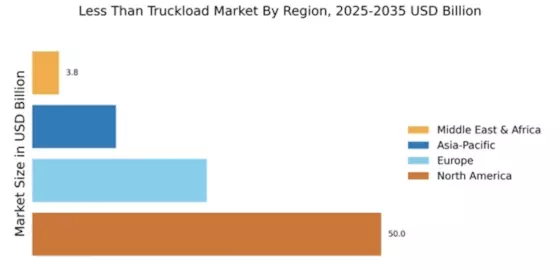
Less Than Truckload Market Infographic
Purchase Options

Less Than Truckload Market Summary

As per MRFR analysis, the Less Than Truckload Market Size was estimated at 90.82 USD Billion in 2024. The Less Than Truckload industry is projected to grow from 93.15 USD Billion in 2025 to 120.06 USD Billion by 2035, exhibiting a compound annual growth rate (CAGR) of 2.57 during the forecast period 2025 - 2035.

Key Market Trends & Highlights

The Less Than Truckload Market is experiencing dynamic growth driven by technological advancements and evolving consumer demands.

  • Technological advancements are reshaping logistics operations, enhancing efficiency and service delivery.
  • Sustainability initiatives are increasingly influencing shipping practices, with companies adopting greener solutions.
  • E-commerce continues to dominate the market, significantly impacting logistics strategies in North America.
  • Rising demand for e-commerce logistics and increased focus on sustainability are key drivers propelling market expansion.

Market Size & Forecast

2024 Market Size 90.82 (USD Billion)
2035 Market Size 120.06 (USD Billion)
CAGR (2025 - 2035) 2.57%

Major Players

FedEx (US), UPS (US), XPO Logistics (US), YRC Worldwide (US), Old Dominion Freight Line (US), Saia (US), R+L Carriers (US), Estes Express Lines (US), ABF Freight (US)

Less Than Truckload Market Trends

The Less Than Truckload Market is currently experiencing a dynamic evolution, driven by various factors that shape its landscape. The increasing demand for efficient logistics solutions, coupled with the rise of e-commerce, appears to be propelling growth in this sector. Companies are increasingly seeking cost-effective transportation options for smaller shipments, which has led to a surge in the adoption of LTL services. Furthermore, advancements in technology, such as real-time tracking and automated logistics management, seem to enhance operational efficiency and customer satisfaction. As businesses strive to optimize their supply chains, the Less Than Truckload Market is likely to witness further innovations and adaptations to meet evolving consumer needs. In addition, sustainability concerns are becoming more pronounced within the Less Than Truckload Market. Companies are increasingly focusing on reducing their carbon footprints and implementing eco-friendly practices. This shift towards greener logistics solutions may influence the strategies of LTL providers, as they seek to align with environmental regulations and consumer preferences. Overall, the Less Than Truckload Market appears poised for continued growth, driven by technological advancements and a heightened emphasis on sustainability, which could redefine the future of freight transportation.

Technological Advancements

The integration of advanced technologies in the Less Than Truckload Market is transforming operations. Innovations such as real-time tracking systems and automated logistics management tools are enhancing efficiency and transparency. These technologies enable companies to optimize routes, reduce delays, and improve overall service quality, thereby meeting the increasing demands of customers.

Sustainability Initiatives

A growing emphasis on sustainability is influencing the Less Than Truckload Market. Companies are adopting eco-friendly practices to minimize their environmental impact. This trend includes the use of alternative fuels, energy-efficient vehicles, and optimized routing to reduce emissions, reflecting a broader commitment to corporate social responsibility.

E-commerce Growth

The expansion of e-commerce is significantly impacting the Less Than Truckload Market. As online shopping continues to rise, businesses require flexible and efficient shipping solutions for smaller shipments. This trend is driving demand for LTL services, as companies seek to meet customer expectations for quick and reliable delivery.

Market Segment Insights

By Application: E-commerce (Largest) vs. Food and Beverage (Fastest-Growing)

The application segment of the Less Than Truckload Market shows a diverse distribution among retail, manufacturing, e-commerce, food and beverage, and pharmaceutical sectors. Retail remains a significant player due to its reliance on flexible shipping solutions, while e-commerce has emerged as the largest segment, driven by the surge in online shopping and the need for expedited delivery. Other segments like food and beverage heavily rely on less than truckload logistics for just-in-time deliveries, indicating their importance in the overall market landscape. Recent trends reveal that the e-commerce sector is a vital growth driver, largely due to shifting consumer behaviors towards online purchases. The food and beverage segment, considered the fastest-growing area, experiences heightened demand for specialized shipping solutions catering to time-sensitive deliveries and perishability. With increasing online food ordering and delivery services, this segment demonstrates robust potential for future expansion, reflecting evolving consumer preferences and market dynamics.

Retail (Dominant) vs. Pharmaceutical (Emerging)

Retail has established itself as a dominant segment within the Less Than Truckload Market, primarily due to its high volume of shipments and the necessity for flexible delivery options. Retailers often require quick turnaround times to meet consumer demands, thereby opting for LTL services that can adapt to fluctuating shipping needs. On the other hand, the pharmaceutical sector represents an emerging player within this landscape, increasingly relying on LTL solutions to ensure the safe and timely delivery of sensitive products. This segment emphasizes compliance with strict regulatory standards and crucial temperature control during transportation, thus highlighting the growing reliance on specialized logistics solutions. As demand for pharmaceuticals rises, both segments will continue to shape the dynamics of the Less Than Truckload Market.

By End Use: Consumer Goods (Largest) vs. Industrial Goods (Fastest-Growing)

In the Less Than Truckload Market, the Consumer Goods segment holds the largest market share, driven by the constant demand for everyday products ranging from food items to household essentials. This segment benefits from an extensive distribution network and strong consumer purchasing behavior, making it a critical driver in the logistics industry. In contrast, the Industrial Goods segment, while smaller currently, is rapidly expanding due to increased manufacturing activity and the rise in e-commerce, contributing to a significant uptick in shipments.

Consumer Goods: Dominant vs. Industrial Goods: Emerging

The Consumer Goods segment is characterized by its broad appeal and steady demand, encompassing various products such as groceries, personal care items, and everyday household materials. This segment leverages robust supply chains and logistics solutions to ensure timely deliveries, thereby maintaining customer satisfaction. On the other hand, the Industrial Goods segment is emerging with growing importance, driven by advancements in manufacturing technology and increased needs for raw materials and machinery transport. As industries evolve and automate, the demand for LTL services in this segment is expected to rise, fostering new opportunities for logistics providers.

By Service Type: Standard Service (Largest) vs. Expedited Service (Fastest-Growing)

In the Less Than Truckload (LTL) market, the Standard Service segment holds the largest market share, appealing to shippers seeking reliable and cost-effective transportation solutions. Meanwhile, the Expedited Service segment is gaining traction among businesses that require quicker delivery times, contributing to its rapid growth in the market. The division among services reflects customer preferences for flexibility, efficiency, and value in shipping operations. The growth trends within this segment are being driven by factors such as the increasing demand for fast delivery and the rise of e-commerce, necessitating more agile logistics solutions. Companies are investing in Expedited Services to meet consumer expectations for shorter delivery windows, while the Standard Service remains essential for regular shipping needs, maintaining its dominance as the backbone of LTL logistics.

Standard Service: Dominant vs. Expedited Service: Emerging

The Standard Service in the Less Than Truckload market is characterized by its cost-effectiveness and reliability, making it the backbone of many shipping strategies. Businesses that utilize standard services benefit from consistent transit times and price stability, essential for budget management in logistics. Conversely, the Expedited Service is gaining popularity as an emerging offering, aimed at shippers who need to prioritize speed and agility. It often commands a premium but offers more flexible options for critical shipments, leading to a growing preference among time-sensitive shippers, particularly in e-commerce. As companies adapt to fast-paced market demands, these two segments are reshaping the landscape of LTL shipping.

By Cargo Type: Dry Freight (Largest) vs. Temperature-Controlled Freight (Fastest-Growing)

In the Less Than Truckload (LTL) market, the cargo type segment is primarily dominated by dry freight. This segment caters to a wide variety of goods that do not require special handling or temperature control, which makes it the backbone of LTL services. Following closely is temperature-controlled freight, which has gained significant traction in recent years due to the rise in e-commerce and the demand for perishable goods. Together, these segments reflect the diverse needs of shippers, balancing cost-effectiveness with specialized logistics.

Dry Freight (Dominant) vs. Temperature-Controlled Freight (Emerging)

Dry freight remains the dominant cargo type in the LTL market, characterized by its versatility and capacity to transport a wide range of non-perishable goods, including household items, textiles, and consumer products. This broad appeal ensures consistent demand and operational efficiency in the supply chain. In contrast, temperature-controlled freight has emerged as a vital segment, driven by the increasing demand for food and pharmaceuticals requiring specific temperature handling. This segment involves specialized equipment and logistics solutions, making it crucial for shippers looking to maintain product integrity in transit. As consumer preferences shift towards fresh and frozen goods, temperature-controlled freight is poised for significant growth.

By Customer Type: Small and Medium Enterprises (Largest) vs. Large Enterprises (Fastest-Growing)

In the Less Than Truckload (LTL) market, Small and Medium Enterprises (SMEs) hold the largest share due to their increasing demand for flexible and cost-effective shipping solutions. SMEs leverage LTL services to optimize logistics and reduce overhead costs, allowing them to compete effectively in the market. Meanwhile, Large Enterprises, though not the largest segment, are experiencing rapid growth as they embrace LTL solutions to enhance supply chain efficiency and meet rising customer demands for quick deliveries. Growth trends in the LTL market are largely driven by the need for efficient freight solutions amongst various customer types. Large Enterprises are increasingly adopting LTL services as they aim to streamline operations, while SMEs continue to expand their logistics capabilities. Government Agencies and Non-Profit Organizations are also showing increasing interest in LTL services to meet specific project needs, contributing to overall market growth. The rise of e-commerce is a significant driver, propelling individual consumers' demand for flexible shipping options.

Small and Medium Enterprises: Dominant vs. Large Enterprises: Emerging

Small and Medium Enterprises are characterized by their agility and ability to adapt quickly to changing market demands, making them a dominant force in the Less Than Truckload market. These businesses often prioritize cost efficiency, utilizing LTL services to maximize their shipping capabilities without incurring the full costs of dedicated transport options. On the other hand, Large Enterprises are emerging as significant players in the LTL space, driven by their need for optimized supply chains and reduced logistics complexities. They are increasingly recognizing the benefits of LTL solutions, leading to a notable growth trend, as these enterprises seek to improve their delivery speed and service quality in response to evolving consumer expectations.

Get more detailed insights about Less Than Truckload Market

Regional Insights

North America : Market Leader in LTL Services

North America continues to dominate the Less Than Truckload (LTL) market, holding a significant share of 50.0% in 2024. The growth is driven by increasing e-commerce activities, demand for efficient logistics solutions, and favorable regulatory frameworks. The region's robust infrastructure and technological advancements further enhance operational efficiencies, making it a key player in the global market. The competitive landscape is characterized by major players such as FedEx, UPS, and XPO Logistics, which are continuously innovating to meet customer demands. The U.S. remains the leading country, supported by a vast network of distribution centers and advanced logistics technologies. This competitive environment fosters a dynamic market, ensuring that North America retains its leadership position in the LTL sector.

Europe : Emerging Market with Growth Potential

Europe's Less Than Truckload (LTL) market is poised for significant growth, currently holding a market share of 25.0%. The rise in cross-border trade, coupled with stringent environmental regulations, is driving demand for efficient logistics solutions. Additionally, the European Union's initiatives to enhance transportation networks and reduce carbon emissions are acting as catalysts for market expansion, making the region increasingly attractive for LTL services. Leading countries such as Germany, France, and the UK are at the forefront of this growth, with a competitive landscape featuring key players like DB Schenker and DPD. The presence of established logistics companies and a focus on sustainability are shaping the market dynamics. As the region adapts to changing consumer preferences, the LTL market is expected to flourish, supported by innovative service offerings and strategic partnerships.

Asia-Pacific : Rapidly Growing Logistics Hub

The Asia-Pacific region is emerging as a rapidly growing hub for the Less Than Truckload (LTL) market, with a current market share of 12.0%. The growth is fueled by increasing urbanization, rising e-commerce activities, and the need for efficient supply chain solutions. Governments in the region are also investing in infrastructure improvements, which are essential for enhancing logistics capabilities and meeting the growing demand for LTL services. Countries like China, Japan, and India are leading the charge, with a competitive landscape that includes both local and international players. The presence of companies such as Nippon Express and CJ Logistics highlights the region's potential. As the market evolves, the focus on technology adoption and customer-centric solutions will be crucial for sustaining growth in the Asia-Pacific LTL sector.

Middle East and Africa : Emerging Market with Challenges

The Middle East and Africa (MEA) region, while holding a smaller market share of 3.82%, presents unique opportunities and challenges in the Less Than Truckload (LTL) market. The growth is driven by increasing trade activities and investments in logistics infrastructure. However, regulatory hurdles and varying levels of market maturity across countries pose challenges to seamless operations. Governments are working to improve logistics frameworks, which is essential for market growth. Countries like South Africa and the UAE are leading the LTL market in the region, with a mix of local and international players vying for market share. The competitive landscape is evolving, with companies focusing on enhancing service offerings and operational efficiencies. As the region continues to develop, the LTL market is expected to grow, driven by strategic investments and partnerships.

Key Players and Competitive Insights

The Less Than Truckload Market is currently characterized by a dynamic competitive landscape, driven by factors such as increasing e-commerce demand, the need for efficient supply chain solutions, and a growing emphasis on sustainability. Major players like FedEx (US), UPS (US), and XPO Logistics (US) are strategically positioning themselves through innovation and digital transformation. FedEx (US) has focused on enhancing its technology infrastructure to improve operational efficiency, while UPS (US) has been investing in sustainable practices to reduce its carbon footprint. XPO Logistics (US) is leveraging its advanced analytics capabilities to optimize routes and enhance service delivery, collectively shaping a competitive environment that prioritizes efficiency and sustainability.

Key business tactics within the Less Than Truckload Market include supply chain optimization and localized service offerings. The market structure appears moderately fragmented, with several key players exerting influence over various segments. This fragmentation allows for a diverse range of services, catering to different customer needs, while also fostering competition among established and emerging players. The collective influence of these companies is significant, as they continuously adapt to market demands and technological advancements.

In November 2025, FedEx (US) announced a partnership with a leading technology firm to develop an AI-driven logistics platform aimed at enhancing delivery efficiency. This strategic move is likely to bolster FedEx's operational capabilities, enabling it to respond more effectively to fluctuating demand patterns and improve customer satisfaction. The integration of AI into logistics operations may also set a new standard for service delivery in the industry.

In October 2025, UPS (US) unveiled its new sustainability initiative, which includes a commitment to achieving carbon neutrality by 2050. This initiative underscores UPS's focus on environmental responsibility and positions the company as a leader in sustainable logistics. By investing in electric vehicles and alternative fuel sources, UPS is not only addressing regulatory pressures but also appealing to environmentally conscious consumers, thereby enhancing its competitive edge.

In September 2025, XPO Logistics (US) expanded its service offerings by acquiring a regional freight carrier, which is expected to enhance its market presence and operational capacity. This acquisition aligns with XPO's strategy to broaden its service portfolio and improve its competitive positioning in the Less Than Truckload Market. The integration of the acquired company’s resources may facilitate better service delivery and operational synergies.

As of December 2025, current trends in the Less Than Truckload Market are heavily influenced by digitalization, sustainability, and the integration of AI technologies. Strategic alliances are increasingly shaping the competitive landscape, as companies seek to enhance their service offerings and operational efficiencies. Looking ahead, competitive differentiation is likely to evolve from traditional price-based competition to a focus on innovation, technology integration, and supply chain reliability. This shift may redefine how companies compete, emphasizing the importance of adaptability and responsiveness in a rapidly changing market.

Key Companies in the Less Than Truckload Market market include

Industry Developments

  • Q2 2025: FedEx Corp. intends to spin off that LTL division as a stand-alone, publicly traded company FedEx announced plans to spin off its FedEx Freight less-than-truckload (LTL) division into a separate, publicly traded company by mid-2026, marking a major structural change in the LTL sector.
  • Q1 2025: Saia (which opened 21 terminals and relocated 9 more in 2024), are seeing tonnage increases of 12.2% year-over-year in February 2025 Saia expanded its LTL network by opening 21 new terminals and relocating 9 more in 2024, resulting in a 12.2% year-over-year increase in tonnage as of February 2025.
  • Q1 2025: ABF Freight and FedEx Freight announced 5.9% increases, while Saia implemented a more aggressive 7.9% and Old Dominion a more modest 4.9% Major LTL carriers including ABF Freight, FedEx Freight, Saia, and Old Dominion implemented general rate increases ranging from 4.9% to 7.9% in early 2025.
  • Q4 2024: TFI International described Q4 2024 as “a disaster” for the company’s LTL division TFI International reported significant operational and financial challenges in its LTL division during the fourth quarter of 2024.
  • Q2 2024: Saia (which opened 21 terminals and relocated 9 more in 2024), are seeing tonnage increases of 12.2% year-over-year in February 2025 Saia completed the opening of 21 new LTL terminals and the relocation of 9 others in 2024, significantly expanding its operational footprint.
  • Q2 2024: Estes Express Lines... generated just under $5 billion in LTL revenue, an increase of more than 18% from the prior year Estes Express Lines reported LTL revenue growth of over 18% in 2024, reaching nearly $5 billion, the strongest growth among major LTL carriers.
  • Q2 2024: XPO ranked No. 4 on this year's Top Less-Than-Truckload Carriers list XPO achieved nearly 5% year-over-year growth in its LTL operations in 2024, with revenue approaching $4.9 billion.

Future Outlook

Less Than Truckload Market Future Outlook

The Less Than Truckload Market is projected to grow at a 2.57% CAGR from 2024 to 2035, driven by e-commerce expansion, technological advancements, and increased demand for efficient logistics solutions.

New opportunities lie in:

  • Integration of AI-driven route optimization software
  • Expansion of cross-border LTL services
  • Development of sustainable packaging solutions for LTL shipments

By 2035, the market is expected to be robust, reflecting steady growth and innovation.

Market Segmentation

Less Than Truckload Market End Use Outlook

  • Consumer Goods
  • Industrial Goods
  • Automotive
  • Construction
  • Electronics

Less Than Truckload Market Cargo Type Outlook

  • Dry Freight
  • Temperature-Controlled Freight
  • Hazardous Materials
  • Oversized Freight
  • Specialized Freight

Less Than Truckload Market Application Outlook

  • Retail
  • Manufacturing
  • E-commerce
  • Food and Beverage
  • Pharmaceutical

Less Than Truckload Market Service Type Outlook

  • Standard Service
  • Expedited Service
  • Guaranteed Service
  • Freight Brokerage
  • Value-Added Services

Less Than Truckload Market Customer Type Outlook

  • Small and Medium Enterprises
  • Large Enterprises
  • Government Agencies
  • Non-Profit Organizations
  • Individual Consumers

Report Scope

MARKET SIZE 202490.82(USD Billion)
MARKET SIZE 202593.15(USD Billion)
MARKET SIZE 2035120.06(USD Billion)
COMPOUND ANNUAL GROWTH RATE (CAGR)2.57% (2024 - 2035)
REPORT COVERAGERevenue Forecast, Competitive Landscape, Growth Factors, and Trends
BASE YEAR2024
Market Forecast Period2025 - 2035
Historical Data2019 - 2024
Market Forecast UnitsUSD Billion
Key Companies ProfiledFedEx (US), UPS (US), XPO Logistics (US), YRC Worldwide (US), Old Dominion Freight Line (US), Saia (US), R+L Carriers (US), Estes Express Lines (US), ABF Freight (US)
Segments CoveredApplication, End Use, Service Type, Cargo Type, Customer Type
Key Market OpportunitiesIntegration of advanced tracking technologies enhances efficiency in the Less Than Truckload Market.
Key Market DynamicsRising demand for efficient logistics solutions drives consolidation and technological advancements in the Less Than Truckload Market.
Countries CoveredNorth America, Europe, APAC, South America, MEA

Leave a Comment

FAQs

What is the expected market size of the Global Less Than Truckload Market in 2024?

The Global Less Than Truckload Market is expected to be valued at 90.82 USD Billion in 2024.

What is the projected market size for the Global Less Than Truckload Market by 2035?

By 2035, the Global Less Than Truckload Market is projected to reach a value of 120.0 USD Billion.

What is the expected compound annual growth rate (CAGR) for the Global Less Than Truckload Market from 2025 to 2035?

The expected CAGR for the Global Less Than Truckload Market from 2025 to 2035 is 2.57%.

Which region holds the largest market share in the Global Less Than Truckload Market in 2024?

North America holds the largest market share in the Global Less Than Truckload Market, valued at 45.5 USD Billion in 2024.

What will be the market size of the Less Than Truckload segment in Europe by 2035?

The market size for the Less Than Truckload segment in Europe is expected to reach 30.0 USD Billion by 2035.

Who are the key players in the Global Less Than Truckload Market?

Major players include Estes Express Lines, R+L Carriers, and FedEx Freight among others.

What segment of the Global Less Than Truckload Market is expected to have the highest value in 2024?

The Standard Less Than Truckload segment is expected to have the highest value, projected at 40.0 USD Billion in 2024.

What is the expected market value of Expedited Less Than Truckload by 2035?

The Expedited Less Than Truckload market is expected to be valued at 40.0 USD Billion by 2035.

What are the projected growth rates for the Less Than Truckload Market in the APAC region?

The Less Than Truckload Market in the APAC region is anticipated to grow from 15.0 USD Billion in 2024 to 20.0 USD Billion by 2035.

What key trends are expected to influence the Global Less Than Truckload Market by 2035?

Emerging trends include increased demand for logistics efficiency and technological innovations in freight forwarding.

Download Free Sample

Kindly complete the form below to receive a free sample of this Report

Compare Licence

×
Features License Type
Single User Multiuser License Enterprise User
Price $4,950 $5,950 $7,250
Maximum User Access Limit 1 User Upto 10 Users Unrestricted Access Throughout the Organization
Free Customization
Direct Access to Analyst
Deliverable Format
Platform Access
Discount on Next Purchase 10% 15% 15%
Printable Versions