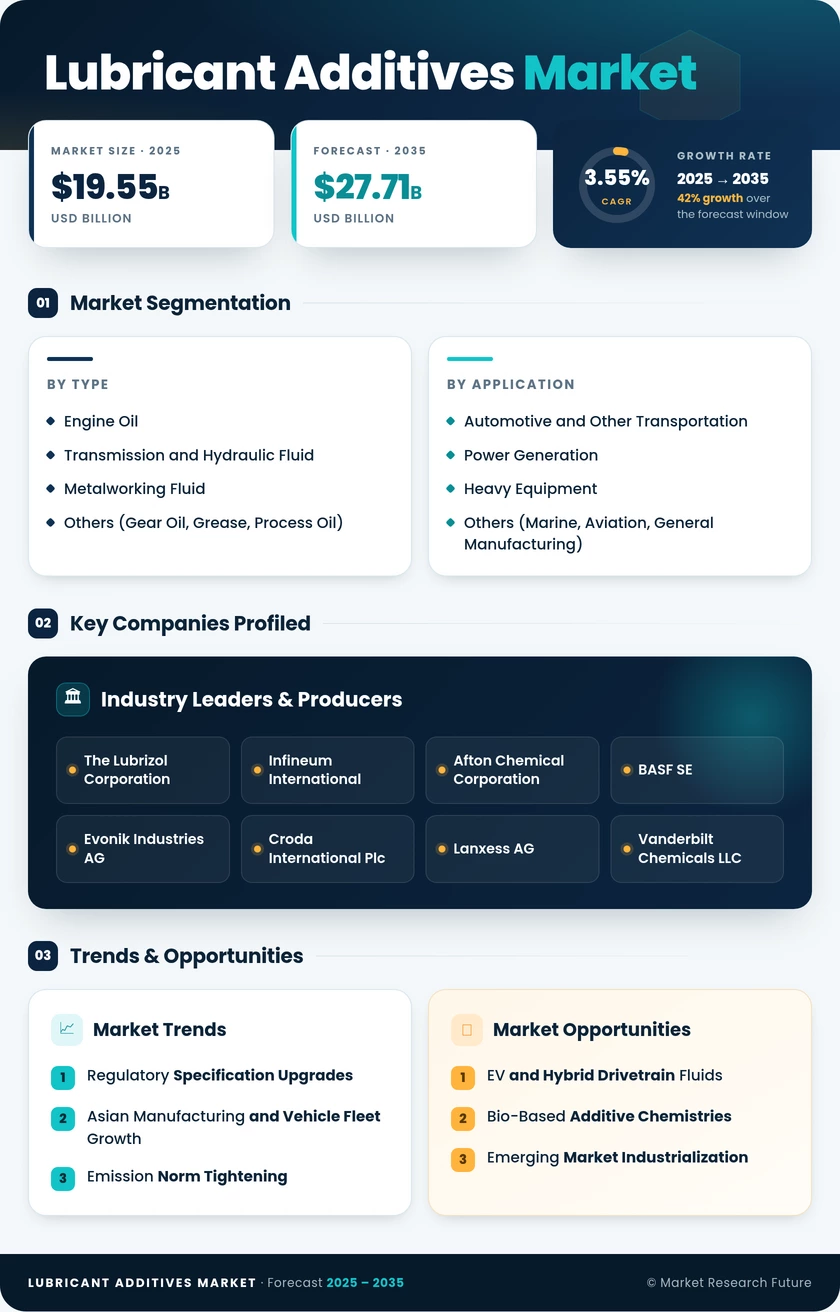
Segmentation Quick Reference
| Dimension | Sub-Segments | Dominant Segment | Fastest Growing Segment |
| By Function Type | Dispersants and Emulsifiers; Viscosity Index Improvers; Detergents; Corrosion Inhibitors; Others | Dispersants and Emulsifiers (31.2% share) | Dispersants and Emulsifiers (4.65% CAGR) |
| By Lubricant Type | Engine Oil; Transmission and Hydraulic Fluid; Metalworking Fluid; Others | Engine Oil (58.2% share) | Metalworking Fluid (4.15% CAGR) |
| By End-User Industry | Automotive and Other Transportation; Power Generation; Heavy Equipment; Others | Automotive and Other Transportation (66.3% share) | Power Generation (4.32% CAGR) |
| By Geography | Asia-Pacific; North America; Europe; South America; Middle East & Africa | Asia-Pacific (48.2% share) | Asia-Pacific (4.28% CAGR) |
Market Segmentation Overview
By Function Type
| Sub-Segment | Key Trend |
| Dispersants and Emulsifiers | Shift toward polyisobutylene succinimide and ashless dispersant chemistries to meet low-SAPs specifications. |
| Viscosity Index Improvers | Demand for high-shear-stability OCP and PMA polymers supporting SAE 0W-16 and 0W-8 grades |
| Detergents | Transition from overbased calcium sulfonates to magnesium and mixed-metal systems for catalyst compatibility |
| Corrosion Inhibitors | Rising need for multi-metal passivation in EV and hybrid drivetrain fluid applications |
| Others | Growing adoption of pour-point depressants and antioxidants for extreme-climate and extended-drain formulations |
Dispersants and emulsifiers dominate the function-type dimension due to the fundamental role soot-suspension chemistry plays in protecting modern emission after-treatment systems. GDI and turbocharged engine architectures produce elevated soot loads, ensuring robust demand for advanced dispersant packages. Viscosity index improvers are gaining importance as global fuel-economy mandates push OEMs toward ultra-low viscosity grades that depend on polymeric modifiers for adequate film strength.
By Lubricant Type
| Sub-Segment | Key Trend |
| Engine Oil | Specification-driven reformulation cycles (GF-7, ACEA C6) sustain high additive treat rates |
| Transmission and Hydraulic Fluid | Automatic transmission proliferation in Asia-Pacific drives demand for friction modifiers and seal swell agents. |
| Metalworking Fluid | Industrial automation and micro-lubrication techniques expand the addressable market for EP and AW chemistries. |
| Others (Gear Oil, Grease, Process Oil) | Specialty industrial applications in wind turbine gearboxes and food-grade manufacturing |
Engine oil leads by a substantial margin because the global passenger vehicle fleet generates continuous, specification-driven replacement demand. Every major standard upgrade resets the additive formulation cycle, requiring blenders to purchase updated packages. Metalworking fluid additives are emerging as the fastest-growing sub-segment, propelled by CNC automation and the expansion of precision manufacturing in Asia-Pacific and Eastern Europe.
By End-User Industry
| Sub-Segment | Key Trend |
| Automotive and Other Transportation | Passenger car, commercial vehicle, and two-wheeler parc expansion drives baseline volume. |
| Power Generation | Gas turbine fleet modernization and distributed energy platforms create high-intensity additive demand. |
| Heavy Equipment | Lubricant Additives Market, construction, and agricultural mechanization sustain robust consumption of hydraulic and gear oil additives. |
| Others (Marine, Aviation, General Manufacturing) | Specialized performance requirements in extreme-temperature and corrosive environments |
Automotive and other transportation dwarfs other end-use verticals based on the sheer recurring-consumption nature of vehicle lubrication. Power generation is gaining share as global electricity demand rises and gas-fired peaking plants proliferate to balance intermittent renewable supply, each installation requiring specialized turbine oil additive packages at high treat rates.