Download Free Sample
Kindly complete the form below to receive a free sample of this Report
Maize Corn Seed Market Size, Share, Industry Trend & Analysis Research Report: By Seed Type (Hybrid Seeds, Open-Pollinated Seeds, Genetically Modified Seeds), By Application (Animal Feed, Food Processing, Industrial Uses), By Growth Type (Field Corn, Sweet Corn, Popcorn), By Sales Channel (Online Retail, Agricultural Cooperatives, Direct Sales) andBy Regional (North America, Europe, South America, Asia Pacific, Middle East and Africa)- Forecast to 2035.
As per Market Research Future analysis, the Maize Corn Seed Market Size was estimated at 32.88 USD Billion in 2024. The Maize Corn Seed industry is projected to grow from 33.83 USD Billion in 2025 to 45.03 USD Billion by 2035, exhibiting a compound annual growth rate (CAGR) of 2.9% during the forecast period 2025 - 2035
The Maize Corn Seed Market is experiencing a dynamic shift towards biotechnology and sustainability.
| 2024 Market Size | 32.88 (USD Billion) |
| 2035 Market Size | 45.03 (USD Billion) |
| CAGR (2025 - 2035) | 2.9% |
The Maize Corn Seed Market is currently experiencing a dynamic phase characterized by evolving agricultural practices and increasing demand for high-yield varieties. Farmers are increasingly adopting advanced seed technologies, which enhance productivity and resilience against environmental stresses. This shift is driven by the need to meet the growing global food requirements, as well as the desire for sustainable farming solutions. Furthermore, the integration of biotechnology in seed development appears to be a pivotal factor, as it enables the creation of genetically modified seeds that offer improved traits such as pest resistance and drought tolerance. In addition, the market is witnessing a surge in investment from both public and private sectors aimed at research and development. This influx of capital is likely to foster innovation in seed varieties, thereby enhancing the overall quality and performance of maize corn seeds. Moreover, the increasing awareness of the benefits associated with hybrid seeds is influencing farmer preferences, leading to a gradual shift from traditional varieties. As the Maize Corn Seed Market continues to evolve, it seems poised for further growth, driven by technological advancements and changing consumer preferences.
The integration of biotechnology in maize corn seed development is becoming increasingly prevalent. This trend suggests that farmers are more inclined to utilize genetically modified seeds that offer enhanced traits, such as improved resistance to pests and diseases. Such advancements may lead to higher yields and reduced reliance on chemical inputs.
There is a growing emphasis on sustainable agricultural practices within the Maize Corn Seed Market. This trend indicates that farmers are seeking seeds that not only provide high yields but also contribute to environmental conservation. The demand for seeds that require fewer resources and have a lower ecological footprint is likely to rise.
Investment in research and development is witnessing an upward trajectory, as both public and private entities recognize the importance of innovation in the maize corn seed sector. This trend implies that enhanced funding could lead to the introduction of new seed varieties that are better suited to changing climatic conditions and consumer demands.
The dynamics of The Maize Corn Seed Industry. Trade agreements and tariffs can influence the availability and pricing of maize seeds across different regions. In 2025, it is anticipated that shifts in trade policies may create new opportunities for seed exporters, particularly in emerging markets where maize consumption is on the rise. Additionally, fluctuations in currency exchange rates can affect the competitiveness of maize seed prices in international markets. As countries seek to secure their food supply chains, the interplay of these trade dynamics is likely to shape the strategies of companies operating within the Maize Corn Seed Market.
Government policies and support play a pivotal role in shaping the Maize Corn Seed Market. Many countries are implementing favorable policies to promote maize cultivation, including subsidies for seed production and research initiatives aimed at improving crop yields. In 2025, it is expected that various governments will continue to invest in agricultural infrastructure and provide financial incentives to farmers adopting modern maize cultivation techniques. Such support is likely to enhance the adoption of high-quality maize seeds, thereby driving the overall market. Furthermore, regulatory frameworks that facilitate the approval of new seed varieties can accelerate innovation within the Maize Corn Seed Market.
The rising demand for maize products, including food, feed, and industrial applications, is a primary driver of the Maize Corn Seed Market. As populations grow and dietary preferences shift, the need for maize as a staple food source intensifies. In 2025, maize is projected to account for a substantial portion of the global cereal production, with estimates suggesting that over 1 billion tons will be produced. This demand is further fueled by the increasing use of maize in biofuels and bioplastics, which diversifies its market applications. Consequently, seed producers are likely to focus on developing high-yield and resilient maize varieties to meet this burgeoning demand, thereby propelling the Maize Corn Seed Market forward.
The increasing awareness of sustainable agriculture practices is influencing the Maize Corn Seed Market. Farmers and consumers alike are becoming more conscious of the environmental impacts of conventional farming methods. This shift is prompting a demand for maize seeds that are not only high-yielding but also environmentally friendly. In 2025, the market is expected to see a rise in the adoption of organic and non-GMO maize seeds, as consumers seek products that align with their values. This trend may encourage seed companies to invest in sustainable breeding practices, thereby enhancing their market position within the Maize Corn Seed Market.
Technological advancements in seed development are significantly influencing the Maize Corn Seed Market. Innovations such as genetic engineering, precision agriculture, and advanced breeding techniques are enhancing seed quality and yield potential. For instance, the introduction of genetically modified maize varieties has led to increased resistance against pests and diseases, which is crucial for maintaining productivity. In 2025, it is anticipated that the market for biotech maize seeds will continue to expand, driven by the need for sustainable agricultural practices. These advancements not only improve crop resilience but also contribute to higher profitability for farmers, thereby stimulating growth in the Maize Corn Seed Market.
In the Maize Corn Seed Market, Hybrid Seeds hold the largest market share, owing to their high yield potential and resilience to adverse climatic conditions. Open-Pollinated Seeds, while important, command a smaller fraction of the market due to lower yields compared to hybrid varieties. Genetically Modified Seeds, designed for specific traits, have been gaining traction in recent years as farmers seek solutions for pests and disease resistance, enhancing their position within the market.
Hybrid Seeds (Dominant) vs. Open-Pollinated Seeds (Emerging)
Hybrid Seeds dominate the Maize Corn Seed Market, offering significant advantages in terms of yield, growth rate, and adaptability to varying environmental conditions. They are engineered to withstand stress factors such as drought and pests, making them a preferred choice among farmers aiming for higher productivity. On the other hand, Open-Pollinated Seeds represent an emerging segment, providing benefits like cost-effectiveness and the ability to save seeds for future planting. While they do not achieve the same yield potential as hybrids, their market presence is bolstered by a growing segment of organic farmers and those focusing on sustainable practices.
Animal Feed (Dominant) vs. Food Processing (Emerging)
Animal Feed is regarded as the dominant application in the Maize Corn Seed Market due to its essential role in livestock nutrition. This segment benefits from robust demand fueled by the livestock sector's growth, and its stability within agricultural frameworks positions it favorably. Conversely, Food Processing is emerging as a significant force, characterized by rising consumer demand for processed maize products, including snacks and staple foods. The versatility of maize in food applications facilitates its incorporation in various products, attracting investment and innovation. As processing technologies advance, the Food Processing segment is poised for substantial growth, appealing to health-conscious consumers seeking nutritional value and convenience.
In the Maize Corn Seed Market, field corn holds the largest market share, significantly dominating the segment due to its vast applications in animal feed, ethanol production, and food processing. This segment is widely cultivated, accounting for most of the maize planted globally. In contrast, sweet corn, although smaller in market share, has been gaining attention as consumer preference shifts towards fresh and organic produce, positioning it as a compelling growth opportunity in the market.
Field Corn (Dominant) vs. Sweet Corn (Emerging)
Field corn is a staple in the Maize Corn Seed Market, known for its versatility and extensive use across food and industrial applications. Its robust characteristics and high yield make it a favored choice for farmers, thereby solidifying its position as a dominant crop. On the other hand, sweet corn, valued for its taste and consumption in fresh and processed forms, is rapidly emerging as a favorite due to increasing health consciousness among consumers. This inclination towards fresh produce is driving innovation in sweet corn varieties, making it a key player for growth in the coming years.
In the Maize Corn Seed Market, the sales channel landscape is evolving with Online Retail holding the largest market share. This channel has gained significant traction due to initiatives in digital marketing and enhanced accessibility for consumers. Meanwhile, Agricultural Cooperatives are performing exceptionally well, emerging as the fastest-growing sales channel as farmers increasingly seek collective purchasing power and shared resources. This trend reflects a shift towards collaboration and community-driven agricultural practices.
Online Retail (Dominant) vs. Direct Sales (Emerging)
Online Retail is currently the dominant sales channel in the Maize Corn Seed Market, providing convenience and competitive pricing to consumers. The rise of e-commerce platforms is reshaping purchasing behaviors, offering farmers easy access to a diverse range of seed varieties from various suppliers. In contrast, Direct Sales is emerging as a valuable sales approach, often accompanied by personalized service and direct engagement between seed suppliers and farmers. This channel allows for tailored recommendations and immediate feedback, making it an attractive option for small-scale farmers seeking specific maize seed solutions.
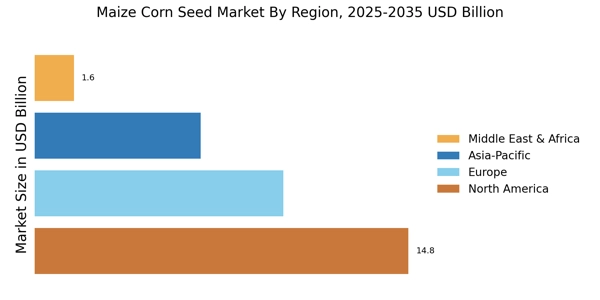
The Global Maize Corn Seed Market exhibited a strong regional presence, with North America leading the valuation at 12.0 USD Billion in 2024 and growing to 17.0 USD Billion by 2035, indicating its majority holding due to advanced farming practices and extensive adoption of biotech seeds.
Europe followed with a valuation of 8.0 USD Billion in 2024, expected to reach 10.5 USD Billion by 2035, driven by increasing demand for high-yield varieties to meet food security needs. The APAC region was also significant, valued at 8.5 USD Billion in 2024 and projected to grow to 10.5 USD Billion, fueled by rising population and agricultural investment initiatives.
South America, with a valuation of 3.0 USD Billion in 2024, gradually emerged as an important player, primarily due to its vast arable land and favorable climate for maize cultivation, aiming for 4.0 USD Billion by 2035. Meanwhile, the MEA region, despite being the smallest with a value of 1.38 USD Billion in 2024, is set to triple to 3.0 USD Billion, showcasing growth potential as agriculture becomes a focal point for economic development.
The diverse Maize Corn Seed Market data illustrated varying growth drivers across regions, with factors such as technological advancements and evolving agricultural practices defining market trends and opportunities in each area.
The Maize Corn Seed Market is characterized by intense competition among various key players, driven by the rising demand for maize as a staple food, animal feed, and biofuel production. The market is influenced by advancements in agricultural technology, including genetically modified organisms that offer better yield, pest resistance, and adaptability to climatic challenges.
Within this framework, companies are vying for market share through innovation, strategic partnerships, and expansive distribution networks. The increasing focus on sustainable agricultural practices and the need for efficient crop production systems further amplify the competitive landscape.
These elements culminate in a dynamic environment where stakeholders are consistently developing new seed varieties and improving existing ones to meet the diverse needs of farmers and consumers.
Bayer holds a prominent position in the Global Maize Corn Seed Market, leveraging its extensive research and development capabilities to bolster its product offerings. The company is recognized for its commitment to innovation, offering a diverse range of high-quality maize seeds that cater to varying agricultural demands across different regions.
Bayer's strengths are rooted in its strong brand reputation and a well-established supply chain that ensures timely delivery and availability of products to farmers. The company's emphasis on sustainable agricultural practices and comprehensive customer support further enhances its market presence.
With a focus on precision agriculture technologies, Bayer is equipped to provide farmers with the tools needed to maximize yield while minimizing environmental impact. This positions Bayer as a leading player, capable of adapting to market trends and responding effectively to the evolving needs of the agricultural sector.
Land O'Lakes has carved out a niche in the Global Maize Corn Seed Market, driven by its dedication to empowering farmers through innovative agricultural solutions. The company's strengths lie in its robust field research initiatives, which enable it to deliver high-performing maize seed varieties tailored to regional climatic conditions and soil types.
Land O'Lakes combines local expertise with cutting-edge research, ensuring that its seeds meet the specific challenges faced by farmers today. Additionally, the company prides itself on fostering strong relationships with agricultural communities, enhancing loyalty and trust among its customer base.
With a strategic focus on sustainability and support services, Land O'Lakes continues to make a significant impact in the maize seed sector, contributing to the overall efficiency and productivity of the agricultural landscape. Its integration of sustainable practices and community-focused initiatives underlines its dedication to fostering long-term growth within the market.






Recent developments in the Global Maize Corn Seed Market indicate a significant focus on innovation and sustainability, with companies like Bayer and Syngenta leading efforts in developing genetically modified seeds that offer higher yields and better pest resistance. East West Seed and Limagrain are increasingly emphasizing partnerships with local farmers to enhance seed adaptation to diverse growing conditions, thereby improving crop resilience.
Additionally, Corteva Agriscience and BASF continue to invest in research and development to create seeds that are not only high-yielding but also environmentally friendly.
Current affairs also highlight the financial growth of key players; for instance, KWS Saat and DuPont are experiencing increased valuations as demand for maize seed continues to rise in response to growing global food demands.
Regarding mergers and acquisitions, Bayer and Monsanto have ramped up integration processes after their merger, while companies like Origin Agritech and Growmark are exploring strategic alliances to expand their market presence.
The market is witnessing a shift towards digitization, with firms deploying data analytics for better decision-making in seed development and distribution strategies. This transformation reflects a broader trend of modernization within the agricultural sector.
The Maize Corn Seed Market is projected to grow at a 2.9% CAGR from 2025 to 2035, driven by increasing demand for biofortified seeds and sustainable agricultural practices.
New opportunities lie in:
By 2035, the market is expected to achieve robust growth, driven by innovation and strategic investments.
| MARKET SIZE 2024 | 32.88(USD Billion) |
| MARKET SIZE 2025 | 33.83(USD Billion) |
| MARKET SIZE 2035 | 45.03(USD Billion) |
| COMPOUND ANNUAL GROWTH RATE (CAGR) | 2.9% (2025 - 2035) |
| REPORT COVERAGE | Revenue Forecast, Competitive Landscape, Growth Factors, and Trends |
| BASE YEAR | 2024 |
| Market Forecast Period | 2025 - 2035 |
| Historical Data | 2019 - 2024 |
| Market Forecast Units | USD Billion |
| Key Companies Profiled | Bayer (DE), Corteva Agriscience (US), Syngenta (CH), Monsanto (US), Dow AgroSciences (US), Limagrain (FR), KWS Saat (DE), Pioneer Hi-Bred (US), RAGT Semences (FR) |
| Segments Covered | Seed Type, Application, Growth Type, Sales Channel, Regional |
| Key Market Opportunities | Adoption of precision agriculture technologies enhances yield potential in the Maize Corn Seed Market. |
| Key Market Dynamics | Technological advancements in seed genetics drive competitive dynamics and influence market consolidation in the maize corn seed sector. |
| Countries Covered | North America, Europe, APAC, South America, MEA |
The Maize Corn Seed Market was valued at 32.88 USD Billion in 2024.
The market is projected to reach 45.03 USD Billion by 2035.
The expected CAGR for the Maize Corn Seed Market from 2025 to 2035 is 2.9%.
Key players include Bayer, Corteva Agriscience, Syngenta, and Monsanto, among others.
The main segments include Type, Application, Growth Type, and Sales Channel.
Hybrid seeds are projected to grow from 12.0 to 16.0 USD Billion during the forecast period.
Genetically modified seeds are anticipated to increase from 10.88 to 17.03 USD Billion by 2035.
Key applications include Animal Feed, Food Processing, and Industrial Uses.
The Animal Feed application segment is expected to grow from 12.0 to 16.0 USD Billion by 2035.



Kindly complete the form below to receive a free sample of this Report

“This is really good guys. Excellent work on a tight deadline. I will continue to use you going forward and recommend you to others. Nice job”


“Thanks. It’s been a pleasure working with you, please use me as reference with any other Intel employees.”


“Thanks for sending the report it gives us a good global view of the Betaïne market.”


“Thank you, this will be very helpful for OQS.”


“We found the report very insightful! we found your research firm very helpful. I'm sending this email to secure our future business.”


“I am very pleased with how market segments have been defined in a relevant way for my purposes (such as "Portable Freezers & refrigerators" and "last-mile"). In general the report is well structured. Thanks very much for your efforts.”


“I have been reading the first document or the study, ,the Global HVAC and FP market report 2021 till 2026. Must say, good info! I have not gone in depth at all parts, but got a good indication of the data inside!”


“We got the report in time, we really thank you for your support in this process. I also thank to all of your team as they did a great job.”


“The Automotive 48V ECU Components Procurement Intelligence Study” was a complex project, but the Market Research Future (MRFR) team handled it with quality, agility, and customer-centricity. They delivered all requested data on time and within the agreed scope. The team, including Shubhendra Anand and Rahul Gotadki, was always readily available to clarify questions and swiftly implement necessary adjustments, driving the project to a successful conclusion within a very demanding timeframe.
I would also like to specifically commend Akshay Agarwal for his responsiveness and support at every stage—from our initial inquiry on May 6th through to final delivery on June 18th. His dedication made the entire process seamless.”



