Download Free Sample
Kindly complete the form below to receive a free sample of this Report
Maize Seed Market Size, Share, Industry Trend & Analysis Research Report: By Crop Type (Field Maize, Sweet Maize, Popcorn), By Seed Variety (Hybrid Seeds, Open-Pollinated Varieties, Transgenic Seeds), By Application (Food Production, Animal Feed, Biofuel), By Distribution Channel (Direct Sales, Retail, E-commerce) andBy Regional (North America, Europe, South America, Asia Pacific, Middle East and Africa)- Forecast to 2035.
As per Market Research Future analysis, the Maize Seed Market Size was estimated at 31.16 USD Billion in 2024. The Maize Seed industry is projected to grow from 31.95 USD Billion in 2025 to 41.02 USD Billion by 2035, exhibiting a compound annual growth rate (CAGR) of 2.53% during the forecast period 2025 - 2035
The maize seed market is experiencing a dynamic shift towards sustainability and technological innovation.
| 2024 Market Size | 31.16 (USD Billion) |
| 2035 Market Size | 41.02 (USD Billion) |
| CAGR (2025 - 2035) | 2.53% |
The Maize Seed Market is currently experiencing a dynamic phase characterized by evolving agricultural practices and increasing demand for high-yield varieties. Farmers are increasingly adopting advanced seed technologies, which enhance productivity and resilience against environmental challenges. This shift is driven by the need to ensure food security and improve crop performance in the face of changing climatic conditions. Furthermore, the integration of biotechnology in seed development appears to be gaining traction, as it offers potential solutions to pest resistance and drought tolerance. As a result, stakeholders in the agricultural sector are likely to invest more in research and development to innovate and meet the growing needs of farmers. In addition, The Maize Seed. There is a noticeable trend towards organic and non-GMO seeds, as consumers become more conscious of food sources and their environmental impact. This shift may lead to a diversification of seed offerings, catering to both conventional and organic farming methods. The interplay between traditional practices and modern agricultural technologies suggests a complex landscape for the Maize Seed Market, where adaptability and innovation will be crucial for future growth.
The Maize Seed Market is witnessing a notable increase in the adoption of biotechnology. This trend is driven by the need for seeds that can withstand pests and diseases, as well as those that can thrive in adverse weather conditions. Biotech seeds are perceived to offer higher yields and improved quality, making them attractive to farmers seeking to maximize their output.
There is a growing inclination towards sustainable agricultural practices within the Maize Seed Market. This trend reflects a broader societal movement towards environmental responsibility. Farmers are increasingly interested in organic and non-GMO seed options, which cater to the rising consumer demand for sustainably sourced food products.
Investment in research and development is becoming increasingly critical in the Maize Seed Market. Companies are focusing on developing innovative seed varieties that can adapt to changing climatic conditions and meet the evolving needs of farmers. This emphasis on R&D is likely to drive advancements in seed technology and enhance overall agricultural productivity.
The maize Seed Industry. Trade agreements and tariffs can facilitate or hinder access to various markets, influencing seed availability and pricing. In recent years, countries have engaged in negotiations to enhance trade relations, which has led to increased exports of maize seeds. For instance, in 2023, maize seed exports rose by 10% due to favorable trade policies. This trend suggests that as international markets become more interconnected, the Maize Seed Market will likely benefit from expanded opportunities, allowing producers to reach new customers and enhance their market presence.
Government support and subsidies play a crucial role in shaping the Maize Seed Market. Many countries implement policies aimed at boosting maize production through financial incentives, research funding, and infrastructure development. For example, in 2023, several nations allocated substantial budgets to enhance agricultural productivity, with maize being a focal point due to its economic importance. Such initiatives encourage farmers to invest in high-quality seeds and modern farming techniques, thereby increasing overall production. This supportive environment is likely to foster growth in the Maize Seed Market, as stakeholders benefit from enhanced resources and opportunities.
The rising demand for maize products, including food, feed, and industrial applications, is a primary driver of the Maize Seed Market. As populations grow and dietary preferences shift, the need for maize as a staple food source intensifies. In 2023, maize accounted for approximately 30% of the total cereal production, highlighting its significance in global agriculture. Furthermore, the increasing use of maize in biofuels and bioplastics is expected to further bolster demand. This trend suggests that the Maize Seed Market will continue to expand as producers seek to meet the diverse needs of consumers and industries alike.
The growing awareness of sustainable agriculture practices is influencing the Maize Seed Market. Consumers and producers alike are increasingly prioritizing environmentally friendly farming methods that reduce chemical inputs and promote biodiversity. This shift is leading to a higher demand for organic and non-GMO maize seeds. In 2023, the organic maize market witnessed a growth rate of approximately 15%, reflecting this trend. As sustainability becomes a key consideration for agricultural stakeholders, the Maize Seed Market is expected to adapt, offering products that align with these values and meet consumer expectations.
Technological advancements in seed development are transforming the Maize Seed Market. Innovations such as genetically modified organisms (GMOs) and precision agriculture techniques are enhancing crop yields and resilience against pests and diseases. For instance, the introduction of drought-resistant maize varieties has shown potential to increase yields by up to 20% in arid regions. These advancements not only improve productivity but also contribute to food security. As farmers increasingly adopt these technologies, the Maize Seed Market is likely to experience significant growth, driven by the need for efficient and sustainable agricultural practices.
In the Maize Seed Market, Field Maize holds the largest share, dominating the segment due to its adaptability and wide utilization in various agricultural practices. As a staple in numerous regions, it caters to both food and feed requirements, thereby securing its top position. Sweet Maize and Popcorn, while important, occupy smaller shares in the market. Sweet Maize, known for its unique flavor and consumer preference in fresh form, is growing steadily, indicating a shift towards specialty crops. Popcorn, although niche, has a loyal consumer base that ensures its stability within the market.
Field Maize (Dominant) vs. Sweet Maize (Emerging)
Field Maize is positioned as the dominant segment in the maize seed sector, favored for its robust yield potential and versatility in cultivation. It is primarily utilized for animal feed and food processing, making it integral to global agriculture. Sweet Maize, in contrast, represents an emerging segment, capturing markets with its appealing taste and increasing consumer demand for fresh produce and processed sweet corn products. This segment is also benefiting from health trends promoting fresh and minimally processed foods, thereby increasing its attractiveness to both farmers and consumers. As health-conscious eating continues to trend upward, Sweet Maize is expected to see significant market growth.
Hybrid Seeds (Dominant) vs. Transgenic Seeds (Emerging)
Hybrid seeds are characterized by their enhanced yield potential and resilience to pests and diseases, making them the preferred choice among mainstream maize farmers. These seeds are the result of controlled pollination techniques, ensuring consistent and high-quality produce. In contrast, transgenic seeds, which incorporate genetic modifications to express desirable traits such as herbicide resistance or improved nutritional content, are emerging rapidly. They appeal to farmers aiming for innovation and increased productivity. As technology advances, transgenic seeds are becoming increasingly popular, potentially transforming agricultural practices in regions heavily reliant on maize.
The maize seed market is divided into several key application segments, with food production taking the largest share. The ability of maize to serve as a staple crop across various regions bolsters its significance in the food production sector. Meanwhile, animal feed is witnessing rapid growth due to an increasing global demand for livestock and poultry products, which is driving the need for high-quality maize seed to ensure optimal animal health and productivity.
Food Production (Dominant) vs. Biofuel (Emerging)
In the maize seed market, food production stands out as the dominant application segment, driven by maize's versatility in culinary uses and its role as a staple food source. This segment accounts for the majority of maize seed usage worldwide, thanks to its integral role in feeding rapidly growing populations. In contrast, biofuel represents an emerging segment as agricultural practices evolve towards sustainable energy solutions. With rising environmental concerns, the push for renewable energy sources is leading to increased interest in using maize as a biofuel feedstock. As technology and biofuel production processes advance, this segment is expected to grow significantly, reflecting a notable shift towards more sustainable agricultural practices.
In the Maize Seed Market, the distribution channel segment showcases a diverse range of channels through which this vital agricultural input reaches farmers. Direct sales have emerged as the largest channel, holding a significant portion of the market share due to their direct interaction with end-users. Retail, while active, contributes less to overall distribution, with e-commerce rapidly gaining traction as a modern sales channel for maize seeds. This shift towards direct engagement highlights the changing dynamics of how farmers source their seed inputs.
Direct Sales (Dominant) vs. Retail (Emerging)
Direct sales stand out as the dominant distribution channel in the Maize Seed Market, largely favored by farmers who appreciate personal service and tailored advice. This method allows seed producers to establish strong relationships with buyers, ensuring customer loyalty. In contrast, retail serves as an emerging channel with its convenience and accessibility. Retail outlets, including local agricultural stores, are adapting to incorporate new technologies and offer a wider variety of maize seed options. As agriculture continues to evolve, both distribution methods will need to adapt to meet changing consumer preferences and operational efficiencies.
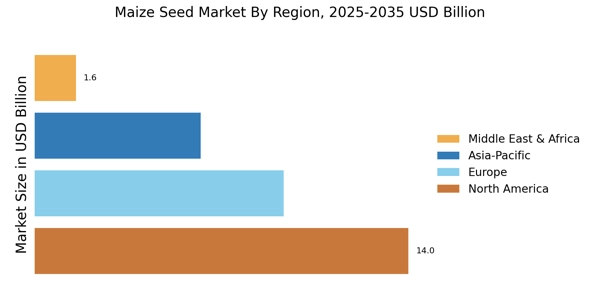
The Global Maize Seed Market revealed a diverse landscape across its regional segmentation. In 2024, North America held a significant market valuation of 8.0 USD Billion, expected to rise to 10.5 USD Billion by 2035, reflecting its major influence in maize seed production.
Europe followed closely with a 2024 valuation of 7.5 USD Billion, projected to grow to 9.7 USD Billion, showcasing its pivotal role in contributing to the Global Maize Seed Market revenue. The Asia-Pacific (APAC) region led with a robust valuation of 10.0 USD Billion in 2024, ascending to 13.0 USD Billion by 2035, indicating its dominance due to the vast agricultural land and increasing demand for maize.
South America, valued at 4.5 USD Billion in 2024, is set to reach 5.7 USD Billion, reflecting potential growth driven by expanding agricultural technology. The Middle East and Africa (MEA) market was smaller, with 1.16 USD Billion in 2024, anticipated to reach 2.1 USD Billion, representing emerging opportunities despite its lower market share.
Overall, the segmentation highlighted key areas poised for growth while underscoring the dominant positions of North America, Europe, and APAC in the Global Maize Seed Market statistics.
The Global Maize Seed Market is characterized by a dynamic landscape where innovation, research, and competitive strategies play pivotal roles. The market is influenced by various factors, including technological advancements, environmental considerations, and growing population demands that require efficient crop yield methodologies.
As maize is one of the most crucial staple crops worldwide, competition among seed manufacturers is intensifying. Companies are increasingly focusing on developing hybrid seeds with enhanced traits such as drought resistance, pest resistance, and improved nutritional profiles, reflecting the urgent need for sustainable agricultural practices.
Moreover, the market is marked by key players investing in extensive research and development to create genetically modified seeds that promise higher productivity and adaptability in diverse climatic conditions. Assessing competitive positioning within this space reveals a mixture of traditional players and emerging biotech firms driving the overall growth trajectory of the market.
Bayer stands as a formidable entity within the Global Maize Seed Market, showcasing an extensive portfolio that addresses a range of agricultural challenges. The company has established a robust market presence through its commitment to innovation and sustainability, underpinned by significant investments in research and development.
Bayer's strength lies in its ability to combine cutting-edge biotechnology with traditional agricultural practices, offering seeds that excel in yield performance, disease resistance, and agronomic advantages. Furthermore, Bayer leverages its global footprint and established distribution networks to reach various markets effectively, nurturing strong relationships with farmers to provide comprehensive solutions that enhance productivity.
By focusing on traits that optimize crop performance under varying conditions, Bayer has solidified its reputation as a leader in the maize seed sector, setting high standards for quality and reliability.
Southeast Asia Seed plays a significant role in the Global Maize Seed Market, particularly in catering to the unique agricultural needs of the Southeast Asian region. The company's competitive edge is highlighted by its focus on developing locally adapted maize varieties that thrive in the region's diverse climatic conditions.
Southeast Asia Seed has built a strong market presence characterized by its understanding of local farming practices, which allows it to provide tailored seed solutions that resonate with farmers. The company's strength lies in its commitment to research and development, emphasizing hybrid seeds with enhanced traits suitable for tropical climates.
This adaptability not only contributes to increased yield potential but also makes its products particularly appealing to the growing farming community in Southeast Asia. Through strategic partnerships and collaborations, Southeast Asia Seed continues to expand its influence, reinforcing its position in the competitive landscape of the maize seed market.






The Maize Seed Market is projected to grow at a 2.53% CAGR from 2025 to 2035, driven by increasing demand for biofortified seeds and sustainable agricultural practices.
New opportunities lie in:
By 2035, the Maize Seed Market is expected to achieve robust growth, driven by innovation and strategic market expansion.
| MARKET SIZE 2024 | 31.16(USD Billion) |
| MARKET SIZE 2025 | 31.95(USD Billion) |
| MARKET SIZE 2035 | 41.02(USD Billion) |
| COMPOUND ANNUAL GROWTH RATE (CAGR) | 2.53% (2025 - 2035) |
| REPORT COVERAGE | Revenue Forecast, Competitive Landscape, Growth Factors, and Trends |
| BASE YEAR | 2024 |
| Market Forecast Period | 2025 - 2035 |
| Historical Data | 2019 - 2024 |
| Market Forecast Units | USD Billion |
| Key Companies Profiled | Monsanto (US), DuPont (US), Syngenta (CH), BASF (DE), Corteva Agriscience (US), Limagrain (FR), KWS (DE), Pioneer (US), Mahyco (IN) |
| Segments Covered | Crop Type, Seed Variety, Application, Distribution Channel, Regional |
| Key Market Opportunities | Adoption of genetically modified maize seeds to enhance yield and pest resistance. |
| Key Market Dynamics | Rising demand for drought-resistant maize seeds drives innovation and competition among seed manufacturers. |
| Countries Covered | North America, Europe, APAC, South America, MEA |
The Maize Seed Market was valued at 31.16 USD Billion in 2024.
The projected valuation for the Maize Seed Market in 2035 is 41.02 USD Billion.
The expected CAGR for the Maize Seed Market during the forecast period 2025 - 2035 is 2.53%.
Field Maize, Sweet Maize, and Popcorn are the leading crop type segments, with valuations of 20.0, 7.0, and 4.16 USD Billion respectively in 2024.
The key seed varieties include Hybrid Seeds, Open-Pollinated Varieties, and Transgenic Seeds, with valuations of 12.0, 10.0, and 9.16 USD Billion respectively in 2024.
The Maize Seed Market is segmented by application into Food Production, Animal Feed, and Biofuel, with valuations of 12.0, 10.0, and 9.16 USD Billion respectively in 2024.
The distribution channels in the Maize Seed Market include Direct Sales, Retail, and E-commerce, with valuations of 10.0, 12.0, and 9.16 USD Billion respectively in 2024.
Key players in the Maize Seed Market include Monsanto, DuPont, Syngenta, BASF, Corteva Agriscience, Limagrain, KWS, Pioneer, and Mahyco.
The Field Maize segment is projected to grow from 20.0 USD Billion in 2024 to 26.0 USD Billion by 2035.
The Sweet Maize segment, valued at 7.0 USD Billion in 2024, is expected to reach 9.0 USD Billion by 2035, indicating steady growth.



Kindly complete the form below to receive a free sample of this Report

“This is really good guys. Excellent work on a tight deadline. I will continue to use you going forward and recommend you to others. Nice job”


“Thanks. It’s been a pleasure working with you, please use me as reference with any other Intel employees.”


“Thanks for sending the report it gives us a good global view of the Betaïne market.”


“Thank you, this will be very helpful for OQS.”


“We found the report very insightful! we found your research firm very helpful. I'm sending this email to secure our future business.”


“I am very pleased with how market segments have been defined in a relevant way for my purposes (such as "Portable Freezers & refrigerators" and "last-mile"). In general the report is well structured. Thanks very much for your efforts.”


“I have been reading the first document or the study, ,the Global HVAC and FP market report 2021 till 2026. Must say, good info! I have not gone in depth at all parts, but got a good indication of the data inside!”


“We got the report in time, we really thank you for your support in this process. I also thank to all of your team as they did a great job.”


“The Automotive 48V ECU Components Procurement Intelligence Study” was a complex project, but the Market Research Future (MRFR) team handled it with quality, agility, and customer-centricity. They delivered all requested data on time and within the agreed scope. The team, including Shubhendra Anand and Rahul Gotadki, was always readily available to clarify questions and swiftly implement necessary adjustments, driving the project to a successful conclusion within a very demanding timeframe.
I would also like to specifically commend Akshay Agarwal for his responsiveness and support at every stage—from our initial inquiry on May 6th through to final delivery on June 18th. His dedication made the entire process seamless.”



