Maize Market

Key Players: Cargill Inc., Archer Daniels Midland (ADM), Bunge Limited, COFCO International, Ingredion Incorporated, Corteva Agriscience, Syngenta Group, Tate & Lyle PLC

Maize Market

Global Maize Market Size, Share, Industry Trend & Analysis Research Report: By Type (Yellow Maize, White Maize, Other Varieties), By Application (Animal Feed, Food & Beverages, Industrial Uses, Others), By Geography (North America, Europe, Asia-Pacific, South America, Middle East & Africa) - Forecast to 2035.
ID: MRFR/Agri/40313-HCR
200 Pages
Snehal Singh
Last Updated: June 22, 2026

Maize Market Summary

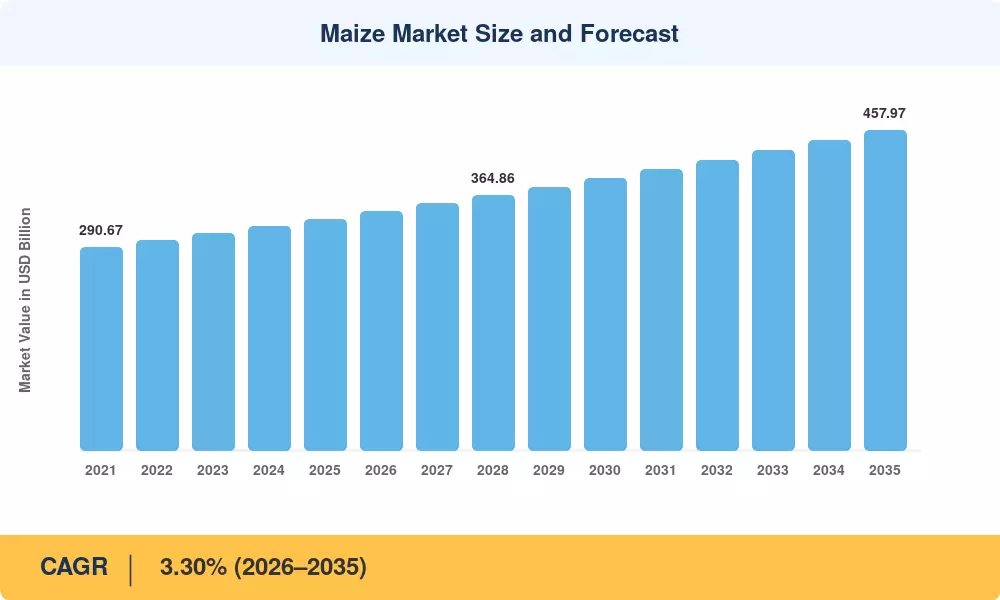
The global maize market reached an estimated USD 331.00 billion in 2025 and is projected to grow from USD 341.92 billion in 2026 to USD 457.97 billion by 2035, registering a CAGR of 3.30% during the forecast period. Biofuel blending mandates in the United States and Brazil, coupled with expanding livestock populations across the Asia-Pacific, remain the two most powerful demand catalysts for corn grain production and trade. The February 2025 reversal of Mexico's biotech-maize import ban removed a critical trade friction point and reopened a corridor worth roughly USD 4.7 billion in annual commodity flow [2].

A structural transformation is reshaping corn cultivation and harvesting practices worldwide. Legacy open-pollinated varieties are steadily giving way to high-yield hybrid and genetically modified seeds that tolerate drought stress and support denser planting configurations. Corteva Agriscience and Bayer CropScience have committed over USD 2.8 billion in combined R&D spending on short-stature maize hybrids designed for mechanized harvesting, signaling the pace of innovation in the maize market [3]. Meanwhile, on-farm grain storage infrastructure is expanding at roughly 6% annually, giving producers greater pricing flexibility and reducing post-harvest losses that historically eroded 12–15% of output in sub-Saharan Africa [4].

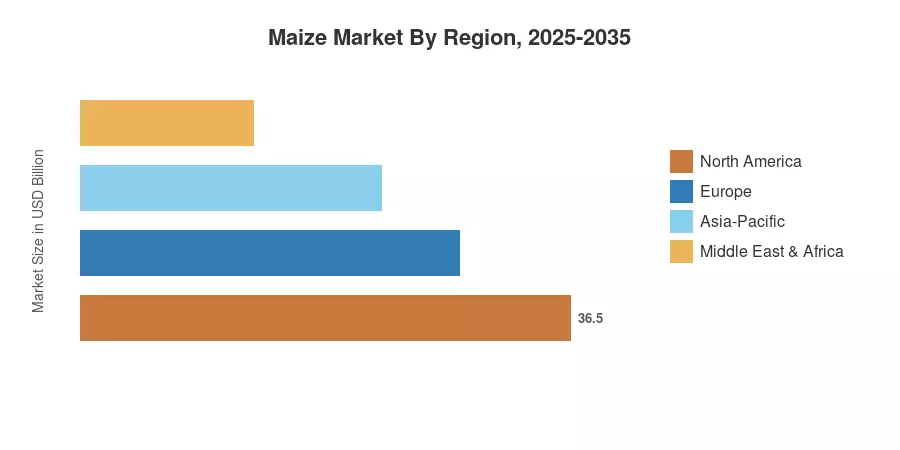
North America commands approximately 37.5% of the global maize market, anchored by the U.S. Corn Belt's unmatched yield density and ethanol refining capacity. Asia-Pacific stands as the fastest-growing region with a projected CAGR of 5.35%, driven by rising demand for maize as food feed and fuel across China, India, and Southeast Asia. Europe holds the second-largest share at roughly 22%, propelled by livestock feed requirements and expanding maize starch and ethanol uses in bio-based packaging. The next decade will test how effectively trade frameworks and climate-resilient agronomy can keep pace with surging global consumption.


Key Report Takeaways

• By Type

  • Yellow maize accounted for roughly 68% of the global maize market value in 2025, reflecting dominant use in animal feed and ethanol refining.
  • White maize is forecast to grow at a 3.85% CAGR through 2035, propelled by food-grade consumption in Africa and Central America.

• By Application

  • Animal feed represented the largest end-use of the maize market, valued at approximately USD 138.80 billion in 2025.
  • Industrial uses — including maize starch and ethanol uses — are expanding at a 4.10% CAGR, the fastest among application segments.
  • Food and beverages held a 19% share of the maize market globally, supported by rising demand for corn-based snack and cereal products.

• By Region

  • North America led the maize market with 37.5% revenue share in 2025, driven by U.S. ethanol mandates and export infrastructure.
  • Asia-Pacific is projected to register the highest CAGR of 5.35%, fueled by expansion of corn grain production and trade in China and India.


Maize Market Size and Forecast (2021–2035)

MRFR's market sizing integrates FAO production statistics, USDA Foreign Agricultural Service trade data, national grain board pricing indices, and proprietary demand models triangulated against industry interviews with grain traders, seed companies, and ethanol producers[5].
Maize Market Size and Forecast
Our Impact
Enabled $4.3B Revenue Impact for Fortune 500 and Leading Multinationals
Partnering with 2000+ Global Organizations Each Year
30K+ Citations by Top-Tier Firms in the Industry

Driver Impact Analysis

Driver ~% Impact on CAGR Geographic Relevance Impact Timeline
Animal feed demand growth +0.90% Global Long-term (≥4 yr)
Biofuel blending mandates +0.75% North America, South America Medium-term (2–4 yr)
High-yield hybrid seed adoption +0.55% Global Long-term (≥4 yr)
On-farm storage expansion +0.35% Africa, Asia-Pacific Medium-term (2–4 yr)
Starch-based industrial applications +0.40% Europe, North America Medium-term (2–4 yr)
Trade liberalization (biotech approvals) +0.25% North America, Asia-Pacific Short-term (≤2 yr)
Dietary protein transition in emerging economies +0.30% Asia-Pacific, Africa Long-term (≥4 yr)


Expanding Animal Feed Requirements

Global meat consumption is projected to rise 14% by 2033 according to FAO-OECD Agricultural Outlook estimates, directly amplifying demand for corn grain production and trade as the primary energy ingredient in compound livestock feeds [10]. Poultry alone absorbs over 45% of all feed-grade maize consumed worldwide. In China, the shift from backyard to commercial-scale hog operations following African Swine Fever recovery has increased per-unit maize inclusion rates by roughly 8%, adding an estimated 22 million metric tons of incremental annual demand since 2021 [10].

Biofuel Blending Mandates

The U.S. Renewable Fuel Standard requires refiners to blend 15 billion gallons of conventional ethanol annually, locking in approximately 37% of the domestic corn crop for maize starch and ethanol uses [9]. Brazil's RenovaBio program continues to ratchet decarbonization credits upward, incentivizing second-crop (safrinha) corn cultivation and harvesting specifically for ethanol distilleries. Combined, North and South American biofuel programs absorb over 180 million metric tons of maize each year, providing a price floor that stabilizes producer margins even during harvest-year oversupply [9].

High-Yield Hybrid Seed Commercialization

Short-stature maize hybrids, now commercialized by Bayer and Corteva, enable planting densities up to 45,000 seeds per acre versus the traditional 34,000, boosting per-acre yields by an estimated 15–20% [3]. These innovations in corn cultivation and harvesting reduce lodging risk and accommodate mechanical harvesters in high-wind geographies. USDA field trials in Iowa reported average yield improvements of 18 bushels per acre for short-stature lines during the 2024 growing season, validating the economic case for premium-priced seed [7].

On-Farm Grain Storage Expansion

The World Bank estimates that inadequate post-harvest storage destroys USD 4 billion worth of maize annually across sub-Saharan Africa alone [4]. Investments in hermetic grain bags, metal silos, and warehouse receipt systems are expanding storage capacity at roughly 6% per year, enabling smallholders to time sales for better prices. This infrastructure build-out strengthens the maize market by reducing supply-chain losses and improving marketing flexibility for yellow and white maize varieties [4].


Restraints Impact Analysis

Restraint impact percentages are directional estimates that illustrate headwinds to market growth. They do not net directly against the driver impacts or the stated CAGR.

Restraint ~% Impact on CAGR Geographic Relevance Impact Timeline
Climate volatility and drought frequency –0.50% Global Long-term (≥4 yr)
Trade policy friction and tariffs –0.30% North America, Asia-Pacific Short-term (≤2 yr)
Input cost inflation (fertilizer, energy) –0.35% Global Medium-term (2–4 yr)
Water scarcity constraints –0.25% Africa, Middle East Long-term (≥4 yr)
Competition from alternative feed grains –0.20% Europe, Asia-Pacific Medium-term (2–4 yr)


Climate Volatility and Drought

The 2023–2024 El Niño cycle reduced Argentine maize output by approximately 20 million metric tons, demonstrating how a single weather event can disrupt global corn grain production and trade flows for an entire marketing year [8]. Rising drought frequency in the U.S. western Corn Belt is compressing irrigated acreage and pushing marginal producers toward sorghum or soybeans. NOAA models project that extreme heat days exceeding 35°C during the critical pollination window will increase by 18% over the next decade, posing a tangible threat to the maize market's long-term yield trajectory [8].

Input Cost Inflation

Fertilizer prices remain 40–60% above pre-2021 levels despite retreating from the 2022 spike, with natural gas — the primary feedstock for nitrogen-based fertilizers — adding persistent cost pressure for corn cultivation and harvesting [14]. MRFR estimates that input cost escalation has compressed average U.S. farm-level margins by USD 45–55 per acre since 2022, discouraging expansion in marginal growing regions and slowing acreage growth for the global maize market [14].

Trade Policy Friction

Tariff escalations and sanitary import restrictions — including China's periodic slow-walking of phytosanitary inspections on U.S. corn shipments — inject uncertainty into trade flows worth over USD 12 billion annually [2]. Even temporary disruptions cascade through global supply chains, forcing importers to source yellow and white maize varieties at premium prices from alternative origins such as Brazil and Ukraine [6].


Maize Market Opportunities

Sustainable Aviation Fuel (SAF) from Corn Ethanol

The ICAO CORSIA framework and the EU ReFuelEU directive are generating an entirely new demand vector for maize-derived ethanol as a SAF feedstock. Corn-to-ethanol-to-jet paths might use an extra 15–20 million metric tons of maize per year by 2032, offering a high-value outlet for maize starch and ethanol uses other than ground transport [11].


Precision Agriculture and Digital Grain Platforms

Satellite-directed variable rate planting and AI-based yield prediction enable 8-12% efficiency gains in maize planting and harvesting. Digital grain trading platforms, such as Bunge’s AgriChart and ADM’s commodity exchange tools, allow producers to hedge and market their maize output in real-time, cutting middleman profits and boosting price discovery [13].


African Import Substitution

Sub-Saharan Africa is still importing around USD 6 billion of maize each year, even though it possesses large amounts of fertile land [4]. In Nigeria, Tanzania and Ethiopia, national programs are seeking self-sufficiency through enhanced seed distribution, fertilizer subsidies, and warehouse receipt finance. The success of these programs would transform the global maize market by changing net importers to regional exporters of yellow and white maize types [4].


Bio-Based Packaging and Industrial Starch

The global attempt to cut down on petroleum-based plastics is boosting the market for corn starch in biodegradable packaging. The bio-plastics segment is anticipated to increase at 14% CAGR by 2030 [11]. This produces incremental demand for maize as food feed and fuel and industrial raw material – a diversification that decreases the past over-reliance of the maize market on feed and ethanol.


Value-Added Maize Processing in Emerging Markets

India and Vietnam are investing in wet-milling capacity to produce high-fructose corn syrup, modified starches, and maize oil domestically rather than importing finished products. India's corn-processing capacity is expanding at over 9% annually, supported by the PLI (Production-Linked Incentive) scheme allocations worth USD 1.2 billion for food processing [10].


Maize Market Future Outlook

Climate-Resilient Agronomy and Gene Editing

CRISPR-based gene editing and marker-assisted breeding are compressing the hybrid development cycle from 8–10 years to 4–5, enabling faster deployment of drought- and heat-tolerant maize germplasm [3]. The CGIAR MAIZE program estimates that climate-adapted varieties could safeguard USD 8 billion in annual production value across sub-Saharan Africa and South Asia by 2032, a crucial buffer for the maize market as growing-season temperatures climb [15].

Digital Supply Chains and Blockchain Traceability

Grain trading houses are investing heavily in blockchain-enabled traceability platforms that track corn grain production and trade from field to port. Cargill's Digital Insights platform and Louis Dreyfus Company's LDC Connect are already processing over 30% of their maize transactions digitally, reducing documentation time by 40% and improving counterparty trust in cross-border trade [13].

Circular Bioeconomy and Industrial Diversification

Maize-derived products are expanding well beyond feed and fuel into bio-plastics, pharmaceutical excipients, and textile fibers. The European Commission's Circular Economy Action Plan targets 20% bio-based content in packaging by 2030, directly boosting demand for maize starch and ethanol uses in downstream manufacturing [11]. This diversification strengthens the maize market by adding higher-margin demand streams.

Energy Transition and Ethanol Pathway Evolution

The emergence of sustainable aviation fuel (SAF) and e-fuels is redefining maize as food, feed and fuel. The U.S. DOE's Billion-Ton Report identifies corn stover as a complementary cellulosic feedstock alongside grain ethanol, potentially unlocking 120 million dry tons of annual biomass supply [9]. As SAF blending mandates scale globally, the maize market's industrial segment is poised for accelerated growth through 2035.


Maize Market Segmentation

By Type

Segment Key Metric Primary Demand Driver
Yellow Maize 68% share (2025) Animal feed, ethanol, industrial starch
White Maize 3.85% CAGR Food-grade consumption in Africa, Central America
Other Varieties USD 11.60 Billion (2025) Specialty waxy, high-amylose, and popcorn types


Yellow maize dominates the global maize market by a wide margin, reflecting its dual role as the primary energy source in livestock feed rations and the preferred feedstock for ethanol distilleries and wet-milling operations. The United States, Brazil, and Argentina collectively produce over 500 million metric tons of yellow corn annually, with international corn grain production and trade flows largely built around this variety [7].

White maize holds particular significance in food-security contexts across sub-Saharan Africa and Mesoamerica, where it serves as the staple grain for tortillas, ugali, and sadza. Demand for yellow and white maize varieties in these regions tracks population growth and urbanization rather than industrial cycles, providing a stable baseline demand floor. The maize market segment for specialty varieties — including waxy corn for modified starch and high-amylose lines for resistant-starch food products — is small but growing rapidly at approximately 4.50% CAGR as health-conscious consumers drive functional food innovation.

By Application

Segment Key Metric Primary Demand Driver
Animal Feed USD 138.80 Billion (2025) Poultry, swine, aquaculture expansion
Food & Beverages 19% share (2025) Corn flour, HFCS, snack products
Industrial Uses (Starch & Ethanol) 4.10% CAGR Biofuel mandates, bio-packaging, pharmaceuticals
Others USD 16.55 Billion (2025) Seed, direct human consumption, animal bedding


Animal feed remains the backbone of the global maize market, absorbing approximately 60% of total production. The segment's growth closely mirrors the protein transition in emerging economies, where per-capita meat consumption is rising 3–5% annually as incomes increase [10]. Poultry feed alone accounts for nearly half of all feed-grade corn grain production and trade, with integrated operations in the U.S., Brazil, and Thailand anchoring demand.

Industrial maize starch and ethanol uses represent the fastest-expanding application within the maize market. Beyond traditional fuel ethanol, applications in adhesives, paper coatings, biodegradable packaging, and pharmaceutical tableting are diversifying the industrial demand base. The maize as food, feed and fuel narrative is becoming increasingly complex as corn-derived ingredients penetrate personal care, textile sizing, and construction materials.


Regional Market Share Analysis

Region Key Metric Primary Investment Themes
North America 37.5% share (2025) Ethanol mandates, export infrastructure, hybrid seed adoption
Europe 22.0% share (2025) Livestock feed, bio-based starch, CAP reform
Asia-Pacific 5.35% CAGR (2026–2035) Feed demand, import dependency, wet-milling expansion
South America USD 52.96 Billion (2025) Safrinha expansion, biofuel programs, port logistics
Middle East & Africa 3.90% CAGR (2026–2035) Import substitution, storage infrastructure, food security
Total USD 331.00 Billion (2025)

The global maize market exhibits pronounced regional concentration, with the top three regions — North America, Europe, and Asia-Pacific — collectively representing over 80% of total value. Trade corridors linking these production and consumption hubs define pricing, logistics, and competitive dynamics for corn grain production and trade worldwide.


North America

Country Key Metric Key Driver
United States 78% of regional share Ethanol mandates, Corn Belt yield leadership
Canada USD 8.15 Billion (2025) Feed grain demand, Prairie province expansion
Mexico 3.60% CAGR Biotech import ban reversal, tortilla demand


The U.S. remains the world's largest maize producer and exporter, with 2024/25 output reaching approximately 387 million metric tons across 90.6 million planted acres [7]. The Renewable Fuel Standard continues to direct over 135 million metric tons into ethanol refining annually, while corn cultivation and harvesting innovations — particularly short-stature hybrids — are lifting per-acre yields in Iowa, Illinois, and Nebraska. Canada's maize market is expanding as Manitoba and Ontario increase planted acreage to supply domestic feed mills, and Mexico's import demand is set to accelerate following the 2025 policy reversal permitting biotech maize imports [2].

Europe

Country Key Metric Key Driver
Germany USD 11.20 Billion (2025) Livestock feed, biogas production
France 24% of regional share Export-oriented production, EU CAP subsidies
Italy 3.15% CAGR Specialty polenta varieties, feed milling
Spain USD 7.45 Billion (2025) Pig farming feed demand
Nordic Countries 1.8% of regional share Limited domestic production, import-reliant
Russia 3.50% CAGR Black Sea export corridor
Rest of Europe USD 14.30 Billion (2025) Romania, Hungary, and Poland as emerging producers


EU Common Agricultural Policy (CAP) reforms incentivize sustainable corn cultivation and harvesting through eco-scheme payments that reward crop rotation, including maize. France and Romania rank as the continent's largest producers, exporting significant volumes of yellow and white maize varieties to feed-deficit Mediterranean markets. The European maize market also benefits from expanding biogas programs in Germany, where approximately 2.4 million hectares of maize are cultivated specifically as an energy crop substrate [17].

Asia-Pacific

Country Key Metric Key Driver
China 42% of regional share Hog herd recovery, strategic reserve restocking
India 5.80% CAGR Poultry feed, starch processing, PLI incentives
Japan USD 7.90 Billion (2025) 100% import-dependent, feed and sweetener use
South Korea 2.9% of regional share Feed milling, CJ Group industrial processing
ASEAN 5.50% CAGR Vietnam, Thailand, Philippines feed demand
Rest of Asia-Pacific USD 4.65 Billion (2025) Australia grain trade, Pacific island imports


China's strategic grain reserve program and the recovery of its 440-million-head hog population have made it the world's largest maize importer, purchasing 18–23 million metric tons annually [10]. India's maize market is evolving rapidly as poultry consumption grows at 8% per year and domestic wet-milling capacity expands for maize starch and ethanol uses. Southeast Asian nations collectively represent one of the fastest-growing demand pockets for maize as food, feed and fuel, driven by industrial-scale poultry and aquaculture operations in Vietnam and Thailand.

South America

Country Key Metric Key Driver
Brazil 65% of regional share Safrinha second-crop, RenovaBio ethanol
Argentina 4.05% CAGR Export-oriented production, Rosario port hub
Rest of South America USD 5.80 Billion (2025) Paraguay, Bolivia smallholder output


Brazil's safrinha (second-crop) maize now accounts for over 75% of national output, a remarkable agronomic shift that has positioned the country as the world's second-largest exporter of corn grain production and trade. RenovaBio decarbonization credits continue to incentivize dedicated corn ethanol plants in Mato Grosso, with installed capacity doubling since 2020 [9]. Argentina's export-corridor infrastructure around Rosario handles roughly 80% of the nation's maize shipments, making logistics investment a critical determinant of the South American maize market trajectory.

Middle East & Africa

Country Key Metric Key Driver
Saudi Arabia USD 2.10 Billion (2025) Poultry feed import demand
UAE 3.70% CAGR Food processing hub, re-export logistics
South Africa 38% of regional share Largest African producer, SAFEX benchmark
Egypt USD 3.85 Billion (2025) Population-driven feed and food consumption
Rest of MEA 4.25% CAGR Nigeria, Ethiopia, Tanzania food security programs


South Africa anchors the continental maize market as both the largest producer and the SAFEX price-setting hub for yellow and white maize varieties traded across the Southern African Development Community. Nigeria's Presidential Fertilizer Initiative and Ethiopia's Agricultural Transformation Agency are channeling investment into domestic corn cultivation and harvesting to reduce import bills that exceed USD 1.5 billion annually across the two countries [4].


Maize Market By Region, 2025-2035

Competitive Benchmarking

The global maize market exhibits moderate-to-low concentration, with an estimated HHI below 800 and the top five players collectively accounting for roughly 28–33% of global trade value. The competitive landscape spans multinational grain traders, regional processors, seed technology firms, and state-backed trading entities, reflecting a fragmented yet strategically interconnected ecosystem.

Company Est. Revenue Share Range Key Offerings Strategic Positioning
Cargill Inc. ~7–10% Grain trading, feed solutions, starch processing Vertically integrated global origination
Archer Daniels Midland (ADM) ~6–9% Commodity trading, ethanol, corn sweeteners Processing-centric diversification
Bunge Limited ~5–7% Grain origination, oilseed & corn milling Port infrastructure advantage in South America
COFCO International ~4–6% State-backed grain trading, storage China import corridor control
Louis Dreyfus Company ~3–5% Commodity merchandising, freight logistics Digital supply chain leadership
Ingredion Incorporated ~2–4% Specialty starches, sweetener systems High-margin ingredient innovation
Corteva Agriscience ~2–3% Hybrid seed, crop protection Short-stature hybrid commercialization
Syngenta Group ~2–3% Seed genetics, digital agriculture Biotech trait pipeline depth
Tate & Lyle PLC ~1–3% Food-grade starches, fiber solutions Clean-label ingredient positioning
BASF Agricultural Solutions ~1–2% Seed treatments, crop protection chemistry Integrated crop management platform


Recent News & Developments


  • Mexico SADER (February 2025): Officially lifted the biotech maize import ban, restoring unrestricted access for U.S. and Brazilian yellow and white maize varieties and resolving a two-year USMCA dispute [2].


  • African Development Bank (November 2023): Approved a USD 350 million Technologies for African Agricultural Transformation (TAAT) Phase II program targeting maize productivity across 12 countries [4].


Maize Market Report Scope

Parameter Detail
Market Scope Global Maize Market — production, consumption, trade, and pricing
Study Period 2021–2035
CAGR 3.30% (2026–2035)
Market Size (2025) USD 331.00 Billion
Market Size (2035) USD 457.97 Billion
Fastest Growing Segment Industrial Uses (Starch & Ethanol) — 4.10% CAGR
Fastest Growing Region Asia-Pacific — 5.35% CAGR
Companies Profiled Cargill, ADM, Bunge, COFCO, Louis Dreyfus, Ingredion, Corteva, Syngenta, Tate & Lyle, BASF
Valuation Currency USD Billion


FAQs

How does on-farm hedging flexibility affect maize procurement costs for industrial buyers?

Expanded on-farm storage lets producers hold grain for better prices, which can tighten spot availability and raise short-term procurement costs by 5–8% during peak demand quarters. Industrial buyers increasingly use forward contracts 6–9 months ahead to mitigate this price risk [14].

Which maize market entry barriers are highest for new grain trading firms?

Capital requirements for port elevator infrastructure and working-capital lines for cargo financing create barriers exceeding USD 500 million for meaningful scale. Regulatory licensing for phytosanitary export certifications adds 12–18 months of lead time [24].

How do short-stature maize hybrids compare with conventional hybrids on total cost of ownership?

Short-stature seed carries a 15–20% price premium but delivers 15–18 bushels per acre in additional yield, resulting in net margin gains of USD 35–50 per acre. Reduced lodging also lowers combine harvesting losses by approximately 3% [3].

What role does China's strategic grain reserve policy play in global maize market pricing?

China's reserve restocking campaigns can absorb 15–20 million metric tons in a single procurement cycle, temporarily lifting FOB prices at Gulf and Brazilian ports by 8–12%. These purchases often trigger speculative momentum in CBOT futures [10].

How are sustainability certifications influencing the maize market for food-grade buyers?

ISCC and ProTerra-certified maize commands a USD 10–15 per metric ton premium in European food manufacturing supply chains. Certification adoption among Brazilian exporters grew 22% in 2024, driven by EU deforestation regulation compliance [17].

What logistics bottlenecks most constrain corn grain production and trade expansion in Africa?

Inland transport costs in East Africa average USD 50–80 per metric ton versus USD 15–20 in the U.S., primarily due to road quality and port congestion at Dar es Salaam and Mombasa. Rail corridor investments under AfDB's TAAT program aim to halve these costs by 2030 [4].

How does the rising SAF blending mandate reshape demand priorities within the maize market?

SAF mandates could redirect 15–20 million metric tons of maize annually from fuel ethanol to jet-fuel pathways by 2032, commanding higher per-gallon margins. This shift favors large integrated processors with distillation-to-jet upgrading capability [11].    
Author
Author
Author Profile
Snehal Singh LinkedIn
Manager - Research
High acumen in analyzing complex macro & micro markets with more than 6 years of work experience in the field of market research. By implementing her analytical skills in forecasting and estimation into market research reports, she has expertise in Packaging, Construction, and Equipment domains. She handles a team size of 20-25 resources and ensures smooth running of the projects, associated marketing activities, and client servicing.

Research Approach


Secondary Research

The secondary research process involved comprehensive analysis of agricultural databases, peer-reviewed journals, government publications, and authoritative food and agriculture organizations. Key sources included the United States Department of Agriculture (USDA), Food and Agriculture Organization of the United Nations (FAO), International Grains Council (IGC), United States Grains Council (USGC), National Corn Growers Association (NCGA), European Commission Agriculture and Rural Development (EC-AGRI), USDA Economic Research Service (ERS), USDA National Agricultural Statistics Service (NASS), International Maize and Wheat Improvement Center (CIMMYT), World Bank Commodity Markets, OECD-FAO Agricultural Outlook, UN Comtrade Database, and national agricultural ministry reports from key producing countries including Brazil (CONAB), Argentina (MAGyP), China (MOA), and India (DAC&FW). These sources were used to collect production statistics, trade data, price trends, regulatory frameworks, consumption patterns, and market landscape analysis for dent maize, flint maize, sweet maize, popcorn, and other maize varieties across food and beverages, animal feed, and industrial applications.


Primary Research

In order to gather both qualitative and quantitative insights, supply-side and demand-side stakeholders were interviewed during the primary research process. CEOs, COOs, VPs of Agricultural Operations, heads of commodities trading, and commercial directors from grain traders, seed producers, agricultural cooperatives, and enterprises that process maize were examples of supply-side sources. Procurement directors from food and beverage firms, feed mill operators, biofuel producers, livestock farmers, retail chain buyers, and agricultural consultants were examples of demand-side suppliers. Primary research verified crop cycle dates, validated market segmentation, and obtained information on supply chain dynamics, pricing tactics, and acceptance patterns of traditional and genetically modified varieties.

Primary Respondent Breakdown:

By Designation: C-level Primaries (28%), Director Level (32%), Others (40%)

By Region: North America (32%), Europe (25%), Asia-Pacific (33%), Rest of World (10%)


Market Size Estimation

Global market valuation was derived through production volume analysis and revenue mapping across the value chain. The methodology included:

Identification of 60+ key stakeholders across North America, Europe, Asia-Pacific, Latin America, and Africa

Product mapping across dent maize, flint maize, sweet maize, popcorn, and specialty maize categories

Analysis of reported and modeled annual revenues specific to maize cultivation, processing, and distribution portfolios

Coverage of stakeholders representing 75-80% of global market share in 2024

Extrapolation using bottom-up (production volume × farm gate and processed prices by country) and top-down (major trader and processor revenue validation) approaches to derive segment-specific valuations across food and beverages, animal feed, and industrial applications

Download Free Sample

Kindly complete the form below to receive a free sample of this Report

Download PDF ×

We do not share your information with anyone. However, we may send you emails based on your report interest from time to time. You may contact us at any time to opt-out.
















