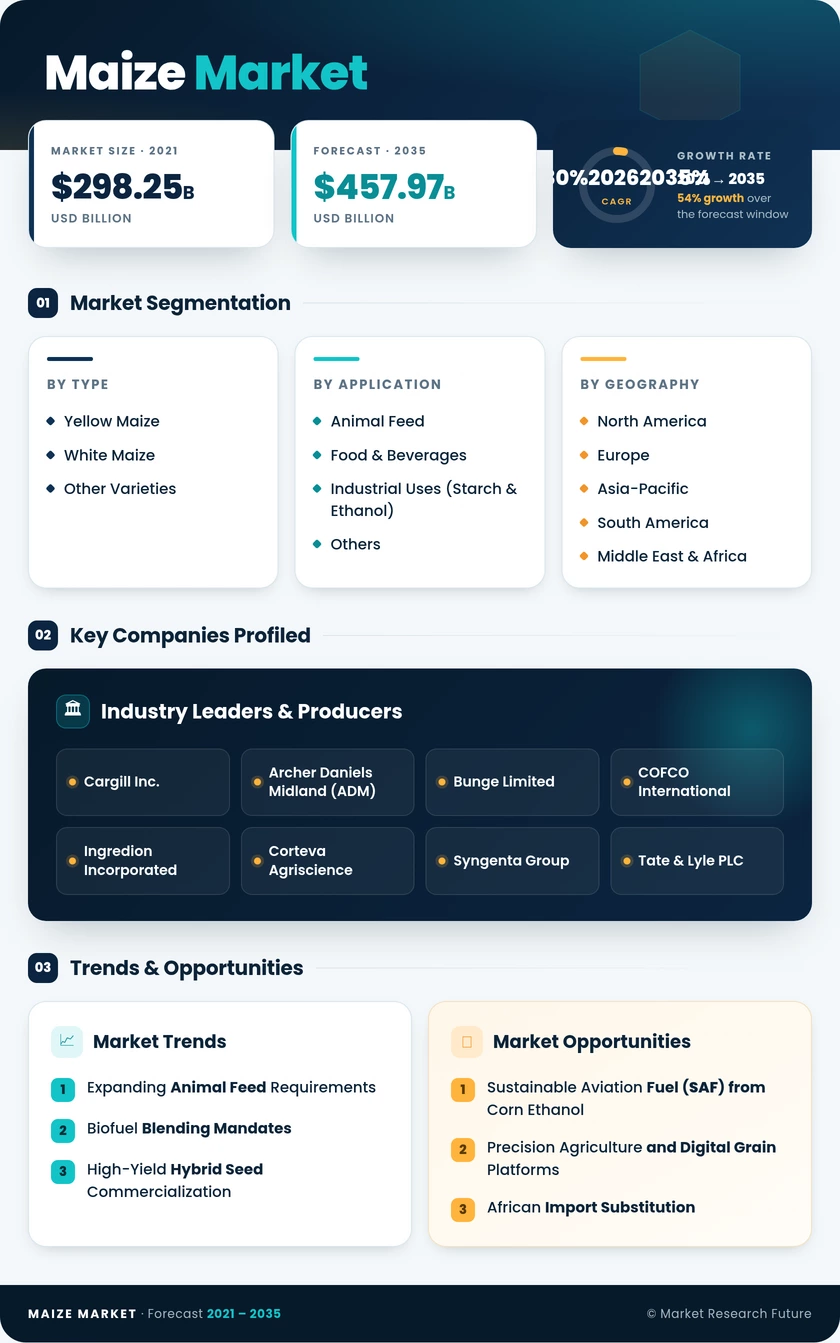
Maize Market

ID: MRFR/Agri/40313-HCR
200 Pages
Snehal Singh
Last Updated: June 22, 2026
Global Maize Market Size, Share, Industry Trend & Analysis Research Report: By Type (Yellow Maize, White Maize, Other Varieties), By Application (Animal Feed, Food & Beverages, Industrial Uses, Others), By Geography (North America, Europe, Asia-Pacific, South America, Middle East & Africa) - Forecast to 2035.
Download PDF ×

We do not share your information with anyone. However, we may send you emails based on your report interest from time to time. You may contact us at any time to opt-out.

  1. 1 Market Overview |
    1. 1.1 Study Assumptions & Market Definition |
    2. 1.2 Scope of the Study |
    3. 1.3 Research Methodology
  2. 2 Market Summary & Key Takeaways
  3. 3 Market Dynamics |
    1. 3.1 Market Drivers Analysis | |
      1. 3.1.1 Expanding Animal Feed Requirements | |
      2. 3.1.2 Biofuel Blending Mandates | |
      3. 3.1.3 High-Yield Hybrid Seed Commercialization | |
      4. 3.1.4 On-Farm Grain Storage Expansion | |
      5. 3.1.5 Dietary Protein Transition in Emerging Economies | |
      6. 3.1.6 Trade Liberalization and Biotech Approvals | |
      7. 3.1.7 Starch-Based Industrial Applications Growth |
    2. 3.2 Market Restraints Analysis | |
      1. 3.2.1 Climate Volatility and Drought Frequency | |
      2. 3.2.2 Trade Policy Friction and Tariffs | |
      3. 3.2.3 Input Cost Inflation (Fertilizer, Energy) | |
      4. 3.2.4 Water Scarcity Constraints | |
      5. 3.2.5 Competition from Alternative Feed Grains |
    3. 3.3 Market Opportunity Analysis | |
      1. 3.3.1 Sustainable Aviation Fuel (SAF) from Corn Ethanol | |
      2. 3.3.2 Precision Agriculture and Digital Grain Platforms | |
      3. 3.3.3 African Import Substitution | |
      4. 3.3.4 Bio-Based Packaging and Industrial Starch | |
      5. 3.3.5 Value-Added Maize Processing in Emerging Markets |
    4. 3.4 Industry Value Chain Analysis |
    5. 3.5 Porter's Five Forces Analysis
  4. 4 Global Maize Market Size & Forecast (2021–2035) |
    1. 4.1 Historical Market Size (2021–2025) |
    2. 4.2 Current & Forecast Market Size (2026–2035) |
    3. 4.3 Market Size by Revenue (USD Billion) |
    4. 4.4 Year-over-Year Growth Analysis
  5. 5 Segmentation Analysis |
    1. 5.1 By Type | |
      1. 5.1.1 Yellow Maize | |
      2. 5.1.2 White Maize | |
      3. 5.1.3 Other Varieties (Waxy, High-Amylose, Popcorn) |
    2. 5.2 By Application | |
      1. 5.2.1 Animal Feed | |
      2. 5.2.2 Food & Beverages | |
      3. 5.2.3 Industrial Uses (Starch & Ethanol) | |
      4. 5.2.4 Others |
    3. 5.3 By Geography | |
      1. 5.3.1 North America | |
      2. 5.3.2 Europe | |
      3. 5.3.3 Asia-Pacific | |
      4. 5.3.4 South America | |
      5. 5.3.5 Middle East & Africa
  6. 6 Regional Analysis |
    1. 6.1 North America | |
      1. 6.1.1 United States | |
      2. 6.1.2 Canada | |
      3. 6.1.3 Mexico |
    2. 6.2 Europe | |
      1. 6.2.1 Germany | |
      2. 6.2.2 France | |
      3. 6.2.3 Italy | |
      4. 6.2.4 Spain | |
      5. 6.2.5 Nordic Countries | |
      6. 6.2.6 Russia | |
      7. 6.2.7 Rest of Europe |
    3. 6.3 Asia-Pacific | |
      1. 6.3.1 China | |
      2. 6.3.2 India | |
      3. 6.3.3 Japan | |
      4. 6.3.4 South Korea | |
      5. 6.3.5 ASEAN | |
      6. 6.3.6 Rest of Asia-Pacific |
    4. 6.4 South America | |
      1. 6.4.1 Brazil | |
      2. 6.4.2 Argentina | |
      3. 6.4.3 Rest of South America |
    5. 6.5 Middle East & Africa | |
      1. 6.5.1 Saudi Arabia | |
      2. 6.5.2 UAE | |
      3. 6.5.3 South Africa | |
      4. 6.5.4 Egypt | |
      5. 6.5.5 Rest of MEA
  7. 7 Competitive Landscape |
    1. 7.1 Market Share Analysis (2025) |
    2. 7.2 Competitive Benchmarking Matrix |
    3. 7.3 Company Profiles | |
      1. 7.3.1 Cargill Inc. | |
      2. 7.3.2 Archer Daniels Midland (ADM) | |
      3. 7.3.3 Bunge Limited | |
      4. 7.3.4 COFCO International | |
      5. 7.3.5 Louis Dreyfus Company | |
      6. 7.3.6 Ingredion Incorporated | |
      7. 7.3.7 Corteva Agriscience | |
      8. 7.3.8 Syngenta Group | |
      9. 7.3.9 Tate & Lyle PLC | |
      10. 7.3.10 BASF Agricultural Solutions
  8. 8 Future Outlook & Strategic Recommendations (2026–2035) |
    1. 8.1 Climate-Resilient Agronomy and Gene Editing |
    2. 8.2 Digital Supply Chains and Blockchain Traceability |
    3. 8.3 Circular Bioeconomy and Industrial Diversification |
    4. 8.4 Energy Transition and Ethanol Pathway Evolution
  9. 9 Recent Developments & News
  10. 10 Frequently Asked Questions (FAQs)
  11. 11 Report Scope & Methodology |
    1. 11.1 Study Period & Base Year |
    2. 11.2 Data Sources & Citations |
    3. 11.3 Abbreviations
  12. 12 LIST OF TABLES |
  13. TABLE 1 Global Maize Market Size & Forecast, by Revenue (USD Billion), 2021–2035 |
  14. TABLE 2 Global Maize Market – Year-over-Year Growth Analysis, 2021–2035 |
  15. TABLE 3 Global Maize Market – Driver Impact Analysis |
  16. TABLE 4 Global Maize Market – Restraint Impact Analysis |
  17. TABLE 5 Global Maize Market Size, by Type, 2021–2035 (USD Billion) |
  18. TABLE 6 Global Maize Market Size, by Application, 2021–2035 (USD Billion) |
  19. TABLE 7 Global Maize Market Size, by Region, 2021–2035 (USD Billion) |
  20. TABLE 8 North America Maize Market Size, by Country, 2021–2035 (USD Billion) |
  21. TABLE 9 Europe Maize Market Size, by Country, 2021–2035 (USD Billion) |
  22. TABLE 10 Asia-Pacific Maize Market Size, by Country, 2021–2035 (USD Billion) |
  23. TABLE 11 South America Maize Market Size, by Country, 2021–2035 (USD Billion) |
  24. TABLE 12 Middle East & Africa Maize Market Size, by Country, 2021–2035 (USD Billion) |
  25. TABLE 13 Competitive Benchmarking Matrix – Global Maize Market, 2025 |
  26. TABLE 14 Company Profiles – Key Players, Global Maize Market |
  27. TABLE 15 Recent Developments & Strategic Announcements, 2023–2025 |
  28. TABLE 16 Report Scope & Methodology Summary |
  29. TABLE 17 Detailed Sources and Citations |
  30. TABLE 18 North America Maize Market Size, by Type, 2021–2035 (USD Billion) |
  31. TABLE 19 North America Maize Market Size, by Application, 2021–2035 (USD Billion) |
  32. TABLE 20 Europe Maize Market Size, by Type, 2021–2035 (USD Billion) |
  33. TABLE 21 Europe Maize Market Size, by Application, 2021–2035 (USD Billion) |
  34. TABLE 22 Asia-Pacific Maize Market Size, by Type, 2021–2035 (USD Billion) |
  35. TABLE 23 Asia-Pacific Maize Market Size, by Application, 2021–2035 (USD Billion) |
  36. TABLE 24 South America Maize Market Size, by Type, 2021–2035 (USD Billion) |
  37. TABLE 25 South America Maize Market Size, by Application, 2021–2035 (USD Billion) |
  38. TABLE 26 Middle East & Africa Maize Market Size, by Type, 2021–2035 (USD Billion) |
  39. TABLE 27 Middle East & Africa Maize Market Size, by Application, 2021–2035 (USD Billion)
  40. 13 LIST OF FIGURES |
  41. FIGURE 1 Global Maize Market Dynamics (Drivers, Restraints, Opportunities) |
  42. FIGURE 2 Industry Value Chain Analysis – Global Maize Market |
  43. FIGURE 3 Porter's Five Forces Analysis – Global Maize Market |
  44. FIGURE 4 Global Maize Market Size Trend (USD Billion), 2021–2035 |
  45. FIGURE 5 Global Maize Market Share, by Type, 2025 (%) |
  46. FIGURE 6 Global Maize Market Share, by Application, 2025 (%) |
  47. FIGURE 7 Global Maize Market Share, by Region, 2025 (%) |
  48. FIGURE 8 North America Maize Market Size Trend, 2021–2035 |
  49. FIGURE 9 Europe Maize Market Size Trend, 2021–2035 |
  50. FIGURE 10 Asia-Pacific Maize Market Size Trend, 2021–2035 |
  51. FIGURE 11 South America Maize Market Size Trend, 2021–2035 |
  52. FIGURE 12 Middle East & Africa Maize Market Size Trend, 2021–2035 |
  53. FIGURE 13 Competitive Landscape — Market Share Analysis, 2025 |
  54. FIGURE 14 Competitive Positioning Matrix — Key Players

Segmentation Quick Reference

DimensionSub-SegmentsDominant SegmentFastest Growing Segment
By TypeYellow Maize, White Maize, Other VarietiesYellow Maize (68% share)White Maize (3.85% CAGR)
By ApplicationAnimal Feed, Food & Beverages, Industrial Uses (Starch & Ethanol), OthersAnimal Feed (USD 138.80B)Industrial Uses (4.10% CAGR)
By GeographyNorth America, Europe, Asia-Pacific, South America, Middle East & AfricaNorth America (37.5% share)Asia-Pacific (5.35% CAGR)


Market Segmentation Overview

By Type

Sub-SegmentKey Trend
Yellow MaizeDominant variety for feed rations and ethanol refining; hybrid yield innovation driving per-acre gains
White MaizeStaple food grain in Africa and Central America; demand tracks population growth and urbanization
Other VarietiesSpecialty waxy, high-amylose, and popcorn corn expanding in functional food and premium snack segments


Yellow maize remains the backbone of global trade, while white maize serves critical food-security functions across developing economies. Specialty varieties are gaining traction as food manufacturers seek differentiated starch profiles for health-oriented product lines.

By Application

Sub-SegmentKey Trend
Animal FeedPoultry and swine sector expansion in Asia-Pacific driving incremental demand for feed-grade corn
Food & BeveragesCorn flour, high-fructose corn syrup, and snack-food manufacturing sustaining steady demand
Industrial Uses (Starch & Ethanol)Biofuel mandates, SAF pathways, and bio-based packaging accelerating industrial consumption
OthersSeed production, direct human consumption, and animal bedding representing niche but stable uses


Animal feed accounts for approximately 60% of global maize consumption, but the industrial segment is growing fastest as ethanol and starch applications diversify beyond traditional fuel and food markets into bio-packaging and sustainable aviation fuel.

By Geography

Sub-SegmentKey Trend
North AmericaU.S. Corn Belt productivity, ethanol mandates, and export logistics dominate regional dynamics
EuropeCAP-supported cultivation, livestock feed demand, and biogas energy cropping drive growth
Asia-PacificChina's strategic reserve purchases and India's feed-processing build-out fuel the fastest regional expansion
South AmericaBrazil's safrinha revolution and RenovaBio ethanol incentives position the region as a global export powerhouse
Middle East & AfricaImport substitution programs and post-harvest infrastructure investments targeting food-security gaps


North America and South America function as the world's production and export engines, while Asia-Pacific and the Middle East & Africa represent the highest-growth consumption markets driven by demographic and dietary shifts.