Download Free Sample
Kindly complete the form below to receive a free sample of this Report
Malt Ingredients Market Size, Share, Industry Trend & Analysis Research Report By Type (Malt Extract, Malt Powder, Malted Barley), By Application (Food and Beverages, Brewing, Animal Feed), By Form (Liquid, Dry, Granular), By Functionality (Sweetening Agent, Flavoring Agent, Fermentation Aid) and By Regional (North America, Europe, South America, Asia Pacific, Middle East and Africa) - Forecast to 2035
As per Market Research Future analysis, the Malt Ingredients Market Size was estimated at 7.17 USD Billion in 2024. The Malt Ingredients industry is projected to grow from 7.568 USD Billion in 2025 to 12.99 USD Billion by 2035, exhibiting a compound annual growth rate (CAGR) of 5.55% during the forecast period 2025 - 2035. North America holds the largest share of the global Malt Ingredients Market per MRFR, growing from USD 7.568 billion in 2025 to USD 12.99 billion by 2035 at a CAGR of 5.55%, driven by surging demand for craft beverages, artisanal food products, and health-oriented malt-based ingredients across the region's well-established brewing and food processing industries. The United States is the leading country within North America, capturing approximately 70% of the North American Malt Ingredients Market share, driven by the booming craft beer industry, strong demand from the food processing sector for malt extracts and syrups, and the presence of leading maltsters such as Briess Malt and Great Western Malting. Malt Extract dominates the Malt Ingredients Market as the largest product segment, accounting for approximately 41% of the global market share in 2025, owing to its high fermentable sugar content, consistent flavor profile, and versatility across brewing, bakery, confectionery, and functional food applications, making it the most widely used malt ingredient globally.
The Malt Ingredients Market is experiencing robust growth driven by evolving consumer preferences and innovative practices.
| 2024 Market Size | 7.17 (USD Billion) |
| 2035 Market Size | 12.99 (USD Billion) |
| CAGR (2025 - 2035) | 5.55% |
The Malt Ingredients Market is currently experiencing a dynamic evolution, driven by various factors that influence consumer preferences and industry practices within the broader malt extracts and ingredients market. The increasing demand for craft beverages, particularly in the brewing sector, has led to a surge in the utilization of malt ingredients. This trend appears to be fueled by a growing interest in artisanal products, where quality and flavor profiles take precedence over mass production. Additionally, the rising health consciousness among consumers is prompting manufacturers to explore innovative formulations that incorporate malt as a source of natural sweetness and nutritional benefits, further expanding the malt ingredients market.
Moreover, sustainability concerns are becoming increasingly prominent within the Malt Ingredients Market. Producers are likely to adopt eco-friendly practices, such as sourcing raw materials from sustainable farms and implementing energy-efficient production methods. This shift not only aligns with consumer expectations but also enhances brand reputation across the evolving malt ingredient market. As the market continues to evolve, it seems that the interplay between tradition and innovation will shape the future landscape of malt ingredients, creating opportunities for growth and diversification across various sectors, including food and beverages, baking, and beyond, strengthening the global malt extracts and ingredients market.
The rising popularity of craft beverages is significantly influencing the Malt Ingredients Market and the overall malt ingredients market landscape. Consumers are increasingly seeking unique flavors and high-quality ingredients, leading to a greater emphasis on malt in brewing processes. This trend suggests a shift towards artisanal production methods, where malt plays a crucial role in enhancing the overall sensory experience.
There is a noticeable shift towards health-conscious consumption patterns, which is impacting the Malt Ingredients Market and accelerating innovation in the malt ingredient market. Manufacturers are exploring ways to incorporate malt as a natural sweetener and a source of essential nutrients. This trend indicates a growing preference for products that offer both taste and health benefits, appealing to a broader audience within the malt extracts and ingredients market.
Sustainability is becoming a key focus within the Malt Ingredients Market and the expanding malt ingredients market ecosystem. Producers are increasingly adopting environmentally friendly practices, such as sourcing ingredients from sustainable farms and reducing energy consumption during production. This trend reflects a commitment to responsible sourcing and aligns with consumer expectations for eco-conscious products in the malt ingredient market.
The increasing popularity of craft beer is a notable driver for the Malt Ingredients Market. As consumers seek unique flavors and artisanal products, craft breweries are expanding their offerings, which in turn boosts the demand for specialized malt ingredients. In 2025, the craft beer segment is projected to account for approximately 25 percent of the total beer market, indicating a substantial growth trajectory. This trend encourages malt suppliers to innovate and diversify their product lines to cater to the evolving preferences of craft brewers. The emphasis on quality and distinctiveness in craft beer production necessitates the use of premium malt ingredients, thereby propelling the Malt Ingredients Market forward.
Innovations in brewing technology are reshaping the Malt Ingredients Market. Advancements in equipment and processes allow brewers to experiment with various malt types and combinations, enhancing flavor profiles and product quality. The introduction of automated brewing systems and precision fermentation techniques enables more efficient production, which can lead to increased demand for diverse malt ingredients. As brewers seek to differentiate their products in a competitive market, the need for innovative malt solutions becomes paramount. This trend is expected to drive the Malt Ingredients Market as brewers invest in high-quality malts that can elevate their offerings.
The shift towards health-conscious consumer behavior significantly influences the Malt Ingredients Market. As individuals become more aware of their dietary choices, there is a growing demand for malt ingredients that offer nutritional benefits. Products such as whole grain malts and those with lower sugar content are gaining traction among health-oriented consumers. In 2025, it is estimated that the market for health-focused malt ingredients will grow by 15%, reflecting the increasing integration of health and wellness trends into food and beverage production. This shift compels manufacturers to adapt their offerings, ensuring that malt ingredients align with the health aspirations of consumers.
The expansion of non-alcoholic beverages is emerging as a significant driver for the Malt Ingredients Market. With a growing segment of consumers seeking alternatives to traditional alcoholic drinks, malt ingredients are being utilized in the production of non-alcoholic beers and malt-based beverages. This trend is indicative of a broader shift towards moderation and mindful consumption. In 2025, the non-alcoholic beverage market is expected to grow by 30%, creating new opportunities for malt suppliers to cater to this evolving demand. As manufacturers explore innovative formulations, the Malt Ingredients Market stands to benefit from this diversification.
Sustainability and eco-friendly practices are increasingly becoming focal points within the Malt Ingredients Market. As consumers demand transparency and environmentally responsible sourcing, malt producers are adopting sustainable practices in their operations. This includes the use of organic grains and environmentally friendly production methods. In 2025, the market for organic malt ingredients is projected to grow by 20%, reflecting the rising consumer preference for sustainable products. This trend not only enhances brand loyalty but also positions companies favorably in a market that values sustainability, thereby driving growth in the Malt Ingredients Market.
The Malt Ingredients Market is prominently shaped by three key segments: Malt Extract, Malt Powder, and Malted Barley. Among these, Malt Extract holds the largest share, dominating the market due to its wide usage in brewing and food applications. Meanwhile, Malt Powder is rapidly gaining traction, serving as a versatile ingredient in various food products and health supplements. Malted Barley, while crucial, occupies a smaller portion of the market, primarily utilized in homebrewing and specialty beerproduction.
Malt Extract (Dominant) vs. Malt Powder (Emerging)
Malt Extract is the dominant force in the Malt Ingredients Market, favored for its high solubility and efficiency in the brewing process. Its ability to enhance flavor and yield makes it essential for brewers and food manufacturers alike. On the other hand, Malt Powder is emerging as a popular choice among health-conscious consumers, being rich in nutrients and often used in baking and protein supplements. This rise is attributed to the increasing demand for clean-label products and natural ingredients. As both segments evolve, their unique characteristics and applications continue to attract diverse customer bases.
In the Malt Ingredients Market, the application segment can be predominantly classified into three categories: Food and Beverages, Brewing, and Animal Feed. The Food and Beverages sector holds the largest share, driven by the increasing consumer preference for malt-based ingredients in various food products and beverages. The Brewing segment, however, is witnessing a rapid surge in demand, primarily owing to the growing craft beer movement and the consistent innovation in brewing technologies.
Food and Beverages (Dominant) vs. Brewing (Emerging)
The Food and Beverages application serves as the cornerstone of the Malt Ingredients Market, catering to a diverse range of consumer products from baked goods to candy. Its dominance is attributed to the versatility of malt, which enhances flavor and texture, making it a preferred ingredient. Conversely, the Brewing application is emerging as the fastest-growing segment, fueled by the craft beer revolution and an increasing number of microbreweries, leading to innovative malt varieties that enhance the brewing process and create distinct flavors. As both segments evolve, they reflect broader consumer trends toward quality, flavor, and innovation in food and drink.
The malt ingredients market demonstrates a diverse composition in the 'Form' segment, with Liquid malt ingredients securing the largest share due to their widespread use in various applications such as brewing and food products. Following Liquid, Dry malt ingredients are gaining traction, appealing to a segment of manufacturers who prefer longer shelf-life and easier transportability. The Granular form, while representing a smaller portion of the market, still plays a significant role in specialized applications.
Liquid (Dominant) vs. Dry (Emerging)
Liquid malt ingredients remain the dominant form in the market, widely recognized for their ease of use and solubility, making them preferred by brewers and food manufacturers. Their versatility allows application across diverse products, thus maintaining their market leadership. In contrast, Dry malt ingredients are emerging rapidly due to their convenience and longer shelf life, appealing particularly to manufacturers focused on efficiency and product consistency. As producers seek more innovative and efficient malt solutions, the demand for Dry forms is expected to escalate, indicating a significant shift in consumer preferences.
In the Malt Ingredients Market, the functionality segment showcases a diverse range of values, prominently featuring Sweetening Agents, Flavoring Agents, and Fermentation Aids. Sweetening Agents command the largest share due to their essential role in beverage manufacturing and food applications, catering to consumer preferences for sweetened products. Meanwhile, Flavoring Agents are rapidly gaining traction, primarily attributed to evolving food trends and increasing demand for unique flavor profiles.
Flavoring Agent (Dominant) vs. Fermentation Aid (Emerging)
The Flavoring Agent segment stands out as a dominant force in the Malt Ingredients Market, leveraging its significant appeal among manufacturers who seek innovative taste experiences. These agents enhance the sensory profile of malt-based products, thus driving their widespread adoption. On the other hand, Fermentation Aids are emerging as crucial components in the brewing process, facilitating improved yeast performance and quality of malt beverages. As the demand for craft beers and artisanal products rises, Fermentation Aids are gaining recognition for their ability to optimize fermentation efficiency and contribute to unique flavor characteristics. This dynamic interplay between Flavoring Agents and Fermentation Aids underscores the evolving landscape of malt ingredients, where innovation and consumer taste preferences drive market evolution.
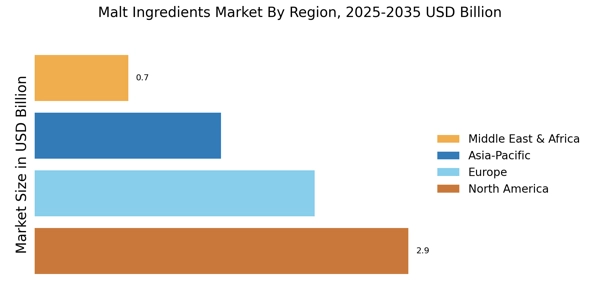
North America is the largest market for malt ingredients, holding approximately 40% of the global share. The region benefits from a robust brewing industry, increasing demand for craft beers, and a growing trend towards organic and specialty malts. Regulatory support for agricultural practices and food safety standards further catalyzes market growth. The U.S. and Canada are the primary contributors, with a strong focus on innovation and sustainability in malt production. The competitive landscape in North America is characterized by key players such as Cargill, Briess Malt & Ingredients Co., and Rahr Corporation. These companies leverage advanced technologies and sustainable practices to enhance product offerings. The presence of established breweries and a rising number of craft breweries contribute to the demand for diverse malt products. The region's focus on quality and innovation positions it as a leader in The Malt Ingredients Market.
Europe is the second-largest market for malt ingredients, accounting for approximately 30% of the global share. The region's rich brewing heritage, coupled with a growing demand for specialty malts, drives market expansion. Regulatory frameworks, such as the EU's Common Agricultural Policy, support sustainable farming practices and quality standards, enhancing the competitiveness of European malt producers. Countries like Germany and the UK are at the forefront, with a strong emphasis on innovation in malt production. Germany leads the European market, with major players like Südzucker AG and Malteurop contributing significantly to the industry. The UK also plays a vital role, with companies like Muntons and Castle Malting. The competitive landscape is marked by a blend of traditional malt houses and modern producers focusing on specialty products. The emphasis on quality, sustainability, and innovation positions Europe as a key player in The Malt Ingredients Market.
Asia-Pacific is an emerging powerhouse in the malt ingredients market, holding approximately 20% of the global share. The region is witnessing rapid growth driven by increasing beer consumption, particularly in countries like China and India. The rise of craft breweries and changing consumer preferences towards premium products are significant demand drivers. Regulatory support for food safety and quality standards is also enhancing market growth, making it a focal point for investment and innovation. China is the largest market in the region, with a growing number of breweries and a shift towards high-quality malt products. India is also emerging as a significant player, with increasing investments in the brewing sector. The competitive landscape features both local and international players, with companies like Malteurop and Dingemans expanding their presence. The focus on quality and innovation is crucial for capturing the growing demand in this dynamic market.
The Middle East and Africa region is witnessing a gradual increase in the malt ingredients market, holding approximately 10% of the global share. The growth is primarily driven by rising beer consumption and the expansion of the brewing industry in countries like South Africa and Kenya. Regulatory frameworks are evolving to support food safety and quality, which is essential for market development. The region's untapped potential presents opportunities for investment and growth in malt production. South Africa is the leading market in the region, with a growing number of breweries and a focus on local malt production. Kenya is also emerging as a significant player, with increasing demand for malt in the beverage sector. The competitive landscape includes both local and international companies, with a focus on quality and sustainability. The region's growth potential is attracting attention from key players looking to expand their footprint in the malt ingredients market.
The Malt Ingredients Market is currently characterized by a dynamic competitive landscape, driven by increasing demand for craft beverages and a growing emphasis on quality ingredients. Key players such as Cargill (US), MaltEurope (BE), and Briess Malt & Ingredients Co. (US) are strategically positioning themselves through innovation and regional expansion. Cargill (US), for instance, has been focusing on enhancing its product portfolio to cater to the craft brewing segment, which appears to be a significant growth driver. Meanwhile, MaltEurope (BE) is investing in sustainable practices, which not only aligns with The Malt Ingredients Market that increasingly values environmental responsibility. Collectively, these strategies indicate a shift towards a more quality-centric and sustainable approach in the malt ingredients sector.In terms of business tactics, companies are increasingly localizing manufacturing to reduce lead times and optimize supply chains. This trend is particularly evident in the moderately fragmented structure of the market, where smaller players are also making strides to enhance their operational efficiencies. The collective influence of major players like Rahr Corporation (US) and Südzucker AG (DE) is notable, as they leverage their extensive distribution networks to maintain a competitive advantage while also responding to localized market demands.
In August Cargill (US) announced the launch of a new line of organic malt products aimed at the craft brewing industry. This strategic move not only diversifies their product offerings but also positions them favorably in a market that is increasingly leaning towards organic and sustainably sourced ingredients. The introduction of these products is likely to attract a new customer base that prioritizes quality and sustainability, thereby enhancing Cargill's market share.
In September Briess Malt & Ingredients Co. (US) expanded its production capabilities by investing in a new malting facility in Wisconsin. This expansion is significant as it allows Briess to meet the rising demand for specialty malts, particularly from craft brewers. The facility is expected to enhance production efficiency and reduce lead times, which could provide Briess with a competitive edge in a rapidly evolving market.
In July MaltEurope (BE) entered into a strategic partnership with a leading beverage company to develop innovative malt-based products. This collaboration is indicative of a broader trend where companies are seeking to leverage partnerships to enhance product innovation and market reach. Such alliances are likely to foster a more collaborative environment within the industry, driving forward new product developments that cater to evolving consumer preferences.
As of October the Malt Ingredients Market is witnessing trends that emphasize digitalization, sustainability, and the integration of advanced technologies such as AI in production processes. These trends are reshaping the competitive landscape, as companies increasingly focus on strategic alliances to bolster innovation and market responsiveness. The shift from price-based competition to a focus on technological advancement and supply chain reliability is becoming evident, suggesting that future competitive differentiation will hinge on the ability to innovate and adapt to changing market dynamics.

The Malt Ingredients Market has witnessed significant developments recently, particularly with companies like Molson Coors Beverage Company and Cargill expanding their product ranges amid growing consumer demand for craft beverages and healthier food options. In September 2023, Rahr Corporation announced an investment to enhance its production capacity, responding to increasing malt consumption. Similarly, the Crisp Malting Group reported plans to expand its facilities to meet the rising demand from the brewing and distilling industries.
Notably, in August 2023, there were reports of a strategic partnership between Viking Malt and local breweries to promote sustainable practices in malt production. There have been no major mergers or acquisition activities reported among the listed companies in the past few months. However, historical records indicate that in early 2022, Muntons acquired a local malt producer to broaden its product offerings. The market is currently experiencing growth, attributed to the rising trend in craft brewing and increasing application of malt in food products, significantly impacting the valuation of companies.
The focus on sustainability also shapes strategic directions within the industry.
The Malt Ingredients Market is projected to grow at a 5.55% CAGR from 2025 to 2035, driven by rising demand for craft beverages and health-conscious products.
New opportunities lie in:
By 2035, the Malt Ingredients Market is expected to achieve robust growth, reflecting evolving consumer preferences and innovative product offerings.
| MARKET SIZE 2024 | 7.17(USD Billion) |
| MARKET SIZE 2025 | 7.568(USD Billion) |
| MARKET SIZE 2035 | 12.99(USD Billion) |
| COMPOUND ANNUAL GROWTH RATE (CAGR) | 5.55% (2025 - 2035) |
| REPORT COVERAGE | Revenue Forecast, Competitive Landscape, Growth Factors, and Trends |
| BASE YEAR | 2024 |
| Market Forecast Period | 2025 - 2035 |
| Historical Data | 2019 - 2024 |
| Market Forecast Units | USD Billion |
| Key Companies Profiled | MaltEurope (BE), Cargill (US), Briess Malt & Ingredients Co. (US), Muntons (GB), Malteurop (FR), Rahr Corporation (US), Südzucker AG (DE), Dingemans (BE), Castle Malting (BE) |
| Segments Covered | Type, Application, Form, Functionality, Regional |
| Key Market Opportunities | Growing demand for gluten-free malt products presents opportunities in the Malt Ingredients Market. |
| Key Market Dynamics | Rising demand for craft beverages drives innovation and competition in the malt ingredients sector. |
| Countries Covered | North America, Europe, APAC, South America, MEA |
The Malt Ingredients Market is projected to reach a valuation of 12.99 USD Billion by 2035.



Kindly complete the form below to receive a free sample of this Report

“This is really good guys. Excellent work on a tight deadline. I will continue to use you going forward and recommend you to others. Nice job”


“Thanks. It’s been a pleasure working with you, please use me as reference with any other Intel employees.”


“Thanks for sending the report it gives us a good global view of the Betaïne market.”


“Thank you, this will be very helpful for OQS.”


“We found the report very insightful! we found your research firm very helpful. I'm sending this email to secure our future business.”


“I am very pleased with how market segments have been defined in a relevant way for my purposes (such as "Portable Freezers & refrigerators" and "last-mile"). In general the report is well structured. Thanks very much for your efforts.”


“I have been reading the first document or the study, ,the Global HVAC and FP market report 2021 till 2026. Must say, good info! I have not gone in depth at all parts, but got a good indication of the data inside!”


“We got the report in time, we really thank you for your support in this process. I also thank to all of your team as they did a great job.”


“The Automotive 48V ECU Components Procurement Intelligence Study” was a complex project, but the Market Research Future (MRFR) team handled it with quality, agility, and customer-centricity. They delivered all requested data on time and within the agreed scope. The team, including Shubhendra Anand and Rahul Gotadki, was always readily available to clarify questions and swiftly implement necessary adjustments, driving the project to a successful conclusion within a very demanding timeframe.
I would also like to specifically commend Akshay Agarwal for his responsiveness and support at every stage—from our initial inquiry on May 6th through to final delivery on June 18th. His dedication made the entire process seamless.”



