Download Free Sample
Kindly complete the form below to receive a free sample of this Report
Medical Devices Accessories Market Research Report By Product Type (Diagnostic Devices, Therapeutic Devices, Monitoring Devices, Surgical Devices, Consumables), By End User (Hospitals, Clinics, Home Healthcare, Ambulatory Surgical Centers, Diagnostic Laboratories), By Application (Cardiology, Orthopedics, Neurology, Ophthalmology, Gynecology), By Technology (Electronics, Optical, Mechanical, Biological, Nanotechnology) and By Regional (North America, Europe, South America, Asia Pacific, Middle East and Africa) - Growth & Industry Forecast 2025 To 2035
As per MRFR analysis, the Medical Device Accessories Market was estimated at 537.9 USD Million in 2024. The Medical Device Accessories industry is projected to grow from 573.92 USD Million in 2025 to 978.67 USD Million by 2035, exhibiting a compound annual growth rate (CAGR) of 5.55% during the forecast period 2025 - 2035.
The Medical Device Accessories Market is poised for substantial growth driven by technological advancements and increasing healthcare demands.
| 2024 Market Size | 537.9 (USD Million) |
| 2035 Market Size | 978.67 (USD Million) |
| CAGR (2025 - 2035) | 5.55% |
The Medical Device Accessories Market is currently experiencing a dynamic evolution, driven by advancements in technology and increasing demand for enhanced patient care. As healthcare systems worldwide strive for improved efficiency and effectiveness, the role of accessories in supporting medical devices has become increasingly prominent. These accessories, which include items such as connectors, batteries, and protective covers, are essential for the optimal functioning of medical devices. The integration of smart technology into these accessories appears to be a key factor influencing market growth, as they offer improved functionality and user experience. Furthermore, the rising prevalence of chronic diseases necessitates the development of innovative accessories that can facilitate better management of health conditions, thereby expanding the market's potential. In addition, the Medical Device Accessories Market is likely to benefit from the growing trend of personalized medicine. As healthcare becomes more tailored to individual patient needs, accessories that can adapt to specific medical devices and patient requirements are increasingly sought after. This trend suggests a shift towards customization, where manufacturers may focus on creating versatile and adaptable accessories. Moreover, regulatory bodies are emphasizing the importance of quality and safety in medical device accessories, which could lead to stricter compliance requirements. Overall, the market appears poised for growth, driven by technological advancements, personalized healthcare, and a focus on quality assurance.
The incorporation of smart technology into medical device accessories is transforming the landscape of healthcare. These innovations enhance functionality, allowing for real-time monitoring and improved patient engagement. As devices become more interconnected, accessories that support this integration are increasingly in demand.
The shift towards personalized medicine is influencing the Medical Device Accessories Market significantly. Accessories that can be tailored to individual patient needs are gaining traction, suggesting a move towards customization. This trend may lead manufacturers to develop more versatile and adaptable products.
The emphasis on regulatory compliance and quality assurance is becoming more pronounced within the Medical Device Accessories Market. Stricter guidelines from regulatory bodies may drive manufacturers to prioritize safety and efficacy, potentially reshaping product development and market strategies.
The aging population globally is a significant driver of the Global Medical Devices Accessories Market Industry. As individuals age, they often require more medical interventions and support, leading to increased demand for medical devices and their accessories. This demographic trend is particularly pronounced in developed nations, where the proportion of elderly individuals is rising. Consequently, the market is expected to grow, with projections indicating a value of 644.4 USD Billion by 2035. This demographic shift necessitates the development of specialized accessories that cater to the unique needs of older patients.
Regulatory support plays a pivotal role in shaping the Global Medical Devices Accessories Market Industry. Governments and regulatory bodies are increasingly recognizing the importance of medical device accessories in enhancing patient care and safety. Initiatives aimed at streamlining the approval process for innovative accessories can foster market growth. For instance, the introduction of expedited pathways for accessory approval can encourage manufacturers to invest in research and development. This supportive regulatory environment is likely to facilitate the introduction of new products, thereby expanding the market and enhancing its overall value.
The prevalence of chronic diseases worldwide is a critical factor influencing the Global Medical Devices Accessories Market Industry. Conditions such as diabetes, cardiovascular diseases, and respiratory disorders require ongoing monitoring and management, which drives the demand for medical devices and their accessories. For example, the increasing use of glucose monitoring devices has led to a corresponding rise in the need for compatible accessories. This trend is likely to contribute to a compound annual growth rate of 2.57% from 2025 to 2035, underscoring the importance of accessories in managing chronic health conditions.
The Global Medical Devices Accessories Market Industry is experiencing a surge in demand due to rapid technological advancements. Innovations such as smart sensors, wireless connectivity, and advanced materials are enhancing the functionality and efficiency of medical devices. For instance, the integration of IoT technology into accessories allows for real-time monitoring and data collection, which improves patient outcomes. As a result, the market is projected to reach 487.3 USD Billion in 2024, reflecting a growing reliance on sophisticated medical accessories that support various healthcare applications.
Increased healthcare expenditure across various regions is a driving force behind the Global Medical Devices Accessories Market Industry. As governments and private sectors allocate more resources to healthcare, there is a corresponding rise in the demand for medical devices and their accessories. This trend is evident in both developed and emerging markets, where investments in healthcare infrastructure are on the rise. The growing focus on improving healthcare delivery systems is expected to bolster the market, contributing to its projected growth and the development of innovative accessories that enhance patient care.
The Medical Device Accessories Market is characterized by its diverse application segments, with Monitoring leading the share distribution. This segment encompasses various tools and accessories used for continuous observation of patients' health metrics, playing a pivotal role in the dynamics of patient care. Following closely is the Therapeutic segment, which is rapidly gaining traction due to the increasing prevalence of chronic diseases and the demand for advanced medical interventions. In terms of growth trends, the Monitoring segment benefits from technological advancements in remote patient monitoring and telemedicine. Meanwhile, the Therapeutic segment is driven by innovations in wearable technologies and personalized medicine. Healthcare providers are increasingly integrating these accessories into treatment protocols, fostering a robust growth trajectory in this area.
Monitoring (Dominant) vs. Diagnostic (Emerging)
The Monitoring segment reigns as the dominant force in the Medical Device Accessories Market, primarily due to the surging demand for real-time health monitoring solutions. It includes devices such as heart rate monitors, blood pressure cuffs, and glucose meters, which are integral to enhancing patient outcomes through continuous tracking. The segment's growth is supported by an aging population and a greater emphasis on chronic disease management. In contrast, the Diagnostic segment is emerging, focusing on accessories used in various diagnostic procedures. It is becoming increasingly important as healthcare transitions toward preventive care. Alongside innovative diagnostic tools, this segment's growth is influenced by advancements in laboratory technologies and a growing market for point-of-care testing, catering to the demand for timely and accurate health assessments.
In the Medical Device Accessories Market, hospitals represent the largest segment, accounting for a substantial share of the overall market demand. This is primarily due to the high volume of medical procedures performed in hospitals, necessitating a wide variety of accessories to support surgical and therapeutic activities. Furthermore, ambulatory surgical centers and nursing homes also contribute significantly to the market, yet their market shares are comparatively smaller. Diagnostic laboratories play a crucial role as well, providing essential accessories for testing and diagnostics that enhance patient care in various settings.
Hospitals (Dominant) vs. Home Care (Emerging)
Hospitals dominate the Medical Device Accessories Market, leveraging their large patient volumes and extensive equipment needs, ranging from surgical instruments to patient monitoring devices. The reliance on sophisticated medical technology and device accessories is critical in enhancing care quality and operational efficiency within hospitals. In contrast, home care is rapidly emerging due to an increasing aging population and a growing trend towards at-home treatment options. This shift is driven by patient preferences for comfort and convenience, prompting advancements in user-friendly medical accessories designed for self-management and remote monitoring, meeting rising demand in emerging health care paradigms.
The Medical Device Accessories Market showcases a diverse range of product types, notably including electrodes, cables, connectors, adapters, and mounts. Among these, electrodes capture the largest market share due to their essential role in various diagnostic and therapeutic applications. As healthcare technology evolves, the demand for specialized electrodes in ECG machines, EEG devices, and other monitoring equipment drives their continued dominance in the market. On the other hand, cables are emerging as the fastest-growing segment, propelled by advancements in telemedicine and connected healthcare. As more healthcare devices incorporate wireless and digital technologies, the requirement for high-quality, reliable cables increases. This trend highlights the industry's shift towards more integrated and sophisticated medical solutions, which enhances the potential for cable innovation and expansion in the coming years.
Electrodes (Dominant) vs. Adapters (Emerging)
Electrodes are a dominant force in the Medical Device Accessories Market, primarily due to their widespread use in critical monitoring and therapeutic functions. They are integral to devices that diagnose and treat patients, thus maintaining a robust demand across healthcare sectors. In contrast, adapters are emerging as vital accessories, bridging various medical equipment functionalities. Their role in ensuring compatibility between devices makes them increasingly important, especially as healthcare systems adopt more advanced technologies. The rising trend of personalized medicine and at-home diagnostics drives the need for versatile adapters that can connect diverse devices seamlessly. This shift not only enhances patient care but also positions adapters as essential components in the future landscape of medical device accessories.
In the Medical Device Accessories Market, the primary material type is plastic, which holds a significant share due to its versatility, cost-effectiveness, and ease of manufacturing. Other materials such as metal, silicone, rubber, and composite also play critical roles, with silicone emerging as a rapidly expanding segment thanks to its adaptability and biocompatibility. While metal products remain essential in specific applications, plastic continues to dominate the market landscape.
Plastic (Dominant) vs. Silicone (Emerging)
Plastic remains the dominant material in the Medical Device Accessories market, favored for its lightweight properties and adaptability across various devices. Its ability to be molded into diverse shapes makes it ideal for numerous applications. Conversely, silicone is emerging as a key player due to its superior biocompatibility and flexibility, making it an ideal choice for a range of medical applications including implants and tubes. As medical technology advances, both materials are expected to evolve, with silicone capturing a growing share by aligning with trends toward safer and more effective patient solutions.
In the Medical Device Accessories Market, the distribution channel landscape reveals a dynamic interplay among various segments. Online sales have emerged as the largest channel, driven by the convenience of e-commerce and increased digital engagement among healthcare professionals and institutions. Retail channels also hold a significant position, contributing to overall accessibility and customer touchpoints, though their share is dwindling compared to the online segment. Furthermore, direct sales, distributors, and wholesalers collectively form a vital part of the market, facilitating a streamlined supply chain that supports diverse purchasing preferences. The growth trajectory of the distribution channels indicates a clear shift towards online platforms, fueled by the pandemic-induced acceleration of digital transformation. Retail channels, while still relevant, are experiencing a rapid decline as more consumers prefer online purchases for their medical device accessories. As the market continues to evolve, direct sales and distributors are adapting by enhancing their logistical capabilities to remain competitive. This transformation points to an ongoing consolidation of distribution strategies aimed at meeting the changing demands of consumers and healthcare providers.
Online (Dominant) vs. Direct Sales (Emerging)
In the Medical Device Accessories Market, online distribution stands out as the dominant channel, providing unparalleled access and convenience for customers. This segment thrives on robust digital marketing strategies and a wide-ranging online product portfolio that appeals to both consumers and healthcare professionals. On the other hand, direct sales are emerging as a promising complement to online platforms. With a focus on personalized service and direct engagement, direct sales representatives are increasingly leveraging technology to bridge the gap between manufacturers and end-users. This hybrid approach not only fosters stronger relationships but also supports tailored solutions for specific customer needs, thereby enhancing the potential for market growth in the evolving landscape.
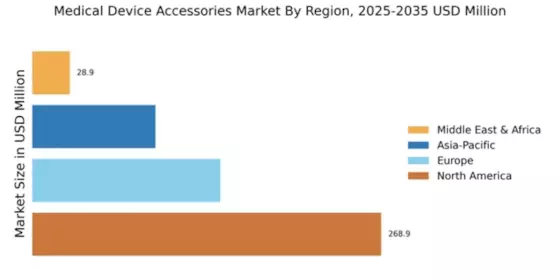
North America continues to lead the Medical Device Accessories Market, holding a significant market share of $268.95M in 2024. The region's growth is driven by advanced healthcare infrastructure, increasing prevalence of chronic diseases, and a strong focus on innovation. Regulatory support from agencies like the FDA further catalyzes market expansion, ensuring that new products meet stringent safety and efficacy standards. The competitive landscape is robust, with key players such as Medtronic, Boston Scientific, and Abbott Laboratories dominating the market. The U.S. remains the largest contributor, benefiting from high healthcare spending and a strong emphasis on research and development. This environment fosters innovation, allowing companies to introduce cutting-edge accessories that enhance patient care and outcomes.
Europe's Medical Device Accessories Market is valued at $145.0M, showcasing a growing demand driven by an aging population and increasing healthcare expenditure. The region benefits from strong regulatory frameworks, such as the EU Medical Device Regulation, which ensures high safety standards and encourages innovation. This regulatory environment is pivotal in fostering trust among consumers and healthcare providers, thereby boosting market growth. Leading countries like Germany, France, and the UK are at the forefront of this market, with a competitive landscape featuring major players like B. Braun Melsungen AG and Smith & Nephew. The presence of these companies, coupled with ongoing investments in R&D, positions Europe as a key player in the global market, driving advancements in medical technology and accessories.
The Asia-Pacific region is witnessing a surge in the Medical Device Accessories Market, valued at $95.0M. This growth is fueled by rising healthcare awareness, increasing disposable incomes, and a growing elderly population. Countries like China and India are experiencing rapid urbanization, leading to enhanced healthcare facilities and increased demand for medical accessories. Government initiatives aimed at improving healthcare infrastructure further support this growth trajectory. The competitive landscape is evolving, with both local and international players vying for market share. Companies like Terumo Corporation and ConvaTec Group are expanding their presence in the region, capitalizing on the growing demand. The focus on affordable healthcare solutions and innovative products is driving competition, making Asia-Pacific a dynamic market for medical device accessories.
The Middle East and Africa (MEA) region, with a market size of $28.94M, is gradually emerging in the Medical Device Accessories Market. Growth is driven by increasing healthcare investments and a rising prevalence of chronic diseases. However, the market faces challenges such as regulatory hurdles and varying healthcare standards across countries. Despite these challenges, the region shows potential for growth as governments prioritize healthcare improvements. Countries like South Africa and the UAE are leading the way, with a growing number of healthcare facilities and investments in medical technology. Key players are beginning to establish a foothold in the region, focusing on tailored solutions that meet local needs. The competitive landscape is evolving, with opportunities for growth as the market matures.
The Medical Device Accessories Market is characterized by a dynamic competitive landscape, driven by innovation, technological advancements, and strategic partnerships. Key players such as Medtronic (US), Boston Scientific (US), and Abbott Laboratories (US) are at the forefront, each adopting distinct strategies to enhance their market presence. Medtronic (US) focuses on integrating advanced digital technologies into its product offerings, thereby improving patient outcomes and operational efficiency. Meanwhile, Boston Scientific (US) emphasizes strategic acquisitions to bolster its product portfolio, particularly in the cardiovascular segment, which appears to be a significant growth area. Abbott Laboratories (US) is also investing heavily in research and development, aiming to introduce cutting-edge accessories that complement its core medical devices, thus shaping a competitive environment that prioritizes innovation and comprehensive solutions.The business tactics employed by these companies reflect a concerted effort to optimize supply chains and localize manufacturing processes. The market structure is moderately fragmented, with a mix of established players and emerging companies vying for market share. This fragmentation allows for diverse product offerings and competitive pricing, although the influence of major players remains substantial. The collective strategies of these key players indicate a trend towards consolidation, as companies seek to leverage synergies and enhance their competitive edge.
In November Medtronic (US) announced a partnership with a leading AI firm to develop smart accessories that monitor patient health in real-time. This strategic move is likely to enhance Medtronic's product offerings, positioning the company as a leader in the integration of AI within medical devices. Such innovations could significantly improve patient management and adherence to treatment protocols, thereby driving market growth.
In October Boston Scientific (US) completed the acquisition of a startup specializing in advanced wound care accessories. This acquisition is strategically important as it expands Boston Scientific's capabilities in a high-demand area, potentially increasing its market share and diversifying its product range. The integration of these new technologies is expected to enhance the company's competitive positioning in the medical device accessories sector.
In September Abbott Laboratories (US) launched a new line of accessories designed for its diabetes management devices, incorporating user-friendly features and enhanced connectivity. This launch reflects Abbott's commitment to innovation and customer-centric design, which may attract a broader consumer base and strengthen its market position. The focus on user experience is increasingly becoming a differentiating factor in the competitive landscape.
As of December current trends in the Medical Device Accessories Market include a pronounced shift towards digitalization, sustainability, and the integration of AI technologies. Strategic alliances are becoming increasingly prevalent, as companies recognize the value of collaboration in driving innovation and expanding market reach. Looking ahead, competitive differentiation is likely to evolve, with a greater emphasis on technological advancements and supply chain reliability rather than solely on price. This shift suggests that companies that prioritize innovation and adaptability will be better positioned to thrive in an increasingly complex market.


The Medical Devices Accessories Market has recently experienced significant developments. Companies such as Stryker Corporation and Siemens Healthineers are bolstering their portfolios with innovative technologies aimed at improving patient outcomes and operational efficiency. Abbott Laboratories has been expanding its cardiac monitoring solutions, while Medtronic continues to enhance its diabetes care products. In terms of mergers and acquisitions, GE Healthcare's acquisition of a startup focusing on AI-driven imaging technology reflects a strategic move to integrate cutting-edge digital capabilities. Zimmer Biomet and Johnson Johnson are also pursuing collaborations to enhance product offerings in joint reconstruction.
Additionally, Boston Scientific has recently reported a growth in its share value due to a surge in demand for its medical intervention devices. Meanwhile, Baxter International and Fresenius Medical Care are exploring partnerships to advance renal care solutions. The growing trend of telemedicine and remote monitoring is expected to further influence the market dynamics as companies like Philips Healthcare align their strategies to address the evolving healthcare landscape. The continuous innovation and strategic alliances in the sector are anticipated to drive market growth and enhance competitive advantages for these key players.
The Medical Device Accessories Market is projected to grow at a 5.55% CAGR from 2025 to 2035, driven by technological advancements, increasing healthcare demands, and regulatory support.
New opportunities lie in:
By 2035, the market is expected to be robust, reflecting substantial growth and innovation.
| MARKET SIZE 2024 | 537.9(USD Million) |
| MARKET SIZE 2025 | 573.92(USD Million) |
| MARKET SIZE 2035 | 978.67(USD Million) |
| COMPOUND ANNUAL GROWTH RATE (CAGR) | 5.55% (2025 - 2035) |
| REPORT COVERAGE | Revenue Forecast, Competitive Landscape, Growth Factors, and Trends |
| BASE YEAR | 2024 |
| Market Forecast Period | 2025 - 2035 |
| Historical Data | 2019 - 2024 |
| Market Forecast Units | USD Million |
| Key Companies Profiled | Medtronic (US), Boston Scientific (US), Abbott Laboratories (US), Johnson & Johnson (US), B. Braun Melsungen AG (DE), Stryker Corporation (US), Smith & Nephew (GB), Terumo Corporation (JP), ConvaTec Group (GB) |
| Segments Covered | Application, End Use, Product Type, Material Type, Distribution Channel |
| Key Market Opportunities | Integration of smart technology in Medical Device Accessories Market enhances patient monitoring and personalized healthcare solutions. |
| Key Market Dynamics | Rising demand for innovative medical device accessories driven by technological advancements and evolving consumer preferences. |
| Countries Covered | North America, Europe, APAC, South America, MEA |
The projected market valuation for the Medical Device Accessories Market in 2035 is approximately 978.67 USD Million.
The overall market valuation for the Medical Device Accessories Market in 2024 was 537.9 USD Million.
The expected CAGR for the Medical Device Accessories Market during the forecast period 2025 - 2035 is 5.55%.
The Rehabilitation application segment is projected to reach approximately 248.67 USD Million by 2035.
In 2024, hospitals had a market valuation of 400.0 USD Million, significantly higher than clinics, which were valued at 180.0 USD Million.
The leading product types include Cables, projected to reach 220.0 USD Million, and Electrodes, expected to reach 180.0 USD Million by 2035.
Plastic is anticipated to dominate the market, with a projected valuation of 400.0 USD Million by 2035.
The Retail distribution channel is expected to show significant growth, with a projected valuation of 295.67 USD Million by 2035.
Key players in the Medical Device Accessories Market include Medtronic, Boston Scientific, and Abbott Laboratories, among others.
The Diagnostic application segment is projected to reach approximately 160.0 USD Million by 2035.


Kindly complete the form below to receive a free sample of this Report

“This is really good guys. Excellent work on a tight deadline. I will continue to use you going forward and recommend you to others. Nice job”


“Thanks. It’s been a pleasure working with you, please use me as reference with any other Intel employees.”


“Thanks for sending the report it gives us a good global view of the Betaïne market.”


“Thank you, this will be very helpful for OQS.”


“We found the report very insightful! we found your research firm very helpful. I'm sending this email to secure our future business.”


“I am very pleased with how market segments have been defined in a relevant way for my purposes (such as "Portable Freezers & refrigerators" and "last-mile"). In general the report is well structured. Thanks very much for your efforts.”


“I have been reading the first document or the study, ,the Global HVAC and FP market report 2021 till 2026. Must say, good info! I have not gone in depth at all parts, but got a good indication of the data inside!”


“We got the report in time, we really thank you for your support in this process. I also thank to all of your team as they did a great job.”


“The Automotive 48V ECU Components Procurement Intelligence Study” was a complex project, but the Market Research Future (MRFR) team handled it with quality, agility, and customer-centricity. They delivered all requested data on time and within the agreed scope. The team, including Shubhendra Anand and Rahul Gotadki, was always readily available to clarify questions and swiftly implement necessary adjustments, driving the project to a successful conclusion within a very demanding timeframe.
I would also like to specifically commend Akshay Agarwal for his responsiveness and support at every stage—from our initial inquiry on May 6th through to final delivery on June 18th. His dedication made the entire process seamless.”



