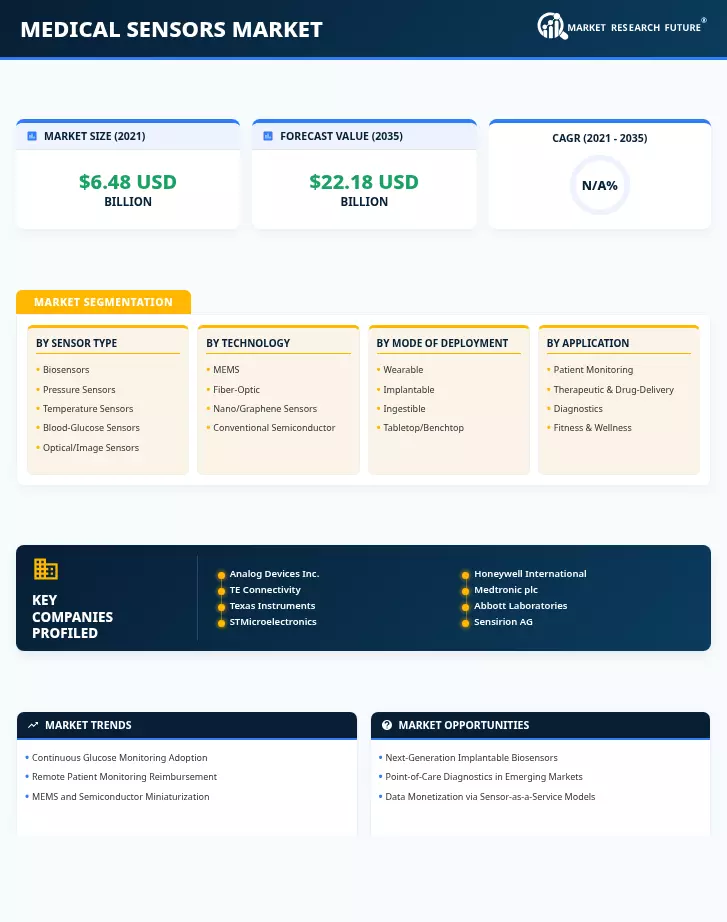
Medical Sensors Market

ID: MRFR/MED/1506-HCR
200 Pages
Satyendra Maurya
Last Updated: June 05, 2026
Medical Sensors Market Research Report By Application (Wearable Devices, Monitoring Systems, Diagnostic Imaging), By Type (Temperature Sensors, Pressure Sensors, Image Sensors, Biosensors), By End Use (Hospitals, Home Care, Diagnostic Laboratories, Research Institutions), By Sensor Technology (Electrochemical, Optical, Thermal, Micro-electromechanical Systems) and By Regional (North America, Europe, South America, Asia Pacific, Middle East and Africa) - Growth & Industry Forecast Till 2035
Download PDF ×

We do not share your information with anyone. However, we may send you emails based on your report interest from time to time. You may contact us at any time to opt-out.

  1. 1 Market Overview |
    1. 1.1 Study Assumptions & Market Definition |
    2. 1.2 Scope of the Study |
    3. 1.3 Research Methodology
  2. 2 Market Summary & Key Takeaways
  3. 3 Market Dynamics |
    1. 3.1 Market Drivers Analysis | |
      1. 3.1.1 Continuous Glucose Monitoring Adoption | |
      2. 3.1.2 Remote Patient Monitoring Reimbursement Expansion | |
      3. 3.1.3 MEMS & Semiconductor Miniaturization | |
      4. 3.1.4 AI-Enabled Edge Analytics on Wearable Biosensor Devices | |
      5. 3.1.5 Aging Population Demographics | |
      6. 3.1.6 Domestic Fab Incentives (CHIPS Act, China NDRC Programs) | |
      7. 3.1.7 Telehealth Infrastructure Buildout |
    2. 3.2 Market Restraints Analysis | |
      1. 3.2.1 Regulatory Approval Timelines for Implantable Physiological Sensors | |
      2. 3.2.2 Data Privacy and Cybersecurity Compliance Costs | |
      3. 3.2.3 Reimbursement Uncertainty in Emerging Markets | |
      4. 3.2.4 Raw Material Supply Volatility | |
      5. 3.2.5 Clinical Validation Burden for AI-Augmented Diagnostics |
    3. 3.3 Market Opportunity Analysis | |
      1. 3.3.1 Next-Generation Implantable Biosensors | |
      2. 3.3.2 Point-of-Care Diagnostics in Emerging Markets | |
      3. 3.3.3 Data Monetization via Sensor-as-a-Service Models | |
      4. 3.3.4 AI-Driven Predictive Diagnostics | |
      5. 3.3.5 Aging Population and Chronic Disease Management |
    4. 3.4 Industry Value Chain Analysis |
    5. 3.5 Porter's Five Forces Analysis
  4. 4 Global Medical Sensors Market Size & Forecast (2021–2035) |
    1. 4.1 Historical Market Size (2021–2025) |
    2. 4.2 Current & Forecast Market Size (2026–2035) |
    3. 4.3 Market Size by Revenue (USD Billion) |
    4. 4.4 Year-over-Year Growth Analysis
  5. 5 Segmentation Analysis |
    1. 5.1 By Sensor Type | |
      1. 5.1.1 Biosensors | |
      2. 5.1.2 Pressure Sensors | |
      3. 5.1.3 Temperature Sensors | |
      4. 5.1.4 Blood-Glucose Sensors | |
      5. 5.1.5 Optical/Image Sensors |
    2. 5.2 By Technology | |
      1. 5.2.1 MEMS | |
      2. 5.2.2 Fiber-Optic | |
      3. 5.2.3 Nano/Graphene Sensors | |
      4. 5.2.4 Conventional Semiconductor | |
      5. 5.2.5 3D-Printed | |
      6. 5.2.6 Sensor Fusion Modules |
    3. 5.3 By Mode of Deployment | |
      1. 5.3.1 Wearable Sensors | |
      2. 5.3.2 Implantable Sensors | |
      3. 5.3.3 Ingestible Sensors | |
      4. 5.3.4 Tabletop/Benchtop |
    4. 5.4 By Application | |
      1. 5.4.1 Patient Monitoring | |
      2. 5.4.2 Therapeutic & Drug-Delivery | |
      3. 5.4.3 Diagnostics | |
      4. 5.4.4 Fitness & Wellness |
    5. 5.5 By End-User | |
      1. 5.5.1 Hospitals & Large Health Systems | |
      2. 5.5.2 Home-Care Settings | |
      3. 5.5.3 Ambulatory Surgical Centers | |
      4. 5.5.4 Research Laboratories
  6. 6 Regional Analysis |
    1. 6.1 North America | |
      1. 6.1.1 United States | |
      2. 6.1.2 Canada | |
      3. 6.1.3 Mexico |
    2. 6.2 Europe | |
      1. 6.2.1 Germany | |
      2. 6.2.2 United Kingdom | |
      3. 6.2.3 France | |
      4. 6.2.4 Italy | |
      5. 6.2.5 Spain | |
      6. 6.2.6 Nordic Countries | |
      7. 6.2.7 Russia | |
      8. 6.2.8 Rest of Europe |
    3. 6.3 Asia-Pacific | |
      1. 6.3.1 China | |
      2. 6.3.2 India | |
      3. 6.3.3 Japan | |
      4. 6.3.4 South Korea | |
      5. 6.3.5 ASEAN | |
      6. 6.3.6 Rest of Asia-Pacific |
    4. 6.4 South America | |
      1. 6.4.1 Brazil | |
      2. 6.4.2 Argentina | |
      3. 6.4.3 Rest of South America |
    5. 6.5 Middle East & Africa | |
      1. 6.5.1 Saudi Arabia | |
      2. 6.5.2 UAE | |
      3. 6.5.3 South Africa | |
      4. 6.5.4 Egypt | |
      5. 6.5.5 Rest of MEA
  7. 7 Competitive Landscape |
    1. 7.1 Market Share Analysis (2025) |
    2. 7.2 Competitive Benchmarking Matrix |
    3. 7.3 Company Profiles | |
      1. 7.3.1 Analog Devices Inc. | |
      2. 7.3.2 TE Connectivity | |
      3. 7.3.3 Texas Instruments | |
      4. 7.3.4 STMicroelectronics | |
      5. 7.3.5 Honeywell International | |
      6. 7.3.6 Medtronic plc | |
      7. 7.3.7 Abbott Laboratories | |
      8. 7.3.8 Sensirion AG | |
      9. 7.3.9 Amphenol Advanced Sensors | |
      10. 7.3.10 NXP Semiconductors
  8. 8 Future Outlook & Strategic Recommendations (2026–2035) |
    1. 8.1 AI-Augmented Autonomous Monitoring |
    2. 8.2 Platform Economics and Sensor-as-a-Service |
    3. 8.3 Sustainability and Circular Sensor Design |
    4. 8.4 Decentralized Clinical Trials and Real-World Evidence
  9. 9 Recent Developments & News
  10. 10 Frequently Asked Questions (FAQs)
  11. 11 Report Scope & Methodology |
    1. 11.1 Study Period & Base Year |
    2. 11.2 Data Sources & Citations |
    3. 11.3 Abbreviations
  12. 12 LIST OF TABLES |
  13. TABLE 1 Global Medical Sensors Market Size & Forecast, by Revenue (USD Billion), 2021–2035 |
  14. TABLE 2 Global Medical Sensors Market – Year-over-Year Growth Analysis, 2021–2035 |
  15. TABLE 3 Global Medical Sensors Market – Driver Impact Analysis |
  16. TABLE 4 Global Medical Sensors Market – Restraint Impact Analysis |
  17. TABLE 5 Global Medical Sensors Market Size, by Sensor Type, 2021–2035 (USD Billion) |
  18. TABLE 6 Global Medical Sensors Market Size, by Technology, 2021–2035 (USD Billion) |
  19. TABLE 7 Global Medical Sensors Market Size, by Mode of Deployment, 2021–2035 (USD Billion) |
  20. TABLE 8 Global Medical Sensors Market Size, by Application, 2021–2035 (USD Billion) |
  21. TABLE 9 Global Medical Sensors Market Size, by End-User, 2021–2035 (USD Billion) |
  22. TABLE 10 Global Medical Sensors Market Size, by Region, 2021–2035 (USD Billion) |
  23. TABLE 11 North America Medical Sensors Market Size, by Country, 2021–2035 (USD Billion) |
  24. TABLE 12 Europe Medical Sensors Market Size, by Country, 2021–2035 (USD Billion) |
  25. TABLE 13 Asia-Pacific Medical Sensors Market Size, by Country, 2021–2035 (USD Billion) |
  26. TABLE 14 South America Medical Sensors Market Size, by Country, 2021–2035 (USD Billion) |
  27. TABLE 15 Middle East & Africa Medical Sensors Market Size, by Country, 2021–2035 (USD Billion) |
  28. TABLE 16 Competitive Benchmarking Matrix – Global Medical Sensors Market, 2025 |
  29. TABLE 17 Company Profiles – Key Players, Global Medical Sensors Market |
  30. TABLE 18 Recent Developments & Strategic Announcements, 2023–2025 |
  31. TABLE 19 Report Scope & Methodology Summary |
  32. TABLE 20 Detailed Sources and Citations |
  33. TABLE 21 North America Medical Sensors Market Size, by Sensor Type, 2021–2035 (USD Billion) |
  34. TABLE 22 North America Medical Sensors Market Size, by Technology, 2021–2035 (USD Billion) |
  35. TABLE 23 North America Medical Sensors Market Size, by Mode of Deployment, 2021–2035 (USD Billion) |
  36. TABLE 24 North America Medical Sensors Market Size, by Application, 2021–2035 (USD Billion) |
  37. TABLE 25 North America Medical Sensors Market Size, by End-User, 2021–2035 (USD Billion) |
  38. TABLE 26 Europe Medical Sensors Market Size, by Sensor Type, 2021–2035 (USD Billion) |
  39. TABLE 27 Europe Medical Sensors Market Size, by Technology, 2021–2035 (USD Billion) |
  40. TABLE 28 Europe Medical Sensors Market Size, by Mode of Deployment, 2021–2035 (USD Billion) |
  41. TABLE 29 Europe Medical Sensors Market Size, by Application, 2021–2035 (USD Billion) |
  42. TABLE 30 Europe Medical Sensors Market Size, by End-User, 2021–2035 (USD Billion) |
  43. TABLE 31 Asia-Pacific Medical Sensors Market Size, by Sensor Type, 2021–2035 (USD Billion) |
  44. TABLE 32 Asia-Pacific Medical Sensors Market Size, by Technology, 2021–2035 (USD Billion) |
  45. TABLE 33 Asia-Pacific Medical Sensors Market Size, by Mode of Deployment, 2021–2035 (USD Billion) |
  46. TABLE 34 Asia-Pacific Medical Sensors Market Size, by Application, 2021–2035 (USD Billion) |
  47. TABLE 35 Asia-Pacific Medical Sensors Market Size, by End-User, 2021–2035 (USD Billion) |
  48. TABLE 36 South America Medical Sensors Market Size, by Sensor Type, 2021–2035 (USD Billion) |
  49. TABLE 37 South America Medical Sensors Market Size, by Technology, 2021–2035 (USD Billion) |
  50. TABLE 38 South America Medical Sensors Market Size, by Mode of Deployment, 2021–2035 (USD Billion) |
  51. TABLE 39 South America Medical Sensors Market Size, by Application, 2021–2035 (USD Billion) |
  52. TABLE 40 South America Medical Sensors Market Size, by End-User, 2021–2035 (USD Billion) |
  53. TABLE 41 Middle East & Africa Medical Sensors Market Size, by Sensor Type, 2021–2035 (USD Billion) |
  54. TABLE 42 Middle East & Africa Medical Sensors Market Size, by Technology, 2021–2035 (USD Billion) |
  55. TABLE 43 Middle East & Africa Medical Sensors Market Size, by Mode of Deployment, 2021–2035 (USD Billion) |
  56. TABLE 44 Middle East & Africa Medical Sensors Market Size, by Application, 2021–2035 (USD Billion) |
  57. TABLE 45 Middle East & Africa Medical Sensors Market Size, by End-User, 2021–2035 (USD Billion)
  58. 13 LIST OF FIGURES |
  59. FIGURE 1 Medical Sensors Market Dynamics — Drivers, Restraints & Opportunities |
  60. FIGURE 2 Medical Sensors Market Value Chain Analysis |
  61. FIGURE 3 Porter's Five Forces Analysis — Medical Sensors Market |
  62. FIGURE 4 Global Medical Sensors Market Size Trend (USD Billion), 2021–2035 |
  63. FIGURE 5 Medical Sensors Market Share, by Sensor Type (%), 2025 |
  64. FIGURE 6 Medical Sensors Market Share, by Technology (%), 2025 |
  65. FIGURE 7 Medical Sensors Market Share, by Mode of Deployment (%), 2025 |
  66. FIGURE 8 Medical Sensors Market Share, by Application (%), 2025 |
  67. FIGURE 9 Medical Sensors Market Share, by End-User (%), 2025 |
  68. FIGURE 10 Medical Sensors Market Share, by Region (%), 2025 |
  69. FIGURE 11 North America Medical Sensors Market Size (USD Billion), 2021–2035 |
  70. FIGURE 12 Europe Medical Sensors Market Size (USD Billion), 2021–2035 |
  71. FIGURE 13 Asia-Pacific Medical Sensors Market Size (USD Billion), 2021–2035 |
  72. FIGURE 14 South America Medical Sensors Market Size (USD Billion), 2021–2035 |
  73. FIGURE 15 Middle East & Africa Medical Sensors Market Size (USD Billion), 2021–2035 |
  74. FIGURE 16 Competitive Landscape — Medical Sensors Market Share by Company (%), 2025 |
  75. FIGURE 17 Competitive Positioning Matrix — Medical Sensors Market, 2025

Segmentation Quick Reference

DimensionSub-SegmentsDominant SegmentFastest Growing Segment
Sensor TypeBiosensors, Pressure Sensors, Temperature Sensors, Blood-Glucose Sensors, Optical/Image SensorsBiosensorsOptical/Image Sensors
TechnologyMEMS, Fiber-Optic, Nano/Graphene Sensors, Conventional SemiconductorMEMSNano/Graphene Sensors
Mode of DeploymentWearable, Implantable, Ingestible, Tabletop/BenchtopWearable SensorsIngestible Sensors
ApplicationPatient Monitoring, Therapeutic & Drug-Delivery, Diagnostics, Fitness & WellnessPatient MonitoringTherapeutic & Drug-Delivery
End-UserHospitals & Large Health Systems, Home-Care Settings, Ambulatory Surgical Centers, Research LaboratoriesHospitals & Large Health SystemsHome-Care Settings
GeographyNorth America, Europe, Asia-Pacific, South America, Middle East & AfricaNorth AmericaAsia-Pacific


Market Segmentation Overview

By Sensor Type

Sub-SegmentKey Trend
BiosensorsShift from enzyme-based to aptamer platforms, enabling multi-analyte detection
Pressure SensorsIntegration into smart ventilators and wearable hemodynamic monitors
Temperature SensorsMiniaturized thermopile arrays for continuous core body temperature tracking
Blood-Glucose Sensors14-day and 15-day continuous wear cycles, reducing per-day monitoring cost
Optical/Image SensorsComputational imaging and hyperspectral analysis for non-invasive diagnostics


Biosensors continue to anchor the Medical Sensors Market, with continuous glucose monitoring representing the single largest revenue contributor. The evolution toward multi-analyte wearable biosensor devices — capable of simultaneously tracking glucose, lactate, and cortisol — is expected to redefine chronic disease management paradigms through 2035.

By Technology

Sub-SegmentKey Trend
MEMSWafer-level chip-scale packaging reduces die area and enables sensor fusion
Fiber-OpticMRI-compatible and electromagnetic-interference-immune sensing for surgical suites
Nano/Graphene SensorsSingle-molecule detection sensitivity for oncology biomarker surveillance
Conventional SemiconductorGradual replacement by MEMS and nano-scale alternatives in new designs


MEMS technology remains the backbone of clinical-grade sensing technology production, leveraging mature fab processes to achieve unit economics that make disposable sensor formats commercially viable at scale.

By Mode of Deployment

Sub-SegmentKey Trend
Wearable SensorsPatch-format devices with multi-day wear and Bluetooth/NFC connectivity
Implantable SensorsBiodegradable substrates and extended battery life, reducing revision surgeries
Ingestible SensorsCapsule-format GI diagnostics replacing invasive endoscopy for screening
Tabletop/BenchtopCompact POC analyzers with lab-grade accuracy for decentralized testing


Wearable biosensor devices dominate deployment volume, but implantable physiological sensors are closing the gap as biocompatible encapsulation materials extend device longevity and reduce long-term total cost of ownership for health systems.

By Application

Sub-SegmentKey Trend
Patient MonitoringTransition from episodic spot-checks to continuous multi-parameter telemetry
Therapeutic & Drug-DeliveryClosed-loop systems autonomously adjust drug infusion based on sensor feedback
DiagnosticsMultiplexed lateral-flow and microfluidic assays for point-of-care testing
Fitness & WellnessConsumer wearables are bridging into clinical data pipelines via physician portals


Patient vitals monitoring sensors account for the largest application share, reflecting hospital and home-care demand for real-time physiological data streams that reduce adverse event rates and shorten length of stay.

By End-User

Sub-SegmentKey Trend
Hospitals & Large Health SystemsEMR-integrated sensor networks driving enterprise procurement cycles
Home-Care SettingsRPM reimbursement expansion is making home-based IoT health data sensors economically viable
Ambulatory Surgical CentersPerioperative monitoring sensors for same-day discharge protocols
Research LaboratoriesHigh-sensitivity nano-sensors enabling novel biomarker discovery programs


Hospitals remain the dominant procurement channel for the Medical Sensors Market, but home-care settings represent the fastest-growing end-user segment as payer policies increasingly reimburse remote patient vitals monitoring sensors.