Mobility as a Service Market

ID: MRFR/ICT/2236-CR
87 Pages
Ankit Gupta
Last Updated: June 22, 2026
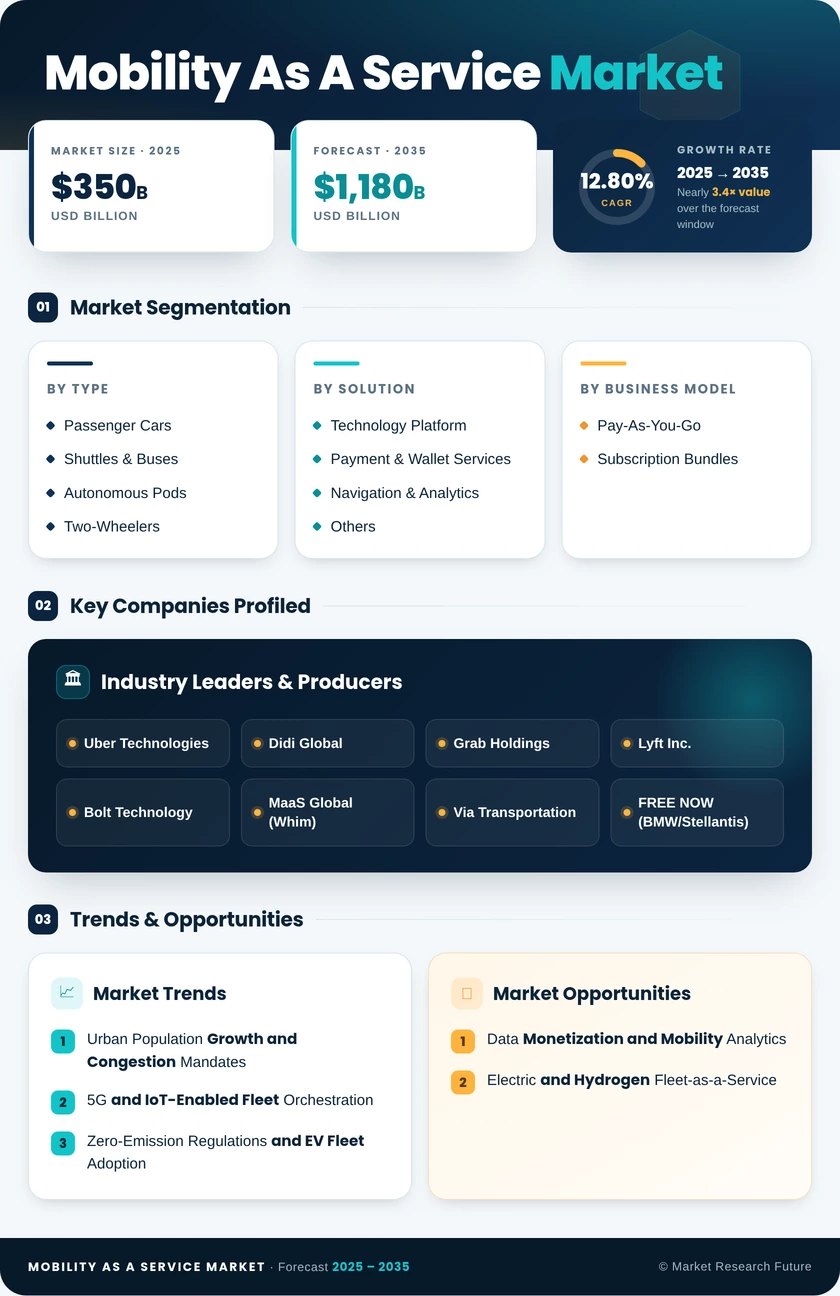
Mobility as a Service Market Size, Share and Research Report By Service Type (Ride-Hailing, Car Sharing, Micro-Mobility, Bike Sharing, Others), By Solution (Technology Platform, Payment & Wallet Services, Navigation & Analytics, Others), By Vehicle Type (Passenger Cars, Shuttles & Buses, Autonomous Pods, Two-Wheelers), By Transportation Type (Public Transportation, Private Transportation), By Business Model (Pay-As-You-Go, Subscription Bundles), By Application (Personal Mobility, Logistics & Last-Mile Delivery), By End-User (Individuals, Enterprises) and By Region (North America, Europe, South America, Asia Pacific, Middle East and Africa) - Industry Forecast to 2035.
Download PDF ×

We do not share your information with anyone. However, we may send you emails based on your report interest from time to time. You may contact us at any time to opt-out.

  1. 1 Market Overview |
    1. 1.1 Study Assumptions & Market Definition |
    2. 1.2 Scope of the Study |
    3. 1.3 Research Methodology
  2. 2 Market Summary & Key Takeaways
  3. 3 Market Dynamics |
    1. 3.1 Market Drivers Analysis | |
      1. 3.1.1 Urban Population Growth & Congestion Reduction Mandates | |
      2. 3.1.2 Smartphone & 5G Penetration Enabling Smart Transportation Apps | |
      3. 3.1.3 Zero-Emission Fleet Regulations & EV Subsidies | |
      4. 3.1.4 API Standardization & Open Data Policies | |
      5. 3.1.5 Contactless & Tokenized Payment Innovation | |
      6. 3.1.6 AI & Predictive Journey Management Adoption | |
      7. 3.1.7 Public-Private Partnership Frameworks |
    2. 3.2 Market Restraints Analysis | |
      1. 3.2.1 Fragmented Regulatory Frameworks Across Jurisdictions | |
      2. 3.2.2 Data Privacy & Cybersecurity Concerns | |
      3. 3.2.3 High Platform Integration Costs for Legacy Transit Agencies | |
      4. 3.2.4 Driver/Gig-Worker Classification Disputes | |
      5. 3.2.5 Rural Coverage Gaps & Digital Divide |
    3. 3.3 Market Opportunity Analysis | |
      1. 3.3.1 Autonomous Vehicle Integration into MaaS Platforms | |
      2. 3.3.2 Subscription-Based Mobility Bundles | |
      3. 3.3.3 Emerging-Market Leapfrog Opportunities | |
      4. 3.3.4 Data Monetization & Mobility Analytics | |
      5. 3.3.5 Electric & Hydrogen Fleet-as-a-Service |
    4. 3.4 Industry Value Chain Analysis |
    5. 3.5 Porter's Five Forces Analysis
  4. 4 Global Mobility as a Service Market Size & Forecast (2021–2035) |
    1. 4.1 Historical Market Size (2021–2025) |
    2. 4.2 Current & Forecast Market Size (2026–2035) |
    3. 4.3 Market Size by Revenue (USD Billion) |
    4. 4.4 Year-over-Year Growth Analysis
  5. 5 Segmentation Analysis |
    1. 5.1 By Service Type | |
      1. 5.1.1 Ride-Hailing | |
      2. 5.1.2 Car Sharing | |
      3. 5.1.3 Micro-Mobility | |
      4. 5.1.4 Bike Sharing | |
      5. 5.1.5 Others |
    2. 5.2 By Solution | |
      1. 5.2.1 Technology Platform | |
      2. 5.2.2 Payment & Wallet Services | |
      3. 5.2.3 Navigation & Analytics | |
      4. 5.2.4 Others |
    3. 5.3 By Vehicle Type | |
      1. 5.3.1 Passenger Cars | |
      2. 5.3.2 Shuttles & Buses | |
      3. 5.3.3 Autonomous Pods | |
      4. 5.3.4 Two-Wheelers |
    4. 5.4 By Transportation Type | |
      1. 5.4.1 Public Transportation | |
      2. 5.4.2 Private Transportation |
    5. 5.5 By Business Model | |
      1. 5.5.1 Pay-As-You-Go | |
      2. 5.5.2 Subscription Bundles |
    6. 5.6 By Application | |
      1. 5.6.1 Personal Mobility | |
      2. 5.6.2 Logistics & Last-Mile Delivery |
    7. 5.7 By End-User | |
      1. 5.7.1 Individuals | |
      2. 5.7.2 Enterprises
  6. 6 Regional Analysis |
    1. 6.1 North America | |
      1. 6.1.1 United States | |
      2. 6.1.2 Canada | |
      3. 6.1.3 Mexico |
    2. 6.2 Europe | |
      1. 6.2.1 Germany | |
      2. 6.2.2 United Kingdom | |
      3. 6.2.3 France | |
      4. 6.2.4 Italy | |
      5. 6.2.5 Spain | |
      6. 6.2.6 Nordic Countries | |
      7. 6.2.7 Russia | |
      8. 6.2.8 Rest of Europe |
    3. 6.3 Asia-Pacific | |
      1. 6.3.1 China | |
      2. 6.3.2 India | |
      3. 6.3.3 Japan | |
      4. 6.3.4 South Korea | |
      5. 6.3.5 ASEAN | |
      6. 6.3.6 Rest of Asia-Pacific |
    4. 6.4 South America | |
      1. 6.4.1 Brazil | |
      2. 6.4.2 Argentina | |
      3. 6.4.3 Rest of South America |
    5. 6.5 Middle East & Africa | |
      1. 6.5.1 Saudi Arabia | |
      2. 6.5.2 UAE | |
      3. 6.5.3 South Africa | |
      4. 6.5.4 Egypt | |
      5. 6.5.5 Rest of MEA
  7. 7 Competitive Landscape |
    1. 7.1 Market Share Analysis (2025) |
    2. 7.2 Competitive Benchmarking Matrix |
    3. 7.3 Company Profiles | |
      1. 7.3.1 Uber Technologies | |
      2. 7.3.2 Didi Global | |
      3. 7.3.3 Grab Holdings | |
      4. 7.3.4 Lyft Inc. | |
      5. 7.3.5 Bolt Technology | |
      6. 7.3.6 MaaS Global (Whim) | |
      7. 7.3.7 Via Transportation | |
      8. 7.3.8 FREE NOW (BMW/Stellantis) | |
      9. 7.3.9 Moovit (Intel) | |
      10. 7.3.10 BlaBlaCar
  8. 8 Future Outlook & Strategic Recommendations (2026–2035) |
    1. 8.1 AI-Powered Journey Orchestration |
    2. 8.2 Platform Economics & Super-App Consolidation |
    3. 8.3 Electrification & Green Fleet Orchestration |
    4. 8.4 ESG Reporting & Carbon-Credit Integration
  9. 9 Recent Developments & News
  10. 10 Frequently Asked Questions (FAQs)
  11. 11 Report Scope & Methodology |
    1. 11.1 Study Period & Base Year |
    2. 11.2 Data Sources & Citations |
    3. 11.3 Abbreviations
  12. 12 LIST OF TABLES |
  13. TABLE 1 Global Mobility as a Service Market Size & Forecast, by Revenue (USD Billion), 2021–2035 |
  14. TABLE 2 Global Mobility as a Service Market – Year-over-Year Growth Analysis, 2021–2035 |
  15. TABLE 3 Market Driver Impact Analysis, 2026–2035 |
  16. TABLE 4 Market Restraint Impact Analysis, 2026–2035 |
  17. TABLE 5 Global Mobility as a Service Market Size, by Service Type, 2021–2035 (USD Billion) |
  18. TABLE 6 Global Mobility as a Service Market Size, by Solution, 2021–2035 (USD Billion) |
  19. TABLE 7 Global Mobility as a Service Market Size, by Vehicle Type, 2021–2035 (USD Billion) |
  20. TABLE 8 Global Mobility as a Service Market Size, by Transportation Type, 2021–2035 (USD Billion) |
  21. TABLE 9 Global Mobility as a Service Market Size, by Business Model, 2021–2035 (USD Billion) |
  22. TABLE 10 Global Mobility as a Service Market Size, by Application, 2021–2035 (USD Billion) |
  23. TABLE 11 Global Mobility as a Service Market Size, by End-User, 2021–2035 (USD Billion) |
  24. TABLE 12 Global Mobility as a Service Market Size, by Region, 2021–2035 (USD Billion) |
  25. TABLE 13 Regional Summary – Key Metrics & Investment Themes, 2025 |
  26. TABLE 14 North America Mobility as a Service Market Size, by Country, 2021–2035 (USD Billion) |
  27. TABLE 15 Europe Mobility as a Service Market Size, by Country, 2021–2035 (USD Billion) |
  28. TABLE 16 Asia-Pacific Mobility as a Service Market Size, by Country, 2021–2035 (USD Billion) |
  29. TABLE 17 South America Mobility as a Service Market Size, by Country, 2021–2035 (USD Billion) |
  30. TABLE 18 Middle East & Africa Mobility as a Service Market Size, by Country, 2021–2035 (USD Billion) |
  31. TABLE 19 Competitive Benchmarking Matrix – Global Mobility as a Service Market, 2025 |
  32. TABLE 20 Company Profiles – Key Players, Global Mobility as a Service Market |
  33. TABLE 21 Recent Developments & Strategic Announcements, 2023–2025 |
  34. TABLE 22 Report Scope & Methodology Summary |
  35. TABLE 23 Detailed Sources & Citations
  36. 13 LIST OF FIGURES |
  37. FIGURE 1 Mobility as a Service Market – Market Dynamics Overview (Drivers, Restraints, Opportunities) |
  38. FIGURE 2 Industry Value Chain Analysis – Mobility as a Service Ecosystem |
  39. FIGURE 3 Porter's Five Forces Analysis – Mobility as a Service Market |
  40. FIGURE 4 Global Mobility as a Service Market Size Trend & Forecast, 2021–2035 (USD Billion) |
  41. FIGURE 5 Mobility as a Service Market Share, by Service Type, 2025 (%) |
  42. FIGURE 6 Mobility as a Service Market Share, by Solution, 2025 (%) |
  43. FIGURE 7 Mobility as a Service Market Share, by Vehicle Type, 2025 (%) |
  44. FIGURE 8 Mobility as a Service Market Share, by Business Model, 2025 (%) |
  45. FIGURE 9 Mobility as a Service Market Share, by Application, 2025 (%) |
  46. FIGURE 10 Mobility as a Service Market Share, by End-User, 2025 (%) |
  47. FIGURE 11 Regional Share of Global Mobility as a Service Market, 2025 (%) |
  48. FIGURE 12 North America Mobility as a Service Market – Country Share, 2025 (%) |
  49. FIGURE 13 Europe Mobility as a Service Market – Country Share, 2025 (%) |
  50. FIGURE 14 Asia-Pacific Mobility as a Service Market – Country Share, 2025 (%) |
  51. FIGURE 15 South America Mobility as a Service Market – Country Share, 2025 (%) |
  52. FIGURE 16 Middle East & Africa Mobility as a Service Market – Country Share, 2025 (%) |
  53. FIGURE 17 Competitive Landscape – Market Share of Top 10 Players, 2025 (%) |
  54. FIGURE 18 Competitive Positioning Matrix – Global Mobility as a Service Market

Segmentation Quick Reference

DimensionSub-SegmentsDominant SegmentFastest Growing Segment
Service TypeRide-Hailing, Car Sharing, Micro-Mobility, Bike Sharing, OthersRide-HailingMicro-Mobility
SolutionTechnology Platform, Payment & Wallet Services, Navigation & Analytics, OthersTechnology PlatformPayment & Wallet Services
Vehicle TypePassenger Cars, Shuttles & Buses, Autonomous Pods, Two-WheelersPassenger CarsAutonomous Pods
Transportation TypePublic, PrivatePrivatePublic
Business ModelPay-As-You-Go, Subscription BundlesPay-As-You-GoSubscription Bundles
ApplicationPersonal Mobility, Logistics & Last-Mile DeliveryPersonal MobilityLogistics & Last-Mile Delivery
End-UserIndividuals, EnterprisesIndividualsEnterprises


Market Segmentation Overview

By Service Type

Sub-SegmentKey Trend
Ride-HailingSuper-app integration; EV fleet transition; dynamic surge pricing optimization
Car SharingPeer-to-peer models expanding; corporate car-sharing programs growing
Micro-MobilityE-scooter regulation standardization; docking-station integration with transit hubs
Bike SharingMunicipal public bike schemes scaling; e-bike adoption accelerating
OthersShuttle-on-demand; waterway transit digitization


Ride-hailing continues to anchor the service-type mix, but micro-mobility's rapid ascent — fueled by last-mile connectivity mandates and low per-trip costs — is reshaping how cities plan multimodal corridors.

By Solution

Sub-SegmentKey Trend
Technology PlatformOpen-API ecosystems; cloud-native SaaS architectures for transit agencies
Payment & Wallet ServicesTokenized fare collection; account-based ticketing replacing physical cards
Navigation & AnalyticsAI-powered predictive routing; anonymized trip-data monetization
OthersCustomer support automation; regulatory compliance modules


Technology platforms are evolving from simple booking engines to full-stack orchestration layers that manage routing, billing, fleet allocation, and carbon reporting within a single interface.

By Vehicle Type

Sub-SegmentKey Trend
Passenger CarsElectrification mandates driving fleet replacement cycles
Shuttles & BusesOn-demand micro-transit replacing fixed-route services in suburban areas
Autonomous PodsPilot scaling in geofenced urban zones; OEM-MaaS partnerships
Two-WheelersDominant mode in South and Southeast Asian ride-hailing ecosystems


Passenger cars remain the volumetric leader, though autonomous pods represent the highest-growth frontier as regulatory sandboxes expand in the US, EU, China, and the Gulf states.

By Transportation Type

Sub-SegmentKey Trend
PublicOpen-data mandates; real-time GTFS feed integration into MaaS platforms
PrivateRide-hailing and car-sharing platforms are dominating consumer spending


Private transportation leads by revenue share, but public transportation's integration into MaaS ecosystems is the single most important catalyst for mass-market adoption.

By Business Model

Sub-SegmentKey Trend
Pay-As-You-GoDefault consumer behavior; transaction-fee monetization for platforms
Subscription BundlesMonthly all-access passes replacing per-trip payments in pilot cities


Subscription bundles are growing fastest as platforms demonstrate that predictable monthly pricing reduces churn and increases average revenue per user by 30–40% compared to pay-as-you-go.

By Application

Sub-SegmentKey Trend
Personal MobilityDaily commute optimization; leisure and airport transfer integration
Logistics & Last-Mile DeliveryE-commerce fulfillment; instant grocery and parcel delivery


Personal mobility dominates today's mix, while logistics and last-mile delivery are poised for rapid expansion as MaaS platforms extend their orchestration capabilities to commercial freight and parcel movement.

By End-User

Sub-SegmentKey Trend
IndividualsMass-market adoption; app-first travel behavior among millennials and Gen Z
EnterprisesCorporate mobility budgets; employee commute benefit programs


Individual consumers drive the majority of platform transactions, but enterprise adoption is accelerating as companies integrate managed mobility into employee benefits and ESG reporting frameworks.