×
Request Free Sample ×

Kindly complete the form below to receive a free sample of this Report

* Please use a valid business email

Leading companies partner with us for data-driven Insights

clients tt-cursor
Hero Background

Monosodium Glutamate Market

ID: MRFR/CnM/2006-HCR
140 Pages
Chitranshi Jaiswal
October 2025

Monosodium Glutamate Market Research Report Information By Application (Additives, Acidity Regulators, Preservatives, and Others), By End-User (Food Processing, Pharmaceuticals, Cosmetics, Animal Feed, and Others), And By Region (North America, Europe, Asia-Pacific, And Rest Of The World) –Market Forecast Till 2035.

Share:
Download PDF ×

We do not share your information with anyone. However, we may send you emails based on your report interest from time to time. You may contact us at any time to opt-out.

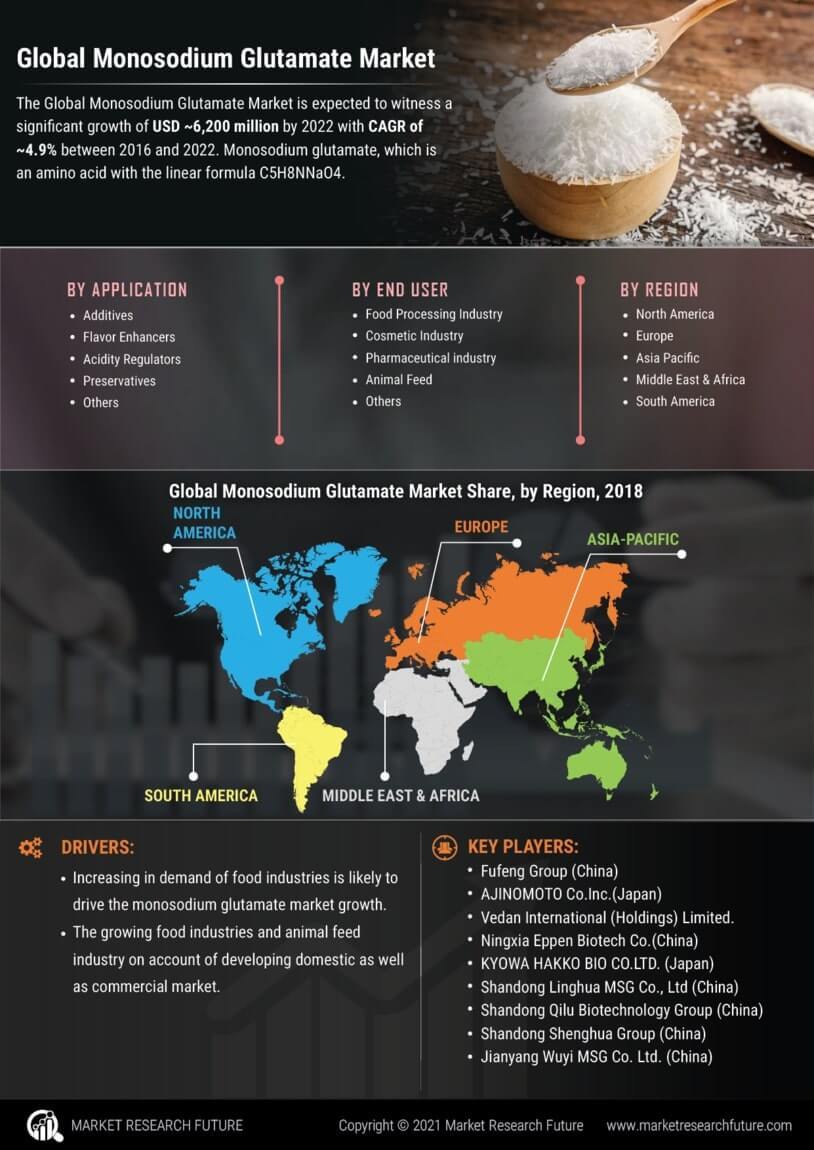
Monosodium Glutamate Market Infographic
Purchase Options

Monosodium Glutamate Market Summary

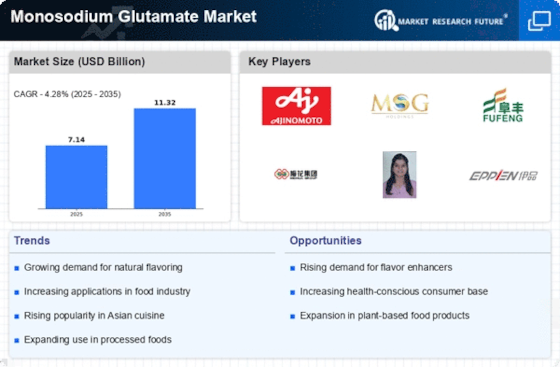
As per MRFR analysis, the Monosodium Glutamate Market Size was estimated at 7.14 USD Billion in 2024. The Monosodium Glutamate industry is projected to grow from 7.446 USD Billion in 2025 to 11.32 USD Billion by 2035, exhibiting a compound annual growth rate (CAGR) of 4.28 during the forecast period 2025 - 2035.

Key Market Trends & Highlights

The Monosodium Glutamate Market is poised for growth driven by evolving consumer preferences and industry dynamics.

  • The demand for umami flavors continues to rise, particularly in North America, which remains the largest market for monosodium glutamate.
  • There is an increasing focus on clean label products, reflecting consumer preferences for transparency and natural ingredients.
  • The Asia-Pacific region is experiencing rapid growth, driven by the rising popularity of plant-based diets and their associated flavoring needs.
  • Key market drivers include the expansion of the food processing sector and technological advancements in production, which are enhancing the availability of monosodium glutamate.

Market Size & Forecast

2024 Market Size 7.14 (USD Billion)
2035 Market Size 11.32 (USD Billion)
CAGR (2025 - 2035) 4.28%

Major Players

Ajinomoto (JP), MSG Holdings (JP), Fufeng Group (CN), Meihua Group (CN), Sambavanam (IN), Ningxia Eppen Biotech (CN), Shandong Qilu Biotechnology (CN), Hunan Dongting (CN)

Monosodium Glutamate Market Trends

The Monosodium Glutamate Market is currently experiencing a dynamic phase characterized by evolving consumer preferences and increasing demand for flavor enhancers in various food applications. This market appears to be influenced by a growing inclination towards umami flavors, which are becoming more prominent in culinary practices worldwide. As consumers seek to enhance their dining experiences, the use of monosodium glutamate in processed foods, snacks, and restaurant dishes is likely to expand. Additionally, the rise of global cuisines and the fusion of flavors may further drive the incorporation of this ingredient into diverse culinary traditions. Moreover, the Monosodium Glutamate Market is also witnessing a shift towards clean label products, as consumers become more health-conscious and attentive to ingredient transparency. This trend suggests that manufacturers may need to adapt their formulations to meet the demands for natural and recognizable ingredients. Furthermore, the increasing popularity of plant-based diets could influence the market, as monosodium glutamate is often used to enhance the flavor profile of meat alternatives. Overall, the Monosodium Glutamate Market seems poised for growth, driven by both culinary innovation and changing consumer expectations.

Rising Demand for Umami Flavors

The Monosodium Glutamate Market is seeing a notable increase in the demand for umami flavors, which are gaining traction in various culinary applications. This trend indicates a shift in consumer preferences towards richer taste experiences, prompting food manufacturers to incorporate monosodium glutamate into their products to enhance flavor profiles.

Focus on Clean Label Products

There is a growing emphasis on clean label products within the Monosodium Glutamate Market, as consumers become more discerning about ingredient transparency. This trend suggests that manufacturers may need to reformulate their offerings to align with consumer expectations for natural and recognizable ingredients.

Impact of Plant-Based Diets

The rise of plant-based diets is influencing the Monosodium Glutamate Market, as this ingredient is often utilized to enhance the flavor of meat alternatives. This trend indicates a potential expansion of monosodium glutamate usage in products catering to health-conscious consumers seeking flavorful plant-based options.

Monosodium Glutamate Market Drivers

Impact of Plant-Based Diets

The rise of plant-based diets is significantly influencing the Monosodium Glutamate Market, as more consumers seek flavorful alternatives to traditional meat-based dishes. As plant-based products often lack the inherent umami flavors found in animal proteins, monosodium glutamate serves as a crucial ingredient in enhancing the taste of these alternatives. Market analysis suggests that the plant-based food sector is expected to grow by over 10% annually, creating a substantial opportunity for monosodium glutamate to be utilized in meat substitutes, dairy alternatives, and snacks. This trend not only supports the growth of the Monosodium Glutamate Market but also aligns with the increasing consumer focus on health and sustainability. The ability of monosodium glutamate to provide a satisfying flavor profile in plant-based offerings is likely to drive its adoption in this expanding market.

Focus on Clean Label Products

In the Monosodium Glutamate Market, there is a growing emphasis on clean label products, which are perceived as healthier and more transparent by consumers. This trend is prompting food manufacturers to reformulate their products, seeking to replace artificial additives with natural alternatives, while still maintaining flavor integrity. Monosodium glutamate, often viewed as a synthetic ingredient, faces scrutiny; however, its safety profile and efficacy in flavor enhancement are being highlighted in marketing strategies. Recent surveys indicate that nearly 60% of consumers are willing to accept monosodium glutamate in clean label products if its benefits are clearly communicated. This shift towards clean labeling is likely to reshape the Monosodium Glutamate Market, as companies strive to balance consumer demands for transparency with the need for effective flavor solutions.

Rising Demand for Umami Flavors

The Monosodium Glutamate Market is experiencing a notable surge in demand for umami flavors, which are increasingly recognized for their ability to enhance the taste of various food products. This trend is particularly evident in the food processing sector, where manufacturers are incorporating monosodium glutamate to create savory profiles in snacks, sauces, and ready-to-eat meals. According to recent data, the market for umami flavor enhancers is projected to grow at a compound annual growth rate of approximately 5% over the next few years. This growth is driven by consumer preferences for richer taste experiences, leading to a broader acceptance of monosodium glutamate as a safe and effective flavor enhancer. As culinary trends evolve, the Monosodium Glutamate Market is likely to benefit from this increasing consumer inclination towards umami-rich foods.

Expansion of the Food Processing Sector

The Monosodium Glutamate Market is poised for growth due to the ongoing expansion of the food processing sector. As food manufacturers seek to improve product quality and flavor, the incorporation of monosodium glutamate has become a common practice. This ingredient is particularly favored in processed foods, where it enhances taste without significantly altering nutritional profiles. Recent statistics indicate that the food processing industry is projected to grow at a rate of 4% annually, driven by increasing consumer demand for convenience foods. This growth presents a favorable environment for the Monosodium Glutamate Market, as manufacturers look to optimize flavor in a competitive market. The ability of monosodium glutamate to deliver consistent flavor enhancement positions it as a key ingredient in the evolving landscape of food processing.

Technological Advancements in Production

Technological advancements in the production of monosodium glutamate are contributing to the growth of the Monosodium Glutamate Market. Innovations in fermentation technology and production efficiency are enabling manufacturers to produce higher quality monosodium glutamate at lower costs. This not only enhances the competitive edge of producers but also allows for greater accessibility of the ingredient in various food applications. Recent developments suggest that production capacities are expected to increase by approximately 15% over the next few years, driven by these technological improvements. As production becomes more efficient, the Monosodium Glutamate Market is likely to see a reduction in prices, making it a more attractive option for food manufacturers. This trend may further stimulate demand and broaden the application of monosodium glutamate across diverse culinary segments.

Market Segment Insights

Monosodium Glutamate Market Application Insights

The Monosodium Glutamate Market segmentation, based on Application, includes Additives, Acidity Regulators, Preservatives and Others. The additives segment dominated the Market, accounting for 58% of market revenue (USD 3.8 billion). MSG is used as a food additive during food preparation. It offers flavor in baked goods, meat, and dairy products, among other food items. It aids in providing food goods flavor and lengthening their shelf lives.

Figure 1:  Monosodium Glutamate Market, by Application, 2022 & 2032 (USD billion)

Source: Secondary Research, Primary Research, Market Research Future Database, and Analyst Review 

Monosodium Glutamate Market End-User Insights

The Monosodium Glutamate Market segmentation, based on End-User, includes Food Processing, Pharmaceuticals, Cosmetics, Animal Feed, and Others. The Food Processing category generated the highest revenue of about 60% (USD 3.9 billion) in 2022. The rising pace of population expansion worldwide drives up consumer demand for food items. Additionally, a shortage of time for preparing food and the rise in job-related obligations push customers to seek healthy substitutes. Additionally, consumers are expected to eat prepared foods internationally, raising the need for MSG products during the projected period.

Get more detailed insights about Monosodium Glutamate Market

Regional Insights

North America : Market Leader in Innovation

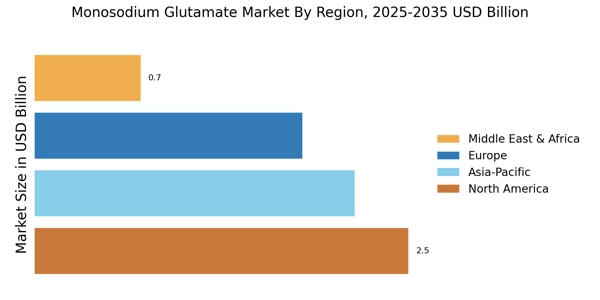
North America is witnessing robust growth in the monosodium glutamate (MSG) market, driven by increasing consumer demand for flavor enhancers in processed foods. The region holds approximately 35% of the global market share, making it the largest market for MSG. Regulatory support for food safety and quality standards further catalyzes market expansion, as consumers seek transparency in food ingredients. The United States and Canada are the leading countries in this region, with major players like Ajinomoto and MSG Holdings dominating the landscape. The competitive environment is characterized by innovation in product offerings and strategic partnerships. The presence of established companies ensures a steady supply chain, meeting the growing demand for MSG in various food applications.

Europe : Emerging Market with Regulations

Europe is emerging as a significant player in the monosodium glutamate market, driven by increasing consumer awareness regarding food additives and flavor enhancers. The region accounts for approximately 25% of the global market share, making it the second-largest market. Stringent regulations regarding food safety and labeling are influencing market dynamics, encouraging manufacturers to adopt cleaner production methods and transparency in ingredient sourcing. Leading countries in Europe include Germany, France, and the UK, where companies like Ajinomoto and Fufeng Group are actively expanding their operations. The competitive landscape is marked by a mix of local and international players, focusing on product innovation and sustainability. The presence of regulatory bodies ensures compliance and fosters consumer trust in MSG products.

Asia-Pacific : Rapid Growth and Demand

Asia-Pacific is experiencing rapid growth in the monosodium glutamate market, fueled by rising disposable incomes and changing dietary preferences. The region holds approximately 30% of the global market share, making it a key player in MSG consumption. The increasing popularity of Asian cuisine globally and the demand for umami flavors are significant drivers of market expansion, supported by favorable government policies promoting food processing industries. China and Japan are the leading countries in this region, with major companies like Fufeng Group and Meihua Group leading the market. The competitive landscape is characterized by a high number of local manufacturers, focusing on cost-effective production methods. The presence of key players ensures a diverse range of MSG products, catering to both domestic and international markets.

Middle East and Africa : Untapped Potential in Market

The Middle East and Africa (MEA) region presents untapped potential in the monosodium glutamate market, driven by increasing urbanization and changing food consumption patterns. The region currently holds about 10% of the global market share, indicating significant growth opportunities. The rising demand for processed and convenience foods is a key driver, alongside government initiatives to enhance food security and quality standards in the region. Leading countries include South Africa and the UAE, where local players are beginning to emerge in the MSG market. The competitive landscape is still developing, with opportunities for both local and international companies to establish a foothold. The presence of key players like Sambavanam and Ningxia Eppen Biotech is expected to shape the market dynamics in the coming years.

Monosodium Glutamate Market Regional Image

Key Players and Competitive Insights

Leading market players are investing heavily in research and development to expand their production capacity, which will help the Monosodium Glutamate Market to grow further. Market participants are undergoing strategic approaches to expand and strengthen their footprint, with important market developments including product innovations, contractual agreements, mergers and acquisitions, higher investments and expenditures, and partnerships with other organizations. The Monosodium Glutamate industry must offer cost-effective solutions to survive in a more competitive and rising market climate.

Manufacturing locally to minimize expenses is one of the organization's key business tactics in the  Monosodium Glutamate industry to benefit the consumer and capture untapped markets. In recent years, the Monosodium Glutamate industry has offered significant advantages to the food industry. Major players in the Monosodium Glutamate Market include Fufeng Group (China), AJINOMOTO Co.Inc.(Japan), and Vedan International (Holdings) Limited. (Hong Kong), Ningxia Eppen Biotech Co.(China), KYOWA HAKKO BIO CO.LTD. (Japan), Shandong Linghua MSG Co., Ltd (China), Shandong Qilu Biotechnology Group (China), Shandong Shenghua Group (China), Jianyang Wuyi MSG Co.

Ltd. (China)and others., are attempting to capture the majority of the market share by investing in research and development to produce affordable solutions.

Vedan International (Holdings) Limited produces and sells refreshments, industrial products made from cassava starch, specialty chemical products, and food additives based on fermentation. MSG, a vital food ingredient at the core of the unique flavors of Asia's two billion consumers, has been the foundation of the company's enviable position as a quality manufacturer. Vedan International has definite competitive benefits that give its products genuine worth as it creates fresh goods that indicate the most recent advancements in manufacturing science and are projected to be significant profit drivers in the future.

They have advanced knowledge in the massive fermentation process, starch analyzing conversion technology, and chemical & electro-chemical technology that will be a market driver in the future. The Group conducted a goods recall drill in July 2022 for each of its primary products, including MSG, Cha Cha Spiced Sunflower Seeds,  Seasoning, Modified Starch, Rice Protein, and Animal & Plant Liquid, giving it the knowledge needed to handle any potential situations.

Seasonings, nutritious oils, prepared foods, drinks, and dairy products are just a few of the food goods that Ajinomoto Co., Inc. manufactures and distributes. The business also produces specialty chemicals, amino acids, and medications. Ajinomoto had 36 operating locations as of 2021 and had an estimated 33,651 employees. In 2021, it will generate about 1.1 trillion JPY (USD 8 billion) in annual income. In September 2020, the Settlement of Japan Patent Litigation Between Ajinomoto Co., Inc. and CJ Japan Corp. Relating to Monosodium Glutamate Market (MSG) Product Manufacturing.

Key Companies in the Monosodium Glutamate Market market include

Industry Developments

Products like monosodium glutamate, known to assist and provide a distinctive flavor to food items that are neither bitter, sour, sweet, nor salty, constitute an important part of the monosodium glutamate market. It is extensively utilized by businesses in the food and beverage sector when manufacturing goods. It has additionally been combined with sugar to improve the flavor of bitter medications and make them more palatable when taken.

The existence of MSG in important markets in North America, such as the US market, is creating a pressing need to follow the guidelines set forth by the Food Chemicals Codex. These hypotheses have an important impact when added to food, either alone or in combination with other ingredients, primarily as a flavor enhancer in various food applications, including soups, meats, vegetable juices,  frozen meats, and dressings.

Due to the demographic diversity and wide range of tastes in nations like the USA and Russia, there has been an increase in the dependable need for flavor enhancers in developed and developing regions. This also encourages the flow of goods among the main destinations for importing MSG from Indonesia and China.

Future Outlook

Monosodium Glutamate Market Future Outlook

The Monosodium Glutamate Market is projected to grow at a 4.28% CAGR from 2024 to 2035, driven by increasing demand in food processing and flavor enhancement.

New opportunities lie in:

  • Expansion into plant-based food products
  • Development of clean-label MSG alternatives
  • Investment in automated production technologies

By 2035, the market is expected to achieve robust growth, solidifying its position in the global food industry.

Market Segmentation

Monosodium Glutamate Market End-User Outlook

  • Food Processing
  • Pharmaceuticals
  • Cosmetics
  • Animal Feed
  • Others

Monosodium Glutamate Market Application Outlook

  • Additives
  • Acidity Regulators
  • Preservatives
  • Others

Report Scope

MARKET SIZE 20247.14(USD Billion)
MARKET SIZE 20257.446(USD Billion)
MARKET SIZE 203511.32(USD Billion)
COMPOUND ANNUAL GROWTH RATE (CAGR)4.28% (2024 - 2035)
REPORT COVERAGERevenue Forecast, Competitive Landscape, Growth Factors, and Trends
BASE YEAR2024
Market Forecast Period2025 - 2035
Historical Data2019 - 2024
Market Forecast UnitsUSD Billion
Key Companies ProfiledMarket analysis in progress
Segments CoveredMarket segmentation analysis in progress
Key Market OpportunitiesGrowing demand for natural flavor enhancers presents opportunities in the Monosodium Glutamate Market.
Key Market DynamicsRising consumer preference for natural flavor enhancers drives demand for Monosodium Glutamate in various food applications.
Countries CoveredNorth America, Europe, APAC, South America, MEA

Market Highlights

Author
Chitranshi Jaiswal
Research Analyst Level I

In her 3 years of experience in the market research field, she has handled critical cross-domain projects. She has an in-depth knowledge of market estimation & analysis, problem-solving, primary as well as secondary research, and team management.She holds an engineering degree and is an MBA professional from a well-known university, capable of evaluating the market and competitive conditions. An exceptional strategist with excellent communication skills and a passion for delivering cutting-edge & practical insights for the market. Proficient in multi-tasking, and can successfully deal with competing demands, while maintaining complete confidentiality. Generated business through active client and project development, networking, and high-quality responses. Her knowledge and skills have helped in making solid business decisions, securing funding from investors, and avoiding business failures.

Leave a Comment

FAQs

What is the current valuation of the Monosodium Glutamate Market as of 2024?

The Monosodium Glutamate Market was valued at 7.14 USD Billion in 2024.

What is the projected market valuation for Monosodium Glutamate by 2035?

The market is projected to reach 11.32 USD Billion by 2035.

What is the expected CAGR for the Monosodium Glutamate Market during the forecast period 2025 - 2035?

The expected CAGR for the Monosodium Glutamate Market during 2025 - 2035 is 4.28%.

Which companies are considered key players in the Monosodium Glutamate Market?

Key players in the market include Ajinomoto, MSG Holdings, Fufeng Group, and Meihua Group.

What are the main application segments of the Monosodium Glutamate Market?

The main application segments include Additives, Acidity Regulators, and Preservatives.

How much is the Additives segment projected to grow by 2035?

The Additives segment is projected to grow from 2.5 USD Billion in 2024 to 4.0 USD Billion by 2035.

Download Free Sample

Kindly complete the form below to receive a free sample of this Report

Compare Licence

×
Features License Type
Single User Multiuser License Enterprise User
Price $4,950 $5,950 $7,250
Maximum User Access Limit 1 User Upto 10 Users Unrestricted Access Throughout the Organization
Free Customization
Direct Access to Analyst
Deliverable Format
Platform Access
Discount on Next Purchase 10% 15% 15%
Printable Versions