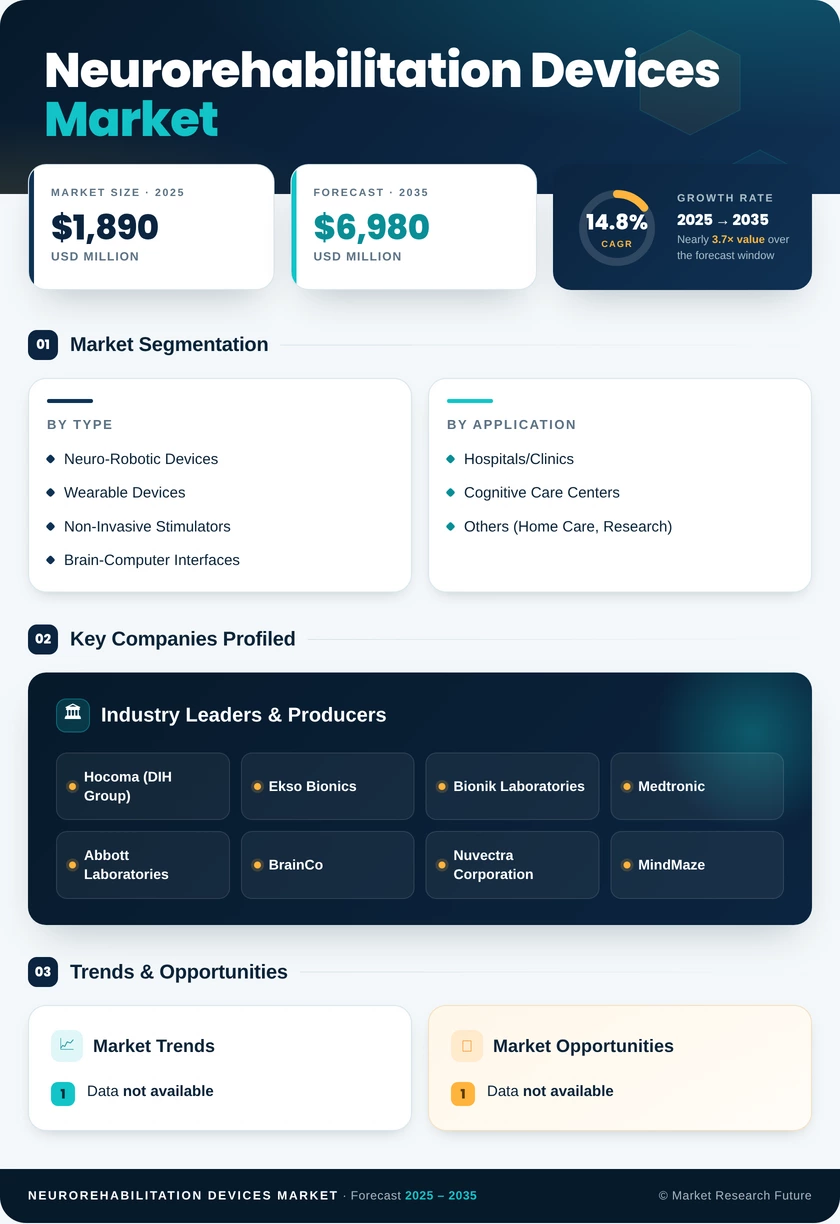
Neurorehabilitation Devices Market

ID: MRFR/MED/1642-CR
115 Pages
Vikita Thakur
Last Updated: June 05, 2026
Neurorehabilitation Devices Market Research Report Information By Type (Neuro-Robotic Devices, Wearable Devices, Non-Invasive Stimulators, and Brain-Computer Interfaces), By Application (Brain Stroke, Parkinson's Disease, Multiple Sclerosis, Spinal Cord Injury, Cerebral Palsy, and Schizophrenia), By End-User (Rehabilitation Centers, Hospitals & Clinics, and Home Care) - Growth & Industry Forecast 2025 To 2035
Download PDF ×

We do not share your information with anyone. However, we may send you emails based on your report interest from time to time. You may contact us at any time to opt-out.

  1. 1 Market Overview |
    1. 1.1 Study Assumptions & Market Definition |
    2. 1.2 Scope of the Study |
    3. 1.3 Research Methodology
  2. 2 Market Summary & Key Takeaways
  3. 3 Market Dynamics |
    1. 3.1 Market Drivers Analysis | |
      1. 3.1.1 Rising Prevalence of Neurological Disorders | |
      2. 3.1.2 Regulatory Clearances for Brain-Computer Interfaces | |
      3. 3.1.3 Advances in Robotic-Assisted Neuro Therapy | |
      4. 3.1.4 Telerehabilitation and Remote Monitoring Expansion | |
      5. 3.1.5 Aging Population Demographics | |
      6. 3.1.6 Government Neuroscience Funding Programs | |
      7. 3.1.7 Insurance and Reimbursement Code Expansion |
    2. 3.2 Market Restraints Analysis | |
      1. 3.2.1 High Device Cost and Limited Reimbursement in LMICs | |
      2. 3.2.2 Shortage of Trained Neurorehabilitation Specialists | |
      3. 3.2.3 Regulatory Fragmentation Across Jurisdictions | |
      4. 3.2.4 Limited Clinical Evidence for Newer Modalities | |
      5. 3.2.5 Data Privacy and Cybersecurity Concerns |
    3. 3.3 Market Opportunity Analysis | |
      1. 3.3.1 AI-Powered Personalized Rehabilitation Protocols | |
      2. 3.3.2 Home-Use Neurorehabilitation Devices | |
      3. 3.3.3 Emerging Market Infrastructure Build-Out | |
      4. 3.3.4 Data Monetization and Outcome-Based Payment Models | |
      5. 3.3.5 Telerehabilitation in Rural and Underserved Regions |
    4. 3.4 Industry Value Chain Analysis |
    5. 3.5 Porter's Five Forces Analysis
  4. 4 Global Neurorehabilitation Devices Market Size & Forecast (2021–2035) |
    1. 4.1 Historical Market Size (2021–2025) |
    2. 4.2 Current & Forecast Market Size (2026–2035) |
    3. 4.3 Market Size by Revenue (USD Million) |
    4. 4.4 Year-over-Year Growth Analysis
  5. 5 Segmentation Analysis |
    1. 5.1 By Product Type | |
      1. 5.1.1 Neuro-Robotic Devices | |
      2. 5.1.2 Wearable Devices | |
      3. 5.1.3 Non-Invasive Stimulators | |
      4. 5.1.4 Brain-Computer Interfaces |
    2. 5.2 By End User | |
      1. 5.2.1 Hospitals/Clinics | |
      2. 5.2.2 Cognitive Care Centers | |
      3. 5.2.3 Others (Home Care, Research Institutions)
  6. 6 Regional Analysis |
    1. 6.1 North America | |
      1. 6.1.1 United States | |
      2. 6.1.2 Canada | |
      3. 6.1.3 Mexico |
    2. 6.2 Europe | |
      1. 6.2.1 Germany | |
      2. 6.2.2 United Kingdom | |
      3. 6.2.3 France | |
      4. 6.2.4 Italy | |
      5. 6.2.5 Spain | |
      6. 6.2.6 Nordic Countries | |
      7. 6.2.7 Russia | |
      8. 6.2.8 Rest of Europe |
    3. 6.3 Asia-Pacific | |
      1. 6.3.1 China | |
      2. 6.3.2 India | |
      3. 6.3.3 Japan | |
      4. 6.3.4 South Korea | |
      5. 6.3.5 ASEAN | |
      6. 6.3.6 Rest of Asia-Pacific |
    4. 6.4 South America | |
      1. 6.4.1 Brazil | |
      2. 6.4.2 Argentina | |
      3. 6.4.3 Rest of South America |
    5. 6.5 Middle East & Africa | |
      1. 6.5.1 Saudi Arabia | |
      2. 6.5.2 UAE | |
      3. 6.5.3 South Africa | |
      4. 6.5.4 Egypt | |
      5. 6.5.5 Rest of MEA
  7. 7 Competitive Landscape |
    1. 7.1 Market Share Analysis (2025) |
    2. 7.2 Competitive Benchmarking Matrix |
    3. 7.3 Company Profiles | |
      1. 7.3.1 Hocoma (DIH Group) | |
      2. 7.3.2 Ekso Bionics | |
      3. 7.3.3 Bionik Laboratories | |
      4. 7.3.4 Medtronic | |
      5. 7.3.5 Abbott Laboratories | |
      6. 7.3.6 BrainCo | |
      7. 7.3.7 Nuvectra Corporation | |
      8. 7.3.8 MindMaze | |
      9. 7.3.9 Neurolutions | |
      10. 7.3.10 Nexstim
  8. 8 Future Outlook & Strategic Recommendations (2026–2035) |
    1. 8.1 AI and Closed-Loop Adaptive Therapy |
    2. 8.2 Platform Economics and Device-as-a-Service |
    3. 8.3 Neural Plasticity Research Breakthroughs |
    4. 8.4 Global Health Equity and Frugal Innovation
  9. 9 Recent Developments & News
  10. 10 Frequently Asked Questions (FAQs)
  11. 11 Report Scope & Methodology |
    1. 11.1 Study Period & Base Year |
    2. 11.2 Data Sources & Citations |
    3. 11.3 Abbreviations
  12. 12 LIST OF TABLES |
  13. TABLE 1 Global Neurorehabilitation Devices Market Size & Forecast, by Revenue (USD Million), 2021–2035 |
  14. TABLE 2 Global Neurorehabilitation Devices Market — Year-over-Year Growth Analysis, 2021–2035 |
  15. TABLE 3 Driver Impact Analysis — Neurorehabilitation Devices Market, 2026–2035 |
  16. TABLE 4 Restraints Impact Analysis — Neurorehabilitation Devices Market, 2026–2035 |
  17. TABLE 5 Regional Market Share Summary — Neurorehabilitation Devices Market, 2025 |
  18. TABLE 6 North America Neurorehabilitation Devices Market, by Country, 2025 |
  19. TABLE 7 Europe Neurorehabilitation Devices Market, by Country, 2025 |
  20. TABLE 8 Asia-Pacific Neurorehabilitation Devices Market, by Country, 2025 |
  21. TABLE 9 South America Neurorehabilitation Devices Market, by Country, 2025 |
  22. TABLE 10 Middle East & Africa Neurorehabilitation Devices Market, by Country, 2025 |
  23. TABLE 11 Neurorehabilitation Devices Market Size, by Product Type, 2025 |
  24. TABLE 12 Neurorehabilitation Devices Market Size, by End User, 2025 |
  25. TABLE 13 Competitive Benchmarking Matrix — Neurorehabilitation Devices Market, 2025 |
  26. TABLE 14 Recent Developments & Strategic Announcements, 2024–2025 |
  27. TABLE 15 Report Scope & Methodology Summary |
  28. TABLE 16 Detailed Sources and Citations
  29. 13 LIST OF FIGURES |
  30. FIGURE 1 Neurorehabilitation Devices Market Dynamics — Drivers, Restraints, Opportunities |
  31. FIGURE 2 Industry Value Chain Analysis — Neurorehabilitation Devices Market |
  32. FIGURE 3 Porter's Five Forces Analysis — Neurorehabilitation Devices Market |
  33. FIGURE 4 Global Neurorehabilitation Devices Market Size Trend (USD Million), 2021–2035 |
  34. FIGURE 5 Neurorehabilitation Devices Market Share, by Product Type, 2025 |
  35. FIGURE 6 Neurorehabilitation Devices Market Share, by End User, 2025 |
  36. FIGURE 7 Neurorehabilitation Devices Market Share, by Region, 2025 |
  37. FIGURE 8 North America Neurorehabilitation Devices Market Share, by Country, 2025 |
  38. FIGURE 9 Europe Neurorehabilitation Devices Market Share, by Country, 2025 |
  39. FIGURE 10 Asia-Pacific Neurorehabilitation Devices Market Share, by Country, 2025 |
  40. FIGURE 11 South America Neurorehabilitation Devices Market Share, by Country, 2025 |
  41. FIGURE 12 Middle East & Africa Neurorehabilitation Devices Market Share, by Country, 2025 |
  42. FIGURE 13 Competitive Landscape — Market Concentration and Share Analysis, 2025

Segmentation Quick Reference

DimensionSub-SegmentsDominant SegmentFastest Growing Segment
By Product TypeNeuro-Robotic Devices, Wearable Devices, Non-Invasive Stimulators, Brain-Computer InterfacesNeuro-Robotic Devices (~35% share)Brain-Computer Interfaces (CAGR ~18.2%)
By End UserHospitals/Clinics, Cognitive Care Centers, OthersHospitals/Clinics (~52% share)Cognitive Care Centers (CAGR ~16.1%)
By GeographyNorth America, Europe, Asia-Pacific, South America, Middle East & AfricaNorth America (~38% share)Asia-Pacific (CAGR ~16.5%)


Market Segmentation Overview

By Product Type

Sub-SegmentKey Trend
Neuro-Robotic DevicesTransition from research-only to community hospital deployment; AI-enhanced motion control
Wearable DevicesMiniaturization enabling home-use applications; integration with telerehabilitation platforms
Non-Invasive StimulatorsExpanding outpatient TMS and tDCS adoption; growing insurance coverage for depression and motor recovery
Brain-Computer InterfacesFDA and CE regulatory breakthroughs; hybrid BCI-gamification therapy platforms


Neuro-robotic devices remain the largest product type by revenue, anchored to hospital capital expenditure cycles and strong clinical evidence for motor recovery outcomes. Brain-computer interfaces are emerging as the fastest-growing category as regulatory pathways mature and clinical trial data demonstrates efficacy in bypassing damaged neural circuits for stroke rehabilitation.

By End User

Sub-SegmentKey Trend
Hospitals/ClinicsIntegrated neurorehabilitation units with robotic and digital therapy suites
Cognitive Care CentersPurpose-built facilities for dementia and TBI, expanding across North America and Europe
Others (Home Care, Research)Direct-to-consumer wearable approvals; growing academic research procurement


Hospitals and clinics continue to dominate end-user demand given the capital-intensive nature of neuro-robotic systems and the requirement for specialist oversight. Cognitive care centers represent the fastest-growing channel as healthcare systems establish dedicated facilities equipped with specialized cognitive rehabilitation and neural plasticity therapy technologies.