×
Request Free Sample ×

Kindly complete the form below to receive a free sample of this Report

* Please use a valid business email

Leading companies partner with us for data-driven Insights

clients tt-cursor
Hero Background

Oil & Gas Pipeline Market

ID: MRFR/EnP/6212-HCR
128 Pages
Anshula Mandaokar
October 2025

Oil and Gas Pipelines Market Research Report Information By Oil Type (Crude Oil Pipeline and Natural Gas Pipeline), By Application (Onshore and Offshore), By Stream Type (Upstream, Midstream, and Downstream), By Region (North America, Europe, Asia-Pacific, And Rest Of The World) –Market Forecast Till 2035

Share:
Download PDF ×

We do not share your information with anyone. However, we may send you emails based on your report interest from time to time. You may contact us at any time to opt-out.

Oil & Gas Pipeline Market Infographic
Purchase Options

Oil & Gas Pipeline Market Summary

As per MRFR analysis, the Oil & Gas Pipeline Market Size was estimated at 80.37 USD Billion in 2024. The Oil & Gas Pipeline industry is projected to grow from 86.81 USD Billion in 2025 to 187.44 USD Billion by 2035, exhibiting a compound annual growth rate (CAGR) of 8.0 during the forecast period 2025 - 2035.

Key Market Trends & Highlights

The Oil and Gas Pipeline Market is poised for growth driven by technological advancements and increasing energy demand.

  • Technological advancements are enhancing the efficiency and safety of pipeline operations, particularly in North America.
  • Sustainability initiatives are gaining traction, influencing investment decisions in the Asia-Pacific region.
  • Geopolitical influences are shaping supply chain dynamics, impacting both crude oil and natural gas segments.
  • Increasing energy demand and investment in infrastructure development are key drivers propelling the market forward.

Market Size & Forecast

2024 Market Size 80.37 (USD Billion)
2035 Market Size 187.44 (USD Billion)
CAGR (2025 - 2035) 8.0%

Major Players

TransCanada (CA), Enbridge (CA), Kinder Morgan (US), Williams Companies (US), Oneok (US), Cheniere Energy (US), TC Energy (CA), Sempra Energy (US), Gazprom (RU), TotalEnergies (FR)

Oil & Gas Pipeline Market Trends

The Oil & Gas Pipeline Market is currently experiencing a transformative phase, driven by a confluence of technological advancements and evolving regulatory frameworks. The increasing demand for energy, coupled with the need for efficient transportation of hydrocarbons, has led to significant investments in pipeline infrastructure. Companies are focusing on enhancing the safety and reliability of their operations, which is reflected in the adoption of smart technologies and real-time monitoring systems. Furthermore, the shift towards sustainable practices is prompting stakeholders to explore alternative materials and methods that minimize environmental impact. In addition, geopolitical factors and fluctuating energy prices are influencing the strategic decisions of market players. As nations strive for energy independence, the development of domestic pipeline networks is gaining traction. This trend is likely to foster competition among regional players while also encouraging collaborations to optimize resource allocation. Overall, the Oil & Gas Pipeline Market appears poised for growth, with a focus on innovation and sustainability shaping its future trajectory.

Technological Advancements

The integration of advanced technologies in the Oil & Gas Pipeline Market is reshaping operational efficiencies. Innovations such as automation, artificial intelligence, and predictive analytics are enhancing monitoring capabilities and reducing downtime. These developments not only improve safety but also optimize maintenance schedules, thereby extending the lifespan of pipeline assets.

Sustainability Initiatives

There is a growing emphasis on sustainability within the Oil & Gas Pipeline Market. Companies are increasingly adopting eco-friendly practices, including the use of alternative materials and energy-efficient processes. This shift is driven by regulatory pressures and a societal push towards reducing carbon footprints, indicating a long-term commitment to environmental stewardship.

Geopolitical Influences

Geopolitical dynamics are playing a crucial role in shaping the Oil & Gas Pipeline Market. As countries seek to secure energy resources and reduce dependence on imports, domestic pipeline projects are becoming more prevalent. This trend may lead to increased competition among nations and influence global energy trade patterns.

Oil & Gas Pipeline Market Drivers

Rising Energy Demand

The Global Oil and Gas Pipelines Market Industry is experiencing a surge in energy demand, driven by population growth and urbanization. As countries develop, the need for reliable energy sources becomes paramount. For instance, in 2024, the market is valued at approximately 80.4 USD Billion, reflecting the increasing investments in pipeline infrastructure to meet this demand. The expansion of cities and industrial sectors necessitates efficient transportation of oil and gas, leading to the construction of new pipelines and the enhancement of existing ones. This trend is expected to continue, with projections indicating a market growth to 187.8 USD Billion by 2035.

Global Trade Dynamics

The dynamics of global trade significantly influence the Global Oil and Gas Pipelines Market Industry. As countries engage in international trade of oil and gas, the need for extensive pipeline networks becomes evident. Pipelines serve as the backbone for transporting these resources across borders, ensuring a steady supply to meet global demands. The increasing interdependence among nations for energy resources is likely to drive investments in cross-border pipeline projects. This trend is expected to enhance market growth, aligning with the projected increase in market value to 187.8 USD Billion by 2035, as countries seek to secure their energy supplies.

Market Growth Projections

The Global Oil and Gas Pipelines Market Industry is poised for substantial growth, with projections indicating a market value of 80.4 USD Billion in 2024 and an expected increase to 187.8 USD Billion by 2035. This growth trajectory suggests a compound annual growth rate (CAGR) of 8.02% from 2025 to 2035. Such figures reflect the increasing investments in pipeline infrastructure, driven by rising energy demand, technological advancements, and regulatory support. The market's expansion is indicative of the critical role that pipelines play in the global energy landscape, facilitating the efficient transportation of oil and gas resources.

Technological Advancements

Technological innovations play a pivotal role in the Global Oil and Gas Pipelines Market Industry, enhancing the efficiency and safety of pipeline operations. Advanced monitoring systems, automation, and predictive maintenance technologies are being integrated into pipeline management. These advancements not only reduce operational costs but also minimize environmental risks associated with pipeline leaks and failures. The adoption of smart pipeline technologies is likely to attract investments, further propelling market growth. As the industry evolves, these technologies are expected to contribute significantly to the projected CAGR of 8.02% from 2025 to 2035, indicating a robust future for pipeline infrastructure.

Environmental Considerations

Environmental concerns are increasingly shaping the Global Oil and Gas Pipelines Market Industry. As awareness of climate change and ecological impacts grows, there is a push for more sustainable practices within the industry. Companies are investing in technologies that reduce emissions and minimize environmental footprints associated with pipeline operations. This shift towards sustainability is likely to influence pipeline design, construction, and maintenance practices. The industry's responsiveness to environmental challenges may enhance its reputation and attract investment, supporting the anticipated market growth to 187.8 USD Billion by 2035.

Regulatory Support and Policies

Government regulations and policies are crucial drivers in the Global Oil and Gas Pipelines Market Industry. Many countries are implementing favorable policies to encourage investment in pipeline infrastructure, recognizing its importance for energy security and economic growth. For example, streamlined permitting processes and financial incentives for pipeline projects are becoming more common. This regulatory support not only facilitates the construction of new pipelines but also ensures compliance with environmental standards. As a result, the industry is likely to see increased activity, contributing to the overall market growth and the anticipated rise in market value to 187.8 USD Billion by 2035.
Market Segment Insights

By Application: Transportation (Largest) vs. Industrial (Fastest-Growing)

The application segment of the Oil & Gas Pipeline Market highlights a diverse distribution of market share, dominated by transportation, which accounts for the majority due to its critical role in moving oil and gas products efficiently across various regions. Following transportation, the industrial sector holds significant importance, serving multiple industries that require reliable pipeline systems for their operations, although it has a smaller share when compared to transportation services.

Industrial (Dominant) vs. Residential (Emerging)

The industrial application within the Oil & Gas Pipeline Market is characterized by its robust infrastructure and high demand, driven by manufacturing and processing sectors that depend on consistent energy supplies. This segment is recognized for its steady performance in terms of robustness and reliability. In contrast, the residential segment emerges as a growing market due to increasing consumption for heating and cooking purposes. As urbanization rises, the residential sector is expected to see enhancements in pipeline technologies, leading to improved safety and service reliability, thereby attracting investments.

By End Use: Crude Oil (Largest) vs. Natural Gas (Fastest-Growing)

In the Oil & Gas Pipeline Market, the end use segment is primarily dominated by crude oil, which continues to hold a significant market share due to its extensive applications in various industries. The demand for crude oil pipelines is bolstered by the increasing need for efficient transportation of oil from extraction sites to refineries and distribution centers. Natural gas, while lower in overall share compared to crude oil, is rapidly gaining traction as a preferred energy source, driving the development and expansion of natural gas pipelines.

Crude Oil (Dominant) vs. Petrochemicals (Emerging)

Crude oil remains the dominant player in the Oil & Gas Pipeline Market, owing to its critical role in energy production and the wide array of products derived from it. The infrastructure for crude oil transportation is extensive, consisting of well-established pipelines that ensure reliability and efficiency in moving this vital resource. In contrast, petrochemicals represent an emerging segment, spurred by increasing industrial applications and a shift towards more sustainable chemical production. As the petrochemical industry evolves, it is likely to drive innovation in pipeline technology, creating new growth opportunities and enhancing market dynamics.

By Material Type: Steel (Largest) vs. Plastic (Fastest-Growing)

In the Oil & Gas Pipeline Market, the material type segment is primarily dominated by steel due to its robustness and ability to withstand high pressure and extreme conditions. Steel pipelines account for the largest share due to their wide applicability in long-distance transportation of oil and gas. Plastic, while historically a smaller segment, is gaining traction especially in less demanding applications, occupying an increasing share of the market.

Steel (Dominant) vs. Plastic (Emerging)

Steel is known for its superior strength and durability, making it the preferred choice for high-pressure oil and gas pipelines, especially in onshore and offshore applications. Its dominance is further supported by established production technologies and extensive supply chains. On the other hand, plastic materials, such as polyethylene, are emerging as favorable options due to their lighter weight, corrosion resistance, and lower installation costs. These attributes are fostering their growth, especially in smaller-scale applications and of particular interest in regions aiming for environmentally friendly solutions, thus contributing to the evolving dynamics of the market.

By Pipeline Type: Transmission Pipeline (Largest) vs. Gathering Pipeline (Fastest-Growing)

In the Oil & Gas Pipeline Market, the segment distribution reveals that transmission pipelines hold the largest market share, serving as the backbone for transporting crude oil and natural gas over long distances. Meanwhile, gathering pipelines are witnessing rapid growth due to the increasing production from shale oil and gas fields, necessitating efficient collection systems. This shift in production dynamics is reshaping market strategies, with companies increasingly investing in gathering infrastructure. The growth trends in this segment are primarily driven by rising energy demands and advancements in extraction technologies. As global energy consumption escalates, especially in emerging economies, the demand for both transmission and gathering pipelines has intensified. Furthermore, regulatory pressures for safer and more efficient transportation methods are fueling investments, creating a robust market environment for pipeline expansion and innovation.

Transmission Pipeline (Dominant) vs. Distribution Pipeline (Emerging)

Transmission pipelines are a dominant force in the Oil & Gas Pipeline Market, facilitating the bulk transfer of hydrocarbons from production areas to distribution centers. These pipelines are characterized by their high capacity and long distances, which make them critical to the supply chain. On the other hand, distribution pipelines serve the final step in delivering natural gas and crude oil to end-users, and they are recognized as an emerging segment due to the growing residential and industrial demand for gas. The trend towards decarbonization and the need for more localized energy solutions position distribution pipelines for substantial growth. As urbanization increases, the integration of smaller distribution networks into existing infrastructures is anticipated, bolstering the overall market.

Get more detailed insights about Oil & Gas Pipeline Market

Regional Insights

North America : Market Leader in Pipeline Infrastructure

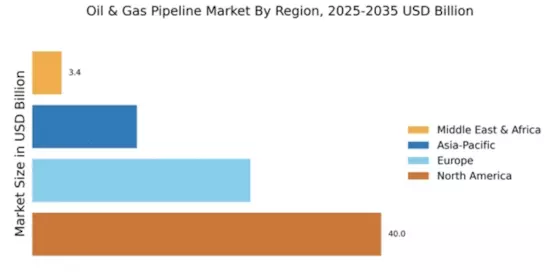
North America continues to lead the Oil & Gas Pipeline Market, holding a significant 40.0% share as of 2024. The region's growth is driven by increasing energy demands, regulatory support for infrastructure development, and advancements in technology. The U.S. and Canada are at the forefront, with investments in both traditional and renewable energy pipelines, ensuring a robust market environment. Regulatory frameworks are evolving to support sustainable practices, further enhancing market potential. The competitive landscape is characterized by major players such as TransCanada, Enbridge, and Kinder Morgan, who dominate the market with extensive pipeline networks. The U.S. is particularly notable for its vast infrastructure, while Canada is focusing on expanding its export capabilities. The presence of these key players ensures a dynamic market, with ongoing projects aimed at enhancing capacity and efficiency, positioning North America as a critical hub in the global energy landscape.

Europe : Growing Demand for Energy Security

Europe's Oil & Gas Pipeline Market is projected to capture a 25.0% share by 2025, driven by the need for energy security and diversification of supply sources. Regulatory initiatives aimed at reducing carbon emissions and enhancing energy efficiency are catalyzing investments in pipeline infrastructure. The European Union's Green Deal is a significant driver, promoting sustainable energy practices and supporting the transition to cleaner energy sources, which is vital for the region's energy strategy. Leading countries in this market include Germany, France, and the UK, where major players like TotalEnergies and Gazprom are actively involved. The competitive landscape is marked by collaborations and partnerships aimed at enhancing cross-border pipeline connectivity. As Europe seeks to reduce dependency on external energy sources, the focus on developing and modernizing pipeline networks is paramount, ensuring a resilient energy supply for the future.

Asia-Pacific : Emerging Market with High Potential

The Asia-Pacific region is witnessing significant growth in the Oil & Gas Pipeline Market, projected to hold a 12.0% share by 2025. This growth is fueled by increasing energy consumption, urbanization, and government initiatives aimed at enhancing energy infrastructure. Countries like China and India are investing heavily in pipeline projects to meet rising energy demands, supported by favorable regulatory frameworks that encourage foreign investments and technological advancements in pipeline construction and management. China leads the region with extensive pipeline networks, while India is rapidly expanding its infrastructure to support economic growth. Key players such as Cheniere Energy and other local firms are actively participating in this burgeoning market. The competitive landscape is evolving, with a focus on innovation and efficiency, positioning Asia-Pacific as a vital player in the global Oil & Gas sector, with immense potential for future growth.

Middle East and Africa : Resource-Rich Region with Challenges

The Middle East and Africa region, with a market share of 3.37%, is rich in oil and gas resources but faces challenges in pipeline infrastructure development. The growth in this region is driven by the need to transport hydrocarbons efficiently and the increasing demand for energy in emerging economies. Regulatory frameworks are gradually improving, encouraging investments in pipeline projects that enhance connectivity and support economic development across the region. Leading countries such as Saudi Arabia and Nigeria are focusing on expanding their pipeline networks to facilitate exports and meet domestic energy needs. The competitive landscape includes key players like Gazprom and local firms, who are working to overcome logistical and regulatory hurdles. As the region seeks to optimize its energy resources, the development of robust pipeline infrastructure will be crucial for its economic growth and energy security.

Key Players and Competitive Insights

The Oil & Gas Pipeline Market is characterized by a competitive landscape that is increasingly shaped by innovation, sustainability initiatives, and strategic partnerships. Key players such as TransCanada (CA), Enbridge (CA), and Kinder Morgan (US) are actively pursuing strategies that emphasize operational efficiency and technological advancement. For instance, these companies are focusing on enhancing pipeline safety and reducing environmental impact, which appears to be a critical driver of competitive differentiation in the current market. The collective strategies of these firms suggest a trend towards a more integrated and sustainable approach to pipeline operations, which is likely to influence market dynamics significantly.

In terms of business tactics, companies are increasingly localizing manufacturing and optimizing supply chains to enhance resilience and responsiveness to market demands. The competitive structure of the Oil & Gas Pipeline Market is moderately fragmented, with several key players exerting substantial influence. This fragmentation allows for a variety of operational strategies, which can lead to both competition and collaboration among firms, particularly in areas such as technology sharing and joint ventures.

In November 2025, Enbridge (CA) announced a major investment in digital pipeline monitoring technologies aimed at enhancing operational safety and efficiency. This strategic move is indicative of a broader trend within the industry towards the adoption of advanced technologies that facilitate real-time monitoring and predictive maintenance, potentially reducing downtime and operational costs. Such innovations are likely to position Enbridge favorably in a market that increasingly values technological prowess.

In October 2025, Kinder Morgan (US) completed a significant expansion of its natural gas pipeline network in the southeastern United States. This expansion not only increases the company’s capacity to transport natural gas but also aligns with the growing demand for cleaner energy sources. The strategic importance of this expansion lies in its potential to enhance Kinder Morgan's market share while supporting regional energy needs, thereby reinforcing its competitive position in a rapidly evolving energy landscape.

In September 2025, TransCanada (CA) entered into a partnership with a leading renewable energy firm to explore the integration of renewable energy sources into its pipeline operations. This collaboration reflects a strategic pivot towards sustainability, which is becoming increasingly vital in the Oil & Gas sector. By aligning with renewable energy initiatives, TransCanada is likely to enhance its reputation and appeal to a broader range of stakeholders, including environmentally conscious investors and regulators.

As of December 2025, the competitive trends in the Oil & Gas Pipeline Market are heavily influenced by digitalization, sustainability, and the integration of artificial intelligence (AI) into operations. Strategic alliances are becoming more prevalent, as companies recognize the value of collaboration in navigating the complexities of modern energy demands. Looking ahead, it appears that competitive differentiation will increasingly hinge on innovation and technology rather than traditional price-based competition. Firms that can effectively leverage technology and maintain reliable supply chains are likely to emerge as leaders in this evolving market.

Key Companies in the Oil & Gas Pipeline Market market include

Industry Developments

December 2022:For the second phase of a natural gas pipeline in the Vaca Muerta shale region, Argentina obtained funding of USD 689 million from the Brazilian state development bank BNDES.June 2022:The Mumbai - Nagpur Pipeline Project (Part A) Section II contract was granted to Kalpataru Power Transmission Limited (KPTL) to lay and construct a steel gas pipeline, terminals, and related facilities for GAIL (India) Ltd.

Future Outlook

Oil & Gas Pipeline Market Future Outlook

The Oil & Gas Pipeline Market is projected to grow at an 8.0% CAGR from 2024 to 2035, driven by increasing energy demand, technological advancements, and infrastructure investments.

New opportunities lie in:

  • Investment in smart pipeline monitoring technologies
  • Expansion of cross-border pipeline projects
  • Development of renewable energy pipeline infrastructure

By 2035, the market is expected to be robust, driven by innovation and strategic investments.

Market Segmentation

Oil & Gas Pipeline Market End Use Outlook

  • Crude Oil
  • Natural Gas
  • Refined Products
  • Petrochemicals

Oil & Gas Pipeline Market Application Outlook

  • Transportation
  • Industrial
  • Residential
  • Commercial

Oil & Gas Pipeline Market Material Type Outlook

  • Steel
  • Plastic
  • Composite
  • Concrete

Oil & Gas Pipeline Market Pipeline Type Outlook

  • Gathering Pipeline
  • Transmission Pipeline
  • Distribution Pipeline
  • Feeder Pipeline

Report Scope

MARKET SIZE 202480.37(USD Billion)
MARKET SIZE 202586.81(USD Billion)
MARKET SIZE 2035187.44(USD Billion)
COMPOUND ANNUAL GROWTH RATE (CAGR)8.0% (2024 - 2035)
REPORT COVERAGERevenue Forecast, Competitive Landscape, Growth Factors, and Trends
BASE YEAR2024
Market Forecast Period2025 - 2035
Historical Data2019 - 2024
Market Forecast UnitsUSD Billion
Key Companies ProfiledTransCanada (CA), Enbridge (CA), Kinder Morgan (US), Williams Companies (US), Oneok (US), Cheniere Energy (US), TC Energy (CA), Sempra Energy (US), Gazprom (RU), TotalEnergies (FR)
Segments CoveredApplication, End Use, Material Type, Pipeline Type
Key Market OpportunitiesIntegration of advanced monitoring technologies enhances safety and efficiency in the Oil & Gas Pipeline Market.
Key Market DynamicsRising regulatory pressures and technological advancements are reshaping the competitive landscape of the Oil and Gas Pipeline Market.
Countries CoveredNorth America, Europe, APAC, South America, MEA

Market Highlights

Author
Anshula Mandaokar
Team Lead - Research

Anshula Mandaokar holds an academic degree in Chemical Engineering and has been contributing to the field for more than 5 years. She has expertise in Market Research and Business Consulting and serves as a Team Lead for a reputed Market Research firm under the Chemicals and Materials domain spectrum. She has worked on multiple projects, generating explicit results in a quick turnaround time. Her understanding of data interpretation justifies her role as a leader.

Leave a Comment

FAQs

How much is the oil and gas pipelines market?

The Oil and Gas Pipelines Market size was valued at USD 80.37 Billion in 2024.

What is the growth rate of the oil and gas pipelines market?

The global market is projected to grow at a CAGR of 8.20% during the forecast period, 2025-2034.

Which region held the largest market share in the oil and gas pipelines market?

North America had the largest share in the global market

Who are the key players in the oil and gas pipelines market?

The key players in the market are Tenaris, Chevron Corporation, TMK Group, NIPPON STEEL ENGINEERING CO., LTD., NOV Inc., ConocoPhillips Company, SUBSEA 7, TechnipFMC pIc, Shell, and Welspun.

Which application led the oil and gas pipelines market?

The offshore category dominated the market in 2022.

Which stream type had the largest market share in the oil and gas pipelines market?

The midstream category had the largest share in the global market.

Download Free Sample

Kindly complete the form below to receive a free sample of this Report

Compare Licence

×
Features License Type
Single User Multiuser License Enterprise User
Price $4,950 $5,950 $7,250
Maximum User Access Limit 1 User Upto 10 Users Unrestricted Access Throughout the Organization
Free Customization
Direct Access to Analyst
Deliverable Format
Platform Access
Discount on Next Purchase 10% 15% 15%
Printable Versions