×
Request Free Sample ×

Kindly complete the form below to receive a free sample of this Report

* Please use a valid business email

Leading companies partner with us for data-driven Insights

clients tt-cursor
Hero Background

Pipeline Construction Market

ID: MRFR/PCM/10670-HCR
111 Pages
Chitranshi Jaiswal
October 2025

Pipeline Construction Market Research Report Information by Pipe Type (Metallic and Non-Metallic), By Application (Liquid Pipeline and Gas Pipeline), By End User (Oil and Gas, Chemical and Petrochemical, Water and Wastewater, Energy, Others), And by Region (North America, South America, Europe, Asia Pacific, And Middle East & Africa) –Market Forecast Till 2035

Share:
Download PDF ×

We do not share your information with anyone. However, we may send you emails based on your report interest from time to time. You may contact us at any time to opt-out.

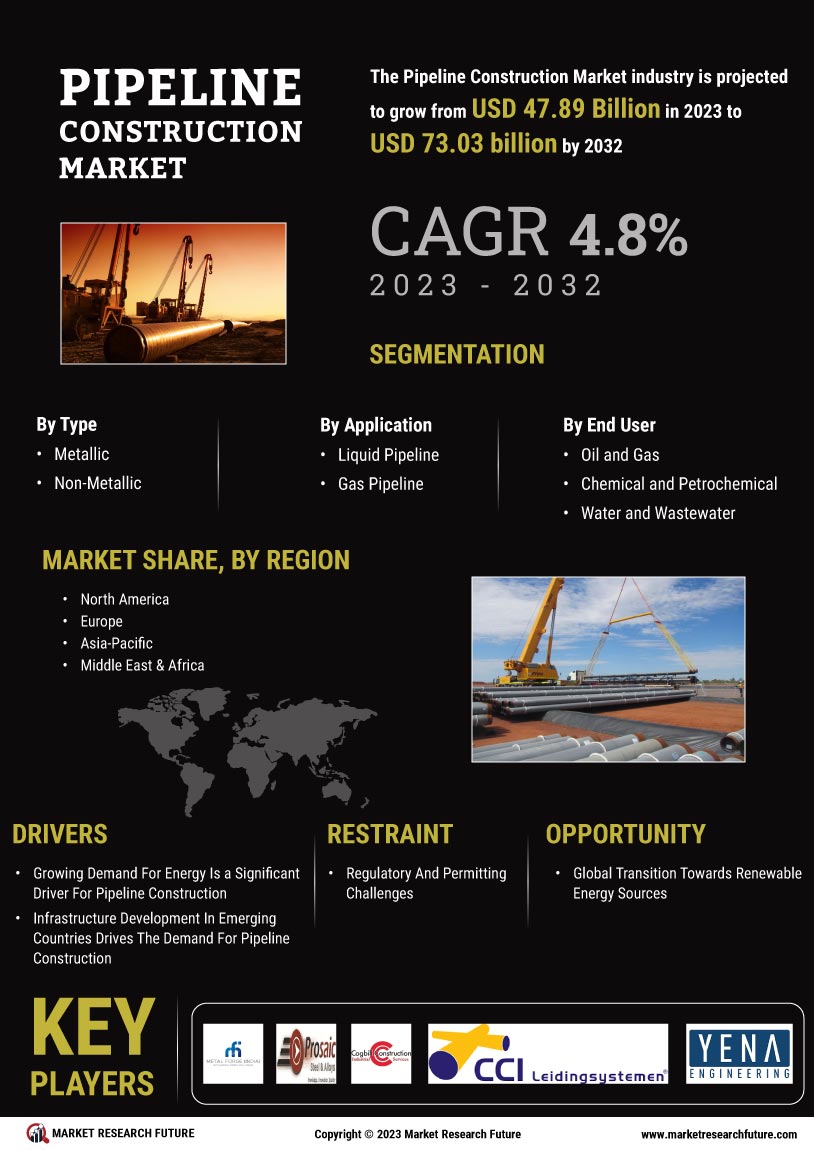
Pipeline Construction Market Infographic
Purchase Options

Pipeline Construction Market Summary

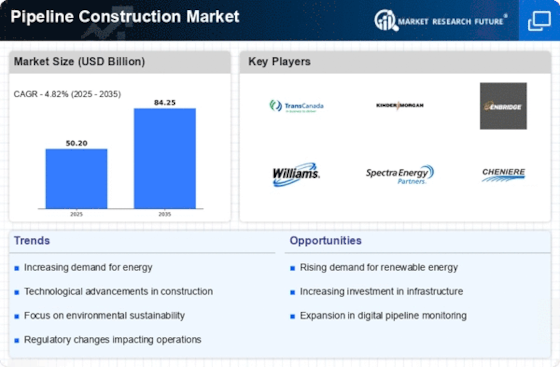
As per MRFR analysis, the Pipeline Construction Market Size was estimated at 50.2 USD Billion in 2024. The Pipeline Construction industry is projected to grow from 52.62 USD Billion in 2025 to 84.25 USD Billion by 2035, exhibiting a compound annual growth rate (CAGR) of 4.82 during the forecast period 2025 - 2035.

Key Market Trends & Highlights

The Pipeline Construction Market is currently experiencing a dynamic shift driven by technological advancements and sustainability initiatives.

  • North America remains the largest market for pipeline construction, driven by extensive infrastructure and energy demands.
  • Asia-Pacific is emerging as the fastest-growing region, fueled by rapid industrialization and urbanization.
  • The metallic pipeline segment continues to dominate the market, while the non-metallic segment is witnessing the fastest growth due to its lightweight and corrosion-resistant properties.
  • Increasing energy demand and investment in infrastructure development are key drivers propelling market expansion.

Market Size & Forecast

2024 Market Size 50.2 (USD Billion)
2035 Market Size 84.25 (USD Billion)
CAGR (2025 - 2035) 4.82%

Major Players

TransCanada Corporation (CA), Kinder Morgan, Inc. (US), Enbridge Inc. (CA), Williams Companies, Inc. (US), Spectra Energy Corp. (US), Cheniere Energy, Inc. (US), Sempra Energy (US), TotalEnergies SE (FR), Saipem S.p.A. (IT)

Pipeline Construction Market Trends

The Pipeline Construction Market is currently experiencing a dynamic phase characterized by evolving technologies and increasing demand for energy infrastructure. As nations strive to enhance their energy security and reduce reliance on traditional energy sources, investments in pipeline construction are likely to rise. This trend is further fueled by the global shift towards renewable energy, which necessitates the development of new pipelines to transport alternative fuels. Additionally, regulatory frameworks are adapting to accommodate these changes, potentially leading to streamlined processes and enhanced project viability. Moreover, the Pipeline Construction Market appears to be influenced by geopolitical factors, as countries seek to secure energy supplies through strategic partnerships and infrastructure development. The integration of advanced technologies, such as automation and digital monitoring systems, may enhance operational efficiency and safety in pipeline projects. As environmental concerns gain prominence, the industry is likely to witness a growing emphasis on sustainable practices, including the use of eco-friendly materials and methods. Overall, the Pipeline Construction Market is poised for transformation, driven by a confluence of technological advancements, regulatory changes, and shifting energy paradigms.

Technological Advancements

The Pipeline Construction Market is witnessing a surge in the adoption of innovative technologies. Automation, digital monitoring, and advanced materials are becoming increasingly prevalent, enhancing efficiency and safety in construction processes. These advancements may lead to reduced project timelines and improved cost management.

Sustainability Initiatives

There is a notable shift towards sustainable practices within the Pipeline Construction Market. Companies are increasingly focusing on eco-friendly materials and construction methods. This trend reflects a broader commitment to environmental stewardship and may influence project planning and execution.

Geopolitical Influences

Geopolitical dynamics are playing a crucial role in shaping the Pipeline Construction Market. Nations are pursuing strategic partnerships to secure energy supplies, which may lead to increased investments in infrastructure. This trend suggests a complex interplay between energy security and international relations.

Pipeline Construction Market Drivers

Increasing Energy Demand

The Pipeline Construction Market is experiencing a surge in demand driven by the increasing global energy requirements. As economies expand, the need for efficient transportation of oil and gas becomes paramount. According to recent data, energy consumption is projected to rise by approximately 30% by 2040, necessitating the construction of new pipelines to facilitate this growth. This trend is particularly evident in emerging markets, where industrialization and urbanization are accelerating. Consequently, the Pipeline Construction Market is likely to see substantial investments aimed at enhancing infrastructure to meet these energy demands.

Technological Innovations

Technological advancements are reshaping the Pipeline Construction Market, leading to enhanced efficiency and reduced costs. Innovations such as automated welding, advanced materials, and real-time monitoring systems are becoming increasingly prevalent. These technologies not only improve the safety and reliability of pipelines but also streamline construction processes. For example, the adoption of smart pipeline technologies is expected to reduce operational costs by up to 20%. As these technologies continue to evolve, they are likely to play a crucial role in the Pipeline Construction Market, enabling companies to meet the growing demand for energy infrastructure.

Regulatory Frameworks and Policies

The Pipeline Construction Market is significantly influenced by evolving regulatory frameworks and policies aimed at ensuring safety and environmental protection. Governments are increasingly implementing stringent regulations that govern pipeline construction, operation, and maintenance. These regulations often require advanced technologies and practices, which can drive up construction costs but also enhance safety and efficiency. For instance, the implementation of the Pipeline Safety Improvement Act has led to increased scrutiny and investment in pipeline integrity management. As a result, the Pipeline Construction Market is adapting to these regulatory changes, which may create opportunities for innovation and growth.

Environmental Sustainability Initiatives

The Pipeline Construction Market is increasingly aligning with environmental sustainability initiatives as stakeholders prioritize eco-friendly practices. Companies are adopting greener technologies and methods to minimize the environmental impact of pipeline construction. This shift is partly driven by public demand for sustainable energy solutions and regulatory pressures. For instance, the implementation of carbon capture technologies in pipeline projects is gaining traction. As a result, the Pipeline Construction Market is likely to see a rise in projects that not only focus on efficiency but also on reducing carbon footprints, thereby contributing to a more sustainable energy future.

Investment in Infrastructure Development

The Pipeline Construction Market is benefiting from increased investment in infrastructure development across various regions. Governments and private entities are recognizing the need for modernized energy infrastructure to support economic growth. In recent years, investments in pipeline projects have surged, with estimates suggesting that spending on pipeline construction could reach over 100 billion dollars annually by 2027. This influx of capital is expected to drive the Pipeline Construction Market forward, facilitating the construction of new pipelines and the expansion of existing networks to meet future energy demands.

Market Segment Insights

By Pipe Type: Metallic (Largest) vs. Non-Metallic (Fastest-Growing)

In the Pipeline Construction Market, the 'Pipe Type' segment showcases a distinct division between metallic and non-metallic pipes. Metallic pipes hold the largest market share, attributed to their robust durability and high-performance capabilities. They are widely utilized in various applications such as oil and gas transportation, where strength and longevity are critical. In contrast, non-metallic pipes, while currently representing a smaller share, are rapidly gaining popularity due to their lightweight nature and resistance to corrosion, making them ideal for diverse applications, including water supply systems and chemical transportation. The growth trends in the 'Pipe Type' segment present a dynamic landscape. The increasing demand for non-metallic pipes is driven by their advantages in terms of ease of installation, lower maintenance costs, and their non-corrosive properties. Moreover, technological advancements in materials and manufacturing processes are enhancing the performance characteristics of non-metallic pipes, further boosting their adoption in the pipeline construction sector. As environmental considerations become paramount, the shift towards non-metallic options is expected to accelerate, highlighting the evolving preferences in the market.

Pipe Material: Metallic (Dominant) vs. Non-Metallic (Emerging)

Metallic pipes, primarily made of steel or iron, dominate the Pipeline Construction Market with their unparalleled strength and durability, allowing them to withstand high pressures and temperatures. Their use is predominant in sectors requiring robust and long-lasting solutions, such as the oil and gas industries. Conversely, non-metallic pipes, often crafted from PVC, HDPE, or composite materials, are emerging rapidly due to their lighter weight, ease of installation, and resistance to corrosion. This growth is spurred by increasing environmental regulations that favor materials with lesser environmental impacts. As technological innovations continue to enhance the capabilities of non-metallic pipes, their market penetration is expected to increase, offering a compelling alternative to traditional metallic solutions.

By Application: Liquid Pipeline (Largest) vs. Gas Pipeline (Fastest-Growing)

The pipeline construction market is significantly segmented into liquid and gas pipeline applications, with liquid pipelines dominating the sector. Liquid pipelines account for the majority of project executions, primarily due to the extensive requirement for transporting crude oil, refined products, and large quantities of water across diverse geographical settings. Gas pipelines, though currently smaller in share, are increasingly important and are being developed rapidly, reflecting changing energy demands. Growth trends in this segment underscore a notable shift towards gas transportation as countries push for cleaner energy solutions. The rise in natural gas extraction, driven by advancements in drilling technologies and the increasing shift towards renewable energy sources, is expected to bolster the gas pipeline market. This evolution is also fueled by burgeoning industrial activity and infrastructure investments aimed at expanding gas distribution networks.

Application: Liquid Pipeline (Dominant) vs. Gas Pipeline (Emerging)

Liquid pipelines are a well-established segment within pipeline construction, characterized by their long-standing infrastructure stability and extensive utilization in transporting crude oil and refined products. Their dominance in the market is anchored in the established demand from traditional energy sectors. Conversely, gas pipelines are emerging as a critical player, driven by a global energy transition towards cleaner alternatives and the rising demand for natural gas. The growth of gas pipelines is propelled by governmental policies promoting natural gas as a transitional fuel, alongside the development of LNG facilities and regional pipeline networks. These dynamics not only highlight liquid pipelines' sustained dominance but also showcase the growing importance and future potential of gas pipelines within the pipeline construction market.

By End User: Oil and Gas (Largest) vs. Water and Wastewater (Fastest-Growing)

The Pipeline Construction Market exhibits a diverse distribution among its end-user segments, with Oil and Gas being the most significant contributor. This segment accounts for a substantial portion of the market, thanks to the enduring demand for energy resources. In contrast, the Water and Wastewater segment is rapidly gaining traction, driven by increasing infrastructure investments and a heightened emphasis on sustainable water management systems. Other segments, such as Chemical and Petrochemical, Energy (Power and Utilities), and Others also play essential roles, but they trail behind in overall market share. Growth trends indicate that while Oil and Gas remains dominant, the Water and Wastewater segment is poised for remarkable expansion, fueled by advancements in technology and regulatory mandates aimed at enhancing water quality. The need for efficient pipeline systems to accommodate urbanization and population growth further supports the growth of this segment. In general, factors such as industrialization, environmental concerns, and government initiatives are key drivers influencing the evolution of the Pipeline Construction Market's end-user segments.

Oil and Gas (Dominant) vs. Water and Wastewater (Emerging)

The Oil and Gas segment in the Pipeline Construction Market has consistently showcased dominance due to the continuous need for energy sources that support global economies. This segment is characterized by extensive project scopes, involving long-distance pipelines and complex logistics tailored for the transportation of crude oil and natural gas. Meanwhile, the Water and Wastewater segment is emerging rapidly, acknowledged for its proactive approach towards tackling water scarcity and wastewater treatment challenges. Driven by innovations in green technology and substantial investments in public utilities, this segment is not only crucial for environmental sustainability but also offers new construction opportunities. As cities expand and the demand for clean water escalates, the Water and Wastewater segment is expected to gain momentum, positioning itself as a significant player in the pipeline construction landscape.

Get more detailed insights about Pipeline Construction Market

Regional Insights

North America : Energy Infrastructure Leader

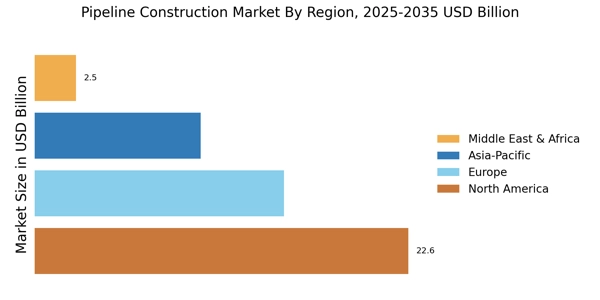
North America is the largest market for pipeline construction, holding approximately 45% of the global share. The region's growth is driven by increasing energy demand, regulatory support for infrastructure development, and significant investments in oil and gas projects. The U.S. and Canada are the primary contributors, with a focus on expanding existing networks and developing new routes to enhance energy security. The competitive landscape is characterized by major players such as TransCanada Corporation, Kinder Morgan, and Enbridge. These companies are actively involved in large-scale projects, leveraging advanced technologies to improve efficiency and safety. The regulatory environment, including the Federal Energy Regulatory Commission's guidelines, supports the expansion of pipeline networks, ensuring compliance with safety and environmental standards.

Europe : Regulatory Framework and Growth

Europe is witnessing a significant transformation in its pipeline construction market, holding around 30% of the global share. The growth is propelled by the European Union's commitment to energy diversification and sustainability, alongside regulatory frameworks that encourage investment in infrastructure. Countries like Germany and France are leading the charge, focusing on enhancing cross-border connectivity and reducing dependency on single energy sources. The competitive landscape features key players such as TotalEnergies and Saipem, who are engaged in various projects aimed at modernizing the existing pipeline infrastructure. The European market is characterized by stringent regulations that ensure environmental protection and safety, fostering a competitive environment that drives innovation and efficiency in construction practices.

Asia-Pacific : Emerging Market Potential

Asia-Pacific is rapidly emerging as a significant player in the pipeline construction market, accounting for approximately 20% of the global share. The region's growth is driven by increasing energy consumption, urbanization, and government initiatives to improve energy infrastructure. Countries like China and India are at the forefront, investing heavily in pipeline projects to support their growing economies and energy needs. The competitive landscape is marked by a mix of local and international players, with companies like Cheniere Energy and Sempra Energy making strategic investments. The region's regulatory environment is evolving, with governments implementing policies to streamline project approvals and enhance safety standards, thereby attracting foreign investments and fostering growth in the sector.

Middle East and Africa : Resource-Rich Opportunities

The Middle East and Africa region is rich in natural resources, holding about 5% of The Pipeline Construction Market. The growth is primarily driven by the need to transport oil and gas from production sites to global markets. Countries like Saudi Arabia and Nigeria are investing in pipeline infrastructure to enhance their export capabilities and meet international demand, supported by favorable government policies. The competitive landscape includes major players such as TotalEnergies and Saipem, who are involved in large-scale projects across the region. The regulatory environment is improving, with governments focusing on attracting foreign investments and ensuring compliance with international standards. This focus on infrastructure development is expected to bolster the region's position in The Pipeline Construction Market.

Pipeline Construction Market Regional Image

Key Players and Competitive Insights

The competitive landscape of the pipeline market report is characterized by the presence of both global and regional players. The pipeline construction market has witnessed consolidation through mergers and acquisitions, with larger companies acquiring smaller players to strengthen their market position and expand their capabilities. This trend has led to the formation of major players with diversified offerings and extensive geographic reach. In the pipeline construction market, pipeline contractors are increasingly adopting advanced technologies to improve project efficiency, safety, and environmental sustainability.

This includes the use of digital tools for project planning and management, advanced pipeline monitoring systems, and innovative construction techniques.

The major Pipeline Construction Market companies in the pipeline market report include Metal Forge India, Prosaic Steel and Alloys, Bechtel Corporation, Cogbill Construction LLC, CCI Leidingsystemen B.V, Yena Engineering B.V., Enka Insaat Ve Sanayi, Larsen & Turbo Limited, Seonghwa Industrial Co Ltd, Sung Il Sim Co. Ltd., among others. Companies with a broad geographic presence have an advantage in accessing diverse markets and opportunities. They can leverage their global or regional footprint to expand their market share and diversify their project portfolio.

Local and regional pipeline contractors have a competitive advantage in their respective markets due to their understanding of local regulations, cultural nuances, and specific project requirements.

Key Companies in the Pipeline Construction Market market include

Industry Developments

In October of 2024, TC Energy announced the completion of the Coastal GasLink pipeline. The project, which spans 416 miles, will translate the gas fields from northeastern British Columbia to the LNG Canada export terminal. More importantly, 10% of the project was owned solely by Indigenous people, which helped to strengthen the relationship between First Nations and infrastructure development.  

In March 2024, the Louisiana Energy Access Pipeline (LEAP) was enhanced by DT Midstream. The project is a multi-phase upgrade and is projected to be completed in late twenty twenty-four. The completion of the project will increase the capacity for transport from between 0.9 to 1.9 Bcf of gas per day. 

In the third Quarter of 2024, the operational launch of the Matterhorn Express Pipeline with a switchable capacity of 2.5 Bcf/day was completed. The Permian Basin is now linked to the Gulf Coast markets with the pipeline's construction.

In 2024, the NG3 project was tailored and presented by Momentum Midstream, and included within the project were plans to develop a 275-mile gathering pipeline network in the Haynesville area. Besides that, the project will incorporate integrated carbon capture and sequestration, which will align with the net-zero emissions target. 

In December 2023, the Permian Highway Project (PHP) expansion began by Kinder Morgan, intended to increase the current capacity by 550 MMcf daily. The project aims to transport.

In June 2023, Larsen & Toubro (L&T) won a major offshore contract with ONGC for the seventh segment of their pipeline replacement projects. It once again reinforced ONGC's faith in L&T Hydrocarbon Engineering (LTHE) to assist ONGC in the oil and gas sector and help enhance the country's energy market. This contract encompasses the engineering, procurement, construction, installation, and commissioning of approximately 350 kilometers of subsea pipelines and other related offshore works in the western coastal offshore fields of ONGC's offshore facilities.

Future Outlook

Pipeline Construction Market Future Outlook

The Pipeline Construction Market is projected to grow at a 4.82% CAGR from 2024 to 2035, driven by increasing energy demand, infrastructure investments, and technological advancements.

New opportunities lie in:

  • Investment in automated pipeline inspection technologies.
  • Development of eco-friendly pipeline materials.
  • Expansion into emerging markets with underdeveloped infrastructure.

By 2035, the market is expected to be robust, driven by innovation and strategic investments.

Market Segmentation

Pipeline Construction Market End User Outlook

  • Oil and Gas
  • Chemical and Petrochemical
  • Water and Wastewater
  • Energy (Power and Utilities)
  • Others

Pipeline Construction Market Pipe Type Outlook

  • Metallic
  • Non-Metallic

Pipeline Construction Market Application Outlook

  • Liquid Pipeline
  • Gas Pipeline

Report Scope

MARKET SIZE 202450.2(USD Billion)
MARKET SIZE 202552.62(USD Billion)
MARKET SIZE 203584.25(USD Billion)
COMPOUND ANNUAL GROWTH RATE (CAGR)4.82% (2024 - 2035)
REPORT COVERAGERevenue Forecast, Competitive Landscape, Growth Factors, and Trends
BASE YEAR2024
Market Forecast Period2025 - 2035
Historical Data2019 - 2024
Market Forecast UnitsUSD Billion
Key Companies ProfiledMarket analysis in progress
Segments CoveredMarket segmentation analysis in progress
Key Market OpportunitiesIntegration of advanced materials and automation technologies enhances efficiency in the Pipeline Construction Market.
Key Market DynamicsRising demand for sustainable energy sources drives innovation and regulatory changes in pipeline construction practices.
Countries CoveredNorth America, Europe, APAC, South America, MEA

Market Highlights

Author
Chitranshi Jaiswal
Research Analyst Level I

In her 3 years of experience in the market research field, she has handled critical cross-domain projects. She has an in-depth knowledge of market estimation & analysis, problem-solving, primary as well as secondary research, and team management.She holds an engineering degree and is an MBA professional from a well-known university, capable of evaluating the market and competitive conditions. An exceptional strategist with excellent communication skills and a passion for delivering cutting-edge & practical insights for the market. Proficient in multi-tasking, and can successfully deal with competing demands, while maintaining complete confidentiality. Generated business through active client and project development, networking, and high-quality responses. Her knowledge and skills have helped in making solid business decisions, securing funding from investors, and avoiding business failures.

Leave a Comment

FAQs

What is the current valuation of the Pipeline Construction Market as of 2024?

The Pipeline Construction Market was valued at 50.2 USD Billion in 2024.

What is the projected market size for the Pipeline Construction Market in 2035?

The market is projected to reach 84.25 USD Billion by 2035.

What is the expected CAGR for the Pipeline Construction Market during the forecast period 2025 - 2035?

The expected CAGR for the Pipeline Construction Market during 2025 - 2035 is 4.82%.

Which companies are considered key players in the Pipeline Construction Market?

Key players include TransCanada Corporation, Kinder Morgan, Inc., Enbridge Inc., and others.

What are the main segments of the Pipeline Construction Market?

The main segments include Pipe Type, Application, and End User.

How much is the Metallic pipe type segment valued at in 2024?

The Metallic pipe type segment was valued at 30.0 USD Billion in 2024.

Download Free Sample

Kindly complete the form below to receive a free sample of this Report

Compare Licence

×
Features License Type
Single User Multiuser License Enterprise User
Price $4,950 $5,950 $7,250
Maximum User Access Limit 1 User Upto 10 Users Unrestricted Access Throughout the Organization
Free Customization
Direct Access to Analyst
Deliverable Format
Platform Access
Discount on Next Purchase 10% 15% 15%
Printable Versions