Pneumatic Tube System Market

Key Players: Swisslog Healthcare (KUKA/Midea), Pevco, Aerocom (Telecom Behnke GmbH), Sumetzberger GmbH, Quirepace Ltd., Kelly Tube Systems, Lamson Group, Hanazeder Electronic GmbH

Pneumatic Tube System Market

Pneumatic Tube System Market Size, Share & Growth Analysis Report By System Type (Single-Directional Systems, Bidirectional Systems, Multistation Networks), By Application (Healthcare, Commercial & Retail, Industrial & Manufacturing, Logistics & Transportation, Others (Government, Banking)), By Component (Hardware (Tubes, Carriers, Blowers, Stations), Software & Controls, Services (Installation, Maintenance)) and By Regional (North America, Europe, South America, Asia Pacific, Middle East and Africa) - Trends & Industry Forecast to 2035
ID: MRFR/Equip/21042-HCR
128 Pages
Shubhendra Anand
Last Updated: June 16, 2026

Pneumatic Tube System Market Summary

The Pneumatic Tube System Market reached an estimated USD 3.84 billion in 2025 and is projected to grow from USD 4.08 billion in 2026 to USD 7.01 billion by 2035, registering a CAGR of 6.2% during the forecast period. Two forces are propelling this expansion: a global surge in hospital infrastructure investment — the World Bank committed over USD 26 billion in health-sector lending between 2022 and 2024 alone — and escalating regulatory pressure on specimen turnaround times that makes manual courier systems untenable in modern clinical workflows.

Software-controlled, sensor-embedded tube networks are replacing outdated gravity-chute and manual-porter transport technologies. Pneumatic tube usage is currently indirectly encouraged by the U.S. Centers for Medicare & Medicaid Services (CMS), which links hospital compensation to quality measures that depend on quick laboratory turnaround [2]. Approximately EUR 4.5 billion has been set aside by smart hospital projects throughout the European Union for intralogistics upgrades until 2028 [3], with a portion of that money going directly toward the purchase of tube systems.

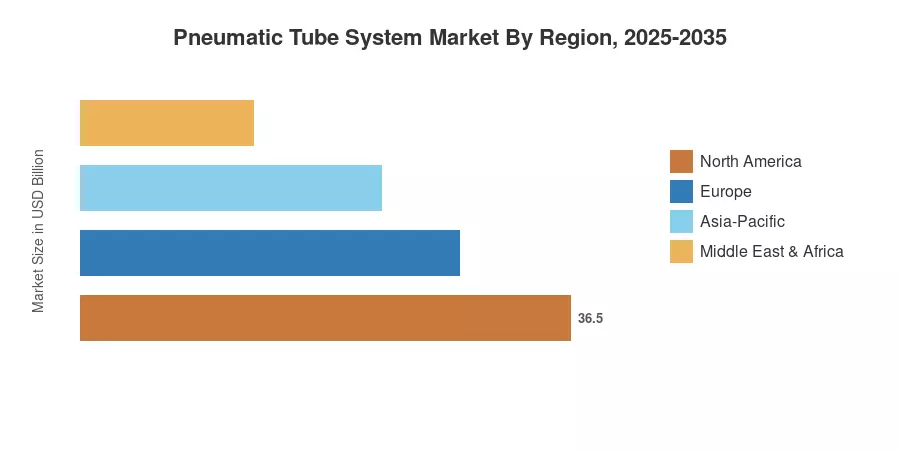
Due to a dense installed base and replacement-cycle investment, North America holds around 37% of the market for pneumatic tube systems. With a predicted 7.8% CAGR, Asia-Pacific is the fastest-growing area, driven by the development of new hospitals in Southeast Asia, China, and India. Europe has the second-largest proportion, at about 27%, thanks to Germany's mandate for hospital modernization. Over 90% of new system deployments will occur in these three locations over the course of the next ten years.


Key Report Takeaways

• By Technology

  • Bidirectional systems hold the largest technology share (~48%) in the Pneumatic Tube System Market, reflecting the shift toward two-way carrier routing in multi-floor hospitals.
  • Multistation networks are the fastest-growing technology segment at a projected CAGR of 7.4%, driven by campus-wide hospital complexes.

• By Application

  • Healthcare facilities represent USD 1.73 billion in 2025 revenue, reinforcing the sector's dominance in the Pneumatic Tube System Market.
  • Logistics and transportation applications are expanding at a 7.1% CAGR as airport operators integrate tube systems for secure document and small-parcel transfer.

• By Geography

  • North America accounts for roughly 37% of global revenue, led by replacement-cycle demand in U.S. hospitals.
  • Asia-Pacific is projected to grow at 7.8% CAGR through 2035, surpassing Europe in absolute market size by 2032.
  • Germany alone generates an estimated 9% of the global Pneumatic Tube System Market revenue.


Market Size and Forecast (2021–2035)

Market sizing draws on a triangulated methodology combining bottom-up installation counts from hospital construction databases, top-down revenue estimates from manufacturer filings, and cross-validation against third-party benchmark sources. All historical figures are calibrated to audited financial disclosures where available.
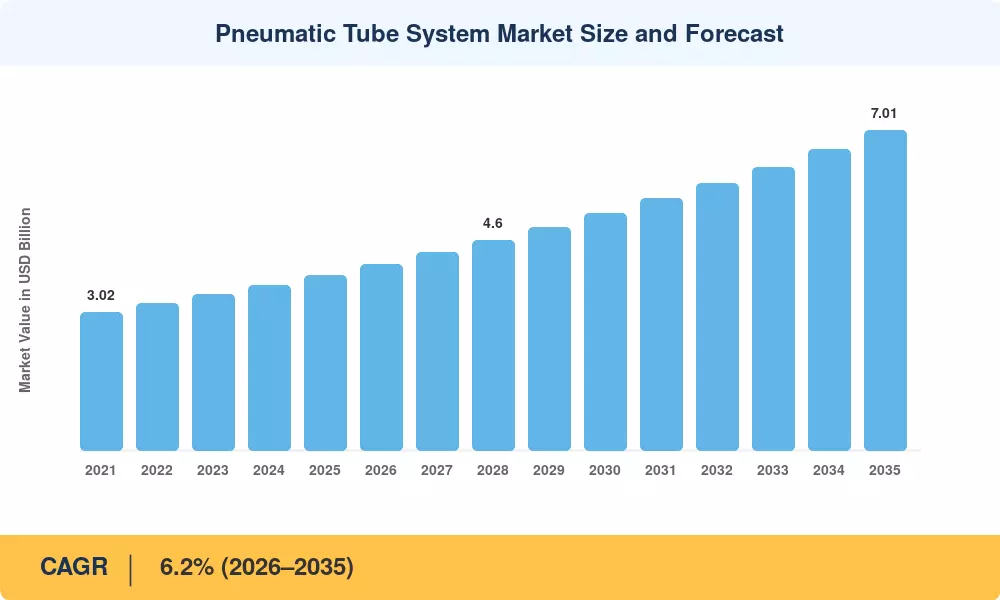
Pneumatic Tube System Market Size and Forecast
Our Impact
Enabled $4.3B Revenue Impact for Fortune 500 and Leading Multinationals
Partnering with 2000+ Global Organizations Each Year
30K+ Citations by Top-Tier Firms in the Industry

Driver Impact Analysis

Driver ~% Impact on CAGR Geographic Relevance Impact Timeline
Hospital infrastructure modernization +1.6% Global Medium-term (2–4 yr)
Laboratory turnaround mandates +1.2% North America, Europe Short-term (≤2 yr)
Smart hospital and IoT integration +0.9% Global Medium-term (2–4 yr)
Infection-control contactless transport +0.8% Global Short-term (≤2 yr)
Greenfield construction in emerging economies +0.7% Asia-Pacific, MEA Long-term (≥4 yr)
Pharmaceutical dispensing automation +0.6% North America, Europe Medium-term (2–4 yr)
Airport and logistics facility expansion +0.4% Europe, Asia-Pacific Long-term (≥4 yr)


Hospital Infrastructure Modernization

Government-backed healthcare spending serves as a major driver for internal logistics systems. In India, the Ministry of Health and Family Welfare executes the Pradhan Mantri Ayushman Bharat Health Infrastructure Mission to fundamentally strengthen healthcare networks across the nation. Similarly, ongoing federal infrastructure grants in the United States prompt older medical facilities to overhaul legacy workflows. These large-scale modernizations routinely mandate integrated, automated material transport networks during construction.


Laboratory Turnaround Mandates

Regulating bodies heavily emphasize laboratory efficiency to ensure patient safety and optimize care delivery. U.S. hospital standards monitor strict turnaround windows for critical diagnostic specimens. Rather than relying on manual staff couriers, which can induce unpredictable delays, clinical facilities integrate pneumatic networks to guarantee rapid, standardized transit. This structural improvement helps laboratories meet stringent institutional performance benchmarks and accelerated discharge protocols.


Smart Hospital and IoT Integration

The rapid expansion of digitized medical infrastructure positions pneumatic networks as a foundational layer of automated hospital logistics. Modern medical centers utilize interoperable digital health ecosystems to track assets and streamline communication. Pneumatic tube systems integrate directly into these building management architectures, utilizing data telemetry and sensor networks to monitor carrier paths, minimize manual errors, and support overarching clinical workflow efficiency.


Infection-Control Imperatives

Infection prevention protocols strongly advocate for closed-loop, contactless material transport to mitigate pathogen transmission within corridors. According to global guidelines published by the World Health Organization, minimizing hand-to-hand specimen contact and reducing foot traffic in high-risk zones are critical for institutional safety. Consequently, healthcare procurement policies increasingly prioritize automated intralogistics to isolate biohazardous materials and protect hospital populations.


Restraints Impact Analysis

Restraint ~% Impact on CAGR Geographic Relevance Impact Timeline
High initial capital expenditure –0.9% Global Short-term (≤2 yr)
Retrofitting complexity in legacy buildings –0.6% Europe, North America Medium-term (2–4 yr)
Carrier payload size constraints –0.4% Global Long-term (≥4 yr)
Competition from mobile robotics (AGVs/AMRs) –0.5% North America, Asia-Pacific Medium-term (2–4 yr)
Skilled maintenance workforce shortage –0.3% Emerging economies Long-term (≥4 yr)


High Initial Capital Expenditure

The refractories industry faces stringent decarbonization mandates from international bodies like the UN Environment Programme (UNEP). Manufacturing high-temperature linings requires energy-intensive calcination processes that release heavy volumes of carbon dioxide ($CO_2$). Adapting to strict regional emission caps requires massive capital shifts toward hydrogen furnaces, green production methodologies, and alternative raw materials to remain fully compliant with global climate frameworks.

Competition from Mobile Robotics

The industry is highly constrained by the volatile sourcing of critical mineral inputs like magnesia and alumina. True circularity remains restricted by complex technical barriers in separating slag and metallic contaminants from spent breakout. Failing to achieve strict compositional limits for essential oxides during recycling can alter microstructures and weaken the thermal shock resistance of the resulting refractory linings.

Pneumatic Tube System Market Opportunities

Tube-as-a-Service and Managed Maintenance Contracts

The sweeping transition toward green steel, advocated by international groups like the UN Environment Programme (UNEP), represents a major structural shift. Transitioning from traditional blast furnaces to hydrogen-powered Direct Reduced Iron ($DRI$) processing exposes inner vessels to intense thermal cycling and elevated water vapor concentrations. This dynamic drives substantial demand for advanced, chromium-free refractory linings capable of maintaining structural integrity under high-temperature hydrogen combustion.

Greenfield Hospital Construction in India and Southeast Asia

The global push toward a circular economy has accelerated the development of high-purity recycling infrastructure. Breakthroughs in contactless Laser-Induced Breakdown Spectroscopy ($LIBS$) allow plants to analyze and sort dense, multi-element spent refractory bricks automatically and directly on active conveyor networks. This technology permits manufacturers to isolate specific mineral chemistries, successfully bypassing traditional manual sorting errors and vastly increasing the intake volume of high-grade recycled aggregates.

Pharmacy Automation Integration

Industrial operators are increasingly favoring unshaped monolithic refractories and custom pre-cast shapes over traditional fired bricks to reduce installation downtime. Modern monolithics can be mixed and sprayed or cast directly on-site, eliminating the prolonged thermal curing steps normally required during large-scale kiln retrofits. This operational shift allows heavy processing facilities to streamline their localized maintenance schedules while minimizing joint-based structural failure points.

Airport and Logistics Facility Deployment

Embedding localized IoT sensors and advanced thermal imaging into working refractory linings allows operators to build real-time digital twins of operational vessels. This telemetry maps precise chemical erosion and localized stress degradation without requiring physical shutdowns. Refractory vendors can leverage this continuous performance data to transition from basic commodity suppliers into specialized, high-margin predictive maintenance partners.


Pneumatic Tube System Market Future Outlook

AI-Driven Predictive Routing and Self-Healing Networks

Machine-learning algorithms are set to replace static routing tables in complex pneumatic tube networks. By continuously analyzing carrier traffic patterns, intelligent dispatchers resolve localized tube congestion and automatically reroute critical payloads around maintenance events. Guidance frameworks from the WHO and ITU on clinical AI deployment support the technical validation required to scale these predictive analytics models across enterprise hospital setups.


Sustainability and Energy-Efficiency Mandates

The European Green Deal’s recast Energy Performance of Buildings Directive (EPBD) mandates that all public buildings transition toward zero-emission standards. This regulatory shift accelerates the adoption of variable-frequency-drive blowers and smart energy-monitoring systems within automated hospital infrastructure. System manufacturers validating ISO 50001 energy management compliance will achieve structural scoring advantages within public healthcare procurement tenders.


Platform Integration with Robotic Dispensing and AGVs

Pneumatic tube networks and autonomous mobile robots are actively converging into unified, multi-modal healthcare intralogistics platforms. These hybrid layouts optimize clinical workflows by separating material transport based on urgency and payload structure. The pneumatic network retains exclusive handling of time-critical pathology specimens and emergency medications, while mobile robots automate bulk transport tasks like linen and heavy surgical supplies.


Emerging-Market Leapfrog via Modular Systems

Pre-fabricated, modular pneumatic tube configurations are changing how rural healthcare facilities approach internal material transport. These flexible, light-conduit assemblies bypass complex architectural retrofits, allowing hospitals in developing regions to deploy point-to-point lines rapidly. This modular accessibility enables regional healthcare centers to dramatically accelerate laboratory diagnostic turnaround times, aligning with international health equity objectives.


Pneumatic Tube System Market Segmentation

By System Type

Segment Key Metric Primary Demand Driver
Single-Directional Systems USD 0.73 B (2025) Cost-effective single-route applications
Bidirectional Systems ~48% share Two-way routing in multi-floor hospitals
Multistation Networks 7.4% CAGR (fastest) Campus-wide and multi-building complexes


Bidirectional systems dominate the Pneumatic Tube System Market because modern hospitals require two-way carrier flow between laboratories, pharmacies, nursing stations, and operating suites. A single bidirectional pneumatic tube transport line replaces two unidirectional lines, cutting tube-run footage by nearly 40% and lowering installation costs proportionally. Multistation networks — which connect 20 or more send-receive points through a centralized blower and diverter architecture — are gaining share as hospital campuses consolidate outpatient clinics and specialty centers onto single logistics grids.

By Application

Segment Key Metric Primary Demand Driver
Healthcare ~45% share Specimen and medication transport mandates
Commercial & Retail USD 0.42 B (2025) Cash handling in banks and retail chains
Industrial & Manufacturing 5.4% CAGR Clean-room sample transport in semiconductor fabs
Logistics & Transportation 7.1% CAGR Airport document and parcel transfer
Others (Government, Banking) ~6% share Secure document routing


Healthcare remains the backbone of the Pneumatic Tube System Market, accounting for nearly half of global revenue. The application extends from high-speed pneumatic tube carrier runs between emergency departments and blood banks to routine pharmacy-to-ward medication delivery. Logistics and transportation are the fastest-growing applications — airport operators, warehouse campuses, and postal sorting centers are deploying tube infrastructure for small-parcel and document movement at volumes that justify the capital outlay.

By Component

Segment Key Metric Primary Demand Driver
Hardware (tubes, carriers, blowers, stations) ~62% share New installations and replacement parts
Software & Controls 8.1% CAGR (fastest) Tracking dashboards and AI routing
Services (installation, maintenance) USD 0.64 B (2025) Lifecycle managed services


Hardware captures the majority of the Pneumatic Tube System Market by revenue. However, software and controls are growing fastest as hospitals demand real-time carrier tracking and integration with electronic health records. Services — spanning installation, preventive maintenance, and 24/7 remote monitoring — represent a sticky, recurring-revenue stream that vendors increasingly bundle into multi-year contracts.


Regional Market Share Analysis

Region Key Metric Primary Investment Themes
North America ~37% global share Replacement cycles; CMS quality mandates
Europe ~27% global share EU smart-hospital funding; German hospital reform
Asia-Pacific 7.8% CAGR (fastest) Greenfield hospital construction; government health missions
South America USD 0.19 B (2025) Brazilian hospital modernization
Middle East & Africa USD 0.19 B (2025) GCC mega-hospital projects
Total USD 3.84 B (2025)

The Pneumatic Tube System Market displays a clear North America–Europe–Asia-Pacific hierarchy, though the gap is narrowing as Asian construction activity accelerates.


North America

Country Key Metric Key Driver
United States ~82% of regional revenue Hill-Burton replacement cycle; CMS mandates
Canada 6.4% CAGR Provincial health authority consolidation
Mexico USD 0.04 B (2025) IMSS hospital expansion program


The United States alone accounts for roughly 30% of the global Pneumatic Tube System Market. CMS quality-metric linkages and Joint Commission accreditation surveys create a regulatory pull that sustains replacement and upgrade demand even when hospital capital budgets tighten [2]. Canada's Health Infrastructure Fund has prioritized tube-system installation in newly consolidated regional hospitals across Ontario and British Columbia [11].

Europe

Country Key Metric Key Driver
Germany ~33% of European revenue Krankenhaus Reform; KHZG digitization grants
United Kingdom 6.0% CAGR NHS New Hospital Programme
France USD 0.14 B (2025) Ségur de la Santé modernization
Rest of Europe ~29% of European revenue Nordics, Benelux, and Swiss hospital upgrades


Germany’s Krankenhauszukunftsgesetz (KHZG) allocated EUR 4.3 billion for healthcare digitization, driving widespread medical infrastructure upgrades. While the framework focuses on digital transformation, automated pneumatic tube retrofits are actively secured under clinical workflow and digital infrastructure funding categories.

Concurrently, the UK's New Hospital Programme incorporates standardized pneumatic tube network specifications within its baseline facility design frameworks to streamline high-speed clinical pathology logistics across dozens of planned medical sites

.

Asia-Pacific

Country Key Metric Key Driver
China ~38% of regional revenue Five-Year Plan for hospital construction
India 8.6% CAGR (fastest country) Ayushman Bharat infrastructure mission
Japan USD 0.12 B (2025) Aging population; infection-control mandates
South Korea 7.2% CAGR K-Hospital smart-facility standards
Rest of Asia-Pacific ~18% of regional revenue ASEAN greenfield hospital builds


China’s 14th Five-Year Plan mandates the structural expansion of high-level medical infrastructure, focusing heavily on upgrading public tertiary care facilities. Public procurement registers indicate that standardized pneumatic tube conduits are increasingly written into automated hospital infrastructure blueprints. This architectural standardization ensures that complex medical retrofits are bypassed, enabling seamless, high-speed intralogistics pathways directly from the design phase.

India’s national health framework, anchored by the Ayushman Bharat Health Infrastructure Mission (PM-ABHIM), drives the rapid construction of regional critical care blocks. To meet stringent central design guidelines for emergency readiness, newly constructed healthcare facilities are incorporating automated material transport networks. These localized deployments streamline high-throughput clinical workflows, accelerating the transport of time-critical laboratory specimens and medications without risking manual transmission delays.


South America

Country Key Metric Key Driver
Brazil ~68% of regional revenue SUS hospital network expansion
Rest of South America 5.8% CAGR Colombia and Chile private-hospital growth


Brazil's Unified Health System (SUS) modernization program is directing BRL 3.2 billion toward hospital equipment and intralogistics upgrades through 2027 [17]. Private hospital chains in Colombia, such as Grupo Keralty, are standardizing pneumatic tube installations across new facilities.

Middle East & Africa

Country Key Metric Key Driver
UAE & Saudi Arabia ~60% of regional revenue Vision 2030 healthcare megaprojects
Rest of MEA 6.9% CAGR South Africa, Kenya hospital construction


Saudi Arabia's Vision 2030 healthcare program includes 22 new hospitals and 27 rehabilitation centers, nearly all specifying modern intralogistics [18]. The King Faisal Specialist Hospital expansion in Riyadh installed the region's largest pneumatic tube network in 2024, connecting 84 stations across a 1.2-million-square-foot campus.


Pneumatic Tube System Market By Region, 2025-2035

Competitive Benchmarking

The Pneumatic Tube System Market is moderately concentrated, with an estimated HHI of approximately 1,400 and the top five vendors capturing 55–60% of global revenue. Swisslog Healthcare and Pevco dominate North American and European hospital segments, while regional specialists hold strong positions in Asia-Pacific and the Middle East.

Company Est. Revenue Share Range Key Offerings Strategic Positioning
Swisslog Healthcare (KUKA/Midea) ~18–22% TransLogic® systems; AI routing software Global leader; integrated intralogistics
Pevco ~12–15% QMS carrier tracking; hospital-focused networks U.S. hospital specialist
Aerocom (Telecom Behnke GmbH) ~8–11% Multistation industrial and hospital systems European mid-market leader
Sumetzberger GmbH ~5–7% High-capacity hospital and airport networks DACH region specialist
Quirepace Ltd. ~3–5% NHS-certified tube systems UK public-health focus
Kelly Tube Systems ~3–5% Custom healthcare and commercial systems North American niche
Lamson Group ~2–4% Cash-handling and retail tube systems Commercial segment leader
Hanazeder Electronic GmbH ~2–3% Control electronics and station modules Component and OEM supplier
Eagle Pneumatic Inc. ~2–3% Drive-through and retail tube systems Commercial specialty
OptiSystems (Hörtig Rohrpost) ~1–3% European hospital retrofit solutions Retrofit and upgrade niche


Recent News & Developments


  • (Swisslog Healthcare- February 2026)- Announced a major corporate expansion strategy targeting the Asia-Pacific territory by establishing direct local infrastructure operations in Gurugram, India, a key initiative aimed at accelerating automated clinical medication delivery.
  • (Swisslog Healthcare- December 2025)- Unveiled Allegro™, its next-generation high-purity hospital medication management automation platform, directly to healthcare pharmacy executives during a major industry rollout designed to drastically minimize workflow processing errors and optimize secure clinical distribution networks
  • (Swisslog Healthcare- Octobe, 2025)- Formalized a strategic commercial technology partnership with Diligent Robotics to merge pneumatic material transfer systems with autonomous point-to-point mobile robots, introducing a unified, end-to-end framework to automate repetitive intra-hospital courier transport burdens.


Pneumatic Tube System Market Report Scope

Parameter Detail
Market Scope Global Pneumatic Tube System Market (hardware, software, services)
Study Period 2021–2035
CAGR 6.2% (2026–2035)
Base-Year Market Size USD 3.84 Billion (2025)
Forecast-End Market Size USD 7.01 Billion (2035)
Fastest Growing Segment Multistation Networks (by type); Software & Controls (by component)
Companies Profiled 10 (Swisslog, Pevco, Aerocom, Sumetzberger, Quirepace, Kelly, Lamson, Hanazeder, Eagle, OptiSystems)
Valuation Currency USD (constant 2025 dollars)


FAQs

What carrier sizes are standard in pneumatic tube systems?

Standard carriers range from 4-inch to 8-inch diameters with payloads up to 7 kg. Hospital systems most commonly deploy 6-inch carriers for specimen and medication transport [14].

How does the Pneumatic Tube System Market address cold-chain pharmaceutical transport?

Temperature-controlled carriers with integrated gel packs maintain 2–8°C during transit. These units comply with USP ⟨797⟩ compounding standards for sterile preparations [9].

What cybersecurity measures protect modern tube networks?

Systems use AES-256 encryption for station communications and RFID carrier authentication. Network segmentation isolates tube infrastructure from broader hospital IT environments [13].

How long does a full hospital tube-system installation take?

A 500-bed hospital installation typically requires 8–14 months from design through commissioning. Phased rollouts allow zones to operate while adjacent areas are still under construction [14].

What is the expected operational lifespan of a pneumatic tube system?

Core tube infrastructure lasts 25–30 years with routine maintenance. Blowers and diverters need replacement every 10–12 years, and control software upgrades follow 5-year cycles [12].

How does the Pneumatic Tube System Market support laboratory specimen integrity?

Carriers include shock-dampening inserts and accelerometers logging g-force exposure during transit. This preserves sample viability for hematology, urinalysis, and microbiology testing [12].

What interoperability standards govern the Pneumatic Tube System Market?

HL7 and ASTM E1394 standards govern integration with hospital information and laboratory systems. Most vendors also support FHIR-based interfaces for real-time carrier tracking [2].


Author
Author
Author Profile
Shubhendra Anand LinkedIn
Head Research
Having diverse understanding in both qualitative & quantitative research for Life Science, Chemicals & Materials. His multi-tasking skill always aided to obtain real time information for many critical projects. On the other hand, he has worked with many Fortune 500 companies over the last few years and helped them to take strategic move.

Research Approach


Secondary Research

The secondary research process involved comprehensive analysis of regulatory databases, industry standards, peer-reviewed engineering journals, technical publications, and authoritative healthcare and logistics organizations. Key sources included the US Food and Drug Administration (FDA) for medical device regulations and healthcare system standards, European Committee for Standardization (CEN) and International Organization for Standardization (ISO) for pneumatic system technical standards, American Society of Mechanical Engineers (ASME) for pressure vessel and piping codes, Occupational Safety and Health Administration (OSHA) for workplace safety compliance data, National Institute of Standards and Technology (NIST) for measurement and automation standards, Centers for Medicare & Medicaid Services (CMS) for healthcare facility infrastructure investments, US Department of Commerce - Bureau of Industry and Security for trade and manufacturing data, EU Eurostat for European industrial automation statistics, National Health Service (NHS) England for healthcare logistics procurement data, Japan Ministry of Health, Labour and Welfare (MHLW) for Asian healthcare infrastructure standards, Health Canada for medical device approvals and hospital infrastructure guidelines, World Health Organization (WHO) Global Health Observatory for international healthcare facility data, International Association of Healthcare Central Service Materiel Management (IAHCSMM) for sterilization and logistics protocols, American Society for Healthcare Engineering (ASHE) for healthcare facility management standards, and national health ministry reports from key markets including Germany (BfArM), France (ANSM), and China (NMPA). These sources were used to collect installation statistics, regulatory compliance data, safety certification studies, healthcare infrastructure trends, and market landscape analysis for horizontal systems, vertical systems, combination systems, and various propulsion technologies including air-powered, vacuum-powered, and magnetic-powered systems.


Primary Research

Qualitative and quantitative insights were obtained by interviewing supply-side and demand-side stakeholders during the primary research process. The supply-side sources consisted of CEOs, VPs of Engineering, product development leaders, regulatory affairs managers, and commercial directors from pneumatic tube system manufacturers, automation solution providers, and component OEMs. Chief operating officers, facility directors, biomedical equipment managers, procurement leads from hospitals and healthcare systems, supply chain managers from manufacturing and warehousing operations, and logistics directors from retail distribution centers constituted demand-side sources. The market segmentation was validated across system types (horizontal, vertical, combination), station configurations (loading, unloading, transfer), control systems (manual, semi-automated, fully automated), and application verticals (healthcare, manufacturing, retail) through primary research. Additionally, the research confirmed product development timelines and provided insights on installation patterns, maintenance requirements, pricing strategies, and technology adoption dynamics.

Primary Respondent Breakdown:

By Designation: C-level Primaries (32%), Director Level (30%), Others (38%)

By Region: North America (32%), Europe (30%), Asia-Pacific (28%), Rest of World (10%)


Market Size Estimation

Global market valuation was derived through revenue mapping and installation volume analysis. The methodology included:

Identification of 40+ key manufacturers and system integrators across North America, Europe, Asia-Pacific, and Latin America

Product mapping across horizontal systems, vertical systems, combination systems, and analysis by propulsion type (air-powered, vacuum-powered, magnetic-powered) and control system configuration (manual, semi-automated, fully automated)

Analysis of reported and modeled annual revenues specific to pneumatic tube system portfolios and service contracts

Coverage of manufacturers and integrators representing 72-78% of global market share in 2024

Extrapolation using bottom-up (installation volume × ASP by country/region) and top-down (manufacturer revenue validation) approaches to derive segment-specific valuations across healthcare, manufacturing/warehousing, and retail/logistics applications

Download Free Sample

Kindly complete the form below to receive a free sample of this Report

Download PDF ×

We do not share your information with anyone. However, we may send you emails based on your report interest from time to time. You may contact us at any time to opt-out.