×
Request Free Sample ×

Kindly complete the form below to receive a free sample of this Report

* Please use a valid business email

Leading companies partner with us for data-driven Insights

clients tt-cursor
Hero Background

Polymer Gel Market

ID: MRFR/CnM/4518-CR
100 Pages
Chitranshi Jaiswal
July 2018

Polymer Gel Market Research Report Information: by type (hydrogel, aerogel), forms (particle forms, amorphous gel, sheets, solid molded forms, blankets), raw material (PVA, PAA, PAN, PAM, silicone), end-use industry (cosmetics & personal care, healthcare, agriculture, water treatment, building & construction, chemical, electrical & electronics), and region – Forecast till 2035

Share:
Download PDF ×

We do not share your information with anyone. However, we may send you emails based on your report interest from time to time. You may contact us at any time to opt-out.

Polymer Gel Market Infographic
Purchase Options

Polymer Gel Market Summary

As per MRFR analysis, the Polymer Gel Market Size was estimated at 8.54 USD Billion in 2024. The Polymer Gel industry is projected to grow from 10.23 USD Billion in 2025 to 61.93 USD Billion by 2035, exhibiting a compound annual growth rate (CAGR) of 19.73 during the forecast period 2025 - 2035.

Key Market Trends & Highlights

The Polymer Gel Market is experiencing robust growth driven by sustainability and technological advancements.

  • North America remains the largest market for polymer gels, primarily due to its advanced healthcare sector.
  • Asia-Pacific is identified as the fastest-growing region, fueled by increasing demand for agricultural applications.
  • The medical segment dominates the market, while the agriculture segment is witnessing rapid expansion.
  • Rising demand in healthcare applications and advancements in material science are key drivers propelling market growth.

Market Size & Forecast

2024 Market Size 8.54 (USD Billion)
2035 Market Size 61.93 (USD Billion)
CAGR (2025 - 2035) 19.73%

Major Players

BASF SE (DE), Dow Inc. (US), Evonik Industries AG (DE), Huntsman Corporation (US), Nippon Shokubai Co., Ltd. (JP), SABIC (SA), 3M Company (US), Ashland Global Holdings Inc. (US), Kraton Corporation (US)

Polymer Gel Market Trends

The Polymer Gel Market is currently experiencing a dynamic evolution, driven by advancements in material science and increasing applications across various industries. These gels, known for their unique properties such as high absorbency and biocompatibility, are finding utility in sectors ranging from healthcare to agriculture. In the medical field, polymer gels are utilized in wound care, drug delivery systems, and tissue engineering, reflecting a growing trend towards innovative healthcare solutions. Furthermore, the agricultural sector is leveraging these materials for soil conditioning and water retention, indicating a shift towards sustainable practices. As the Polymer Gel Market continues to expand, the demand for environmentally friendly and biodegradable options is becoming more pronounced. Manufacturers are increasingly focusing on developing products that align with sustainability goals, which may enhance their market competitiveness. Additionally, the rise of personalized medicine and tailored therapeutic solutions is likely to further propel the market forward. Overall, the Polymer Gel Market appears poised for substantial growth, driven by technological advancements and evolving consumer preferences.

Sustainability Initiatives

The Polymer Gel Market is witnessing a notable shift towards sustainable practices, with manufacturers prioritizing the development of biodegradable and eco-friendly products. This trend reflects a broader societal push for environmental responsibility, as consumers increasingly favor products that minimize ecological impact.

Technological Advancements

Innovations in polymer chemistry are significantly influencing the Polymer Gel Market. Enhanced formulations and processing techniques are leading to improved performance characteristics, which may expand the range of applications and increase market penetration across various sectors.

Personalized Applications

The demand for customized solutions is rising within the Polymer Gel Market. Tailored products designed for specific applications in healthcare and agriculture are becoming more prevalent, suggesting a shift towards more individualized approaches that cater to unique consumer needs.

Polymer Gel Market Drivers

Growth in Agricultural Applications

The Global Polymer Gel Market Industry is significantly influenced by the agricultural sector, where polymer gels are utilized for water retention and soil conditioning. These gels enhance soil structure and improve moisture retention, which is crucial for sustainable agriculture. As global agricultural practices evolve towards more efficient water usage, the adoption of polymer gels is expected to rise. This trend is particularly relevant in arid regions where water scarcity is a pressing issue. The increasing focus on sustainable farming practices suggests that the Global Polymer Gel Market Industry will see a steady growth, contributing to the overall market value projected to reach 73.6 USD Billion by 2035.

Rising Demand in Healthcare Applications

The Global Polymer Gel Market Industry experiences a notable surge in demand due to its extensive applications in the healthcare sector. Polymer gels are increasingly utilized in drug delivery systems, wound care products, and tissue engineering. For instance, hydrogels are employed in advanced wound dressings that promote healing and reduce infection risks. As the global healthcare expenditure continues to rise, projected to reach 55 USD Billion in 2024, the demand for innovative polymer gel solutions is likely to increase. This trend indicates a robust growth trajectory for the Global Polymer Gel Market Industry, particularly in biocompatible and biodegradable materials.

Technological Advancements in Material Science

Innovations in material science are propelling the Global Polymer Gel Market Industry forward. The development of new polymer formulations and crosslinking techniques enhances the performance characteristics of polymer gels, making them more versatile for various applications. For example, advancements in smart hydrogels that respond to environmental stimuli are gaining traction in sectors such as drug delivery and biosensors. These technological improvements not only expand the application range but also increase the market's attractiveness to investors. As a result, the Global Polymer Gel Market Industry is poised for growth, with a projected CAGR of 2.68% from 2025 to 2035, reflecting the ongoing evolution in polymer technology.

Expansion of the Cosmetics and Personal Care Sector

The Global Polymer Gel Market Industry benefits from the expansion of the cosmetics and personal care sector, where polymer gels are widely used in formulations for skincare, haircare, and makeup products. These gels serve as effective thickeners, stabilizers, and moisturizers, enhancing product performance and consumer experience. The increasing demand for innovative and high-quality personal care products is driving manufacturers to incorporate polymer gels into their formulations. As the global cosmetics market continues to grow, the Global Polymer Gel Market Industry is likely to experience a corresponding increase in demand, further solidifying its position in the market.

Increasing Consumer Awareness of Eco-Friendly Products

The Global Polymer Gel Market Industry is witnessing a shift towards eco-friendly products, driven by increasing consumer awareness regarding environmental sustainability. Biodegradable polymer gels are gaining popularity as consumers seek alternatives to traditional materials that contribute to pollution. This trend is particularly evident in packaging and personal care products, where sustainable options are becoming a priority. As manufacturers respond to this demand by developing greener polymer gel solutions, the market is likely to expand. The emphasis on sustainability aligns with global initiatives aimed at reducing plastic waste, thereby enhancing the growth potential of the Global Polymer Gel Market Industry.
Market Segment Insights

By Application: Medical (Largest) vs. Agriculture (Fastest-Growing)

In the Polymer Gel Market, the application segment is diversifying, with a significant share captured by the Medical sector. Medical applications leverage polymer gels for drug delivery systems, wound care, and tissue engineering, reflecting the sector's dominance in market contributions. On the other hand, Agriculture is emerging strongly, utilizing polymer gels for soil moisture retention and controlled release fertilizers, indicating a growing recognition of their benefits in sustainable practices.

Agriculture: Soil Moisture Retention (Dominant) vs. Medical: Drug Delivery Systems (Emerging)

In the Polymer Gel Market, Agriculture has established itself as a dominant application, primarily due to its benefits in enhancing soil moisture retention and improving crop yields. Various forms of polymer gels are used to create a more conducive environment for plant growth while minimizing water usage, aligning with sustainability trends. Meanwhile, Medical applications, particularly drug delivery systems, are on the rise, as innovations in biocompatible materials revolutionize treatment methodologies. This sector is witnessing rapid advancements, enabling more effective and targeted delivery of pharmaceuticals, which positions it as an emerging player with immense growth potential.

By Type: Natural Polymer Gel (Largest) vs. Synthetic Polymer Gel (Fastest-Growing)

In the Polymer Gel Market, the segment distribution reveals that Natural Polymer Gel holds the largest market share, appealing to customers who prioritize eco-friendliness and sustainability. This segment thrives due to its application in various industries, including personal care and agriculture, driven by a growing trend toward natural and biodegradable products. In contrast, Synthetic Polymer Gel, while currently smaller in size, is recognized as the fastest-growing segment due to advancements in technology and the demand for versatile applications across medical and industrial sectors.

Natural Polymer Gel (Dominant) vs. Synthetic Polymer Gel (Emerging)

Natural Polymer Gel is positioned as the dominant segment in the Polymer Gel Market, characterized by its biodegradable properties and wide range of applications, particularly in cosmetics and agriculture. This segment benefits from a robust consumer trend favoring sustainable products that minimize environmental impact. On the other hand, Synthetic Polymer Gel is emerging rapidly, propelled by innovations that allow for customized properties, meeting specific industry needs including enhanced stability and performance. This dichotomy highlights a market increasingly defined by consumer preferences for sustainability versus performance-driven demands.

By End Use: Wound Care (Largest) vs. Drug Delivery (Fastest-Growing)

The Polymer Gel Market is significantly segmented into Wound Care, Drug Delivery, Personal Care, and Agricultural Products. Among these, Wound Care holds the largest share, driven by an increasing prevalence of chronic wounds and a growing aging population. In contrast, Drug Delivery is rapidly emerging as a substantial sector, leveraging innovative advancements in polymer technology to enhance therapeutic efficacy and patient compliance. Growth trends indicate that the Drug Delivery segment is set to outpace other areas within the Polymer Gel Market, fueled by rising demand for advanced drug formulations and personalized medicine. Moreover, increasing investments in research and development, coupled with the introduction of regulatory frameworks to support innovative products, are key drivers fostering this growth trajectory across the segments.

Wound Care (Dominant) vs. Drug Delivery (Emerging)

Wound Care represents a dominant segment within the Polymer Gel Market, primarily focusing on advanced wound dressings that promote healing and offer infection control. It benefits from a robust demand driven by the increasing number of surgical procedures and a higher incidence of diabetes-related wounds. On the other hand, Drug Delivery is emerging as a critical area, utilizing polymer gels to create controlled-release systems for medications. This segment's growth is propelled by advancements in formulation technologies, enhancing the bioavailability of drugs while minimizing side effects. Both segments highlight the versatility of polymer gels, showing substantial potential for innovation and market expansion.

By Formulation: Hydrogels (Largest) vs. Aerogels (Fastest-Growing)

In the Polymer Gel Market, hydrogels currently dominate the landscape owing to their versatile applications across health, agriculture, and personal care sectors. They hold a significant market share, primarily due to their ability to retain moisture, making them a favored choice in wound care products and agricultural gels. Aerogels, while holding a smaller share, are gaining traction in niches such as insulation and superabsorbent materials due to their lightweight and highly porous nature. The growth trends within this segment indicate a rapid expansion of aerogel applications driven by advancements in material science and increasing demand for lightweight materials in numerous industries. Hydrogels are also benefitting from ongoing innovations that enhance their properties, paving the way for new applications, particularly in the biomedical field, thereby contributing to their steady market presence.

Hydrogels (Dominant) vs. Aerogels (Emerging)

Hydrogels are a dominant force in the Polymer Gel Market, primarily due to their established applications in medical and agricultural sectors. Their ability to absorb and retain significant amounts of water makes them essential for products like wound dressings, moisture-retentive agricultural gels, and personal care items. In contrast, aerogels, while considered emerging in some areas, are rapidly finding their footing, particularly in insulation and specialty applications. Their ultralight nature and remarkable insulating properties position them as ideal materials for advanced engineering applications, such as in the aerospace and oil industries. As both segments continue to innovate, hydrogels will likely maintain a strong position, while aerogels exhibit dynamic growth potential.

By Functionality: Absorbent (Largest) vs. Adhesive (Fastest-Growing)

The Polymer Gel Market exhibits a significant distribution of market share across its functionality segments, with Absorbent leading as the largest segment due to its widespread applications in hygiene products, agriculture, and medical supplies. Adhesive follows closely, propelled by the increasing demand in packaging and construction industries, demonstrating substantial growth potential. Thickening Agents and Stabilizers also play essential roles but hold smaller market shares in comparison, reflecting their niche applications in specific sectors such as food and cosmetics.

Thickening Agent (Dominant) vs. Stabilizer (Emerging)

Thickening Agents are dominant in the Polymer Gel Market due to their versatility and widespread use in food processing and cosmetics, providing essential functions like viscosity control and texture enhancement. Meanwhile, Stabilizers are emerging as a noteworthy segment, essential for maintaining the consistency and quality of products such as paints and coatings. Innovations in formulations and increasing regulatory standards are driving the demand for Stabilizers as they ensure the longevity and stability of finished products. As industries continue to evolve, both segments show promise for sustained relevance and market growth.

Get more detailed insights about Polymer Gel Market

Regional Insights

North America : Market Leader in Polymer Gels

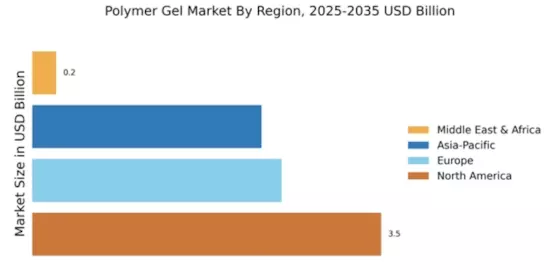
North America is poised to maintain its leadership in the Polymer Gel market, holding a significant share of 4.5 in 2024. The region's growth is driven by increasing demand in sectors such as healthcare, agriculture, and personal care. Regulatory support for innovative materials and sustainability initiatives further catalyze market expansion. The presence of major players like Dow Inc. and BASF SE enhances competitive dynamics, ensuring a robust market environment. The United States stands out as the leading country, contributing significantly to the regional market size. The competitive landscape is characterized by key players such as Huntsman Corporation and 3M Company, which are investing in R&D to develop advanced polymer gel solutions. This focus on innovation, coupled with strategic partnerships, positions North America as a hub for polymer gel advancements, catering to diverse applications across industries.

Europe : Emerging Market with Growth Potential

Europe's Polymer Gel market is on a growth trajectory, with a market size of 2.5 in 2024. The region benefits from stringent regulations promoting eco-friendly materials, driving demand for sustainable polymer gel solutions. Countries like Germany and France are at the forefront, leveraging technological advancements and innovation to meet market needs. The increasing application of polymer gels in pharmaceuticals and cosmetics is a key growth driver, supported by favorable government policies. Germany leads the market, supported by major players such as Evonik Industries AG and BASF SE, which are focusing on sustainable product development. The competitive landscape is marked by collaborations and mergers aimed at enhancing product offerings. As the market evolves, Europe is expected to witness increased investments in R&D, further solidifying its position in The Polymer Gel.

Asia-Pacific : Rapid Growth in Emerging Economies

The Asia-Pacific region is experiencing rapid growth in the Polymer Gel market, with a market size of 1.8 in 2024. This growth is fueled by rising industrialization, urbanization, and increasing demand for polymer gels in agriculture and healthcare. Countries like China and Japan are leading the charge, supported by government initiatives aimed at boosting manufacturing and innovation in polymer technologies. The region's diverse applications are driving significant investments in the sector. China is the dominant player in the market, with key companies like Nippon Shokubai Co., Ltd. and Kraton Corporation actively expanding their operations. The competitive landscape is characterized by a mix of local and international players, fostering innovation and competitive pricing. As the market matures, Asia-Pacific is expected to become a significant contributor to the global polymer gel landscape, driven by technological advancements and strategic partnerships.

Middle East and Africa : Emerging Market with Untapped Potential

The Middle East and Africa region is gradually emerging in the Polymer Gel market, with a market size of 0.74 in 2024. The growth is primarily driven by increasing demand in sectors such as agriculture and construction, where polymer gels are utilized for water retention and soil enhancement. Government initiatives aimed at diversifying economies and promoting sustainable practices are also contributing to market development. The region's untapped potential presents opportunities for growth in polymer gel applications. Countries like South Africa and Saudi Arabia are leading the way, with local companies beginning to explore polymer gel production. The competitive landscape is still developing, with a few key players starting to establish their presence. As investments in infrastructure and technology increase, the Middle East and Africa are expected to see significant advancements in the polymer gel market, paving the way for future growth.

Key Players and Competitive Insights

The Polymer Gel Market is currently characterized by a dynamic competitive landscape, driven by innovation, sustainability, and strategic partnerships. Key players such as BASF SE (DE), Dow Inc. (US), and Evonik Industries AG (DE) are at the forefront, leveraging their extensive research and development capabilities to enhance product offerings. BASF SE (DE) has focused on expanding its portfolio of bio-based polymer gels, which aligns with the growing demand for sustainable materials. Meanwhile, Dow Inc. (US) emphasizes digital transformation and supply chain optimization, aiming to improve operational efficiency and customer engagement. These strategies collectively foster a competitive environment that prioritizes innovation and responsiveness to market needs.

In terms of business tactics, companies are increasingly localizing manufacturing to reduce lead times and enhance supply chain resilience. The market structure appears moderately fragmented, with several players vying for market share while also collaborating through strategic alliances. This collective influence of key players not only shapes pricing strategies but also drives technological advancements within the sector.

In November 2025, Evonik Industries AG (DE) announced a strategic partnership with a leading biotechnology firm to develop advanced polymer gels for medical applications. This collaboration is poised to enhance Evonik's capabilities in the healthcare sector, reflecting a broader trend towards specialization and innovation in product development. The strategic importance of this partnership lies in its potential to open new revenue streams and strengthen Evonik's position in a high-growth market segment.

In October 2025, Dow Inc. (US) launched a new line of polymer gels designed for use in personal care products, emphasizing sustainability and performance. This initiative not only showcases Dow's commitment to environmentally friendly solutions but also responds to the increasing consumer demand for sustainable personal care options. The launch is likely to enhance Dow's competitive edge by appealing to eco-conscious consumers and expanding its market reach.

In September 2025, BASF SE (DE) completed the acquisition of a small but innovative polymer gel manufacturer, which is expected to bolster its product development capabilities. This acquisition reflects a strategic move to enhance BASF's technological expertise and diversify its product offerings. The integration of this new entity is anticipated to accelerate innovation and improve BASF's competitive positioning in the polymer gel market.

As of December 2025, current competitive trends indicate a strong emphasis on digitalization, sustainability, and the integration of artificial intelligence in product development. Strategic alliances are increasingly shaping the landscape, allowing companies to pool resources and expertise to drive innovation. Looking ahead, competitive differentiation is likely to evolve from traditional price-based competition towards a focus on technological advancements, supply chain reliability, and sustainable practices. This shift underscores the importance of innovation as a key driver of market success.

Key Companies in the Polymer Gel Market market include

Industry Developments

In the year 2020, one of the leading market players, BASF had brought in a new version of polymer gel that is named Luviset 360, which is considered as the new styling polymer and is designed especially for humid regions.

In the year 2020, one of the leading market players, Evonik had stated that they were exploring the characteristics of superabsorbent polymers.

Future Outlook

Polymer Gel Market Future Outlook

The Polymer Gel Market is projected to grow at a 19.73% CAGR from 2024 to 2035, driven by advancements in healthcare, agriculture, and consumer products.

New opportunities lie in:

  • Development of biodegradable polymer gels for sustainable packaging solutions.
  • Expansion into emerging markets with tailored product offerings.
  • Investment in R&D for innovative applications in drug delivery systems.

By 2035, the Polymer Gel Market is expected to achieve substantial growth, solidifying its position as a key industry.

Market Segmentation

Polymer Gel Market Type Outlook

  • Natural Polymer Gel
  • Synthetic Polymer Gel
  • Hybrid Polymer Gel

Polymer Gel Market End Use Outlook

  • Wound Care
  • Drug Delivery
  • Personal Care
  • Agricultural Products

Polymer Gel Market Application Outlook

  • Medical
  • Agriculture
  • Cosmetics
  • Food
  • Industrial

Polymer Gel Market Formulation Outlook

  • Hydrogels
  • Aerogels
  • Elastomers

Polymer Gel Market Functionality Outlook

  • Absorbent
  • Adhesive
  • Thickening Agent
  • Stabilizer

Report Scope

MARKET SIZE 20248.54(USD Billion)
MARKET SIZE 202510.23(USD Billion)
MARKET SIZE 203561.93(USD Billion)
COMPOUND ANNUAL GROWTH RATE (CAGR)19.73% (2024 - 2035)
REPORT COVERAGERevenue Forecast, Competitive Landscape, Growth Factors, and Trends
BASE YEAR2024
Market Forecast Period2025 - 2035
Historical Data2019 - 2024
Market Forecast UnitsUSD Billion
Key Companies ProfiledBASF SE (DE), Dow Inc. (US), Evonik Industries AG (DE), Huntsman Corporation (US), Nippon Shokubai Co., Ltd. (JP), SABIC (SA), 3M Company (US), Ashland Global Holdings Inc. (US), Kraton Corporation (US)
Segments CoveredApplication, Type, End Use, Formulation, Functionality
Key Market OpportunitiesAdvancements in biocompatible polymer gels enhance applications in medical and pharmaceutical sectors.
Key Market DynamicsRising demand for biodegradable polymer gels drives innovation and competition among manufacturers in diverse applications.
Countries CoveredNorth America, Europe, APAC, South America, MEA

Market Highlights

Author
Chitranshi Jaiswal
Research Analyst Level I

In her 3 years of experience in the market research field, she has handled critical cross-domain projects. She has an in-depth knowledge of market estimation & analysis, problem-solving, primary as well as secondary research, and team management.She holds an engineering degree and is an MBA professional from a well-known university, capable of evaluating the market and competitive conditions. An exceptional strategist with excellent communication skills and a passion for delivering cutting-edge & practical insights for the market. Proficient in multi-tasking, and can successfully deal with competing demands, while maintaining complete confidentiality. Generated business through active client and project development, networking, and high-quality responses. Her knowledge and skills have helped in making solid business decisions, securing funding from investors, and avoiding business failures.

Leave a Comment

FAQs

What was the polymer gel market valuation in 2035?

In 2035, the valuation was USD 11,357.2 million.

What would be the valuation of the polymer gel market by 2035?

The polymer gel valuation would be USD 16,312.5 million.

What is the market size of the polymer gel industry?

The market value of the polymer gel industry was at USD 39 billion in the year 2019 and it is expected to surpass the market value of over USD 55 billion by the year 2024 while registering a CAGR of 6% during the forecast period.

What would be the valuation of the polyacrylic acid by 2035?

The valuation would reach USD 7.83 billion.

Which form would dominate the polyacrylic acid market?

The amorphous segment would have the upper hand in the market.

What are the common raw materials used?

• Poly Acrylic Acid • Poly Vinyl Alcohol

Download Free Sample

Kindly complete the form below to receive a free sample of this Report

Compare Licence

×
Features License Type
Single User Multiuser License Enterprise User
Price $4,950 $5,950 $7,250
Maximum User Access Limit 1 User Upto 10 Users Unrestricted Access Throughout the Organization
Free Customization
Direct Access to Analyst
Deliverable Format
Platform Access
Discount on Next Purchase 10% 15% 15%
Printable Versions