×
Request Free Sample ×

Kindly complete the form below to receive a free sample of this Report

* Please use a valid business email

Leading companies partner with us for data-driven Insights

clients tt-cursor
Hero Background

Sol-Gel Coatings Market

ID: MRFR/CnM/4843-CR
130 Pages
Anshula Mandaokar
September 2019

Sol-Gel Coatings Market Research Report Information by Application (Automotive Glass, Healthcare, Marine, Construction, Mobile Device Screens, Solar Panels and others) and Region (North America, Europe, Asia-Pacific, Latin America and Middle East & Africa) - Forecast till 2035

Share:
Download PDF ×

We do not share your information with anyone. However, we may send you emails based on your report interest from time to time. You may contact us at any time to opt-out.

Sol-Gel Coatings Market Infographic
Purchase Options

Sol-Gel Coatings Market Summary

As per MRFR analysis, the Sol-Gel Coatings Market Size was estimated at 14.88 USD Million in 2024. The Sol-Gel Coatings industry is projected to grow from 16.13 in 2025 to 36.1 by 2035, exhibiting a compound annual growth rate (CAGR) of 8.39 during the forecast period 2025 - 2035.

Key Market Trends & Highlights

The Sol-Gel Coatings Market is poised for substantial growth driven by sustainability and technological advancements.

  • North America remains the largest market for sol-gel coatings, reflecting a strong demand across various industries.
  • Asia-Pacific is emerging as the fastest-growing region, indicating a shift towards innovative coating solutions.
  • Protective coatings dominate the market, while optical coatings are gaining traction due to their versatility and customization options.
  • Key market drivers include a heightened focus on sustainability and advancements in nanotechnology, which are shaping future developments.

Market Size & Forecast

2024 Market Size 14.88 (USD Million)
2035 Market Size 36.1 (USD Million)
CAGR (2025 - 2035) 8.39%

Major Players

Sol-Gel Technologies (US), Heraeus Holding (DE), Nippon Paint Holdings (JP), AkzoNobel (NL), PPG Industries (US), BASF (DE), 3M (US), Saint-Gobain (FR), Huntsman Corporation (US)

Sol-Gel Coatings Market Trends

The Sol-Gel Coatings Market is currently experiencing a notable transformation, driven by advancements in material science and increasing demand for high-performance coatings across various industries. These coatings, characterized by their unique properties such as excellent adhesion, durability, and resistance to environmental factors, are finding applications in sectors ranging from automotive to electronics. The versatility of sol-gel technology allows for the development of coatings that can be tailored to meet specific requirements, thereby enhancing their appeal in a competitive landscape. Furthermore, the growing emphasis on sustainability and eco-friendly solutions is prompting manufacturers to explore innovative formulations that minimize environmental impact while maintaining performance standards. In addition, the Sol-Gel Coatings Market is witnessing a shift towards the integration of nanotechnology, which appears to enhance the functional properties of coatings. This trend suggests a potential for improved performance characteristics, such as increased hardness and scratch resistance, which are crucial for applications in demanding environments. As industries continue to prioritize efficiency and longevity in their products, the sol-gel approach is likely to gain further traction. Overall, the market seems poised for growth, driven by technological advancements and evolving consumer preferences that favor high-quality, sustainable solutions.

Sustainability Focus

The Sol-Gel Coatings Market is increasingly influenced by a shift towards sustainable practices. Manufacturers are exploring eco-friendly materials and processes to reduce environmental impact. This trend reflects a broader industry movement towards greener alternatives, appealing to environmentally conscious consumers.

Nanotechnology Integration

The incorporation of nanotechnology into sol-gel coatings is emerging as a significant trend. This integration enhances the performance characteristics of coatings, such as durability and resistance to wear. As industries seek advanced solutions, this trend is likely to shape future developments in the market.

Customization and Versatility

Customization is becoming a key driver in the Sol-Gel Coatings Market. The ability to tailor coatings for specific applications allows manufacturers to meet diverse customer needs. This versatility is essential in sectors like automotive and electronics, where performance requirements vary widely.

Sol-Gel Coatings Market Drivers

Market Growth Projections

The Global Sol-Gel Coatings Market Industry is poised for substantial growth, with projections indicating a market size of 2500 USD Million in 2024 and an expected increase to 5000 USD Million by 2035. This growth trajectory suggests a robust demand for sol-gel coatings across various industries, driven by technological advancements and increasing applications. The market is likely to experience a compound annual growth rate of 6.5% from 2025 to 2035, reflecting the ongoing innovation and adoption of sol-gel technologies in diverse sectors.

Advancements in Nanotechnology

Nanotechnology is revolutionizing the Global Sol-Gel Coatings Market Industry by enhancing the properties of coatings. The incorporation of nanoparticles into sol-gel formulations can improve mechanical strength, thermal stability, and corrosion resistance. This technological advancement is particularly beneficial in industries such as electronics and aerospace, where performance is critical. As manufacturers continue to explore innovative applications, the demand for high-performance sol-gel coatings is expected to rise. The market is anticipated to grow at a CAGR of 6.5% from 2025 to 2035, indicating a robust future driven by technological progress.

Rising Applications in Electronics

The electronics sector is increasingly adopting sol-gel coatings due to their superior insulating and protective properties. These coatings are utilized in various applications, including circuit boards and optical devices, where durability and performance are paramount. The Global Sol-Gel Coatings Market Industry is witnessing a surge in demand as manufacturers seek reliable solutions to enhance product longevity. With the market projected to reach 5000 USD Million by 2035, the electronics industry plays a crucial role in driving growth and innovation within the sol-gel coatings segment.

Expansion of the Construction Sector

The construction sector's expansion is significantly influencing the Global Sol-Gel Coatings Market Industry. As urbanization continues to rise globally, there is an increasing demand for durable and aesthetically pleasing coatings for buildings and infrastructure. Sol-gel coatings offer excellent adhesion, weather resistance, and aesthetic versatility, making them ideal for various applications in construction. This trend is likely to drive market growth, as the construction industry seeks innovative solutions to enhance the longevity and appearance of structures. The anticipated growth in this sector further supports the overall expansion of the sol-gel coatings market.

Growing Demand for Eco-Friendly Coatings

The increasing emphasis on sustainability is driving the Global Sol-Gel Coatings Market Industry towards eco-friendly solutions. As industries seek to reduce their environmental footprint, sol-gel coatings, which are often derived from non-toxic materials, are gaining traction. These coatings not only provide excellent performance but also align with regulatory requirements aimed at minimizing hazardous substances. This trend is evident in sectors such as automotive and construction, where companies are adopting greener alternatives. The Global Sol-Gel Coatings Market is projected to reach 2500 USD Million in 2024, reflecting a significant shift towards sustainable practices.

Increased Investment in Research and Development

Investment in research and development is a key driver of innovation within the Global Sol-Gel Coatings Market Industry. Companies are focusing on developing new formulations that offer enhanced properties and broader applications. This commitment to R&D is evident in collaborations between academic institutions and industry players, leading to breakthroughs in sol-gel technology. As a result, the market is likely to expand, with new products entering the market that cater to diverse needs. This focus on innovation is expected to contribute to the overall growth of the market in the coming years.
Market Segment Insights

By Application: Protective Coatings (Largest) vs. Optical Coatings (Fastest-Growing)

The Sol-Gel Coatings Market segment is predominantly led by Protective Coatings, which holds a significant share in terms of applications. This segment's robust demand stems from its ability to provide durable and resilient finishes for various substrates, making it a preferred choice across industries such as aerospace, automotive, and construction. On the other hand, Optical Coatings have emerged as a rapidly growing application, driven by the increasing advancement in the electronics and optics sectors, where precision is crucial.

Protective Coatings (Dominant) vs. Functional Coatings (Emerging)

Protective Coatings are characterized by their excellent resistance to environmental factors, abrasion, and chemicals, which contributes to their dominant position in the Sol-Gel Coatings Market. This application is particularly favored in industries requiring long-lasting protection solutions. In contrast, Functional Coatings represent an emerging segment that includes interactive and responsive surfaces, such as self-cleaning and anti-fogging coatings. As industries continue to innovate, the demand for Functional Coatings is expected to escalate, driven by technological advancements and the need for sustainable solutions. Their unique properties are creating new avenues for growth.

By End Use Industry: Automotive (Largest) vs. Aerospace (Fastest-Growing)

The Sol-Gel Coatings Market is significantly influenced by its end-use industries, with the automotive sector holding the largest share due to the increasing demand for lightweight materials that enhance vehicle performance and aesthetics. This segment benefits from advancements in sol-gel technology, enabling manufacturers to create coatings that provide superior adhesion, durability, and resistance to environmental factors. Meanwhile, aerospace is emerging as a rapidly growing segment driven by innovations in coating applications that enhance the safety and performance of aircraft components. Growth trends in the Sol-Gel Coatings Market for these end-use industries highlight a shift towards sustainability and energy efficiency. In the automotive sector, regulatory pressures for fuel economy and emissions reduction are propelling the adoption of sol-gel coated products. The aerospace industry, on the other hand, is experiencing a surge in demand for advanced coatings that offer weight reduction and improved thermal resistance, making it a fast-growing area that caters to the latest advancements in aircraft design and engineering.

Automotive (Dominant) vs. Electronics (Emerging)

The automotive sector stands out as a dominant player in the Sol-Gel Coatings Market, primarily due to its established use of advanced coatings that improve performance and extend the lifespan of various automotive components. These coatings are valued for their protective qualities, which shield against corrosion and environmental wear, thereby enhancing the overall vehicle performance. Moreover, the trend towards electric and hybrid vehicles is further driving innovations in this sector, as manufacturers seek to optimize weight and efficiency. In contrast, the electronics segment is emerging as a key player in the market due to the increasing reliance on coatings that enhance the functionality and reliability of electronic devices. This segment is experiencing rapid growth as the demand for miniaturization and improved thermal management in electronic components rises, leading to a greater adoption of sol-gel coatings that can provide protective barriers and enhance performance.

By Material Type: Silica (Largest) vs. Alumina (Fastest-Growing)

In the Sol-Gel Coatings Market, material types are pivotal in defining product performance and application areas. Silica leads the segment with a significant share, driven by its superior properties in optical transmission and durability. Alumina follows closely, experiencing rapid adoption in various industrial applications, owing to its excellent thermal stability and mechanical strength. Titania and Zirconia also play crucial roles, but their market shares are comparatively smaller, reflecting a more niche focus within the broader coatings landscape. With growing interest in high-performance coatings, the Sol-Gel segment is witnessing substantial growth trends. Alumina is branded as the fastest-growing material type, fueled by rising demand in sectors emphasizing advanced durability and corrosion resistance. Silica remains a staple, but innovative developments in Titania and Zirconia are expected to shape competitive dynamics, enhancing their profiles in the market.

Silica (Dominant) vs. Zirconia (Emerging)

Silica is characterized by its wide-ranging applications in the Sol-Gel Coatings Market, proving to be the dominant material due to its high chemical stability and effectiveness as a coupling agent in various formulations. Its ability to enhance optical clarity and surface protection makes it a preferred choice in industries such as electronics and automotive. In contrast, Zirconia is seen as an emerging player in the market, gaining traction due to its unique properties such as high fracture toughness and wear resistance. Though it holds a smaller share compared to Silica, Zirconia’s growth is attributed to the increasing push for advanced coatings in high-performance environments, showcasing its potential in specialized applications.

By Formulation Type: Water-Based (Largest) vs. Hybrid (Fastest-Growing)

In the Sol-Gel Coatings Market, the formulation type segment is characterized by three primary categories: solvent-based, water-based, and hybrid solutions. Among these, water-based formulations hold the largest market share due to their eco-friendly properties and widespread acceptance in various industries. Solvent-based formulations, while still significant, are gradually declining in preference due to increasing regulatory challenges and environmental concerns. Hybrid formulations, which combine the benefits of both solvent and water-based products, are gaining traction as industries seek versatile solutions that meet diverse application requirements. The growth trends for the formulation type segment indicate a significant shift towards water-based and hybrid solutions over the forecast period. Industries are increasingly favoring water-based coatings for their low volatility organic compound (VOC) emissions and sustainability attributes. This trend is further accelerated by stringent regulatory frameworks that promote environmentally friendly practices. Hybrid formulations are emerging due to their adaptability and performance benefits, positioning them well to capture a larger share of the market as manufacturers innovate and respond to consumer preferences for high-performance, sustainable products.

Water-Based (Dominant) vs. Hybrid (Emerging)

Water-based sol-gel coatings are recognized for their superior eco-friendliness and compliance with environmental regulations, making them the dominant choice in many applications. They offer excellent adhesion and durability while minimizing toxic emissions, appealing to industries looking for sustainable solutions. Conversely, hybrid sol-gel coatings are emerging rapidly, combining attributes of both water-based and solvent-based products. These formulations provide enhanced performance in terms of hardness and resistance to abrasion, making them suitable for diverse industrial applications. The versatility of hybrid coatings allows manufacturers to tailor solutions that meet stringent performance requirements, facilitating their growth against the backdrop of increasing environmental awareness and demand for high-quality coatings.

By Technology: Dip Coating (Largest) vs. Spray Coating (Fastest-Growing)

In the Sol-Gel Coatings Market, the technology segment displays a varied market share distribution among dip, spray, and spin coating techniques. Dip coating emerges as the largest segment due to its wide application and effectiveness in providing uniform layers. Meanwhile, spray coating, although smaller in market share, is gaining traction owing to its ability to cover intricate surfaces and its efficiency for production lines. The growth trends within this segment are driven by the increasing demand for high-performance coatings in industrial applications and advancements in spray technologies. Innovations in formulations and environmental regulations are propelling the spray coating segment, making it the fastest-growing among the technologies. Dip coating continues to hold its ground due to established processes in industries such as automotive and electronics.

Technology: Dip Coating (Dominant) vs. Spray Coating (Emerging)

Dip coating stands out as the dominant technology in the Sol-Gel Coatings Market, owing to its capability to produce even and consistent layers on a variety of substrates. This method is particularly favored in sectors such as automotive and electronics, where precision and uniformity are critical. It efficiently allows for large-scale production while ensuring high-quality finishes. On the other hand, spray coating is an emerging technology that is gaining popularity due to its versatility and efficiency, especially for coatings on irregular shapes and complex geometries. It provides a more economical solution in terms of material usage and is favored for faster application processes. With a shift towards more sustainable practices, the advancements in spray technologies collectively enhance the appeal of both segments.

Get more detailed insights about Sol-Gel Coatings Market

Regional Insights

North America : Market Leader in Sol-Gel Coatings

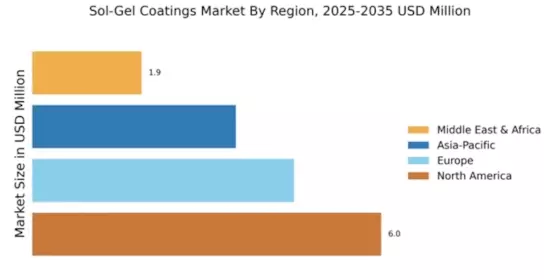
North America is poised to maintain its leadership in the Sol-Gel Coatings Market, holding a significant market share of $6.0 billion in 2024. The region's growth is driven by increasing demand in industries such as automotive, aerospace, and electronics, alongside stringent regulations promoting eco-friendly coatings. The push for advanced materials and sustainable solutions further fuels this growth, making North America a key player in the global market. The competitive landscape in North America is robust, featuring major players like Sol-Gel Technologies, PPG Industries, and 3M. These companies are investing heavily in R&D to innovate and enhance product offerings. The presence of established manufacturing facilities and a strong distribution network also contribute to the region's market strength. As the demand for high-performance coatings rises, North America is expected to continue leading the Sol-Gel Coatings Market.

Europe : Emerging Innovations and Regulations

Europe's Sol-Gel Coatings Market is projected to reach $4.5 billion by 2025, driven by increasing environmental regulations and a shift towards sustainable materials. The region's focus on innovation in coatings technology, particularly in the automotive and construction sectors, is a significant growth driver. Regulatory bodies are promoting the use of eco-friendly coatings, which is expected to enhance market demand and compliance across various industries. Leading countries in Europe include Germany, France, and the Netherlands, where companies like BASF and AkzoNobel are at the forefront of innovation. The competitive landscape is characterized by a mix of established players and emerging startups, all vying for market share. The presence of strong research institutions and collaborative initiatives further strengthens the region's position in the global Sol-Gel Coatings Market.

Asia-Pacific : Rapid Growth and Expansion

The Asia-Pacific region is witnessing rapid growth in the Sol-Gel Coatings Market, projected to reach $3.5 billion by 2025. This growth is fueled by increasing industrialization, urbanization, and rising demand for advanced coatings in sectors such as electronics and construction. Government initiatives aimed at promoting sustainable practices and reducing environmental impact are also contributing to market expansion, making the region a focal point for investment and innovation. Key players in the Asia-Pacific market include Nippon Paint Holdings and Huntsman Corporation, which are leveraging local manufacturing capabilities to meet growing demand. Countries like China and Japan are leading the charge, with significant investments in R&D and technology development. The competitive landscape is evolving, with both multinational corporations and local firms striving to capture market share in this dynamic environment.

Middle East and Africa : Emerging Market with Challenges

The Sol-Gel Coatings Market in the Middle East and Africa is estimated at $1.88 billion, with growth driven by increasing construction activities and a rising focus on sustainable materials. However, the region faces challenges such as regulatory hurdles and varying standards across countries. Despite these challenges, the demand for high-performance coatings in sectors like oil and gas is expected to drive market growth, supported by government initiatives promoting industrial development. Leading countries in this region include the UAE and South Africa, where companies are beginning to invest in advanced coating technologies. The competitive landscape is still developing, with a mix of local and international players. As the market matures, the presence of key players and investment in R&D will be crucial for capturing growth opportunities in the Sol-Gel Coatings Market.

Key Players and Competitive Insights

The Sol-Gel Coatings Market is currently characterized by a dynamic competitive landscape, driven by innovation, sustainability, and technological advancements. Key players such as Sol-Gel Technologies (US), Heraeus Holding (DE), and AkzoNobel (NL) are actively shaping the market through strategic initiatives. Sol-Gel Technologies (US) focuses on developing advanced sol-gel processes that enhance the performance of coatings, while Heraeus Holding (DE) emphasizes sustainable solutions, integrating eco-friendly materials into their product lines. AkzoNobel (NL) is leveraging digital transformation to optimize its operations and improve customer engagement, indicating a trend towards more integrated and responsive business models. Collectively, these strategies contribute to a competitive environment that prioritizes innovation and sustainability.

In terms of business tactics, companies are increasingly localizing manufacturing to reduce lead times and enhance supply chain efficiency. The market structure appears moderately fragmented, with several players vying for market share, yet the influence of major companies remains substantial. This competitive structure allows for a diverse range of products and innovations, fostering an environment where smaller firms can also thrive alongside industry giants.

In November 2025, PPG Industries (US) announced a strategic partnership with a leading technology firm to develop AI-driven solutions for optimizing coating applications. This move is significant as it positions PPG at the forefront of digital innovation within the coatings sector, potentially enhancing product performance and customer satisfaction through tailored solutions. The integration of AI into their processes may lead to improved efficiency and reduced waste, aligning with current sustainability trends.

In October 2025, BASF (DE) launched a new line of eco-friendly sol-gel coatings aimed at the automotive sector. This initiative reflects BASF's commitment to sustainability and innovation, as the new coatings are designed to reduce environmental impact while maintaining high performance. The introduction of these products not only strengthens BASF's market position but also responds to increasing consumer demand for sustainable solutions in the automotive industry.

In September 2025, 3M (US) expanded its sol-gel coatings portfolio by acquiring a small innovative firm specializing in nanotechnology. This acquisition is likely to enhance 3M's capabilities in producing high-performance coatings with unique properties, thereby broadening its market reach. The strategic importance of this move lies in 3M's ability to leverage advanced technologies to differentiate its offerings in a competitive market.

As of December 2025, current trends in the Sol-Gel Coatings Market indicate a strong shift towards digitalization, sustainability, and AI integration. Strategic alliances are increasingly shaping the competitive landscape, allowing companies to pool resources and expertise to drive innovation. Looking ahead, competitive differentiation is expected to evolve, with a notable shift from price-based competition to a focus on innovation, technology, and supply chain reliability. This transition suggests that companies that prioritize these aspects will likely gain a competitive edge in the evolving market.

Key Companies in the Sol-Gel Coatings Market market include

Industry Developments

  • Q2 2024: Vibrantz Technologies Launches New Sol-Gel Coating for Automotive Applications Vibrantz Technologies announced the commercial launch of a new sol-gel coating designed to enhance durability and chemical resistance for automotive components, targeting OEMs and tier-1 suppliers.
  • Q2 2024: Akzo Nobel Expands Sol-Gel Coatings Market Production Facility in Germany Akzo Nobel completed an expansion of its sol-gel coatings manufacturing facility in Leverkusen, Germany, increasing capacity to meet growing demand from the European automotive and electronics sectors.
  • Q3 2024: Henkel Signs Strategic Partnership with Gaema Tech for Advanced Sol-Gel Coatings Market Henkel AG entered a strategic partnership with Gaema Tech Co. Ltd. to co-develop next-generation sol-gel coatings for electronics and renewable energy applications.
  • Q3 2024: 3M Unveils New Silane-Based Sol-Gel Coating for Solar Panels 3M launched a new silane-based sol-gel coating aimed at improving the efficiency and lifespan of photovoltaic cells, targeting the rapidly growing solar energy market.
  • Q4 2024: Aspen Systems Wins Major Contract to Supply Sol-Gel Coatings Market for Aerospace Components Aspen Systems secured a multi-year contract to provide advanced sol-gel coatings for a leading aerospace manufacturer, supporting next-generation aircraft production.
  • Q1 2025: Akzo Nobel Appoints New Head of Sol-Gel Coatings Market Division Akzo Nobel announced the appointment of Dr. Petra Klein as the new head of its Sol-Gel Coatings Market Division, effective January 2025, to drive innovation and global expansion.
  • Q1 2025: Chemat Technology Receives Patent for Novel Hybrid Organic-Inorganic Sol-Gel Coating Chemat Technology Inc. was granted a U.S. patent for its new hybrid organic-inorganic sol-gel coating, which offers enhanced scratch resistance for consumer electronics.
  • Q2 2025: Henkel Opens New R&D Center for Sol-Gel Coatings Market in Düsseldorf Henkel inaugurated a dedicated research and development center in Düsseldorf focused on advancing sol-gel coating technologies for industrial and consumer applications.
  • Q2 2025: Vibrantz Technologies Acquires Minority Stake in Sol-Gel Start-up NanoLayer Vibrantz Technologies acquired a minority equity stake in NanoLayer, an Israeli start-up specializing in sol-gel nanocoatings for medical devices and diagnostics.
  • Q2 2025: Sol-Gel Technologies Ltd. Announces $30 Million Private Placement to Fund Coatings Expansion Sol-Gel Technologies Ltd. raised $30 million in a private placement to accelerate the commercialization of its proprietary sol-gel coatings for industrial and healthcare markets.

Future Outlook

Sol-Gel Coatings Market Future Outlook

The Sol-Gel Coatings Market is projected to grow at an 8.39% CAGR from 2024 to 2035, driven by advancements in nanotechnology, increasing demand for eco-friendly coatings, and expanding applications in various industries.

New opportunities lie in:

  • Development of customized sol-gel formulations for specific industrial applications.
  • Expansion into emerging markets with tailored marketing strategies.
  • Investment in R&D for innovative sol-gel coating technologies to enhance performance.

By 2035, the Sol-Gel Coatings Market is expected to achieve substantial growth and diversification.

Market Segmentation

Sol-Gel Coatings Market Technology Outlook

  • Dip Coating
  • Spray Coating
  • Spin Coating

Sol-Gel Coatings Market Application Outlook

  • Optical Coatings
  • Protective Coatings
  • Functional Coatings
  • Biomedical Coatings

Sol-Gel Coatings Market Material Type Outlook

  • Silica
  • Titania
  • Zirconia
  • Alumina

Sol-Gel Coatings Market End Use Industry Outlook

  • Automotive
  • Aerospace
  • Electronics
  • Construction

Sol-Gel Coatings Market Formulation Type Outlook

  • Solvent-Based
  • Water-Based
  • Hybrid

Report Scope

MARKET SIZE 202414.88(USD Million)
MARKET SIZE 202516.13(USD Million)
MARKET SIZE 203536.1(USD Million)
COMPOUND ANNUAL GROWTH RATE (CAGR)8.39% (2024 - 2035)
REPORT COVERAGERevenue Forecast, Competitive Landscape, Growth Factors, and Trends
BASE YEAR2024
Market Forecast Period2025 - 2035
Historical Data2019 - 2024
Market Forecast UnitsUSD Million
Key Companies ProfiledSol-Gel Technologies (US), Heraeus Holding (DE), Nippon Paint Holdings (JP), AkzoNobel (NL), PPG Industries (US), BASF (DE), 3M (US), Saint-Gobain (FR), Huntsman Corporation (US)
Segments CoveredApplication, End Use Industry, Material Type, Formulation Type, Technology
Key Market OpportunitiesGrowing demand for eco-friendly coatings drives innovation in the Sol-Gel Coatings Market.
Key Market DynamicsRising demand for eco-friendly solutions drives innovation and competition in the Sol-Gel Coatings Market.
Countries CoveredNorth America, Europe, APAC, South America, MEA

Market Highlights

Author
Anshula Mandaokar
Team Lead - Research

Anshula Mandaokar holds an academic degree in Chemical Engineering and has been contributing to the field for more than 5 years. She has expertise in Market Research and Business Consulting and serves as a Team Lead for a reputed Market Research firm under the Chemicals and Materials domain spectrum. She has worked on multiple projects, generating explicit results in a quick turnaround time. Her understanding of data interpretation justifies her role as a leader.

Leave a Comment

FAQs

What do you mean by sol-gel coating?

Sol-gel is an interaction where strong materials are created from little atoms. The cycle handles monomers' change into a colloidal arrangement (the Sol) that goes about as the precursor for an incorporated organization (the Gel) of either discrete particles or organization polymers.

What is the major difference between Gel and Sol?

Sol: The fluid condition of a colloidal arrangement is known as the Sol. Gel: The strong or semi-strong (Jelly like) phase of a colloidal arrangement is known as the Gel.

Why this entire process is known as the bottom-up approach?

Sol-gel handling varies from other compound cycles because of its generally low preparing temperature. This makes the sol-gel measure financially savvy and flexible.

Why this bottom-up method is reliable?

The bottom-up method is more beneficial than the top-down approach in light of the fact that the previous has a superior possibility of creating nanostructures with fewer deformities, more homogenous synthetic arrangement, and better short-and long-range requesting.

What are the limitations of the top-down approach?

Top-down project arranging has one significant detriment: Because the group isn't associated with the venture arranging, they may understand left and as though they can't voice their conclusions. Besides, the essential for top-down projects intending to work is that correspondence is exact.

What is the significant difference between gelatinization and gelation?

Gelatinization is the way toward separating the intermolecular connections between starch atoms, permitting the hydrogen holding locales to connect more water particles. Gelation, then again, is the interaction of arrangement of a gel from a framework with polymers.

Download Free Sample

Kindly complete the form below to receive a free sample of this Report

Compare Licence

×
Features License Type
Single User Multiuser License Enterprise User
Price $4,950 $5,950 $7,250
Maximum User Access Limit 1 User Upto 10 Users Unrestricted Access Throughout the Organization
Free Customization
Direct Access to Analyst
Deliverable Format
Platform Access
Discount on Next Purchase 10% 15% 15%
Printable Versions