Polyphenylene Oxide Market
Polyphenylene Oxide Market Summary
As per Market Research Future analysis, the Polyphenylene Oxide Market Size was estimated at 1.65 USD Billion in 2024. The Polyphenylene Oxide industry is projected to grow from 1.72 USD Billion in 2025 to 2.611 USD Billion by 2035, exhibiting a compound annual growth rate (CAGR) of 4.26% during the forecast period 2025 - 2035
Key Market Trends & Highlights
The Polyphenylene Oxide Market is poised for growth driven by sustainability and technological advancements.
- North America remains the largest market for polyphenylene oxide, primarily due to its robust electrical and electronics sector.
- The Asia-Pacific region is emerging as the fastest-growing market, fueled by increasing industrialization and demand for advanced materials.
- The electrical and electronics segment dominates the market, while the automotive segment is experiencing rapid growth due to evolving applications.
- Key market drivers include sustainability initiatives and technological advancements, which are shaping the future of polyphenylene oxide applications.
Market Size & Forecast
| 2024 Market Size | 1.65 (USD Billion) |
| 2035 Market Size | 2.611 (USD Billion) |
| CAGR (2025 - 2035) | 4.26% |
Major Players
BASF SE (DE), Mitsubishi Gas Chemical Company, Inc. (JP), General Electric Company (US), SABIC (SA), Sumitomo Chemical Company, Limited (JP), Kraton Corporation (US), Toray Industries, Inc. (JP), Huntsman Corporation (US)
Polyphenylene Oxide Market Trends
The Polyphenylene Oxide Market is currently experiencing a notable transformation, driven by advancements in material science and increasing demand across various industries. This high-performance polymer is recognized for its exceptional thermal stability, chemical resistance, and electrical insulating properties, making it suitable for applications in electronics, automotive, and aerospace sectors. As industries seek to enhance product performance and sustainability, the adoption of polyphenylene oxide is likely to rise, reflecting a shift towards innovative materials that meet stringent regulatory standards and consumer expectations. Moreover, the Polyphenylene Oxide Market appears to be influenced by the growing emphasis on lightweight materials and energy efficiency. Manufacturers are increasingly exploring the potential of polyphenylene oxide in composite materials, which could lead to enhanced mechanical properties and reduced weight in end products. This trend suggests a broader acceptance of polyphenylene oxide as a viable alternative to traditional materials, potentially reshaping supply chains and production processes. As the market evolves, stakeholders must remain vigilant to emerging technologies and changing consumer preferences that could further impact the trajectory of polyphenylene oxide applications.
Sustainability Initiatives
The Polyphenylene Oxide Market is witnessing a shift towards sustainable practices, as manufacturers prioritize eco-friendly production methods. This trend indicates a growing awareness of environmental impacts, prompting companies to explore bio-based alternatives and recycling options for polyphenylene oxide products.
Technological Advancements
Innovations in processing techniques and material formulations are shaping the Polyphenylene Oxide Market. Enhanced manufacturing processes may lead to improved product performance, enabling applications in high-demand sectors such as electronics and automotive.
Increased Demand in Electronics
The demand for polyphenylene oxide in the electronics sector is on the rise, driven by the need for materials that offer superior thermal and electrical properties. This trend suggests that polyphenylene oxide could become a preferred choice for manufacturers seeking reliable components in advanced electronic devices.
Polyphenylene Oxide Market Drivers
Sustainability Initiatives
The Polyphenylene Oxide Market is experiencing a notable shift towards sustainability initiatives. As environmental concerns gain prominence, manufacturers are increasingly focusing on eco-friendly production processes. This trend is driven by regulatory pressures and consumer demand for sustainable products. The industry is witnessing a rise in the adoption of recyclable materials and energy-efficient manufacturing techniques. In 2025, the market is projected to grow at a compound annual growth rate of approximately 5.2%, reflecting the increasing emphasis on sustainability. Companies are investing in research and development to create innovative solutions that minimize environmental impact. This focus on sustainability not only enhances brand reputation but also aligns with global efforts to reduce carbon footprints. As a result, the Polyphenylene Oxide Market is likely to see a surge in demand for products that meet these sustainability criteria.
Technological Advancements
Technological advancements play a pivotal role in shaping the Polyphenylene Oxide Market. Innovations in polymer processing and material science are leading to the development of enhanced polyphenylene oxide products with superior properties. These advancements enable manufacturers to produce materials that exhibit improved thermal stability, chemical resistance, and mechanical strength. In 2025, the market is expected to benefit from the integration of advanced manufacturing techniques such as 3D printing and automation. These technologies not only streamline production processes but also reduce costs, making polyphenylene oxide more accessible to various industries. Furthermore, ongoing research is likely to yield new applications in sectors such as automotive, aerospace, and electronics. As a result, the Polyphenylene Oxide Market is poised for growth, driven by the continuous evolution of technology and its applications.
Growing Automotive Applications
The automotive sector is emerging as a key driver for the Polyphenylene Oxide Market. As vehicles become more sophisticated, the demand for lightweight and high-performance materials is escalating. Polyphenylene oxide offers a unique combination of properties, including high heat resistance and dimensional stability, making it suitable for various automotive applications. In 2025, the market is expected to see increased utilization of polyphenylene oxide in components such as fuel systems, electrical connectors, and interior parts. This trend is further fueled by the automotive industry's shift towards electric vehicles, which require advanced materials to enhance efficiency and performance. Consequently, the Polyphenylene Oxide Market is likely to benefit from the growing emphasis on innovation and sustainability within the automotive sector.
Increased Demand in Electronics
The demand for polyphenylene oxide in the electronics sector is witnessing a significant upsurge, thereby influencing the Polyphenylene Oxide Market. With the proliferation of electronic devices and the need for lightweight, durable materials, polyphenylene oxide is becoming a preferred choice for manufacturers. Its excellent electrical insulating properties and thermal stability make it ideal for applications in connectors, circuit boards, and other electronic components. In 2025, the electronics segment is projected to account for a substantial share of the market, driven by the increasing adoption of smart devices and the Internet of Things. This trend indicates a robust growth trajectory for the Polyphenylene Oxide Market, as manufacturers seek materials that can withstand the demands of modern electronics. The synergy between technological innovation and rising consumer electronics demand is likely to propel the market forward.
Expansion in Healthcare Applications
The healthcare sector is increasingly recognizing the potential of polyphenylene oxide, thereby driving growth in the Polyphenylene Oxide Market. With its biocompatibility and resistance to sterilization processes, polyphenylene oxide is finding applications in medical devices, diagnostic equipment, and pharmaceutical packaging. In 2025, the demand for polyphenylene oxide in healthcare is projected to rise significantly, as manufacturers seek materials that meet stringent regulatory requirements. The ongoing advancements in medical technology and the increasing focus on patient safety are likely to further propel this trend. As a result, the Polyphenylene Oxide Market is expected to expand, driven by the need for innovative materials that enhance the performance and safety of healthcare products.
Market Segment Insights
By Application: Electrical & Electronics (Largest) vs. Automotive (Fastest-Growing)
In the Polyphenylene Oxide Market, the application segment demonstrates a diverse distribution among key sectors, with Electrical & Electronics holding the largest market share. This category, which includes applications in various electronic devices and components, benefits from the material's excellent electrical insulating properties and high thermal stability. Following closely, Automotive emerges as the fastest-growing segment, driven by the increasing adoption of lightweight materials and advanced technologies aimed at enhancing fuel efficiency and performance.
Electrical & Electronics (Dominant) vs. Automotive (Emerging)
Electrical & Electronics has established itself as a dominant application of polyphenylene oxide due to its superior dielectric properties and heat resistance, making it ideal for use in connectors, circuit boards, and capacitors. The demand in this sector is sustained by ongoing innovations in consumer electronics and telecommunications. Conversely, the Automotive sector, though currently smaller, is emerging rapidly; it is increasingly incorporating polyphenylene oxide in components such as fuel lines and electrical systems to improve efficiency and reduce weight. As automotive technologies advance, this segment is poised for significant growth, aided by a shift towards electric and hybrid vehicles.
Regional Insights
North America : Innovation and Demand Surge
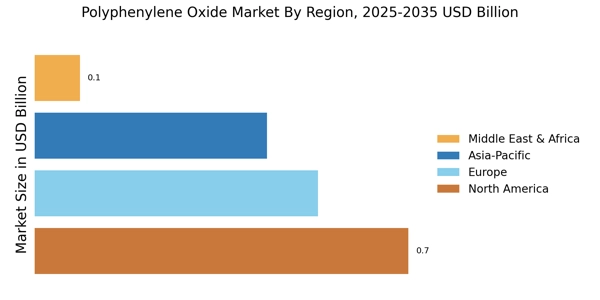
North America is the largest market for polyphenylene oxide, holding approximately 40% of the global share. The region's growth is driven by increasing demand in the automotive and electronics sectors, alongside stringent regulations promoting high-performance materials. The U.S. leads this market, supported by advancements in technology and a robust manufacturing base. Regulatory catalysts, such as the EPA's initiatives for sustainable materials, further enhance market growth. The competitive landscape in North America is characterized by the presence of major players like General Electric Company and BASF SE. These companies are investing in R&D to innovate and improve product offerings. The U.S. is the primary market, followed by Canada, which is also witnessing growth due to rising industrial applications. The focus on sustainability and performance in materials is shaping the competitive dynamics in this region.
Europe : Sustainability and Innovation Focus
Europe is witnessing significant growth in the polyphenylene oxide market, accounting for approximately 30% of the global share. The region's demand is driven by stringent environmental regulations and a shift towards sustainable materials in various industries, including automotive and electronics. Countries like Germany and France are at the forefront, with policies promoting the use of high-performance polymers, which are essential for energy efficiency and reduced emissions. Germany is the leading country in this market, supported by key players such as BASF SE and SABIC. The competitive landscape is marked by innovation, with companies focusing on developing eco-friendly products. The European market is characterized by collaborations between manufacturers and research institutions to enhance product performance and sustainability. This collaborative approach is expected to drive further growth in the coming years.
Asia-Pacific : Rapid Growth and Expansion
Asia-Pacific is rapidly emerging as a significant player in the polyphenylene oxide market, holding around 25% of the global share. The region's growth is fueled by increasing industrialization, particularly in countries like China and Japan, where demand for high-performance materials is surging. Regulatory support for advanced materials in electronics and automotive sectors is also a key driver, enhancing market dynamics and attracting investments. China is the largest market in the region, with substantial contributions from local manufacturers and multinational corporations. The competitive landscape is evolving, with companies like Mitsubishi Gas Chemical and Sumitomo Chemical leading the charge. The focus on innovation and cost-effective production methods is shaping the market, as firms strive to meet the growing demand for polyphenylene oxide in various applications, including consumer electronics and automotive components.
Middle East and Africa : Resource-Rich and Growing Demand
The Middle East and Africa region is gradually emerging in the polyphenylene oxide market, currently holding about 5% of the global share. The growth is primarily driven by increasing industrial activities and a rising demand for high-performance materials in sectors such as construction and automotive. Countries like South Africa and the UAE are witnessing a surge in demand, supported by government initiatives to diversify economies and promote manufacturing. South Africa is leading the market in this region, with a growing number of local and international players entering the landscape. The competitive environment is characterized by investments in production facilities and partnerships aimed at enhancing supply chain efficiency. As the region continues to develop its industrial base, the demand for polyphenylene oxide is expected to rise, presenting significant opportunities for growth and investment.
Key Players and Competitive Insights
Leading market players are investing heavily in research and development to spread their product lines, which will help the Polyphenylene Oxide Market grow even more. Market participants are also undertaking various strategic activities to expand their footprint, with important market developments including new product launches, contractual agreements, mergers and acquisitions, higher investments, and collaboration with other organizations. The Polyphenylene Oxide industry must offer cost-effective items to expand and survive in a more competitive and rising market climate.
Manufacturing locally to minimize operational costs is one of the key business tactics used by manufacturers in the Polyphenylene Oxide industry to benefit clients and increase the market sector. In recent years, the Polyphenylene Oxide industry has offered some of the most significant advantages to medicine.
Major players in the Polyphenylene Oxide Market, including BASF SE (Germany), SABIC (Saudi Arabia), RTP Company (US), Celanese Corporation (US), Ensinger Inc. (India), Mitsubishi Electric Corporation (Japan), 3M (US), Goodfellow (UK), Asahi Kasei Chemicals Corp. (Japan), Solvay SA (Belgium), Sumitomo Chemical Co., Ltd (Japan), LyondellBasell Industries Holdings BV (Netherlands), and others, are attempting to increase market demand by investing in research and development operations.
BASF SE, also known as Badische Anilin und Soda-Fabrik, founded in 1865, located in Ludwigshafen, Germany, is a European company that is the largest producer of chemicals in the world. The products included are dyes, soda, sulfuric acid, ammonia, rubber, fuels, carbon, and many more.
In June BASF will build a commercial-scale battery recycling black mass plant in Schwarzheide, Germany. BASF will offer a range of chemical intermediates with a product carbon footprint significantly below the market average.
DIC Corporation, founded in 1908, and located in Chiyoda Ku, Tokyo, Japan, is a Japanese chemical company specializing in developing, manufacturing, and selling inks, polymers, pigments, plastics, biochemicals, and compounds. It operates worldwide and includes Sun Chemical Corporation, which is based in America and Europe.
In April DIC Corporation resolved to revise its sales prices for DIC PPS polyphenylene sulfide (PPS) products. The company has started to apply higher sales prices for the products shipped after April 2022.
In 2022, LG Chem created a fire-resistant material that it claims can withstand temperatures of up to 1,000°F, the temperature at which lithium explodes. At the same time, Henkel has introduced two new protective coatings intended to safeguard battery housings from heat and fire. The Korean chemical manufacturer claimed its flame-retardant plastic, composed of polyphenylene oxide (PPO), polyamide (PA), and polybutylene terephthalate (PBT), could withstand fires at 1,000°F for up to 400 seconds. As a result, it offered 45 times greater resistance than existing flame-retardant polymers.
Key Companies in the Polyphenylene Oxide Market include
Industry Developments
In January 2024, Asahi Kasei expanded its portfolio of the ISCC PLUS certified products to several more thermoplastic elastomers, rubbers, engineering plastics, and others. The corporation has the goal to achieve a carbon neutral material value chain through the utilization of biomass feedstock, recycled feedstock, and renewable power sources. The ISCC PLUS certificate guarantees proper management of biomass and recycled materials within the supply chain, including manufacturing. In April 2024, Estonian company Toray Industries announced that they developed a new Polyphenylene Ether (PPE) composite material with enhanced mechanical strength and thermal stability.
The material is intended for high-performance sectors including automotive parts and industrial equipment. In March 2024: Kuraray further developed its Polyphenylene Sulfide (PPS) product line by adding products featuring better chemical resistance. The expansion is aimed at serving industries that require stronger materials for chemical processing and industrial applications. February 2024: Sumitomo Chemical presented a new Polyphenylene Sulfide (PPS) resin designed to withstand high temperatures and pressures in the oil and gas industry. The resin has good durability and resistance to adverse environmental conditions which are specific to this particular sector.
Future Outlook
Polyphenylene Oxide Market Future Outlook
The Polyphenylene Oxide Market is projected to grow at a 4.26% CAGR from 2025 to 2035, driven by increasing demand in electronics, automotive, and healthcare sectors.
New opportunities lie in:
- Development of high-performance polyphenylene oxide composites for automotive applications.
- Expansion into emerging markets with tailored product offerings.
- Investment in R&D for sustainable production methods and recycling technologies.
By 2035, the Polyphenylene Oxide Market is expected to achieve robust growth and enhanced market positioning.
Market Segmentation
Polyphenylene Oxide Market Application Outlook
- Automotive
- Electrical & Electronics
- Healthcare
- Building & Construction
- Air Separation Membranes
- Others
Report Scope
| MARKET SIZE 2024 | 1.65(USD Billion) |
| MARKET SIZE 2025 | 1.72(USD Billion) |
| MARKET SIZE 2035 | 2.611(USD Billion) |
| COMPOUND ANNUAL GROWTH RATE (CAGR) | 4.26% (2025 - 2035) |
| REPORT COVERAGE | Revenue Forecast, Competitive Landscape, Growth Factors, and Trends |
| BASE YEAR | 2024 |
| Market Forecast Period | 2025 - 2035 |
| Historical Data | 2019 - 2024 |
| Market Forecast Units | USD Billion |
| Key Companies Profiled | BASF SE (DE), Mitsubishi Gas Chemical Company, Inc. (JP), General Electric Company (US), SABIC (SA), Sumitomo Chemical Company, Limited (JP), Kraton Corporation (US), Toray Industries, Inc. (JP), Huntsman Corporation (US) |
| Segments Covered | Application, Region |
| Key Market Opportunities | Growing demand for lightweight, high-performance materials in electronics and automotive sectors drives Polyphenylene Oxide Market opportunities. |
| Key Market Dynamics | Rising demand for lightweight materials drives innovation and competition in the Polyphenylene Oxide market. |
| Countries Covered | North America, Europe, APAC, South America, MEA |
Market Highlights
FAQs
What is the projected market valuation of the Polyphenylene Oxide Market by 2035?
The Polyphenylene Oxide Market is projected to reach a valuation of 2.611 USD Billion by 2035.
What was the market valuation of Polyphenylene Oxide in 2024?
In 2024, the Polyphenylene Oxide Market was valued at 1.65 USD Billion.
What is the expected CAGR for the Polyphenylene Oxide Market from 2025 to 2035?
The expected CAGR for the Polyphenylene Oxide Market during the forecast period 2025 - 2035 is 4.26%.
Which application segment had the highest valuation in 2024?
The Electrical & Electronics segment had the highest valuation at 0.45 USD Billion in 2024.
What is the projected valuation for the Automotive segment by 2035?
The Automotive segment is projected to reach a valuation of 0.39 USD Billion by 2035.
Who are the key players in the Polyphenylene Oxide Market?
What is the expected growth trend for the Healthcare segment from 2024 to 2035?
How does the Building & Construction segment perform in terms of valuation?
What is the valuation trend for the Air Separation Membranes segment?
What potential does the Others segment hold in the Polyphenylene Oxide Market?
Research Approach
Secondary Research
The secondary research process involved comprehensive analysis of regulatory databases, peer-reviewed engineering and polymer science journals, chemical industry publications, and authoritative industrial organizations. Key sources included the US Environmental Protection Agency (EPA), European Chemicals Agency (ECHA), US Occupational Safety and Health Administration (OSHA), International Organization for Standardization (ISO) technical committees for plastics, Society of Plastics Engineers (SPE), American Chemistry Council (ACC), European Plastics Association (Plastics Europe), Japan Plastics Industry Federation (JPIF), National Institute of Standards and Technology (NIST), US Census Bureau — Manufacturing & Construction Statistics, Eurostat — Industrial Production Database, Organisation for Economic Co-operation and Development (OECD) — Chemicals Production Statistics, World Trade Organization (WTO) — Trade Statistics, International Trade Centre (ITC) — Trade Map, US International Trade Commission (USITC), China National Chemical Information Center (CNCIC), India's Ministry of Chemicals and Fertilizers — Chemicals and Petrochemicals Statistics, Germany's Federal Statistical Office (Destatis) — Chemical Industry Data, Society of the Plastics Industry (SPI) — Market Reports, Freedonia Group — Polymer Industry Reports, and national chemical ministry reports from key manufacturing markets. These sources were used to collect production capacity data, regulatory compliance frameworks, material safety data sheets (MSDS), processing technology studies, application-specific demand trends, and competitive landscape analysis for polyphenylene oxide across automotive, electrical & electronics, healthcare, building & construction, air separation membranes, and other industrial applications.
Primary Research
Qualitative and quantitative insights were obtained by interviewing supply-side and demand-side stakeholders during the primary research process. Supply-side sources comprised CEOs, VPs of Polymer Technology, regulatory compliance leaders, and commercial directors from engineering plastics OEMs, compounders, and PPO resin manufacturers. Automotive design engineers, electrical and electronics procurement managers, medical device material specialists, building and construction specification consultants, and membrane technology R&D leads from tier-1 suppliers, original equipment manufacturers (OEMs), and industrial end-users comprised demand-side sources. Market segmentation was verified, capacity expansion timelines were confirmed, and insights regarding material substitution patterns, pricing strategies, and supply chain dynamics were obtained through primary research.
Primary Respondent Breakdown:
By Designation: C-level Primaries (32%), Director Level (30%), Others (38%)
By Region: North America (32%), Europe (30%), Asia-Pacific (28%), Rest of World (10%)
By Application Expertise: Electrical & Electronics (28%), Automotive (24%), Healthcare (18%), Building & Construction (15%), Air Separation Membranes (10%), Others (5%)
Market Size Estimation
Global market valuation was derived through production capacity mapping and consumption volume analysis. The methodology included:
Identification of 35+ key manufacturers and compounders across North America, Europe, Asia-Pacific, Latin America, and the Middle East
Product mapping across virgin PPO resin, modified PPO/PPE alloys, and reinforced/compounded PPO grades
Analysis of reported and modeled annual revenues specific to PPO and PPE (polyphenylene ether) portfolios
Coverage of manufacturers representing 75–80% of global market share in 2024
Extrapolation using bottom-up (application volume × ASP by country/region) and top-down (manufacturer revenue validation) approaches to derive segment-specific valuations for automotive, electrical & electronics, healthcare, building & construction, air separation membranes, and other industrial segments
Kindly complete the form below to receive a free sample of this Report
Customer Stories
“This is really good guys. Excellent work on a tight deadline. I will continue to use you going forward and recommend you to others. Nice job”
“Thanks. It’s been a pleasure working with you, please use me as reference with any other Intel employees.”
“Thanks for sending the report it gives us a good global view of the Betaïne market.”
“Thank you, this will be very helpful for OQS.”
“We found the report very insightful! we found your research firm very helpful. I'm sending this email to secure our future business.”
“I am very pleased with how market segments have been defined in a relevant way for my purposes (such as "Portable Freezers & refrigerators" and "last-mile"). In general the report is well structured. Thanks very much for your efforts.”
“I have been reading the first document or the study, ,the Global HVAC and FP market report 2021 till 2026. Must say, good info! I have not gone in depth at all parts, but got a good indication of the data inside!”
“We got the report in time, we really thank you for your support in this process. I also thank to all of your team as they did a great job.”