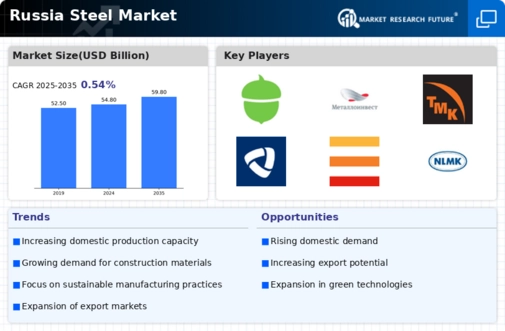
The steel market in Russia is characterized by a competitive landscape that is both dynamic and multifaceted. Key growth drivers include increasing domestic demand for construction and infrastructure projects, alongside a push towards modernization and sustainability. Major players such as Severstal (RU), NLMK (RU), and Evraz (RU) are strategically positioned to leverage these trends. Severstal (RU) focuses on innovation and digital transformation, investing in advanced manufacturing technologies to enhance efficiency. NLMK (RU) emphasizes sustainability, aiming to reduce its carbon footprint through eco-friendly production methods. Evraz (RU), on the other hand, is pursuing regional expansion, particularly in emerging markets, to diversify its revenue streams. Collectively, these strategies shape a competitive environment that is increasingly oriented towards technological advancement and sustainability.
In terms of business tactics, companies are localizing manufacturing and optimizing supply chains to enhance operational efficiency. The market structure appears moderately fragmented, with several key players exerting influence over pricing and production capabilities. This fragmentation allows for competitive maneuvering, as companies seek to differentiate themselves through unique value propositions and operational efficiencies.
In November 2025, Severstal (RU) announced a partnership with a leading technology firm to develop AI-driven solutions for predictive maintenance in its production facilities. This strategic move is likely to enhance operational reliability and reduce downtime, thereby improving overall productivity. The integration of AI technologies may also position Severstal (RU) as a leader in smart manufacturing within the steel sector.
In October 2025, NLMK (RU) unveiled its new sustainability initiative aimed at achieving carbon neutrality by 2035. This ambitious plan includes investments in renewable energy sources and the implementation of carbon capture technologies. The strategic importance of this initiative lies in its potential to not only comply with regulatory pressures but also to enhance NLMK's brand reputation as a responsible corporate citizen, appealing to environmentally conscious consumers and investors alike.
In September 2025, Evraz (RU) completed the acquisition of a regional steel producer, which is expected to bolster its market presence in Eastern Europe. This acquisition is significant as it allows Evraz (RU) to tap into new customer bases and optimize its supply chain logistics. By expanding its operational footprint, Evraz (RU) is likely to enhance its competitive edge in a rapidly evolving market.
As of December 2025, current competitive trends in the steel market are increasingly defined by digitalization, sustainability, and the integration of advanced technologies. Strategic alliances are becoming more prevalent, as companies recognize the need to collaborate in order to innovate and meet evolving market demands. Looking ahead, competitive differentiation is expected to shift from traditional price-based competition towards a focus on innovation, technology adoption, and supply chain reliability. This evolution suggests that companies that prioritize these aspects will likely emerge as leaders in the steel market.




















Leave a Comment