×
Request Free Sample ×

Kindly complete the form below to receive a free sample of this Report

* Please use a valid business email

Leading companies partner with us for data-driven Insights

clients tt-cursor
Hero Background

Russia Steel Products Market

ID: MRFR/CnM/46483-HCR
111 Pages
Chitranshi Jaiswal
October 2025

Russia Steel Products Market Research Report: By Steel Type (Carbon Steel, Alloy Steel), By Shape Of Steel Products (Long Steel, Tubular Steel, Flat Steel) andBy End-Uses (Shipping, Energy, Construction, Packaging, Consumer Appliances Industry, Automotive, Housing, Others)- Forecast to 2035

Share:
Download PDF ×

We do not share your information with anyone. However, we may send you emails based on your report interest from time to time. You may contact us at any time to opt-out.

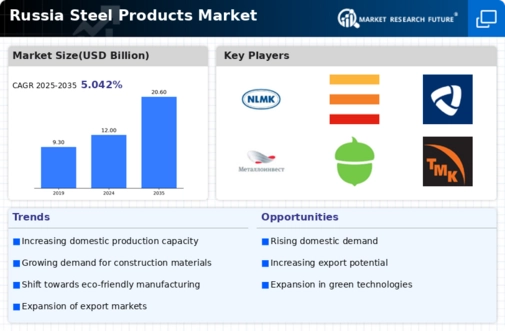
Russia Steel Products Market Infographic
Purchase Options

Russia Steel Products Market Summary

As per analysis, the Russia steel products market is projected to grow from USD 7.6 Billion in 2025 to USD 13.36 Billion by 2035, exhibiting a compound annual growth rate (CAGR) of 5.8% during the forecast period (2025 - 2035).

Key Market Trends & Highlights

The Russia steel products market is currently experiencing a shift towards sustainability and local production amidst growing domestic demand.

  • The construction segment remains the largest in the market, driven by ongoing infrastructure projects.
  • The automotive segment is the fastest-growing, reflecting increasing demand for lightweight and high-strength materials.
  • Flat steel products dominate the market, while long steel products are witnessing rapid growth due to their applications in various sectors.
  • Government investment in infrastructure and energy sector expansion are key drivers propelling market growth.

Market Size & Forecast

2024 Market Size 7.18 (USD Billion)
2035 Market Size 13.36 (USD Billion)
CAGR (2025 - 2035) 5.8%

Major Players

Severstal (RU), NLMK (RU), Evraz (RU), TMK (RU), Mechel (RU), Novolipetsk Steel (RU), Cherepovets Steel Mill (RU), Magnitogorsk Iron and Steel Works (RU)

Russia Steel Products Market Trends

The Russia steel products market is currently experiencing a dynamic phase characterized by various factors influencing its trajectory. The demand for steel products is closely tied to the construction and manufacturing sectors, which are pivotal in driving economic growth. Recent developments in infrastructure projects and industrial activities have contributed to a steady increase in consumption. Additionally, the market is witnessing a shift towards more sustainable practices, with an emphasis on reducing carbon emissions and enhancing energy efficiency in production processes. This transition appears to be shaping the future landscape of the industry, as stakeholders adapt to evolving regulations and consumer preferences. Moreover, the geopolitical climate has introduced complexities that may affect trade relations and supply chains. Domestic production capabilities are being scrutinized, with a focus on enhancing self-sufficiency in steel manufacturing. The government is likely to implement policies aimed at supporting local producers, which could further influence market dynamics. As the Russia steel products market continues to evolve, it remains essential for industry participants to stay attuned to these trends and adapt their strategies accordingly. The interplay of domestic demand, regulatory changes, and global market influences will likely define the competitive landscape in the coming years.

Sustainability Initiatives

The Russia steel products market is increasingly prioritizing sustainability, with manufacturers exploring eco-friendly production methods. This trend reflects a broader commitment to reducing environmental impact and aligning with international standards. Companies are investing in technologies that minimize waste and enhance energy efficiency, which may lead to a more sustainable industry.

Infrastructure Development

Ongoing infrastructure projects across Russia are driving demand for steel products. The government is focusing on modernizing transportation networks and public facilities, which necessitates a robust supply of steel. This trend suggests a potential for growth in the sector as investments in infrastructure continue.

Local Production Focus

There is a noticeable shift towards enhancing local production capabilities within the Russia steel products market. This trend is driven by a desire for self-sufficiency and reduced reliance on imports. The government may support initiatives aimed at bolstering domestic manufacturers, which could reshape the competitive landscape.

Market Segment Insights

By Application: Construction (Largest) vs. Automotive (Fastest-Growing)

In the Russia steel products market, the application segments exhibit a diverse distribution, with construction leading as the largest segment due to high demand for infrastructure development. This is driven by governmental investments and urbanization initiatives throughout the country. The automotive sector follows, showcasing substantial growth as manufacturers are increasingly utilizing advanced steel products to enhance vehicle performance and safety features.

Construction (Dominant) vs. Automotive (Emerging)

The construction segment represents the dominant force in the Russia steel products market, fueled by significant infrastructure projects and housing developments. This segment relies heavily on durable and versatile steel grades which cater to a wide range of building requirements. In contrast, the automotive segment is emerging rapidly as automakers adopt innovative steel technologies to improve fuel efficiency and sustainability. As electric vehicles rise in popularity, the demand for lightweight and high-strength steels is becoming pivotal, positioning this segment for continued expansion in alignment with global automotive trends.

By Product Type: Flat Steel (Largest) vs. Long Steel (Fastest-Growing)

In the Russia steel products market, the distribution of market share among different product types shows that Flat Steel occupies the largest segment, appealing to a wide range of industries including automotive and construction. Long Steel, while not the largest, is emerging rapidly, driven by increasing demand in infrastructure projects such as railways, highways, and buildings, marking it as a key player in the near future. Growth trends in the 'Product Type' sector indicate that Flat Steel remains a staple due to its versatility and durability, while Long Steel is gaining momentum with the rise in construction activities across the country. This uptick can be attributed to government investments and favorable regulations that support infrastructure development, paving the way for sustained demand in Long Steel products.

Flat Steel (Dominant) vs. Long Steel (Emerging)

Flat Steel is characterized by its extensive use in various applications including automotive manufacturing, construction, and appliances, making it the dominant product type in the Russia steel products market. Its attributes such as formability and surface finish give it a competitive edge. In contrast, Long Steel, which includes rebar and sections, is experiencing robust growth. This segment is favored for its strength and adaptability, particularly in large-scale construction and engineering projects. The shift towards sustainable building practices is likely to bolster its demand, pushing Long Steel to emerge as a significant player and contributing to the overall growth of the steel industry in Russia.

By End Use Industry: Infrastructure (Largest) vs. Transportation (Fastest-Growing)

The Russia steel products market demonstrates significant diversity across its end-use industries, with Infrastructure leading in market share. This segment encompasses various applications such as construction, roadways, and public transport, making it integral to national development. Following closely, the Transportation sector is rapidly growing, emerging as a vital area for steel consumption due to increasing investments in railways and automotive industries. The focus on improving infrastructure aims to boost economic regression and modernization efforts. As the market evolves, several key trends drive growth in these segments. Infrastructure projects continue to attract government and private investments, especially in light of urbanization and rural development initiatives. On the other hand, the Transportation sector benefits from advancements in technology and sustainability mandates, leading to a surge in demand for durable steel products. This trend is expected to accelerate further, enhancing the interconnectivity and mobility within Russia.

Infrastructure (Dominant) vs. Transportation (Emerging)

In the Russia steel products market, Infrastructure stands out as the dominant segment, characterized by its substantial use of steel in construction and public works. This segment encompasses a wide range of applications, from residential buildings to bridges and road construction, necessitating specific steel grades and types that offer enhanced strength and durability. Meanwhile, the Transportation segment is emerging as a crucial player due to its increasing role in the automotive and railway sectors. Factors such as rising urban mobility needs and government initiatives to bolster transportation networks drive this segment's growth. The competition to provide lightweight yet resilient steel solutions is intensifying, making this segment a focal point for innovation and development.

By Steel Grade: Carbon Steel (Largest) vs. Alloy Steel (Fastest-Growing)

The Russian steel products market showcases a diverse distribution across various steel grades, with Carbon Steel holding the largest share. This segment is favored for its versatility and cost-effectiveness, making it the go-to choice for numerous applications, including construction and automotive industries. It is complemented by Alloy Steel, which, while smaller in market share, is rapidly gaining momentum due to its enhanced properties that cater to specialized applications. As industrial needs evolve, the demand for these grades reflects shifting consumer preferences. The growth trends for the steel grades in Russia reveal a robust upsurge in the demand for Alloy Steel, driven by advancements in technology and innovation in manufacturing processes. Industry sectors such as machinery, aerospace, and automotive increasingly require high-performance materials, positioning Alloy Steel as an essential component. Moreover, the emerging focus on sustainability and energy efficiency in production processes is fostering a competitive edge in the market, with Alloy Steel leveraging these trends effectively.

Carbon Steel (Dominant) vs. Tool Steel (Emerging)

Carbon Steel remains the dominant force in the Russian steel products market, characterized by its wide availability and affordability, making it suitable for a variety of applications. Its properties, including strength and weldability, ensure it fulfills the diverse needs of various sectors. On the other hand, Tool Steel is categorized as an emerging segment, known for its specialized applications in tools and machinery. While it represents a smaller niche, the demand for Tool Steel is on the rise due to advancements in manufacturing that require higher durability and performance. Its unique properties, such as high hardness and resistance to abrasion, position it favorably for industries that require precision and quality. This segmentation highlights a clear distinction in market dynamics, underscoring the versatility of Carbon Steel against the specialized nature of Tool Steel.

By Form: Coil (Largest) vs. Bar (Fastest-Growing)

In the Russia steel products market, segmented by form, Coil holds a significant market share, primarily driven by its applications in automotive and construction industries. Sheet and Plate are also notable, catering to various manufacturing needs, while Rod and Bar, although smaller in share, are essential for infrastructure projects. The diversity of applications for these forms demonstrates varying buyer preferences and industry dynamics, contributing to a complex market landscape.

Coil: Dominant vs. Bar: Emerging

In the current landscape of the Russia steel products market, Coil represents a dominant form widely adopted for its versatility and strength, making it a preferred choice across multiple sectors including automotive, construction, and machinery. In contrast, Bar is emerging rapidly as a vital component for construction and engineering due to its suitability for high-strength applications. The demand for Bar is accelerating, partly fueled by ongoing infrastructure projects and a shift towards more robust building materials. This trend indicates a significant competitive potential for Bar, paving the way for growth in customer applications that rely on robust steel solutions.

Get more detailed insights about Russia Steel Products Market

Key Players and Competitive Insights

The steel products market in Russia is characterized by a competitive landscape that is both dynamic and multifaceted. Key growth drivers include increasing domestic demand for construction and infrastructure projects, alongside a push towards modernization and sustainability within the industry. Major players such as Severstal (RU), NLMK (RU), and Evraz (RU) are strategically positioned to leverage these trends. Severstal (RU) focuses on innovation and digital transformation, investing in advanced manufacturing technologies to enhance efficiency. NLMK (RU) emphasizes sustainability, aiming to reduce its carbon footprint through eco-friendly production methods. Evraz (RU), on the other hand, is actively pursuing regional expansion, particularly in emerging markets, to diversify its revenue streams and mitigate risks associated with domestic fluctuations.

The business tactics employed by these companies reflect a concerted effort to optimize operations and adapt to market demands. Localizing manufacturing and optimizing supply chains are prevalent strategies, allowing firms to respond swiftly to changes in demand and reduce operational costs. The market structure appears moderately fragmented, with several key players exerting considerable influence. This collective presence fosters a competitive environment where innovation and operational excellence are paramount.

In November 2025, Severstal (RU) announced a partnership with a leading technology firm to develop AI-driven solutions for predictive maintenance in its production facilities. This strategic move is likely to enhance operational efficiency and reduce downtime, positioning Severstal (RU) as a frontrunner in the adoption of smart manufacturing practices. The integration of AI technologies may also lead to significant cost savings and improved product quality, thereby strengthening its competitive edge.

In October 2025, NLMK (RU) unveiled its new sustainability initiative aimed at achieving carbon neutrality by 2035. This ambitious plan includes investments in renewable energy sources and the implementation of circular economy principles. The strategic importance of this initiative lies in its potential to align NLMK (RU) with global sustainability trends, appealing to environmentally conscious consumers and investors alike. Such a commitment could enhance the company's reputation and market position in an increasingly eco-aware landscape.

In September 2025, Evraz (RU) completed the acquisition of a regional steel mill, expanding its production capacity and market reach. This acquisition is significant as it not only bolsters Evraz's (RU) operational capabilities but also allows for greater market penetration in the region. The strategic expansion is expected to yield synergies that enhance overall productivity and profitability, further solidifying Evraz's (RU) status as a key player in the market.

As of December 2025, current competitive trends indicate a pronounced shift towards digitalization, sustainability, and the integration of advanced technologies such as AI. Strategic alliances are increasingly shaping the landscape, enabling companies to pool resources and expertise to tackle common challenges. The evolution of competitive differentiation appears to be moving away from traditional price-based competition towards a focus on innovation, technological advancement, and supply chain reliability. This shift suggests that companies that prioritize these elements are likely to thrive in the evolving market.


Key Companies in the Russia Steel Products Market market include

Industry Developments

Recent developments in the Russia Steel Products Market reveal significant activity among major players. Novolipetsk Steel reported a decrease in production in 2023 due to sanctions affecting raw material supplies. Meanwhile, NLMK Group is focusing on expanding its production capacity to meet growing domestic demands. The price of steel products has seen fluctuations due to changes in global commodity prices, prompting manufacturers like Severstal to adjust their strategies accordingly. In terms of mergers and acquisitions, Metalloinvest is actively seeking partnerships to enhance its technological capabilities as of July 2023.

Additionally, the company has reported a positive growth trend in its market valuation over the past year, reflecting increased demand for steel products in infrastructure projects across Russia. Ural Steel and TMK are also capitalizing on opportunities created by the local market's push for self-sufficiency in steel production. In the last two years, substantial investments in modernization and expansion have been noted, particularly in April 2022 when Evraz announced enhancements to its facilities to improve efficiency and output. The market remains dynamic as companies adapt to both domestic and international challenges while exploring growth opportunities.

Future Outlook

Russia Steel Products Market Future Outlook

The Russian steel products market is projected to grow at a 5.8% CAGR from 2024 to 2035, driven by infrastructure development, industrial demand, and technological advancements.

New opportunities lie in:

  • Expansion of high-strength steel production for automotive applications.
  • Investment in automated steel processing technologies to enhance efficiency.
  • Development of eco-friendly steel production methods to meet regulatory standards.

By 2035, the market is expected to solidify its position as a leader in innovative steel solutions.

Market Segmentation

Russia Steel Products Market Form Outlook

  • Coil
  • Sheet
  • Plate
  • Bar
  • Rod

Russia Steel Products Market Application Outlook

  • Construction
  • Automotive
  • Manufacturing
  • Shipbuilding
  • Energy

Russia Steel Products Market Steel Grade Outlook

  • Carbon Steel
  • Alloy Steel
  • Stainless Steel
  • Tool Steel
  • High Strength Steel

Russia Steel Products Market Product Type Outlook

  • Flat Steel
  • Long Steel
  • Steel Pipes
  • Steel Wire
  • Steel Sheets

Russia Steel Products Market End Use Industry Outlook

  • Infrastructure
  • Transportation
  • Energy Generation
  • Consumer Goods
  • Heavy Machinery

Report Scope

MARKET SIZE 20247.18(USD Billion)
MARKET SIZE 20257.6(USD Billion)
MARKET SIZE 203513.36(USD Billion)
COMPOUND ANNUAL GROWTH RATE (CAGR)5.8% (2024 - 2035)
REPORT COVERAGERevenue Forecast, Competitive Landscape, Growth Factors, and Trends
BASE YEAR2024
Market Forecast Period2025 - 2035
Historical Data2019 - 2024
Market Forecast UnitsUSD Billion
Key Companies ProfiledSeverstal (RU), NLMK (RU), Evraz (RU), TMK (RU), Mechel (RU), Novolipetsk Steel (RU), Cherepovets Steel Mill (RU), Magnitogorsk Iron and Steel Works (RU)
Segments CoveredApplication, Product Type, End Use Industry, Steel Grade, Form
Key Market OpportunitiesAdoption of advanced manufacturing technologies enhances efficiency in the Russia steel products market.
Key Market DynamicsIntensifying competition among domestic producers drives innovation and efficiency in the Russian steel products market.
Countries CoveredRussia

Leave a Comment

FAQs

What is the projected market size of the Russia Steel Products Market in 2024?

The Russia Steel Products Market is expected to be valued at 11.97 USD Billion in 2024.

What will be the market value of the Russia Steel Products Market by 2035?

By 2035, the Russia Steel Products Market is projected to reach a value of 20.57 USD Billion.

What is the expected compound annual growth rate (CAGR) for the Russia Steel Products Market from 2025 to 2035?

The market is expected to grow at a CAGR of 5.042% from 2025 to 2035.

What was the market value for carbon steel in the Russia Steel Products Market in 2024?

The market value for carbon steel is expected to be 6.5 USD Billion in 2024.

What is the expected market size for alloy steel in the Russia Steel Products Market by 2035?

The expected market size for alloy steel is projected to be 9.32 USD Billion by 2035.

Who are the key players in the Russia Steel Products Market?

Major players include Novolipetsk Steel, NLMK Group, Evraz, Severstal, and Ural Steel among others.

What are some key applications driving the demand in the Russia Steel Products Market?

Key applications include construction, automotive, and manufacturing sectors.

What challenges might the Russia Steel Products Market face in the coming years?

Challenges may include fluctuating raw material prices and global economic conditions impacting demand.

How is the growth rate of the Russia Steel Products Market expected to vary by steel type?

The growth rate is anticipated to remain robust across both carbon steel and alloy steel segments.

What impact do current global scenarios have on the Russia Steel Products Market?

Current global scenarios may influence production costs and export opportunities in the steel market.

Download Free Sample

Kindly complete the form below to receive a free sample of this Report

Compare Licence

×
Features License Type
Single User Multiuser License Enterprise User
Price $4,950 $5,950 $7,250
Maximum User Access Limit 1 User Upto 10 Users Unrestricted Access Throughout the Organization
Free Customization
Direct Access to Analyst
Deliverable Format
Platform Access
Discount on Next Purchase 10% 15% 15%
Printable Versions