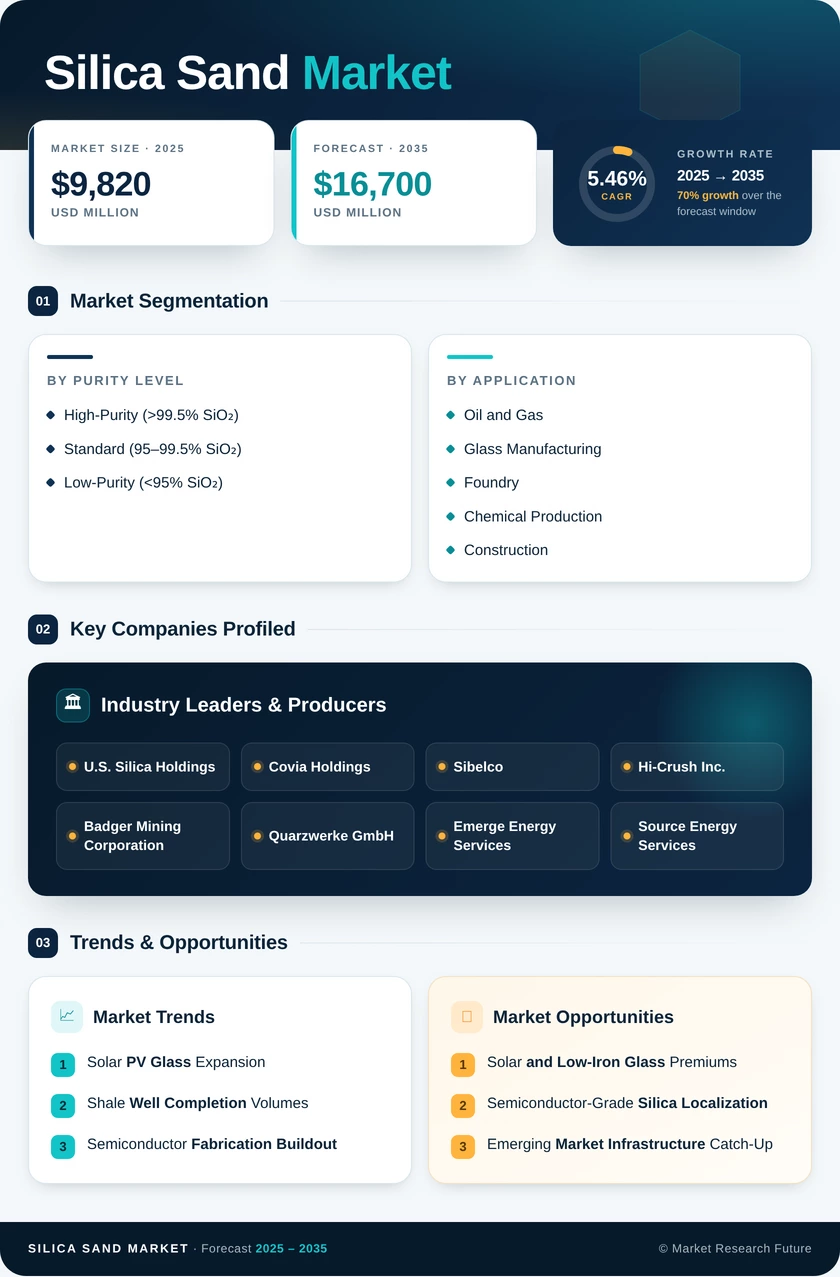
Silica Sand Market

ID: MRFR/CnM/6744-CR
128 Pages
Anshula Mandaokar
Last Updated: June 16, 2026
Silica Sand Market Research Report Information by Mesh Size (< 70 Mesh, 70-120 Mesh, 120-200 Mesh, and >200 Mesh), By Grade (Glass, Foundry and Chemical), By Process (Wet Silica Sand, and Dry Silica Sand), By Application(Glass, Hydraulic Fracturing, Foundry, Construction, Chemicals, Water Filtration, Paints & Coatings, Ceramics, and Others) And By Region (North America, Europe, Asia-Pacific, Middle East & Africa and Latin America) - Forecast Till 2035
Download PDF ×

We do not share your information with anyone. However, we may send you emails based on your report interest from time to time. You may contact us at any time to opt-out.

  1. 1 Market Overview |
    1. 1.1 Study Assumptions & Market Definition |
    2. 1.2 Scope of the Study |
    3. 1.3 Research Methodology
  2. 2 Market Summary & Key Takeaways
  3. 3 Market Dynamics |
    1. 3.1 Market Drivers Analysis | |
      1. 3.1.1 Solar PV Glass Expansion | |
      2. 3.1.2 Shale Well Completion Volumes | |
      3. 3.1.3 Semiconductor Fabrication Buildout | |
      4. 3.1.4 Urbanization and Infrastructure Programs | |
      5. 3.1.5 Foundry Lightweighting for EVs | |
      6. 3.1.6 Water Filtration Regulatory Mandates | |
      7. 3.1.7 Specialty Coatings Demand Growth |
    2. 3.2 Market Restraints Analysis | |
      1. 3.2.1 Silicosis and Occupational Health Regulations | |
      2. 3.2.2 Environmental Permitting Delays | |
      3. 3.2.3 Substitute Proppant Technologies | |
      4. 3.2.4 Logistics and Transportation Cost Inflation | |
      5. 3.2.5 Water Consumption Scrutiny in Mining |
    3. 3.3 Market Opportunity Analysis | |
      1. 3.3.1 Solar and Low-Iron Glass Premiums | |
      2. 3.3.2 Semiconductor-Grade Silica Localization | |
      3. 3.3.3 Emerging Market Infrastructure Catch-Up | |
      4. 3.3.4 Recycled and Circular Sand Business Models | |
      5. 3.3.5 Water Filtration and Environmental Remediation |
    4. 3.4 Industry Value Chain Analysis |
    5. 3.5 Porter's Five Forces Analysis
  4. 4 Global Silica Sand Market Size & Forecast (2021–2035) |
    1. 4.1 Historical Market Size (2021–2025) |
    2. 4.2 Current & Forecast Market Size (2026–2035) |
    3. 4.3 Market Size by Revenue (USD Million) |
    4. 4.4 Year-over-Year Growth Analysis
  5. 5 Segmentation Analysis |
    1. 5.1 By Purity Level | |
      1. 5.1.1 High-Purity (>99.5% SiO₂) | |
      2. 5.1.2 Standard (95–99.5% SiO₂) | |
      3. 5.1.3 Low-Purity (<95% SiO₂) |
    2. 5.2 By End-User Industry | |
      1. 5.2.1 Glass Manufacturing | |
      2. 5.2.2 Foundry | |
      3. 5.2.3 Chemical Production | |
      4. 5.2.4 Construction | |
      5. 5.2.5 Paints and Coatings | |
      6. 5.2.6 Ceramics and Refractories | |
      7. 5.2.7 Filtration | |
      8. 5.2.8 Oil and Gas | |
      9. 5.2.9 Other End-User Industries
  6. 6 Regional Analysis |
    1. 6.1 North America | |
      1. 6.1.1 United States | |
      2. 6.1.2 Canada | |
      3. 6.1.3 Mexico |
    2. 6.2 Europe | |
      1. 6.2.1 Germany | |
      2. 6.2.2 United Kingdom | |
      3. 6.2.3 France | |
      4. 6.2.4 Italy | |
      5. 6.2.5 Spain | |
      6. 6.2.6 Nordic Countries | |
      7. 6.2.7 Russia | |
      8. 6.2.8 Rest of Europe |
    3. 6.3 Asia-Pacific | |
      1. 6.3.1 China | |
      2. 6.3.2 India | |
      3. 6.3.3 Japan | |
      4. 6.3.4 South Korea | |
      5. 6.3.5 ASEAN | |
      6. 6.3.6 Rest of Asia-Pacific |
    4. 6.4 South America | |
      1. 6.4.1 Brazil | |
      2. 6.4.2 Argentina | |
      3. 6.4.3 Rest of South America |
    5. 6.5 Middle East & Africa | |
      1. 6.5.1 Saudi Arabia | |
      2. 6.5.2 UAE | |
      3. 6.5.3 South Africa | |
      4. 6.5.4 Egypt | |
      5. 6.5.5 Rest of MEA
  7. 7 Competitive Landscape |
    1. 7.1 Market Share Analysis (2025) |
    2. 7.2 Competitive Benchmarking Matrix |
    3. 7.3 Company Profiles | |
      1. 7.3.1 U.S. Silica Holdings | |
      2. 7.3.2 Covia Holdings | |
      3. 7.3.3 Sibelco | |
      4. 7.3.4 Hi-Crush Inc. | |
      5. 7.3.5 Badger Mining Corporation | |
      6. 7.3.6 Quarzwerke GmbH | |
      7. 7.3.7 Emerge Energy Services | |
      8. 7.3.8 Source Energy Services | |
      9. 7.3.9 Fairmount Santrol | |
      10. 7.3.10 Minerali Industriali
  8. 8 Future Outlook & Strategic Recommendations (2026–2035) |
    1. 8.1 Clean Energy Supply Chain Intensification |
    2. 8.2 Digital Traceability and Quality Certification |
    3. 8.3 Sustainability and ESG Reporting Mandates |
    4. 8.4 Automation and Precision Processing
  9. 9 Recent Developments & News
  10. 10 Frequently Asked Questions (FAQs)
  11. 11 Report Scope & Methodology |
    1. 11.1 Study Period & Base Year |
    2. 11.2 Data Sources & Citations |
    3. 11.3 Abbreviations
  12. 12 LIST OF TABLES |
  13. TABLE 1 Global Silica Sand Market Size & Forecast, by Revenue (USD Million), 2021–2035 |
  14. TABLE 2 Global Silica Sand Market — Year-over-Year Growth Analysis, 2021–2035 |
  15. TABLE 3 Global Silica Sand Market — Driver Impact Analysis |
  16. TABLE 4 Global Silica Sand Market — Restraint Impact Analysis |
  17. TABLE 5 Global Silica Sand Market Size, by Purity Level, 2021–2035 (USD Million) |
  18. TABLE 6 Global Silica Sand Market Size, by End-User Industry, 2021–2035 (USD Million) |
  19. TABLE 7 Global Silica Sand Market Size, by Region, 2021–2035 (USD Million) |
  20. TABLE 8 North America Silica Sand Market Size, by Country, 2021–2035 (USD Million) |
  21. TABLE 9 Europe Silica Sand Market Size, by Country, 2021–2035 (USD Million) |
  22. TABLE 10 Asia-Pacific Silica Sand Market Size, by Country, 2021–2035 (USD Million) |
  23. TABLE 11 South America Silica Sand Market Size, by Country, 2021–2035 (USD Million) |
  24. TABLE 12 Middle East & Africa Silica Sand Market Size, by Country, 2021–2035 (USD Million) |
  25. TABLE 13 Competitive Benchmarking Matrix — Global Silica Sand Market, 2025 |
  26. TABLE 14 Company Profiles — Key Players, Global Silica Sand Market |
  27. TABLE 15 Recent Developments & Strategic Announcements, 2023–2025 |
  28. TABLE 16 Report Scope & Methodology Summary |
  29. TABLE 17 Detailed Sources and Citations |
  30. TABLE 18 North America Silica Sand Market Size, by Purity Level, 2021–2035 (USD Million) |
  31. TABLE 19 North America Silica Sand Market Size, by End-User Industry, 2021–2035 (USD Million) |
  32. TABLE 20 Europe Silica Sand Market Size, by Purity Level, 2021–2035 (USD Million) |
  33. TABLE 21 Europe Silica Sand Market Size, by End-User Industry, 2021–2035 (USD Million) |
  34. TABLE 22 Asia-Pacific Silica Sand Market Size, by Purity Level, 2021–2035 (USD Million) |
  35. TABLE 23 Asia-Pacific Silica Sand Market Size, by End-User Industry, 2021–2035 (USD Million) |
  36. TABLE 24 South America Silica Sand Market Size, by Purity Level, 2021–2035 (USD Million) |
  37. TABLE 25 South America Silica Sand Market Size, by End-User Industry, 2021–2035 (USD Million) |
  38. TABLE 26 Middle East & Africa Silica Sand Market Size, by Purity Level, 2021–2035 (USD Million) |
  39. TABLE 27 Middle East & Africa Silica Sand Market Size, by End-User Industry, 2021–2035 (USD Million) |
  40. TABLE 28 United States Silica Sand Market Size, by Purity Level, 2021–2035 (USD Million) |
  41. TABLE 29 United States Silica Sand Market Size, by End-User Industry, 2021–2035 (USD Million) |
  42. TABLE 30 Canada Silica Sand Market Size, by Purity Level, 2021–2035 (USD Million) |
  43. TABLE 31 Canada Silica Sand Market Size, by End-User Industry, 2021–2035 (USD Million) |
  44. TABLE 32 Mexico Silica Sand Market Size, by Purity Level, 2021–2035 (USD Million) |
  45. TABLE 33 Mexico Silica Sand Market Size, by End-User Industry, 2021–2035 (USD Million) |
  46. TABLE 34 Germany Silica Sand Market Size, by Purity Level, 2021–2035 (USD Million) |
  47. TABLE 35 Germany Silica Sand Market Size, by End-User Industry, 2021–2035 (USD Million) |
  48. TABLE 36 United Kingdom Silica Sand Market Size, by Purity Level, 2021–2035 (USD Million) |
  49. TABLE 37 United Kingdom Silica Sand Market Size, by End-User Industry, 2021–2035 (USD Million) |
  50. TABLE 38 France Silica Sand Market Size, by Purity Level, 2021–2035 (USD Million) |
  51. TABLE 39 France Silica Sand Market Size, by End-User Industry, 2021–2035 (USD Million) |
  52. TABLE 40 Italy Silica Sand Market Size, by Purity Level, 2021–2035 (USD Million) |
  53. TABLE 41 Italy Silica Sand Market Size, by End-User Industry, 2021–2035 (USD Million) |
  54. TABLE 42 Spain Silica Sand Market Size, by Purity Level, 2021–2035 (USD Million) |
  55. TABLE 43 Spain Silica Sand Market Size, by End-User Industry, 2021–2035 (USD Million) |
  56. TABLE 44 China Silica Sand Market Size, by Purity Level, 2021–2035 (USD Million) |
  57. TABLE 45 China Silica Sand Market Size, by End-User Industry, 2021–2035 (USD Million) |
  58. TABLE 46 India Silica Sand Market Size, by Purity Level, 2021–2035 (USD Million) |
  59. TABLE 47 India Silica Sand Market Size, by End-User Industry, 2021–2035 (USD Million) |
  60. TABLE 48 Japan Silica Sand Market Size, by Purity Level, 2021–2035 (USD Million) |
  61. TABLE 49 Japan Silica Sand Market Size, by End-User Industry, 2021–2035 (USD Million) |
  62. TABLE 50 South Korea Silica Sand Market Size, by Purity Level, 2021–2035 (USD Million) |
  63. TABLE 51 South Korea Silica Sand Market Size, by End-User Industry, 2021–2035 (USD Million) |
  64. TABLE 52 Brazil Silica Sand Market Size, by Purity Level, 2021–2035 (USD Million) |
  65. TABLE 53 Brazil Silica Sand Market Size, by End-User Industry, 2021–2035 (USD Million) |
  66. TABLE 54 Saudi Arabia Silica Sand Market Size, by Purity Level, 2021–2035 (USD Million) |
  67. TABLE 55 Saudi Arabia Silica Sand Market Size, by End-User Industry, 2021–2035 (USD Million)
  68. 13 LIST OF FIGURES |
  69. FIGURE 1 Global Silica Sand Market Dynamics — Drivers, Restraints, and Opportunities |
  70. FIGURE 2 Silica Sand Industry Value Chain Analysis |
  71. FIGURE 3 Porter's Five Forces Analysis — Global Silica Sand Market |
  72. FIGURE 4 Global Silica Sand Market Size Trend (USD Million), 2021–2035 |
  73. FIGURE 5 Global Silica Sand Market Share, by Purity Level, 2025 (%) |
  74. FIGURE 6 Global Silica Sand Market Share, by End-User Industry, 2025 (%) |
  75. FIGURE 7 Global Silica Sand Market Share, by Region, 2025 (%) |
  76. FIGURE 8 North America Silica Sand Market Size Trend (USD Million), 2021–2035 |
  77. FIGURE 9 Europe Silica Sand Market Size Trend (USD Million), 2021–2035 |
  78. FIGURE 10 Asia-Pacific Silica Sand Market Size Trend (USD Million), 2021–2035 |
  79. FIGURE 11 South America Silica Sand Market Size Trend (USD Million), 2021–2035 |
  80. FIGURE 12 Middle East & Africa Silica Sand Market Size Trend (USD Million), 2021–2035 |
  81. FIGURE 13 Competitive Landscape — Market Share of Top 10 Players, 2025 (%) |
  82. FIGURE 14 Competitive Positioning Matrix — Global Silica Sand Market

Segmentation Quick Reference

DimensionSub-SegmentsDominant SegmentFastest Growing Segment
Purity LevelHigh-Purity (>99.5% SiO₂), Standard (95–99.5%), Low-Purity (<95%)Standard (95–99.5%)High-Purity (>99.5% SiO₂)
End-User IndustryGlass Manufacturing, Foundry, Chemical Production, Construction, Paints and Coatings, Ceramics and Refractories, Filtration, Oil and Gas, OtherOil and GasFiltration
GeographyAsia-Pacific, North America, Europe, South America, the Middle East & AfricaAsia-PacificAsia-Pacific


Market Segmentation Overview

By Purity Level

Sub-SegmentKey Trend
High-Purity (>99.5% SiO₂)Semiconductor and solar glass demand are driving premium pricing and beneficiation investment
Standard (95–99.5% SiO₂)Stable volume base underpinned by glass manufacturing and construction applications
Low-Purity (<95% SiO₂)Commoditized segment serving foundry and general fill applications with thin margins


The purity level dimension captures the fundamental quality gradient in the silica sand industry. Standard-grade material accounts for the majority of tonnage shipped globally, but high-purity grades are growing at a faster rate as semiconductor, solar, and specialty chemical buyers tighten their feedstock specifications. Low-purity material remains volume-significant in foundry and construction contexts where chemical composition tolerances are wider.

By End-User Industry

Sub-SegmentKey Trend
Glass ManufacturingSolar PV glass expansion and architectural glass premiumization
FoundryEV gigacasting adoption increasing demand for precision-graded mold sand
Chemical ProductionGrowing use as feedstock for silicones, sodium silicate, and catalysts
ConstructionInfrastructure mega-projects in Asia-Pacific and the Middle East
Paints and CoatingsFunctional filler demand in anti-corrosion and textured coatings
Ceramics and RefractoriesKiln lining replacements and tile production in Southern Europe and Asia
FiltrationTightening municipal water quality standards, expanding filter media demand
Oil and GasHorizontal well proppant intensity rising with longer lateral lengths
Other End-User IndustriesSports turf, recreation surfaces, and specialty industrial applications


The end-user dimension reflects the extraordinary breadth of silica sand consumption across the global economy. Oil and gas dominates on share, but the growth center is shifting toward glass manufacturing and filtration as clean energy and water quality regulations intensify. Foundry applications are evolving rapidly with the automotive industry's transition to lightweight aluminum castings.

By Geography

Sub-SegmentKey Trend
Asia-PacificLargest and fastest-growing region driven by solar glass, construction, and semiconductor demand
North AmericaFrac sand demand and specialty product premiums anchoring the second-largest position
EuropeAutomotive foundry transition and solar glass capacity additions
South AmericaHigh-purity export deposits and emerging shale proppant demand
Middle East & AfricaMega-project construction and nascent glass manufacturing capacity


Geographic segmentation reveals a market where Asia-Pacific's dominance is structural — rooted in both massive construction volumes and the region's concentration of solar glass and semiconductor manufacturing capacity. North America's position is uniquely shaped by the shale energy ecosystem, while Europe's growth increasingly reflects the continent's clean energy transition. South America and MEA represent smaller but faster-evolving segments where greenfield investment is creating new supply and demand nodes.