×
Request Free Sample ×

Kindly complete the form below to receive a free sample of this Report

* Please use a valid business email

Leading companies partner with us for data-driven Insights

clients tt-cursor
Hero Background

Smart Lighting Market

ID: MRFR/SEM/0485-CR
200 Pages
Ankit Gupta
February 2025

Smart Lighting Market Research Report Information By Installation Type (New Installation, Retrofit Installations), By Offering (Hardware, Software, Services), End Use Application (Indoor, Outdoor), Communication Technology (Wired, Wireless), and Region (North America, Europe, Asia-Pacific, Middle East & Africa, and South America) - Industry Size, Share and Forecast till 2035

Share:
Download PDF ×

We do not share your information with anyone. However, we may send you emails based on your report interest from time to time. You may contact us at any time to opt-out.

Smart Lighting Market Infographic
Purchase Options

Smart Lighting Market Summary

As per MRFR analysis, the Smart Lighting Market Size was estimated at 19.15 USD Million in 2024. The Smart Lighting industry is projected to grow from 23.01 in 2025 to 143.88 by 2035, exhibiting a compound annual growth rate (CAGR) of 20.12 during the forecast period 2025 - 2035.

Key Market Trends & Highlights

The Smart Lighting Market is poised for substantial growth driven by technological advancements and increasing energy efficiency demands.

  • The integration of IoT technology is transforming smart lighting solutions, enhancing connectivity and user control.
  • North America remains the largest market, while the Asia-Pacific region is emerging as the fastest-growing area for smart lighting adoption.
  • The residential segment dominates the market, whereas the commercial segment is experiencing rapid growth due to increasing demand for smart solutions.
  • Rising demand for energy efficiency and technological advancements in lighting solutions are key drivers propelling market expansion.

Market Size & Forecast

2024 Market Size 19.15 (USD Million)
2035 Market Size 143.88 (USD Million)
CAGR (2025 - 2035) 20.12%

Major Players

Signify (NL), Osram (DE), Acuity Brands (US), Cree (US), GE Lighting (US), Philips Hue (NL), Honeywell (US), Lutron Electronics (US), Legrand (FR)

Smart Lighting Market Trends

The Smart Lighting Market is currently experiencing a transformative phase, driven by advancements in technology and increasing consumer awareness regarding energy efficiency. The integration of Internet of Things (IoT) capabilities into lighting systems has enabled enhanced control and automation, allowing users to manage their lighting environments more effectively. This shift towards smart solutions is not only about convenience but also about sustainability, as energy-efficient lighting options contribute to reduced carbon footprints. Furthermore, the growing trend of smart homes and buildings is propelling the demand for intelligent lighting solutions, as consumers seek to create more connected and responsive living spaces. In addition to technological advancements, regulatory frameworks are evolving to support the adoption of smart lighting systems. Governments worldwide are implementing policies that encourage energy conservation and the use of renewable resources, which aligns with the objectives of the Smart Lighting Market. As a result, manufacturers are increasingly focusing on developing innovative products that meet these regulatory standards while also appealing to environmentally conscious consumers. The convergence of these factors suggests a promising future for the Smart Lighting Market, characterized by continuous growth and innovation, as stakeholders adapt to changing consumer preferences and regulatory landscapes.

Integration of IoT Technology

The Smart Lighting Market is witnessing a notable trend towards the integration of Internet of Things (IoT) technology. This development allows for enhanced connectivity and control, enabling users to manage their lighting systems remotely through smartphones and other devices. Such advancements not only improve user experience but also facilitate energy management, contributing to overall efficiency.

Focus on Energy Efficiency

A growing emphasis on energy efficiency is shaping the Smart Lighting Market. Consumers and businesses alike are increasingly prioritizing sustainable solutions that reduce energy consumption. This trend is prompting manufacturers to innovate and offer products that not only meet performance expectations but also align with environmental goals.

Regulatory Support for Smart Solutions

Regulatory frameworks are evolving to support the adoption of smart lighting technologies. Governments are implementing policies that promote energy conservation and the use of smart solutions. This regulatory backing is likely to accelerate the growth of the Smart Lighting Market, as it encourages manufacturers to develop compliant and innovative products.

Smart Lighting Market Drivers

Technological Advancements in IoT

The integration of Internet of Things (IoT) technology into lighting systems is a pivotal driver for the Global Smart Lighting Market Industry. IoT-enabled smart lighting allows for remote control, automation, and data collection, enhancing user experience and operational efficiency. With advancements in wireless communication technologies, such as Zigbee and Wi-Fi, smart lighting systems can be seamlessly integrated into smart homes and cities. This technological evolution is likely to propel the market forward, with projections indicating a compound annual growth rate (CAGR) of 16.66% from 2025 to 2035, as more consumers adopt these innovative solutions.

Growing Demand for Energy Efficiency

The Global Smart Lighting Market Industry is experiencing a surge in demand for energy-efficient solutions as consumers and businesses seek to reduce energy consumption and costs. Smart lighting systems, which utilize LED technology and intelligent controls, can lead to significant energy savings. For instance, it is estimated that smart lighting can reduce energy usage by up to 70% compared to traditional lighting. This trend is expected to drive the market's growth, with the market projected to reach 16.7 USD Billion in 2024, reflecting a growing awareness of sustainability and energy conservation.

Government Initiatives and Regulations

Government initiatives aimed at promoting energy efficiency and sustainability are significantly influencing the Global Smart Lighting Market Industry. Various countries are implementing regulations that encourage the adoption of smart lighting technologies, often providing incentives for businesses and homeowners. For example, energy efficiency programs in Europe and North America are designed to facilitate the transition to smart lighting solutions. These initiatives not only aim to reduce carbon footprints but also enhance public safety and urban aesthetics. As a result, the market is expected to expand, with a projected value of 90.9 USD Billion by 2035, driven by supportive policies and funding.

Increased Focus on Public Safety and Security

Public safety and security concerns are increasingly influencing the Global Smart Lighting Market Industry. Smart lighting systems equipped with sensors and cameras can enhance surveillance and deter criminal activities in public spaces. Cities are adopting smart lighting solutions to improve visibility and safety in high-crime areas, thereby fostering a sense of security among residents. This trend is particularly evident in urban areas where crime rates are a concern. The implementation of smart lighting for public safety is expected to drive market growth, as municipalities recognize the benefits of investing in advanced lighting technologies.

Rising Urbanization and Smart City Development

The rapid pace of urbanization and the development of smart cities are key factors driving the Global Smart Lighting Market Industry. As urban populations grow, the demand for efficient and sustainable lighting solutions becomes increasingly critical. Smart lighting plays a vital role in smart city initiatives, providing enhanced safety, improved energy management, and better public services. Cities worldwide are investing in smart lighting infrastructure to address these challenges, leading to a projected market growth. The integration of smart lighting in urban planning is likely to contribute to the overall market expansion, aligning with global trends toward sustainable urban development.

Market Segment Insights

By Application: Residential (Largest) vs. Commercial (Fastest-Growing)

In the Smart Lighting Market, the application segment is primarily dominated by the Residential sector, which accounts for a significant market share due to increasing consumer demand for energy-efficient lighting solutions and smart home technologies. The Commercial application follows closely, benefiting from the increasing focus on energy savings and the implementation of smart systems in workplaces. Other segments like Industrial, Outdoor, and Smart City applications are also growing, showcasing an increasing trend towards integrating smart lighting solutions across various environments.

Residential (Dominant) vs. Commercial (Emerging)

The Residential segment is the cornerstone of the Smart Lighting Market, characterized by extensive adoption of smart bulbs, connected lighting systems, and integration with home automation. Consumers are increasingly investing in energy-efficient lighting solutions that enhance home aesthetics and provide convenience. On the other hand, the Commercial segment is emerging rapidly, driven by advancements in IoT and the need for businesses to reduce operating costs. Commercial establishments are adopting smart lighting systems to improve energy efficiency, enhance employee productivity, and create adaptable lighting environments. The dual focus on functionality and sustainability positions both segments on complementary paths toward a smarter, more energy-conscious future.

By Technology: LED (Largest) vs. Smart Sensors (Fastest-Growing)

In the Smart Lighting Market, LED technology dominates the market share, driven by its energy efficiency and long lifespan. Following LEDs, fluorescent lighting continues to hold a significant position, though its popularity is waning with the increasing adoption of advanced lighting solutions. Incandescent bulbs are gradually being phased out due to regulatory changes and efficiency concerns. Meanwhile, smart sensors and wireless technologies are capturing attention with their innovative applications and integration into IoT ecosystems, expanding their market presence rapidly.

Smart Lighting: LED (Dominant) vs. Smart Sensors (Emerging)

LED technology remains the cornerstone of the Smart Lighting Market, known for its high energy efficiency, durability, and environmental benefits. It caters to a wide range of applications, from residential to commercial settings, and is favored for its cost-effectiveness in the long run. In contrast, smart sensors represent an emerging trend, enhancing lighting systems with automation and connectivity features. As cities and buildings evolve towards smarter infrastructures, the integration of smart sensors with existing lighting systems is accelerating, potentially transforming user experiences and operational efficiencies in lighting management.

By End Use: Retail (Largest) vs. Hospitality (Fastest-Growing)

In the Smart Lighting Market, the end-use segments exhibit distinctive market share distributions. Retail leads as the largest segment, driven by the increasing adoption of smart technologies in retail environments to enhance customer experiences. Following closely, the hospitality sector showcases significant growth, leveraging smart lighting to optimize energy efficiency and improve guest satisfaction. Other sectors like healthcare, education, and transportation also contribute to the market, but to a lesser extent in comparison to retail and hospitality. The growth trends in the Smart Lighting Market are propelled by a multitude of factors. The retail segment is seeing an uptick due to the demand for personalized lighting solutions that influence consumer behavior. Simultaneously, the hospitality sector, recognized as the fastest-growing segment, is increasingly adopting smart lighting solutions to create customizable atmospheres that align with branding goals and sustainability initiatives. Awareness of energy efficiency and usability enhancements further drive advancements in smart lighting technology across all end-use sectors.

Retail (Dominant) vs. Hospitality (Emerging)

Retail holds a dominant position in the Smart Lighting Market due to its focus on enhancing customer experiences and store aesthetics through innovative lighting solutions. The segment benefits from investments in advanced lighting technologies that not only reduce energy costs but also create engaging environments for shoppers. Smart lighting systems in retail are often integrated with analytics to monitor foot traffic and store activity, further enhancing strategic marketing initiatives. On the other hand, the hospitality sector represents an emerging segment characterized by rapid innovation. Hotels and restaurants are adopting smart lighting solutions to provide personalized ambiance for guests, optimize energy use, and enhance operational efficiency. This versatility in application, along with an increasing focus on sustainability, positions hospitality as a dynamic player in the smart lighting landscape.

Get more detailed insights about Smart Lighting Market

Regional Insights

North America : Market Leader in Smart Lighting

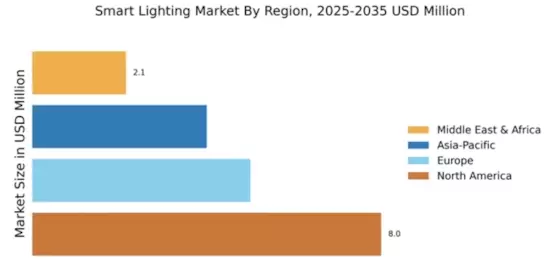
North America is poised to maintain its leadership in the smart lighting market, holding a significant share of 9.58 billion. The growth is driven by increasing demand for energy-efficient solutions and smart home technologies. Regulatory support, such as energy efficiency standards, further catalyzes market expansion. The region's focus on sustainability and innovation is expected to bolster the adoption of smart lighting solutions across residential and commercial sectors. The United States stands out as the leading country, with major players like Signify, Acuity Brands, and GE Lighting driving competition. The presence of advanced infrastructure and high consumer awareness contributes to the robust market landscape. As smart lighting technology evolves, companies are investing in R&D to enhance product offerings, ensuring a competitive edge in this dynamic market.

Europe : Emerging Smart Lighting Hub

Europe is rapidly emerging as a key player in the smart lighting market, with a market size of €5.73 billion. The region benefits from stringent energy regulations and a strong push towards sustainability, driving demand for smart lighting solutions. Initiatives like the EU's Green Deal aim to reduce carbon emissions, further enhancing market growth. The increasing integration of IoT in lighting systems is also a significant trend, promoting energy efficiency and user convenience. Leading countries such as Germany, France, and the UK are at the forefront of this transformation, with companies like Osram and Philips Hue leading the charge. The competitive landscape is characterized by innovation and collaboration among key players, focusing on smart city projects and residential applications. The European market is expected to continue its upward trajectory as technology advances and consumer preferences shift towards smart solutions.

Asia-Pacific : Rapid Growth in Smart Lighting

The Asia-Pacific region is witnessing rapid growth in the smart lighting market, with a market size of $3.25 billion. Factors such as urbanization, rising disposable incomes, and increasing awareness of energy efficiency are driving demand. Governments are implementing policies to promote smart technologies, which is expected to further accelerate market growth. The region's focus on smart city initiatives is also a significant catalyst for the adoption of smart lighting solutions. Countries like China, Japan, and India are leading the charge, with a growing number of local and international players entering the market. Companies such as Cree and Honeywell are expanding their presence, focusing on innovative products tailored to regional needs. The competitive landscape is evolving, with partnerships and collaborations becoming common as firms seek to leverage technological advancements and meet consumer demands for smart lighting solutions.

Middle East and Africa : Emerging Market Potential

The Middle East and Africa (MEA) region is gradually emerging in the smart lighting market, currently valued at $0.59 billion. The growth is driven by increasing urbanization, infrastructure development, and a rising focus on energy efficiency. Governments are beginning to recognize the importance of smart technologies, leading to initiatives that promote sustainable lighting solutions. The region's diverse climate and energy needs also create unique opportunities for tailored smart lighting applications. Countries like the UAE and South Africa are at the forefront of this market, with investments in smart city projects and energy-efficient technologies. The competitive landscape is characterized by a mix of local and international players, including Legrand and other emerging firms. As awareness of smart lighting benefits grows, the MEA region is expected to see significant growth in the coming years, driven by both public and private sector initiatives.

Key Players and Competitive Insights

The Smart Lighting Market is currently characterized by a dynamic competitive landscape, driven by technological advancements and increasing demand for energy-efficient solutions. Key players such as Signify (NL), Osram (DE), and Acuity Brands (US) are strategically positioned to leverage innovation and sustainability as core components of their operational focus. Signify (NL), for instance, emphasizes its commitment to circular economy principles, which not only enhances its brand image but also aligns with global sustainability goals. Meanwhile, Osram (DE) has been focusing on expanding its smart lighting portfolio through strategic partnerships, thereby enhancing its market presence and technological capabilities. Collectively, these strategies contribute to a competitive environment that is increasingly defined by innovation and sustainability.

In terms of business tactics, companies are localizing manufacturing and optimizing supply chains to enhance efficiency and responsiveness to market demands. The competitive structure of the Smart Lighting Market appears moderately fragmented, with several key players exerting influence over various segments. This fragmentation allows for a diverse range of products and solutions, catering to different consumer needs and preferences, while also fostering healthy competition among established and emerging players.

In November 2025, Signify (NL) announced the launch of its new range of solar-powered smart streetlights, which are designed to reduce energy consumption and carbon emissions. This strategic move not only reinforces Signify's commitment to sustainability but also positions the company as a leader in the growing segment of eco-friendly lighting solutions. The introduction of these products is likely to attract municipalities and urban planners looking to enhance public spaces while adhering to environmental regulations.

In October 2025, Osram (DE) entered into a partnership with a leading technology firm to integrate AI capabilities into its smart lighting systems. This collaboration aims to enhance the functionality of lighting solutions, allowing for more personalized and adaptive lighting experiences. The integration of AI is expected to provide Osram with a competitive edge, as it aligns with the increasing consumer demand for smart home technologies and automation.

In September 2025, Acuity Brands (US) unveiled a new cloud-based platform that enables users to manage their lighting systems remotely. This platform not only enhances user convenience but also allows for real-time monitoring and energy management. By investing in digital transformation, Acuity Brands is likely to strengthen its market position and appeal to tech-savvy consumers who prioritize smart home integration.

As of December 2025, the Smart Lighting Market is witnessing trends such as digitalization, sustainability, and AI integration, which are reshaping competitive dynamics. Strategic alliances among key players are becoming increasingly prevalent, facilitating the sharing of resources and expertise. Looking ahead, competitive differentiation is expected to evolve, with a shift from price-based competition to a focus on innovation, technology, and supply chain reliability. Companies that can effectively harness these trends are likely to secure a more prominent position in the market.

Key Companies in the Smart Lighting Market market include

Industry Developments

  • Q2 2024: Signify launches new Philips Hue Secure smart lighting system Signify introduced the Philips Hue Secure system, integrating smart lighting with security features such as motion sensors and cameras, expanding its product portfolio in the smart home sector.
  • Q2 2024: Acuity Brands acquires KE2 Therm Solutions to expand smart building controls Acuity Brands announced the acquisition of KE2 Therm Solutions, a provider of smart refrigeration controls, to enhance its smart building and lighting control offerings.
  • Q2 2024: Lutron Electronics unveils Athena Wireless Node for smart lighting control Lutron Electronics launched the Athena Wireless Node, a new device enabling wireless smart lighting control for commercial buildings, supporting energy efficiency and flexible lighting management.
  • Q3 2024: Osram signs partnership with Siemens for smart city lighting projects Osram entered a strategic partnership with Siemens to deploy smart lighting solutions in urban infrastructure projects, focusing on energy efficiency and IoT integration.
  • Q3 2024: Smart lighting startup Noon Home raises $25 million in Series B funding Noon Home, a smart lighting technology startup, secured $25 million in Series B funding to accelerate product development and expand its market presence in North America.
  • Q3 2024: Cree Lighting launches Connected Max Smart Outdoor Security Lights Cree Lighting introduced the Connected Max line of smart outdoor security lights, featuring app-based controls and integration with major smart home platforms.
  • Q4 2024: Schneider Electric opens new smart lighting R&D center in Singapore Schneider Electric inaugurated a research and development center in Singapore dedicated to advancing smart lighting and building automation technologies.
  • Q4 2024: GE Current wins contract to retrofit smart street lighting in Los Angeles GE Current secured a major contract to upgrade Los Angeles' street lighting infrastructure with smart, energy-efficient LED systems and IoT connectivity.
  • Q1 2025: Signify acquires WiZ Connected to strengthen Wi-Fi smart lighting portfolio Signify completed the acquisition of WiZ Connected, a developer of Wi-Fi-based smart lighting solutions, to expand its connected lighting product range.
  • Q1 2025: Legrand appoints new CEO to drive smart lighting and IoT strategy Legrand announced the appointment of a new CEO, emphasizing a renewed focus on smart lighting and IoT-enabled building solutions.
  • Q2 2025: Acuity Brands launches nLight AIR 2.0 for advanced wireless lighting control Acuity Brands released nLight AIR 2.0, an upgraded wireless lighting control platform designed for commercial and industrial applications, featuring enhanced security and scalability.
  • Q2 2025: LIFX introduces Matter-compatible smart bulbs for global markets LIFX launched a new line of smart bulbs compatible with the Matter standard, aiming to improve interoperability across smart home ecosystems worldwide.

Future Outlook

Smart Lighting Market Future Outlook

The Smart Lighting Market is projected to grow at a 20.12% CAGR from 2024 to 2035, driven by advancements in IoT, energy efficiency, and urbanization.

New opportunities lie in:

  • Integration of AI-driven analytics for energy management solutions.
  • Development of smart lighting systems for urban infrastructure projects.
  • Expansion into emerging markets with tailored smart lighting solutions.

By 2035, the Smart Lighting Market is expected to be a pivotal sector, reflecting robust growth and innovation.

Market Segmentation

Smart Lighting Market End Use Outlook

  • Retail
  • Hospitality
  • Healthcare
  • Education
  • Transportation

Smart Lighting Market Technology Outlook

  • LED
  • Fluorescent
  • Incandescent
  • Smart Sensors
  • Wireless

Smart Lighting Market Application Outlook

  • Residential
  • Commercial
  • Industrial
  • Outdoor
  • Smart City

Report Scope

MARKET SIZE 202419.15(USD Million)
MARKET SIZE 202523.01(USD Million)
MARKET SIZE 2035143.88(USD Million)
COMPOUND ANNUAL GROWTH RATE (CAGR)20.12% (2024 - 2035)
REPORT COVERAGERevenue Forecast, Competitive Landscape, Growth Factors, and Trends
BASE YEAR2024
Market Forecast Period2025 - 2035
Historical Data2019 - 2024
Market Forecast UnitsUSD Million
Key Companies ProfiledSignify (NL), Osram (DE), Acuity Brands (US), Cree (US), GE Lighting (US), Philips Hue (NL), Honeywell (US), Lutron Electronics (US), Legrand (FR)
Segments CoveredApplication, Technology, End Use
Key Market OpportunitiesIntegration of Internet of Things technology enhances energy efficiency in the Smart Lighting Market.
Key Market DynamicsTechnological advancements and energy efficiency regulations drive rapid adoption of smart lighting solutions across various sectors.
Countries CoveredNorth America, Europe, APAC, South America, MEA

Market Highlights

Author
Ankit Gupta
Senior Research Analyst

Ankit Gupta is an analyst in market research industry in ICT and SEMI industry. With post-graduation in "Telecom and Marketing Management" and graduation in "Electronics and Telecommunication" vertical he is well versed with recent development in ICT industry as a whole. Having worked on more than 150+ reports including consultation for fortune 500 companies such as Microsoft and Rio Tinto in identifying solutions with respect to business problems his opinions are inclined towards mixture of technical and managerial aspects.

Leave a Comment

FAQs

How much is the Smart Lighting market?

Smart Lighting Market was valued at USD 19.15 billion in 2024

What is the growth rate of the Smart Lighting market?

The global market is projected to grow at a CAGR of 20.12% during the forecast period, 2025 to 2035.

Which region held the largest market share in the Smart Lighting market?

North America had the largest share in the global market

Who are the prominent players in the Smart Lighting market?

Control4 Corp. (Snap One LLC), Lutron Electronics Co. Inc., Signify Holding, Wyze Labs Inc., Sengled, Inter IKEA Holding, Acuity Brands Inc., Hubbell Incorporated, Crestron Electronics Inc., Insteon ,EGLO Leuchten GmbH, Eve Systems GmbH, LG Electronics Inc., Wiz Connected Lighting Co. Ltd, and Wipro Lighting Limited.

Which Installation Type led the Smart Lighting Market??

The New Installations dominated the market in 2024

Download Free Sample

Kindly complete the form below to receive a free sample of this Report

Compare Licence

×
Features License Type
Single User Multiuser License Enterprise User
Price $4,950 $5,950 $7,250
Maximum User Access Limit 1 User Upto 10 Users Unrestricted Access Throughout the Organization
Free Customization
Direct Access to Analyst
Deliverable Format
Platform Access
Discount on Next Purchase 10% 15% 15%
Printable Versions