Download Free Sample
Kindly complete the form below to receive a free sample of this Report
South America Women's Healthcare Market Research Report: Size, Share, Trend Analysis By Indication (Postmenopausal Osteoporosis, Infertility, Reproductive Health Management, Polycystic Ovary Syndrome, Gynecologic Cancer, Others), By Diagnosis (Bone Densitometry, Diagnostic Imaging Tests, Biopsies, Ovulation Testing, Others), By Treatment (Therapeutics, Surgeries, Others) and By End Users (Hospitals Clinics, Gynecology Centers, Research Institutes, Others) - Growth Outlook & Industry Forecast 2025 To 2035
As per analysis, the South America Women Healthcare Market is projected to grow from USD 2.79 Billion in 2024 to USD 6.56 Billion by 2035, exhibiting a compound annual growth rate (CAGR) of 8.08% during the forecast period (2025 - 2035).
The South America Women Healthcare Market is experiencing a transformative shift towards enhanced services and technological integration.
| 2024 Market Size | 2.79 (USD Billion) |
| 2035 Market Size | 6.56 (USD Billion) |
| CAGR (2025 - 2035) | 8.08% |
Johnson & Johnson (US), Bayer AG (DE), Merck & Co. (US), Pfizer Inc. (US), AbbVie Inc. (US), Novartis AG (CH), GSK (GB), Sanofi (FR), AstraZeneca (GB)
Our Impact
Enabled $4.3B Revenue Impact for Fortune 500 and Leading Multinationals
Partnering with 2000+ Global Organizations Each Year
30K+ Citations by Top-Tier Firms in the Industry
The South America Women Healthcare Market is currently experiencing a transformative phase, characterized by a growing emphasis on women's health issues and an increasing awareness of healthcare needs specific to this demographic. Governments and health organizations across the region are prioritizing initiatives aimed at improving access to healthcare services for women, particularly in rural and underserved areas. This shift is likely driven by a combination of factors, including rising health concerns, changing societal norms, and a greater focus on preventive care. As a result, there is a noticeable increase in the availability of specialized healthcare services tailored to women's unique health requirements, such as reproductive health, maternal care, and chronic disease management. Moreover, the South America Women Healthcare Market is witnessing a surge in technological advancements that enhance healthcare delivery. Telemedicine and digital health solutions are becoming more prevalent, enabling women to access medical consultations and health information conveniently. This trend appears to be particularly beneficial for those in remote locations, where traditional healthcare facilities may be limited. Additionally, educational campaigns aimed at promoting health literacy among women are gaining traction, empowering them to make informed decisions regarding their health. Overall, the South America Women Healthcare Market is poised for continued growth, driven by a commitment to improving health outcomes for women across the region.
Chronic diseases, such as diabetes and hypertension, are increasingly prevalent among women in South America, prompting a shift in healthcare focus. The South America Women Healthcare Market is responding to this trend by developing targeted programs aimed at managing these conditions. Data suggests that approximately 25% of women in the region are living with at least one chronic disease, necessitating specialized care. Healthcare providers are likely to enhance their offerings by integrating chronic disease management into women's health services. This focus on chronic conditions is expected to drive growth and innovation within the South America Women Healthcare Market.
The South America Women Healthcare Market is increasingly recognizing the importance of mental health among women. There is a growing awareness of the impact of mental health on overall well-being, particularly in relation to reproductive health. Recent surveys indicate that nearly 40% of women in the region report experiencing mental health challenges, yet access to mental health services remains limited. This gap presents an opportunity for healthcare providers to develop integrated services that address both physical and mental health needs. As awareness continues to rise, it is anticipated that the South America Women Healthcare Market will adapt to include comprehensive mental health support.
Government initiatives play a crucial role in shaping the South America Women Healthcare Market. Various countries in the region have introduced policies aimed at improving women's health outcomes. For instance, Brazil's Ministry of Health has launched programs focused on maternal and child health, which have resulted in a decrease in maternal mortality rates. Additionally, the introduction of health insurance schemes that cover women's health services is expected to enhance access to care. These supportive policies are likely to foster a more robust healthcare environment, encouraging further development within the South America Women Healthcare Market.
The South America Women Healthcare Market is witnessing a notable increase in demand for reproductive health services. This trend is driven by rising awareness regarding women's health issues, including family planning, contraception, and sexually transmitted infections. According to recent data, approximately 30% of women in South America express a need for improved access to reproductive health services. Governments and NGOs are responding by implementing programs aimed at enhancing education and access to these services. This growing demand is likely to stimulate investments in healthcare infrastructure and services, thereby contributing to the overall growth of the South America Women Healthcare Market.
Technological advancements are significantly influencing the South America Women Healthcare Market. The integration of digital health solutions, such as mobile health applications and telemedicine, is enhancing access to healthcare services for women. For example, a study indicates that telehealth consultations have increased by 50% in urban areas, allowing women to receive timely medical advice without geographical constraints. This shift towards technology-driven healthcare is expected to improve patient outcomes and satisfaction, thereby propelling the growth of the South America Women Healthcare Market. The ongoing investment in health technology is likely to further expand these services.
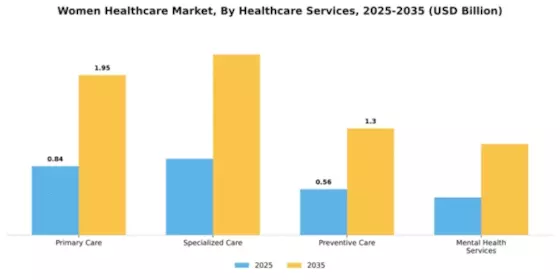
In the South America Women Healthcare Market, the distribution of market share among healthcare services reveals that specialized care holds the largest share, driven by an increasing focus on tailored medical solutions for women's health conditions. Primary care follows closely, providing essential health services, while preventive and mental health services hold a smaller yet significant share, indicating growing awareness and demand for comprehensive women's health services. The growth trends for these segments are promising, with mental health services identified as the fastest-growing segment due to heightened awareness surrounding mental well-being among women. Factors such as increased healthcare access, evolving societal norms, and rising incidences of mental health issues are propelling the expansion of mental health services, while specialized care continues to thrive with advancements in medical technology and a surge in chronic illness management.
Specialized Care (Dominant) vs. Mental Health Services (Emerging)
Specialized care stands out as the dominant segment in the South America Women Healthcare Market, characterized by its focus on specific health conditions such as reproductive health, hormonal disorders, and gynecological surgeries. This segment benefits from a comprehensive network of skilled professionals and advanced treatment facilities. On the other hand, mental health services are emerging rapidly, catering to the increasing demand for psychological support and counseling among women. This segment is becoming increasingly vital in the healthcare landscape due to societal shifts towards recognizing mental health's importance. As more resources, such as skilled therapists and integrated care approaches, become available, mental health services are poised to grow substantially, appealing to a diverse demographic and enhancing overall women's health outcomes.
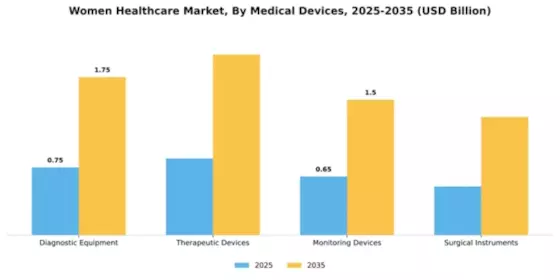
The South America Women Healthcare Market is characterized by a diversified range of medical devices, with therapeutic devices holding the largest share. As women’s health concerns gain prominence, modalities for treating conditions such as fertility issues and hormonal imbalances continue to dominate the landscape. Monitoring devices, while currently smaller in market share, are emerging rapidly due to the increasing emphasis on preventive healthcare and remote patient monitoring. In terms of growth trends, the medical devices segment is driven by advancements in technology and rising awareness regarding women's health issues. Factors such as the growing aging population and rising disposable income are propelling demand, particularly for monitoring devices. Furthermore, increased investment in healthcare infrastructure enhances the accessibility and affordability of these medical devices, encouraging adoption across various demographics in South America.
Therapeutic Devices (Dominant) vs. Monitoring Devices (Emerging)
Therapeutic devices, as the dominant segment in the South America Women Healthcare Market, include products ranging from drug delivery systems to advanced treatment devices for reproductive health. Their position is fortified by the continuous development of innovative technologies aimed at improving patient outcomes. In contrast, monitoring devices represent an emerging segment, reflecting the growing trend towards personalized healthcare. These devices enable consistent tracking of health metrics, facilitating early detection of issues. Their surge in popularity is attributed to heightened consumer consciousness regarding health and wellness, driven by the pandemic and a shift towards proactive management of health conditions. Together, these segments illustrate the dynamic nature of medical device offerings in the region.
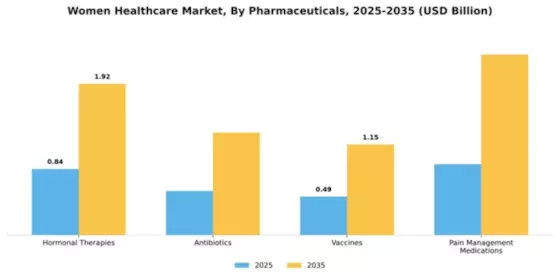
In the South America Women Healthcare Market, the Pharmaceuticals segment is primarily characterized by its diverse offerings, with Hormonal Therapies holding the largest market share. This category includes a variety of treatments aimed at addressing hormonal imbalances in women, which are crucial during various life stages such as menopause and reproductive health challenges. Following Hormonal Therapies, Vaccines are recognized as the fastest-growing segment, driven by rising awareness of preventive healthcare and vaccination programs specifically targeting women's health issues.
Hormonal Therapies (Dominant) vs. Vaccines (Emerging)
Hormonal Therapies have established themselves as a dominant force in the South America Women Healthcare Market, largely due to their essential role in managing hormonal imbalances and related health issues among women. These therapies encompass a broad range of treatments, including hormone replacement therapies and contraceptives, which are pivotal for women's reproductive health. On the other hand, Vaccines represent an emerging segment, fueled by an increased focus on immunizations and preventive measures. This growth is further propelled by government initiatives and public health campaigns aimed at reducing the incidence of diseases affecting women, thereby ensuring a healthier future for the female population.
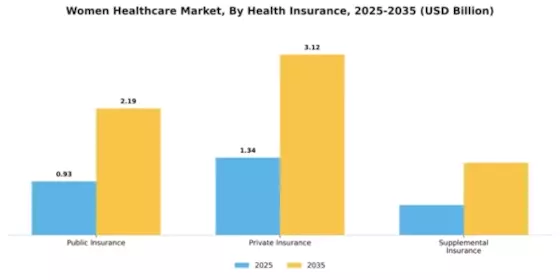
In the South America Women Healthcare Market, the health insurance segment is primarily divided into public, private, and supplemental insurance. Currently, public insurance emerges as the largest segment, accounting for a significant share of the market due to government initiatives aimed at improving healthcare accessibility for women. Conversely, private insurance, while smaller in share, is rapidly gaining traction, driven by rising incomes and an increasing awareness of the benefits of private healthcare services among women. The growth trends in this segment are influenced by various factors, including an expanding middle class and the increasing availability of private health plans tailored to women’s specific needs. As urbanization continues in South America, more women are opting for private insurance to access better healthcare services. Additionally, supplemental insurance is witnessing a rise as women seek comprehensive coverage that includes services not fully covered under public or private plans, indicating a shift towards more personalized care approaches.
Public Insurance (Dominant) vs. Supplemental Insurance (Emerging)
Public insurance in the South America Women Healthcare Market remains a dominant force, funded primarily through government systems, providing essential healthcare services to women at low or no cost. This segment is crucial for women in lower socioeconomic strata, ensuring access to maternal care, preventive screenings, and reproductive health services. However, as awareness grows, many women are turning towards supplemental insurance, which is emerging as a viable option. This insurance provides additional coverage beyond what public options offer, allowing women to choose additional services, private consultations, and faster medical attention. The emerging trend in supplemental insurance reflects a growing consumer preference for personalized healthcare solutions, filling gaps left by public systems and catering to the unique healthcare needs of women.
Get more detailed insights about South America Womens Healthcare Market Request Free Sample
Brazil holds a significant market share of 1.2 in the South American women healthcare sector, driven by increasing awareness of women's health issues and government initiatives promoting healthcare access. The demand for innovative healthcare solutions is rising, particularly in urban areas. Regulatory policies are becoming more supportive, with the government investing in healthcare infrastructure and technology to enhance service delivery and patient outcomes.
Mexico's women healthcare market, valued at 0.7, is characterized by a growing demand for reproductive health services and maternal care. Key growth drivers include increasing healthcare expenditure and a rising population. The government has implemented policies to improve healthcare access, particularly in rural areas, while private sector investments are enhancing service delivery and innovation in healthcare products.
Argentina's women healthcare market, with a share of 0.5, is witnessing steady growth due to heightened awareness of women's health issues and government support for healthcare initiatives. Demand for preventive care and reproductive health services is increasing, driven by urbanization and changing societal norms. Regulatory frameworks are evolving to support healthcare access and affordability, fostering a more inclusive healthcare environment.
The Rest of South America, holding a market share of 0.39, presents diverse opportunities and challenges in the women healthcare sector. Key growth drivers include increasing healthcare investments and regional collaborations to improve healthcare access. However, disparities in healthcare infrastructure and regulatory environments exist across countries. Local dynamics vary significantly, with some areas focusing on maternal health while others prioritize reproductive health services.
The Women Healthcare Market in South America is characterized by a dynamic competitive landscape, driven by increasing awareness of women's health issues and a growing demand for specialized healthcare solutions. Key players such as Johnson & Johnson (US), Bayer AG (DE), and Merck & Co. (US) are strategically positioned to leverage innovation and regional expansion to capture market share. Johnson & Johnson (US) focuses on developing advanced medical devices and pharmaceuticals tailored to women's health, while Bayer AG (DE) emphasizes its commitment to research and development in reproductive health. Merck & Co. (US) is actively pursuing partnerships to enhance its product offerings, particularly in the areas of fertility and menopause management, thereby shaping a competitive environment that prioritizes specialized care.
In terms of business tactics, companies are increasingly localizing manufacturing and optimizing supply chains to enhance efficiency and responsiveness to market demands. The competitive structure of the Women Healthcare Market appears moderately fragmented, with several key players exerting influence through innovative product offerings and strategic collaborations. This fragmentation allows for a diverse range of solutions, catering to the unique needs of women across the region.
In December 2025, Bayer AG (DE) announced a strategic partnership with a local biotech firm to co-develop a new contraceptive method aimed at addressing unmet needs in South America. This collaboration is likely to enhance Bayer's product portfolio and strengthen its market position by providing tailored solutions that resonate with local consumers. The partnership underscores Bayer's commitment to innovation and responsiveness to regional health challenges.
In November 2025, Merck & Co. (US) launched a digital health platform designed to support women undergoing fertility treatments. This initiative not only reflects the growing trend of digitalization in healthcare but also positions Merck as a leader in integrating technology with women's health solutions. The platform aims to provide personalized support and resources, potentially improving treatment outcomes and patient satisfaction.
In October 2025, Johnson & Johnson (US) expanded its women's health division by acquiring a startup focused on developing AI-driven diagnostic tools for early detection of gynecological conditions. This acquisition is indicative of the increasing importance of technology in healthcare, as it allows Johnson & Johnson to enhance its diagnostic capabilities and offer more comprehensive care solutions.
As of January 2026, current trends in the Women Healthcare Market are increasingly defined by digitalization, sustainability, and the integration of AI technologies. Strategic alliances among key players are shaping the competitive landscape, fostering innovation and collaboration. The shift from price-based competition to a focus on technological advancement and supply chain reliability is evident, suggesting that future differentiation will hinge on the ability to deliver innovative, high-quality solutions that meet the evolving needs of women in South America.





Recent developments in the South America Women's Healthcare Market have been characterized by significant strides in the pharmaceutical sector, particularly from key players such as AbbVie, Johnson Johnson, Bayer, and Merck Co. The market has seen increased investment in reproductive health initiatives, with firms advancing innovative solutions for women's health issues, including hormonal therapies and contraceptive technologies. In August 2023, Johnson Johnson announced plans to expand its women's health division, focusing on improving access to their products in Brazil and Argentina.
Additionally, in July 2023, Bayer and Roche collaborated on a groundbreaking study on the efficacy of new menstrual health treatments across the region, highlighting the growing emphasis on research and development.The growth of the South America Women's Healthcare Market is reflected in rising company valuations spurred by heightened demand for women's health products and services.
Notable is the acquisition of a local health tech firm by Merck Co in June 2023, which aimed to bolster their portfolio in telehealth services for women. Over the past two years, significant market shifts have occurred, particularly in the areas of mental health support and maternal care, indicating a broader recognition of women's health issues across the continent.
The South America Women Healthcare Market is projected to grow at 8.08% CAGR from 2025 to 2035, driven by increasing healthcare access, technological advancements, and rising awareness of women's health issues.
New opportunities lie in:
By 2035, the South America Women Healthcare Market is expected to be robust, reflecting substantial growth and innovation.
| MARKET SIZE 2024 | 2.79(USD Billion) |
| MARKET SIZE 2025 | 3.04(USD Billion) |
| MARKET SIZE 2035 | 6.56(USD Billion) |
| COMPOUND ANNUAL GROWTH RATE (CAGR) | 8.08% (2024 - 2035) |
| REPORT COVERAGE | Revenue Forecast, Competitive Landscape, Growth Factors, and Trends |
| BASE YEAR | 2024 |
| Market Forecast Period | 2025 - 2035 |
| Historical Data | 2019 - 2024 |
| Market Forecast Units | USD Billion |
| Key Companies Profiled | Johnson & Johnson (US), Bayer AG (DE), Merck & Co. (US), Pfizer Inc. (US), AbbVie Inc. (US), Novartis AG (CH), GSK (GB), Sanofi (FR), AstraZeneca (GB) |
| Segments Covered | Healthcare Services, Medical Devices, Pharmaceuticals, Health Insurance |
| Key Market Opportunities | Expansion of telehealth services enhances access to women's healthcare in South America. |
| Key Market Dynamics | Rising demand for personalized healthcare solutions drives innovation in South America's Women Healthcare Market. |
| Countries Covered | Brazil, Mexico, Argentina, Rest of South America |
As of 2024, the market valuation was 2.79 USD Billion.
The market is expected to reach a valuation of 6.56 USD Billion by 2035.
The market is projected to grow at a CAGR of 8.08% from 2025 to 2035.
The market includes segments such as Primary Care, Specialized Care, Preventive Care, and Mental Health Services.
In 2024, the Primary Care segment was valued at 0.84 USD Billion.
The Specialized Care segment is anticipated to reach 2.2 USD Billion by 2035.
Key players include Johnson & Johnson, Bayer AG, Merck & Co., and Pfizer Inc.
The Therapeutic Devices segment was valued at 0.85 USD Billion in 2024.
Pain Management Medications are expected to reach a valuation of 2.29 USD Billion by 2035.
The Public Insurance segment is projected to grow from 0.93 USD Billion in 2024 to 2.19 USD Billion by 2035.


Kindly complete the form below to receive a free sample of this Report

“This is really good guys. Excellent work on a tight deadline. I will continue to use you going forward and recommend you to others. Nice job”


“Thanks. It’s been a pleasure working with you, please use me as reference with any other Intel employees.”


“Thanks for sending the report it gives us a good global view of the Betaïne market.”


“Thank you, this will be very helpful for OQS.”


“We found the report very insightful! we found your research firm very helpful. I'm sending this email to secure our future business.”


“I am very pleased with how market segments have been defined in a relevant way for my purposes (such as "Portable Freezers & refrigerators" and "last-mile"). In general the report is well structured. Thanks very much for your efforts.”


“I have been reading the first document or the study, ,the Global HVAC and FP market report 2021 till 2026. Must say, good info! I have not gone in depth at all parts, but got a good indication of the data inside!”


“We got the report in time, we really thank you for your support in this process. I also thank to all of your team as they did a great job.”


“The Automotive 48V ECU Components Procurement Intelligence Study” was a complex project, but the Market Research Future (MRFR) team handled it with quality, agility, and customer-centricity. They delivered all requested data on time and within the agreed scope. The team, including Shubhendra Anand and Rahul Gotadki, was always readily available to clarify questions and swiftly implement necessary adjustments, driving the project to a successful conclusion within a very demanding timeframe.
I would also like to specifically commend Akshay Agarwal for his responsiveness and support at every stage—from our initial inquiry on May 6th through to final delivery on June 18th. His dedication made the entire process seamless.”



