Download Free Sample
Kindly complete the form below to receive a free sample of this Report
UK Women's Healthcare Market Research Report By Indication (Postmenopausal Osteoporosis, Infertility, Reproductive Health Management, Polycystic Ovary Syndrome, Gynecologic Cancer, Others), By Diagnosis (Bone Densitometry, Diagnostic Imaging Tests, Biopsies, Ovulation Testing, Others), By Treatment (Therapeutics, Surgeries, Others) and By End User (Hospitals Clinics, Gynecology Centers, Research Institutes, Others) - Growth & Industry Forecast 2025 To 2035
As per analysis, the UK Women Healthcare Market is projected to grow from USD 0.76 Billion in 2025 to USD 1.64 Billion by 2035, exhibiting a compound annual growth rate (CAGR) of 8.08% during the forecast period (2025 - 2035).
The UK Women Healthcare Market is experiencing a transformative shift towards personalized and technology-driven solutions.
| 2024 Market Size | 0.698 (USD Billion) |
| 2035 Market Size | 1.64 (USD Billion) |
| CAGR (2025 - 2035) | 8.08% |
NHS (GB), Bayer (GB), Pfizer (GB), Merck (GB), GSK (GB), AbbVie (GB), Johnson & Johnson (GB), Novartis (GB), AstraZeneca (GB)
Our Impact
Enabled $4.3B Revenue Impact for Fortune 500 and Leading Multinationals
Partnering with 2000+ Global Organizations Each Year
30K+ Citations by Top-Tier Firms in the Industry
The UK Women Healthcare Market is currently experiencing a transformative phase, characterized by a growing emphasis on personalized healthcare solutions tailored specifically for women. This shift appears to stem from an increasing recognition of the unique health challenges faced by women, which often differ from those encountered by men. As a result, healthcare providers are likely to enhance their offerings, focusing on preventive care, reproductive health, and mental well-being. Furthermore, the integration of technology into healthcare services seems to be gaining traction, with telehealth and digital health platforms becoming more prevalent. This trend may facilitate greater access to healthcare resources, particularly for women in underserved areas, thereby promoting equity in health outcomes. In addition, the UK government appears to be prioritizing women's health through various initiatives aimed at improving access to services and raising awareness about specific health issues. Campaigns focusing on conditions such as endometriosis and menopause are likely to foster a more informed public, encouraging women to seek necessary care. Overall, the UK Women Healthcare Market is poised for growth, driven by a combination of innovative healthcare solutions and supportive policy frameworks that aim to address the distinct needs of women across the nation.
The UK Women Healthcare Market is witnessing a heightened emphasis on mental health, particularly among women. Mental health issues, such as anxiety and depression, disproportionately affect women, leading to a growing demand for mental health services tailored to their needs. The UK government has recognized this trend, allocating additional funding to mental health initiatives aimed at women. In 2023, it was reported that 1 in 5 women sought mental health support, highlighting the urgent need for accessible services. This focus on mental well-being is likely to drive the expansion of mental health programs within the UK Women Healthcare Market, as healthcare providers adapt to address these critical issues.
Recent policy changes and increased healthcare funding are shaping the UK Women Healthcare Market. The UK government has committed to enhancing healthcare services for women, particularly in underserved areas. In 2023, the government announced a funding boost for women's health services, focusing on improving access to care and reducing health disparities. This financial support is expected to facilitate the development of new programs and services that cater specifically to women's health needs. As funding increases and policies evolve, the UK Women Healthcare Market is likely to expand, providing more comprehensive and equitable healthcare solutions for women across the country.
The UK Women Healthcare Market is experiencing a notable increase in demand for preventive healthcare services. Women are becoming more proactive about their health, seeking regular screenings and check-ups to detect potential health issues early. This trend is supported by the National Health Service (NHS) initiatives that promote awareness of conditions such as breast and cervical cancer. In 2023, approximately 80% of women aged 25-64 participated in cervical screening programs, reflecting a growing recognition of the importance of preventive measures. This shift towards preventive care is likely to drive growth in the UK Women Healthcare Market, as healthcare providers expand their offerings to meet the needs of this increasingly health-conscious demographic.
There is a rising awareness of women's health issues within the UK Women Healthcare Market, driven by advocacy groups and educational campaigns. Topics such as menopause, reproductive rights, and chronic conditions affecting women are gaining visibility. The UK government has launched several initiatives to educate women about their health, including the 'Menopause Matters' campaign, which aims to provide information and support. This increased awareness is likely to lead to higher demand for specialized healthcare services and products tailored to women's unique health needs. As women become more informed, they are expected to seek out healthcare solutions that address their specific concerns, thereby propelling market growth.
Technological advancements in reproductive health are significantly influencing the UK Women Healthcare Market. Innovations such as in vitro fertilization (IVF) and fertility preservation techniques are becoming more accessible to women. The Human Fertilisation and Embryology Authority (HFEA) reported that in 2022, over 70,000 IVF cycles were performed in the UK, indicating a robust demand for reproductive health services. Additionally, the introduction of telemedicine has facilitated consultations and follow-ups, making reproductive health services more convenient. As these technologies continue to evolve, they are expected to enhance the quality of care and expand the market for women's reproductive health services in the UK.
In the UK Women Healthcare Market, the distribution of market share among healthcare services reveals that Specialized Care holds a significant position, catering to various medical needs specific to women's health. This segment addresses complex issues through specialized practitioners, thus contributing notably to the overall market. Preventive Care, while smaller in share, is gaining traction and is increasingly recognized for its role in promoting health and averting diseases, making it a vital part of women’s healthcare services.
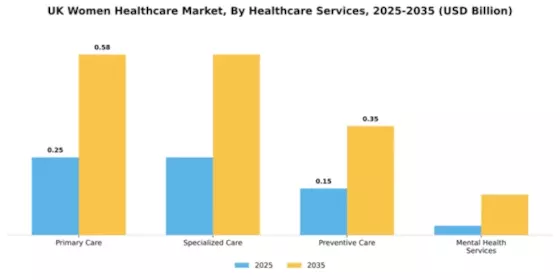
Specialized Care (Dominant) vs. Preventive Care (Emerging)
Specialized Care has established itself as a dominant segment within the UK Women Healthcare Market, offering comprehensive services that are tailored to individual health concerns such as reproductive health and gynecological issues. This segment often sees higher engagement due to the complexity of conditions being treated. In contrast, Preventive Care is emerging rapidly, with more emphasis on wellness and early detection, supported by increasing awareness among women regarding their health. This shift is propelled by campaigns promoting regular screenings and lifestyle management, addressing conditions like breast cancer and cervical health. The growing interest in holistic health practices is further fuelling this segment's expansion.
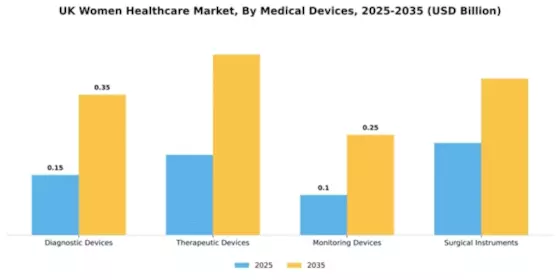
In the UK Women Healthcare Market, the Medical Devices segment is witnessing a diverse range of products catering to women's health needs. Diagnostic Devices hold a prominent share, driven by the increasing demand for early detection of health issues. Therapeutic Devices are also gaining traction and are recognized as the fastest-growing category due to the rise in chronic conditions affecting women. This segmentation reveals a market focused on both prevention and treatment, illustrating a balanced approach to women's healthcare. The growth trends in this segment are propelled by advancements in technology and the growing awareness regarding women's health. Factors such as increased funding for women's health research and innovative diagnostic tools are playing a pivotal role in enhancing patient outcomes. The expansion of telehealth services and the surge in personalized medicine are expected to further drive the Therapeutic Devices segment, reflecting a shift towards more customized healthcare solutions for women in the UK.
Diagnostic Devices (Dominant) vs. Monitoring Devices (Emerging)
The Diagnostic Devices segment has established itself as the dominant force within the UK Women Healthcare Market, owing to its role in early disease detection and health monitoring. These devices include advanced imaging systems, laboratory diagnostics, and point-of-care testing equipment, which cater specifically to women's unique health needs. In contrast, the Monitoring Devices segment is emerging, focused on chronic disease management and wellness tracking. These devices, such as wearable health trackers and remote monitoring systems, are gaining popularity due to their convenience and ability to provide real-time health data. Together, these segments highlight the critical balance between proactive health assessments and ongoing health management for women.
In the UK Women Healthcare Market, the Pharmaceuticals segment is primarily characterized by Hormonal Therapies and Fertility Treatments. Hormonal Therapies hold a significant portion of the market share, appealing to a wide demographic of women throughout various life stages, while Fertility Treatments are increasingly gaining traction as more women prioritize reproductive health. The combination of both segments illustrates the diverse needs and preferences of women, emphasizing the importance of tailored healthcare solutions. As women in the UK continue to seek effective healthcare strategies to manage hormonal balance and fertility challenges, these segments are projected to grow. The adoption of advanced medical technologies, an increasing number of health awareness campaigns, and significant investments in women's health initiatives play a vital role in driving this growth in the Pharmaceuticals sector.
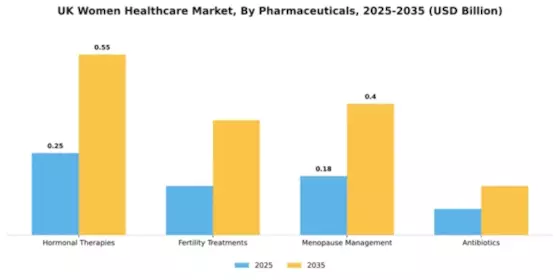
Hormonal Therapies (Dominant) vs. Fertility Treatments (Emerging)
Hormonal Therapies represent a dominant force in the UK Women Healthcare Market, addressing a range of conditions, including hormonal imbalances, menopause symptoms, and contraceptive needs. This segment is characterized by a variety of products, including oral contraceptives and hormone replacement therapies, which are widely accepted and prescribed by healthcare professionals. In contrast, Fertility Treatments, while still an emerging segment, are rapidly evolving with advancements in assisted reproductive technologies and increasing societal acceptance. More women are undergoing fertility assessments and treatments as they delay childbearing. This dynamic reflects a shift in societal norms and underscores the growing demand for specialized reproductive health services, making Fertility Treatments a key focus area moving forward.
Get more detailed insights about UK Womens Healthcare Market Request Free Sample
The Women Healthcare Market in the UK is characterized by a dynamic competitive landscape, driven by a confluence of innovation, strategic partnerships, and a growing emphasis on personalized healthcare solutions. Key players such as NHS (GB), Bayer (GB), and Pfizer (GB) are at the forefront, each adopting distinct strategies to enhance their market positioning. NHS (GB) continues to focus on integrating digital health solutions to improve patient outcomes, while Bayer (GB) emphasizes research and development in women's health products, particularly in hormonal therapies. Pfizer (GB) is leveraging its extensive portfolio to expand access to essential medications, thereby enhancing its competitive edge in this sector.
The market structure appears moderately fragmented, with a blend of established pharmaceutical giants and emerging biotech firms. Key players are increasingly localizing manufacturing and optimizing supply chains to enhance efficiency and responsiveness to market demands. This collective approach not only strengthens their operational capabilities but also fosters a competitive environment where innovation and quality are paramount.
In December 2025, Bayer (GB) announced a strategic partnership with a leading digital health company to develop a new telehealth platform aimed at improving access to reproductive health services. This initiative is likely to enhance Bayer's market presence by addressing the growing demand for remote healthcare solutions, particularly among women seeking convenient access to care. The partnership underscores Bayer's commitment to integrating technology into its healthcare offerings, potentially setting a new standard in the industry.
In November 2025, Pfizer (GB) launched a new initiative focused on expanding its women's health portfolio, particularly in the area of menopause management. This move is indicative of Pfizer's strategic intent to address unmet needs in women's health, thereby positioning itself as a leader in this niche market. By enhancing its product offerings, Pfizer aims to capture a larger share of the growing demand for menopause-related therapies, which is expected to rise as awareness increases.
In October 2025, NHS (GB) unveiled a comprehensive strategy to enhance maternal health services across the UK, which includes the implementation of new guidelines and increased funding for maternal care programs. This initiative reflects NHS's proactive approach to addressing maternal health disparities and improving overall health outcomes for women. By prioritizing maternal health, NHS (GB) is likely to strengthen its role as a key player in the Women Healthcare Market, fostering trust and engagement within the community.
As of January 2026, the competitive trends in the Women Healthcare Market are increasingly defined by digitalization, sustainability, and the integration of artificial intelligence (AI) into healthcare solutions. Strategic alliances among key players are shaping the landscape, facilitating the development of innovative products and services. The shift from price-based competition to a focus on technological advancement and supply chain reliability is becoming evident. Companies that prioritize innovation and adaptability are likely to thrive in this evolving market, as they respond to the growing expectations of consumers for personalized and efficient healthcare solutions.





The UK Women's Healthcare Market has been experiencing notable developments recently, particularly in relation to ongoing efforts for better healthcare provisions. In October 2023, the NHS announced enhanced funding initiatives aimed at improving access to women’s health services across the UK, reflecting increasing governmental focus on this sector.
Additionally, AbbVie and GSK have ramped up their research and development efforts in women's health therapeutics, particularly in reproductive health and menopause management, in line with broader market demand. In terms of mergers and acquisitions, Bayer completed its acquisition of a women's healthcare portfolio in March 2023, strengthening its position in this specific sector. The market capitalization of companies like Pfizer and Merck has shown positive growth, driven by innovations in treatments for conditions predominantly affecting women.
Over the past two to three years, significant events have included the launch of government initiatives to address women’s health disparities in July 2022 and the introduction of new health policies aimed at improving maternal health outcomes in January 2021. These developments underscore a heightened acknowledgment of the importance of women’s health within the overall healthcare landscape in the UK.
The UK Women Healthcare Market is projected to grow at an 8.08% CAGR from 2025 to 2035, driven by technological advancements, increasing awareness, and rising healthcare expenditures.
New opportunities lie in:
By 2035, the market is expected to be robust, reflecting substantial growth and innovation.
| MARKET SIZE 2024 | 0.698(USD Billion) |
| MARKET SIZE 2025 | 0.76(USD Billion) |
| MARKET SIZE 2035 | 1.64(USD Billion) |
| COMPOUND ANNUAL GROWTH RATE (CAGR) | 8.08% (2024 - 2035) |
| REPORT COVERAGE | Revenue Forecast, Competitive Landscape, Growth Factors, and Trends |
| BASE YEAR | 2024 |
| Market Forecast Period | 2025 - 2035 |
| Historical Data | 2019 - 2024 |
| Market Forecast Units | USD Billion |
| Key Companies Profiled | NHS (GB), Bayer (GB), Pfizer (GB), Merck (GB), GSK (GB), AbbVie (GB), Johnson & Johnson (GB), Novartis (GB), AstraZeneca (GB) |
| Segments Covered | Healthcare Services, Medical Devices, Pharmaceuticals |
| Key Market Opportunities | Integration of telehealth services enhances access to women's healthcare in the UK Women Healthcare Market. |
| Key Market Dynamics | Growing emphasis on personalized medicine and digital health solutions reshapes the UK Women Healthcare Market landscape. |
| Countries Covered | UK |
The market valuation was 0.698 USD Billion in 2024.
The market is projected to reach 1.64 USD Billion by 2035.
The expected CAGR for the market from 2025 to 2035 is 8.08%.
The market includes segments such as Primary Care, Specialized Care, Preventive Care, and Mental Health Services.
The Primary Care segment is projected to range from 0.58 to 1.00 USD Billion by 2035.
Key players such as NHS and Bayer are instrumental in shaping the market landscape and driving innovation.
The Diagnostic Devices segment is projected to range from 0.35 to 0.55 USD Billion by 2035.
The Therapeutic Devices segment is anticipated to grow to between 0.45 and 0.65 USD Billion by 2035.
Hormonal Therapies are expected to range from 0.55 to 0.75 USD Billion by 2035.
Mental Health Services are projected to grow from 0.03 to 0.13 USD Billion by 2035.


Kindly complete the form below to receive a free sample of this Report

“This is really good guys. Excellent work on a tight deadline. I will continue to use you going forward and recommend you to others. Nice job”


“Thanks. It’s been a pleasure working with you, please use me as reference with any other Intel employees.”


“Thanks for sending the report it gives us a good global view of the Betaïne market.”


“Thank you, this will be very helpful for OQS.”


“We found the report very insightful! we found your research firm very helpful. I'm sending this email to secure our future business.”


“I am very pleased with how market segments have been defined in a relevant way for my purposes (such as "Portable Freezers & refrigerators" and "last-mile"). In general the report is well structured. Thanks very much for your efforts.”


“I have been reading the first document or the study, ,the Global HVAC and FP market report 2021 till 2026. Must say, good info! I have not gone in depth at all parts, but got a good indication of the data inside!”


“We got the report in time, we really thank you for your support in this process. I also thank to all of your team as they did a great job.”


“The Automotive 48V ECU Components Procurement Intelligence Study” was a complex project, but the Market Research Future (MRFR) team handled it with quality, agility, and customer-centricity. They delivered all requested data on time and within the agreed scope. The team, including Shubhendra Anand and Rahul Gotadki, was always readily available to clarify questions and swiftly implement necessary adjustments, driving the project to a successful conclusion within a very demanding timeframe.
I would also like to specifically commend Akshay Agarwal for his responsiveness and support at every stage—from our initial inquiry on May 6th through to final delivery on June 18th. His dedication made the entire process seamless.”



