×
Hero Background
English
Chinese
French
Japanese
Korean
German
Spanish

Sports drink Market Trends

ID: MRFR/FnB/0650-HCR
115 Pages
Sakshi Gupta
October 2025

Sports Drink Market Research Report Information By Ingredient (Citric Acid, Flavors, & Preservatives, Salts & Electrolytes, Carbohydrates, Vitamins and others), By Product Type (Hypotonic, Isotonic and Hypertonic), By End User (Athletes, Casual Consumers and Lifestyle User), And By Region (North America, Europe, Asia-Pacific, And Rest Of The World) –Market Forecast Till 2035

Share:
Download PDF ×

We do not share your information with anyone. However, we may send you emails based on your report interest from time to time. You may contact us at any time to opt-out.

Sports drink Market Infographic
Purchase Options

Market Trends

Key Emerging Trends in the Sports drink Market

The sports drink market is experiencing notable trends shaped by evolving consumer preferences, health awareness, and changing lifestyles. A significant trend in recent years is the increasing demand for functional beverages that cater to fitness enthusiasts and individuals leading active lives. Sports drinks, with their electrolyte content and hydration benefits, have gained popularity among consumers looking for beverages that support their workout routines and replenish essential nutrients. This trend is fueled by a growing awareness of the importance of staying hydrated and maintaining electrolyte balance, not only during intense physical activities but also in daily life.

Health and wellness considerations are driving innovation in the sports drink market. Consumers are seeking beverages that not only provide hydration but also offer additional health benefits. As a response, sports drink manufacturers are introducing formulations with natural ingredients, reduced sugar content, and added vitamins or antioxidants. The shift towards healthier beverage options aligns with the broader trend of consumers making conscious choices to support their well-being.

Convenience remains a key factor influencing the sports drink market. With busy schedules and on-the-go lifestyles, consumers are looking for beverages that are portable and easily accessible. This has led to the popularity of sports drinks in convenient packaging, including ready-to-drink bottles and powder mixes. The convenience factor is further accentuated by the growth of e-commerce, allowing consumers to order sports drinks online and have them delivered to their doorstep, ensuring easy access to their preferred beverages.

In response to the global push towards sustainability, the sports drink market is witnessing a surge in eco-friendly practices. Consumers are increasingly environmentally conscious, prompting sports drink manufacturers to explore sustainable packaging options, reduce plastic usage, and implement recycling initiatives. Brands are recognizing the importance of aligning with eco-friendly values, not only as a response to consumer expectations but also as a way to contribute positively to the environment.

Flavor diversity is another key trend shaping the sports drink market. Consumers are looking for refreshing and unique flavor profiles beyond the traditional offerings. Sports drink companies are responding by introducing a variety of flavors, including exotic fruit blends and natural extracts. This diversity allows brands to appeal to a wider audience and cater to the evolving taste preferences of consumers who seek exciting and novel beverage experiences.

Technology is playing a role in enhancing the consumer experience in the sports drink market. From interactive mobile apps providing personalized hydration plans to smart bottles that track fluid intake, technology is being integrated to offer more than just a beverage. These innovations aim to engage consumers, provide real-time feedback on hydration levels, and create a more interactive and personalized relationship between the brand and the consumer.

While the sports drink market is experiencing positive trends, challenges persist. Intense competition, regulatory considerations, and potential saturation in mature markets are factors that brands need to navigate. Adapting to changing consumer preferences and effectively communicating the health benefits of sports drinks will be crucial for sustained success in this dynamic market.


Author
Sakshi Gupta
Research Analyst Level II

I have about two years of experience working in the consumer goods and retail industries and I am a biotech graduate.A tech-savvy analytically focused professional with a strong capabilities in identification, concept generation, and strategy evaluation. I can produce data-driven solutions while fusing unusual viewpoints with original concepts. I have been extensively working on business case studies, competitive & comparative analyses, and strategic reports. My primary areas of experience include client management, financial analysis, supply chain evaluation, market entry strategy evaluation, and estimating and forecasting market size.

Leave a Comment

FAQs

What is the current valuation of The Global Sports Drink as of 2024?

The Global Sports Drink was valued at 28.07 USD Billion in 2024.

What is the projected market valuation for The Global Sports Drink in 2035?

The market is projected to reach 41.33 USD Billion by 2035.

What is the expected CAGR for The Global Sports Drink during the forecast period 2025 - 2035?

The expected CAGR for the market during the forecast period is 3.58%.

Which product type segment is anticipated to have the highest valuation in 2035?

The Isotonic product type segment is expected to reach 27.12 USD Billion by 2035.

How do the valuations of casual consumers compare to athletes in The Global Sports Drink?

In 2035, casual consumers are projected to reach 15.0 USD Billion, while athletes are expected to reach 12.25 USD Billion.

What are the key ingredients contributing to the market's growth?

Salts & Electrolytes are projected to grow from 6.0 USD Billion to 8.0 USD Billion by 2035.

Market Summary

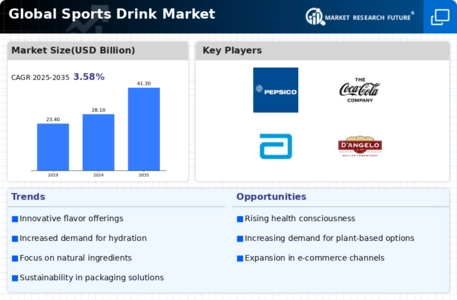
As per MRFR analysis, The Global Sports Drink Size was estimated at 28.07 USD Billion in 2024. The sports drink industry is projected to grow from 29.07 USD Billion in 2025 to 41.33 USD Billion by 2035, exhibiting a compound annual growth rate (CAGR) of 3.58 during the forecast period 2025 - 2035.

Key Market Trends & Highlights

The Global Sports Drink is experiencing a dynamic shift towards health-conscious and innovative product offerings.

  • The North American market remains the largest, driven by a robust health and wellness focus among consumers.
  • In contrast, the Asia-Pacific region is emerging as the fastest-growing market, fueled by rising participation in sports and fitness activities.
  • Salts and electrolytes dominate the market, while flavors and preservatives are witnessing rapid growth due to changing consumer preferences.
  • Key market drivers include increased awareness of hydration benefits and innovations in product formulation, which are shaping the future of sports drinks.

Market Size & Forecast

2024 Market Size 28.07 (USD Billion)
2035 Market Size 41.33 (USD Billion)
CAGR (2025 - 2035) 3.58%
Largest Regional Market Share in 2024 North America

Major Players

<p>Gatorade (US), Powerade (US), Lucozade (GB), Isostar (FR), BodyArmor (US), Nuun (US), Aquafina (US), Vitaminwater (US), Pocari Sweat (JP)</p>

Market Trends

The Global Sports Drink is currently experiencing a dynamic evolution, driven by a growing awareness of health and fitness among consumers. This market appears to be influenced by various factors, including the increasing participation in sports and fitness activities, as well as a rising demand for hydration solutions that cater to active lifestyles. Companies are likely focusing on product innovation, introducing new flavors and formulations that appeal to a broader audience. Additionally, the trend towards natural and organic ingredients seems to be gaining traction, as consumers become more discerning about the products they consume. Moreover, the market landscape is characterized by a shift towards sustainability, with brands exploring eco-friendly packaging options and sustainable sourcing practices. This shift may reflect a broader societal movement towards environmental consciousness, which could resonate with consumers who prioritize sustainability in their purchasing decisions. As The Global Sports Drink continues to evolve, it is essential for stakeholders to remain attuned to these trends, as they may shape the future of product offerings and marketing strategies.

Health and Wellness Focus

There is a noticeable trend towards health and wellness, with consumers increasingly seeking products that support their active lifestyles. This focus on health may drive demand for sports drinks that offer functional benefits, such as enhanced hydration and recovery.

Natural Ingredients Preference

A growing preference for natural ingredients is evident, as consumers become more aware of the potential health impacts of artificial additives. This trend suggests that brands may need to reformulate their products to align with consumer expectations for clean labels.

Sustainability Initiatives

Sustainability initiatives are becoming more prominent within The Global Sports Drink. Companies are likely to adopt eco-friendly practices, including sustainable packaging and responsible sourcing, to appeal to environmentally conscious consumers.

Sports drink Market Market Drivers

Expansion of Distribution Channels

The expansion of distribution channels is a pivotal driver for The Global Sports Drink Industry. With the rise of e-commerce and online retail platforms, consumers now have greater access to a variety of sports drink options. This shift in purchasing behavior has prompted manufacturers to enhance their distribution strategies, ensuring that products are readily available in both physical and digital marketplaces. Data suggests that online sales of sports drinks have increased by over 30% in recent years, reflecting changing consumer preferences. Furthermore, partnerships with gyms, fitness centers, and sporting events have allowed brands to reach target audiences more effectively. As distribution networks continue to evolve, The Global Sports Drink Industry is likely to see increased penetration in diverse markets, catering to a wider range of consumers and enhancing overall sales.

Innovations in Product Formulation

Innovations in product formulation represent a critical driver for The Global Sports Drink Industry. Manufacturers are increasingly focusing on developing beverages that cater to specific consumer needs, such as low-calorie options, enhanced electrolyte content, and functional ingredients like vitamins and minerals. For instance, the introduction of plant-based sports drinks has gained traction, appealing to health-conscious consumers. Market data indicates that the segment of low-sugar sports drinks is projected to grow at a compound annual growth rate of 8% over the next five years. This innovation not only addresses health concerns but also aligns with the evolving preferences of consumers who seek functional benefits from their beverages. As companies invest in research and development, The Global Sports Drink Industry is poised for diversification and expansion, potentially attracting a broader audience.

Growing Demand for Functional Beverages

The growing demand for functional beverages serves as a compelling driver for The Global Sports Drink Industry. Consumers are increasingly seeking drinks that offer health benefits beyond basic hydration, such as improved energy, recovery, and overall wellness. This trend is evident in the rising popularity of sports drinks that incorporate adaptogens, probiotics, and other functional ingredients. Market Research Future indicates that the functional beverage segment is expected to grow at a rate of 10% annually, reflecting a shift in consumer preferences towards products that support active lifestyles. As the market evolves, brands that successfully innovate and market their functional offerings are likely to capture a larger share of The Global Sports Drink Industry. This demand for multifunctional products may also encourage companies to explore new formulations and marketing strategies, further driving market growth.

Increased Awareness of Hydration Benefits

Increased awareness of hydration benefits is a significant driver for The Global Sports Drink Industry. As consumers become more educated about the importance of proper hydration for athletic performance and overall health, the demand for sports drinks is likely to rise. Educational campaigns and endorsements from health professionals have contributed to this awareness, emphasizing the role of electrolytes in maintaining fluid balance during physical exertion. Recent surveys indicate that nearly 70% of athletes prioritize hydration strategies, which often include the use of specialized sports drinks. This trend suggests that The Global Sports Drink Industry may experience growth as consumers actively seek products that support their hydration needs. Additionally, the rise of endurance sports and competitive events has further fueled the demand for effective hydration solutions, positioning sports drinks as essential components of athletes' regimens.

Rising Participation in Sports and Fitness Activities

The increasing participation in sports and fitness activities is a notable driver for The Global Sports Drink Industry. As more individuals engage in physical activities, the demand for hydration solutions rises. According to recent data, approximately 60% of adults engage in some form of regular exercise, which correlates with a heightened need for sports drinks. This trend is particularly pronounced among younger demographics, who are more inclined to seek out products that enhance performance and recovery. The Global Sports Drink Industry is likely to benefit from this growing consumer base, as athletes and fitness enthusiasts turn to specialized beverages to replenish electrolytes and maintain hydration during workouts. Furthermore, the rise of fitness influencers and social media platforms has amplified awareness and accessibility of sports drinks, potentially driving sales and market growth.

Market Segment Insights

By Type: Salts & Electrolytes (Largest) vs. Flavors & Preservatives (Fastest-Growing)

<p>In The Global Sports Drink, the 'Type' segment showcases diverse values including Ingredients, Citric Acid, Flavors & Preservatives, Salts & Electrolytes, Carbohydrates, Vitamins, and Others. Salts & Electrolytes currently dominate the market share due to their critical role in rehydration and recovery during sports activities. Following behind are Flavors & Preservatives, which are gaining traction as consumers increasingly seek more appealing and diverse taste options in their sports drinks. The growth trends within this segment indicate a shift towards products that not only replenish lost nutrients but also enhance the sensory experience. The demand for innovative flavors and natural preservatives is rising, making Flavors & Preservatives one of the fastest-growing categories. Meanwhile, the ongoing emphasis on hydration and electrolyte balance ensures Salts & Electrolytes maintain their position as a key component within sports drinks, contributing to overall health and performance during physical activities.</p>

<p>Salts & Electrolytes (Dominant) vs. Flavors & Preservatives (Emerging)</p>

<p>Salts & Electrolytes represent the dominant value in The Global Sports Drink, reflecting a substantial preference among athletes and fitness enthusiasts for products that effectively restore crucial minerals lost during intense physical exertion. These components are essential for maintaining fluid balance, nerve function, and muscle contraction, making them indispensable in sports drink formulations. In contrast, Flavors & Preservatives are emerging rapidly as consumers seek enhanced experiences from their beverages, focusing on taste, variety, and shelf stability. Brands are increasingly investing in natural flavoring agents and cleaner labels, appealing to health-conscious consumers. This trend not only diversifies product lines but also enhances consumer loyalty as brands cater to evolving tastes and preferences.</p>

By Product Type: Isotonic (Largest) vs. Hypotonic (Fastest-Growing)

<p>Isotonic sports drinks dominate The Global Sports Drink, capturing the largest market share among the various product types. These drinks are designed to quickly replace fluids lost during physical activity, making them the preferred choice for athletes and fitness enthusiasts. As the awareness of the importance of hydration grows, isotonic options continue to be favored across various sports sectors. Hypotonic drinks trend as the fastest-growing segment, gaining traction among consumers looking for lower sugar options that still provide hydration without excess calories, thus appealing to health-conscious demographics.</p>

<p>Hypotonic: Emerging vs. Isotonic: Dominant</p>

<p>Hypotonic sports drinks have started to carve a niche in the rapidly evolving The Global Sports Drink, being recognized for their lower sugar levels and suitability for hydration without energy boosts. This emerging segment appeals to health-conscious athletes and everyday consumers who prefer nutritional balance. In contrast, isotonic drinks remain the dominant force due to their effective formulation in promoting quick rehydration, specifically during rigorous physical activities. The growing inclination toward healthier alternatives positions hypotonic drinks favorably, while isotonic drinks maintain a stronghold thanks to established consumer loyalty.</p>

By End User: Athletes (Largest) vs. Casual Consumers (Fastest-Growing)

<p>In The Global Sports Drink, the End User segment is divided primarily among Athletes, Casual Consumers, and Lifestyle Users. Athletes dominate this segment, accounting for a significant portion of market share. They tend to prefer products that enhance performance and recovery, particularly during high-intensity training sessions. However, Casual Consumers have been rapidly gaining traction, drawn by the growing popularity of health and wellness trends. The awareness of hydration's importance in daily life has led this segment to experience the fastest growth.</p>

<p>Casual Consumers: Fastest-Growing vs. Athletes: Dominant</p>

<p>Casual Consumers represent a burgeoning demographic in the sports drink market, characterized by their propensity to purchase products for health benefits rather than competitive sports. This segment encompasses a wide range of individuals, from gym-goers to those seeking hydration alternatives to sugary beverages. Their increasing awareness of fitness and wellness trends has led manufacturers to innovate by creating lighter, more appealing formulations that cater to everyday hydration needs. Conversely, Athletes remain the dominant segment, relying on specialized sports drinks for performance enhancement and recovery. They typically seek higher electrolyte content and functional ingredients that support intense physical exertion. While Athletes have traditionally led the market, the rapid growth of Casual Consumers indicates a significant shift in consumer behavior toward general wellness.</p>

Get more detailed insights about Sports Drink Market Research Report - Forecast to 2035

Regional Insights

By region, the study provides market insights into North America, Europe, Asia-Pacific and the Rest of the World. The North American Sports Drink market area will dominate this market; due to the expanding fitness trend and growing health concerns, the region continues to be the top market. A shift in dietary habits brought on by changing consumer lifestyles is also anticipated to fuel market expansion in North America. The demand for the drink will likely be fueled by a big portion of the population engaging in outdoor activities.

Similar to the last example, the high level of sports involvement has encouraged using athletic drinks to enhance performance.

Furthermore, the major countries studied in the market report are The US, Canada, German, France, the UK, Italy, Spain, China, Japan, India, Australia, South Korea, and Brazil.

Figure 2: SPORTS DRINK MARKET SHARE BY REGION 2022 (USD Billion) 

Europe Sports Drink market accounts for the second-largest market share due to the increasing number of people joining fitness clubs who require the drink to improve their workout. Similar increases in usage were caused by an increase in tourists visiting Europe, who use it to refuel while visiting other locations. The UK sports drink also had the quickest growth rate in the European region, while the German sports drink industry had the largest market share.

From 2023 to 2032, the fastest CAGR is anticipated in the Asia-Pacific sports drink market. Since these beverages include sufficient vitamins, carbs, minerals, and electrolytes, they are more frequently consumed after a pandemic. Additionally, as consumers tend to keep good health, they have become more active in different sports, which has increased the demand for various sports beverages and drinks. Additionally, the Indian market of sports drink had the Asia-Pacific region's fastest expanding market, and China's sports drink industry had the greatest market share.

Key Players and Competitive Insights

Leading industry companies are making significant R&D investments to diversify their product offerings, which will drive the Ready-to-eat Popcorn market's expansion. Important market developments include new product releases, contractual agreements, mergers and acquisitions, greater investments, and collaboration with other organizations. Market participants also engage in several strategic actions to increase their worldwide presence. The Sports Drink needs to provide reasonably priced goods to grow and thrive in an increasingly competitive and challenging market environment.

Local production to minimize operating costs is one of the key business tactics manufacturers use in the Sports Drink to support clients and increase the market sector. The Sports Drink has recently provided some of the most significant benefits. Major players in the Sports Drink market, including General Mills Inc., Amway, Conagra Brands Inc., Cargill Incorporated, Abbott Laboratories, Kraft Foods Group Inc., and others, are attempting to increase market demand by investing in research and development operations.

A beverage firm called The Coca-Cola firm produces, markets, and sells a variety of nonalcoholic beverages worldwide. The company sells a variety of beverages, including juice, value-added dairy products, plant-based beverages, water, sports drinks, coffee, and tea. Additionally, it provides syrups and concentrates for beverages and fountain syrups to businesses that sell fountain drinks, like restaurants and convenience stores. In June 2019, Coca-Cola announced the launch of its Powerade sports beverage in India to diversify its product line and provide Indian consumers with more options.

A popular American company known for its line of sports beverages, Gatorade also produces food items with a sports theme. PepsiCo currently produces Gatorade, which is sold in more than 80 nations.[3] A group of scientists under the direction of Dr. Robert Cade created the beverage for the first time in 1965. It was initially created for the University of Florida's Gators to replace the carbohydrates its student-athletes burned and the combination of water and electrolytes they lost via sweat when participating in strenuous sports. In July 2019, BOLT24, a low-calorie electrolyte beverage for athletes, was introduced by Gatorade.

This hydration-focused product is free of artificial sweeteners and flavors.

Key Companies in the Sports drink Market market include

Industry Developments

  • Q2 2024: PepsiCo Launches Gatorade Water, Expanding Hydration Portfolio PepsiCo announced the launch of Gatorade Water, a new alkaline water product under the Gatorade brand, marking its entry into the premium hydration segment and expanding its sports drink portfolio.
  • Q2 2024: Coca-Cola Unveils POWERADE Active Water in U.S. Market Coca-Cola introduced POWERADE Active Water, a zero-sugar, electrolyte-infused water targeting athletes and fitness enthusiasts, as part of its strategy to diversify its sports drink offerings.
  • Q2 2024: Bodyarmor Opens New Manufacturing Facility in Texas Bodyarmor, owned by Coca-Cola, inaugurated a new state-of-the-art manufacturing facility in Texas to increase production capacity and meet growing demand for its sports drink products.
  • Q3 2024: Monster Beverage Acquires Bang Energy Brand Assets Monster Beverage completed the acquisition of Bang Energy's brand assets, strengthening its position in the sports and energy drink market and expanding its product portfolio.
  • Q2 2024: Prime Hydration Signs Multi-Year Sponsorship Deal with UFC Prime Hydration, co-founded by Logan Paul and KSI, secured a multi-year sponsorship agreement with UFC, making Prime the official sports drink partner for the global mixed martial arts organization.
  • Q3 2024: Sports Drink Startup Electra Raises $15M Series A Funding Electra, a U.S.-based sports drink startup focused on clean-label hydration products, announced the closing of a $15 million Series A funding round led by venture capital firm Accel.
  • Q2 2024: Gatorade Partners with NFL for Official Hydration Products Gatorade renewed its partnership with the National Football League (NFL), continuing as the official sports drink provider and expanding its product placement across major sporting events.
  • Q3 2024: Coca-Cola Appoints New Head of Sports Drink Division Coca-Cola announced the appointment of Maria Chen as the new head of its global sports drink division, overseeing brands such as POWERADE and Bodyarmor.
  • Q2 2024: Prime Hydration Launches New Caffeinated Sports Drink Prime Hydration introduced a new caffeinated sports drink variant, expanding its product line to cater to consumers seeking both hydration and energy boost.
  • Q3 2024: PepsiCo Invests $100M in Gatorade R&D Center PepsiCo announced a $100 million investment in a new Gatorade research and development center focused on innovation in sports nutrition and hydration science.
  • Q2 2024: Coca-Cola Launches POWERADE+ in European Markets Coca-Cola expanded its POWERADE+ product line into several European countries, introducing new flavors and functional ingredients aimed at athletes and active consumers.
  • Q3 2024: Hydration Tech Startup H2GO Wins Major Retail Contract H2GO, a sports drink tech startup specializing in smart hydration solutions, secured a nationwide retail contract with Target, significantly expanding its distribution footprint.

Future Outlook

Sports drink Market Future Outlook

<p>The Global Sports Drink is projected to grow at a 3.58% CAGR from 2024 to 2035, driven by increasing health consciousness, innovation in flavors, and rising participation in sports activities.</p>

New opportunities lie in:

  • <p>Expansion of plant-based sports drink lines</p>
  • <p>Development of personalized hydration solutions</p>
  • <p>Integration of smart technology in beverage packaging</p>

<p>By 2035, the market is expected to achieve robust growth, reflecting evolving consumer preferences and innovative product offerings.</p>

Market Segmentation

Sports drink Market Type Outlook

  • Ingredients
  • Citric Acid
  • Flavors & Preservatives
  • Salts & Electrolytes
  • Carbohydrates
  • Vitamins
  • Others

Sports drink Market End User Outlook

  • Athletes
  • Casual Consumers
  • Lifestyle Users

Sports drink Market Product Type Outlook

  • Hypotonic
  • Isotonic
  • Hypertonic

Report Scope

MARKET SIZE 202428.07(USD Billion)
MARKET SIZE 202529.07(USD Billion)
MARKET SIZE 203541.33(USD Billion)
COMPOUND ANNUAL GROWTH RATE (CAGR)3.58% (2024 - 2035)
REPORT COVERAGERevenue Forecast, Competitive Landscape, Growth Factors, and Trends
BASE YEAR2024
Market Forecast Period2025 - 2035
Historical Data2019 - 2024
Market Forecast UnitsUSD Billion
Key Companies ProfiledMarket analysis in progress
Segments CoveredMarket segmentation analysis in progress
Key Market OpportunitiesGrowing demand for natural ingredients and functional benefits in The Global Sports Drink.
Key Market DynamicsRising consumer demand for healthier options drives innovation and competition in the sports drink sector.
Countries CoveredNorth America, Europe, APAC, South America, MEA

FAQs

What is the current valuation of The Global Sports Drink as of 2024?

The Global Sports Drink was valued at 28.07 USD Billion in 2024.

What is the projected market valuation for The Global Sports Drink in 2035?

The market is projected to reach 41.33 USD Billion by 2035.

What is the expected CAGR for The Global Sports Drink during the forecast period 2025 - 2035?

The expected CAGR for the market during the forecast period is 3.58%.

Which product type segment is anticipated to have the highest valuation in 2035?

The Isotonic product type segment is expected to reach 27.12 USD Billion by 2035.

How do the valuations of casual consumers compare to athletes in The Global Sports Drink?

In 2035, casual consumers are projected to reach 15.0 USD Billion, while athletes are expected to reach 12.25 USD Billion.

What are the key ingredients contributing to the market's growth?

Salts & Electrolytes are projected to grow from 6.0 USD Billion to 8.0 USD Billion by 2035.

No Data Available

Sports Drink Market Segmentation

Sports Drink Ingredient Outlook (USD Billion, 2018-2032)

Citric Acid

Flavors & Preservatives

Salts & Electrolytes

Carbohydrates

Vitamins

Others

Sports Drink Product Type Outlook (USD Billion, 2018-2032)

Hypotonic

Isotonic

Hypertonic

Sports Drink End User Outlook (USD Billion, 2018-2032)

Athletes

Casual Consumers

Lifestyle User

Sports Drink Regional Outlook (USD Billion, 2018-2032)

North America Outlook (USD Billion, 2018-2032)

North America Sports Drink by Ingredient

Citric Acid

Flavors & Preservatives

Salts & Electrolytes

Carbohydrates

Vitamins

Others

North America Sports Drink by Product Type

Hypotonic

Isotonic

Hypertonic

North America Sports Drink by End User

Athletes

Casual Consumers

Lifestyle User

US Outlook (USD Billion, 2018-2032)

US Sports Drink by Ingredient

Citric Acid

Flavors & Preservatives

Salts & Electrolytes

Carbohydrates

Vitamins

Others

US Sports Drink by Product Type

Hypotonic

Isotonic

Hypertonic

US Sports Drink by End User

Athletes

Casual Consumers

Lifestyle User

CANADA Outlook (USD Billion, 2018-2032)

CANADA Sports Drink by Ingredient

Citric Acid

Flavors & Preservatives

Salts & Electrolytes

Carbohydrates

Vitamins

Others

CANADA Sports Drink by Product Type

Hypotonic

Isotonic

Hypertonic

CANADA Sports Drink by End User

Athletes

Casual Consumers

Lifestyle User

Europe Outlook (USD Billion, 2018-2032)

Europe Sports Drink by Ingredient

Citric Acid

Flavors & Preservatives

Salts & Electrolytes

Carbohydrates

Vitamins

Others

Europe Sports Drink by Product Type

Hypotonic

Isotonic

Hypertonic

Europe Sports Drink by End User

Athletes

Casual Consumers

Lifestyle User

Germany Outlook (USD Billion, 2018-2032)

Germany Sports Drink by Ingredient

Citric Acid

Flavors & Preservatives

Salts & Electrolytes

Carbohydrates

Vitamins

Others

Germany Sports Drink by Product Type

Hypotonic

Isotonic

Hypertonic

Germany Sports Drink by End User

Athletes

Casual Consumers

Lifestyle User

France Outlook (USD Billion, 2018-2032)

France Sports Drink by Ingredient

Citric Acid

Flavors & Preservatives

Salts & Electrolytes

Carbohydrates

Vitamins

Others

France Sports Drink by Product Type

Hypotonic

Isotonic

Hypertonic

France Sports Drink by End User

Athletes

Casual Consumers

Lifestyle User

UK Outlook (USD Billion, 2018-2032)

UK Sports Drink by Ingredient

Citric Acid

Flavors & Preservatives

Salts & Electrolytes

Carbohydrates

Vitamins

Others

UK Sports Drink by Product Type

Hypotonic

Isotonic

Hypertonic

UK Sports Drink by End User

Athletes

Casual Consumers

Lifestyle User

ITALY Outlook (USD Billion, 2018-2032)

ITALY Sports Drink by Ingredient

Citric Acid

Flavors & Preservatives

Salts & Electrolytes

Carbohydrates

Vitamins

Others

ITALY Sports Drink by Product Type

Hypotonic

Isotonic

Hypertonic

ITALY Sports Drink by End User

Athletes

Casual Consumers

Lifestyle User

SPAIN Outlook (USD Billion, 2018-2032)

Spain Sports Drink by Ingredient

Citric Acid

Flavors & Preservatives

Salts & Electrolytes

Carbohydrates

Vitamins

Others

Spain Sports Drink by Product Type

Hypotonic

Isotonic

Hypertonic

Spain Sports Drink by End User

Athletes

Casual Consumers

Lifestyle User

Rest Of Europe Outlook (USD Billion, 2018-2032)

Rest Of Europe Sports Drink by Ingredient

Citric Acid

Flavors & Preservatives

Salts & Electrolytes

Carbohydrates

Vitamins

Others

Rest Of Europe Sports Drink by Product Type

Hypotonic

Isotonic

Hypertonic

Rest Of Europe Sports Drink by End User

Athletes

Casual Consumers

Lifestyle User

Asia-Pacific Outlook (USD Billion, 2018-2032)

Asia-Pacific Sports Drink by Ingredient

Citric Acid

Flavors & Preservatives

Salts & Electrolytes

Carbohydrates

Vitamins

Others

Asia-Pacific Sports Drink by Product Type

Hypotonic

Isotonic

Hypertonic

Asia-Pacific Sports Drink by End User

Athletes

Casual Consumers

Lifestyle User

China Outlook (USD Billion, 2018-2032)

China Sports Drink by Ingredient

Citric Acid

Flavors & Preservatives

Salts & Electrolytes

Carbohydrates

Vitamins

Others

China Sports Drink by Product Type

Hypotonic

Isotonic

Hypertonic

China Sports Drink by End User

Athletes

Casual Consumers

Lifestyle User

Japan Outlook (USD Billion, 2018-2032)

Japan Sports Drink by Ingredient

Citric Acid

Flavors & Preservatives

Salts & Electrolytes

Carbohydrates

Vitamins

Others

Japan Sports Drink by Product Type

Hypotonic

Isotonic

Hypertonic

Japan Sports Drink by End User

Athletes

Casual Consumers

Lifestyle User

India Outlook (USD Billion, 2018-2032)

India Sports Drink by Ingredient

Citric Acid

Flavors & Preservatives

Salts & Electrolytes

Carbohydrates

Vitamins

Others

India Sports Drink by Product Type

Hypotonic

Isotonic

Hypertonic

India Sports Drink by End User

Athletes

Casual Consumers

Lifestyle User

Australia Outlook (USD Billion, 2018-2032)

Australia Sports Drink by Ingredient

Citric Acid

Flavors & Preservatives

Salts & Electrolytes

Carbohydrates

Vitamins

Others

Australia Sports Drink by Product Type

Hypotonic

Isotonic

Hypertonic

Australia Sports Drink by End User

Athletes

Casual Consumers

Lifestyle User

Rest of Asia-Pacific Outlook (USD Billion, 2018-2032)

Rest of Asia-Pacific Sports Drink by Ingredient

Citric Acid

Flavors & Preservatives

Salts & Electrolytes

Carbohydrates

Vitamins

Others

Rest of Asia-Pacific Sports Drink by Product Type

Hypotonic

Isotonic

Hypertonic

Rest of Asia-Pacific Sports Drink by End User

Athletes

Casual Consumers

Lifestyle User

Rest of the World Outlook (USD Billion, 2018-2032)

Rest of the World Sports Drink by Ingredient

Citric Acid

Flavors & Preservatives

Salts & Electrolytes

Carbohydrates

Vitamins

Others

Rest of the World Sports Drink by Product Type

Hypotonic

Isotonic

Hypertonic

Rest of the World Sports Drink by End User

Athletes

Casual Consumers

Lifestyle User

Middle East Outlook (USD Billion, 2018-2032)

Middle East Sports Drink by Ingredient

Citric Acid

Flavors & Preservatives

Salts & Electrolytes

Carbohydrates

Vitamins

Others

Middle East Sports Drink by Product Type

Hypotonic

Isotonic

Hypertonic

Middle East Sports Drink by End User

Athletes

Casual Consumers

Lifestyle User

Africa Outlook (USD Billion, 2018-2032)

Africa Sports Drink by Ingredient

Citric Acid

Flavors & Preservatives

Salts & Electrolytes

Carbohydrates

Vitamins

Others

Africa Sports Drink by Product Type

Hypotonic

Isotonic

Hypertonic

Africa Sports Drink by End User

Athletes

Casual Consumers

Lifestyle User

Latin America Outlook (USD Billion, 2018-2032)

Latin America Sports Drink by Ingredient

Citric Acid

Flavors & Preservatives

Salts & Electrolytes

Carbohydrates

Vitamins

Others

Latin America Sports Drink by Product Type

Hypotonic

Isotonic

Hypertonic

Latin America Sports Drink by End User

Athletes

Casual Consumers

Lifestyle User

Infographic

Free Sample Request

Kindly complete the form below to receive a free sample of this Report

Get Free Sample

Customer Strories

Compare Licence

×
Features License Type
Single User Multiuser License Enterprise User
Price $4,950 $5,950 $7,250
Maximum User Access Limit 1 User Upto 10 Users Unrestricted Access Throughout the Organization
Free Customization
Direct Access to Analyst
Deliverable Format
Platform Access
Discount on Next Purchase 10% 15% 15%
Printable Versions