×
Request Free Sample ×

Kindly complete the form below to receive a free sample of this Report

* Please use a valid business email

Leading companies partner with us for data-driven Insights

clients tt-cursor
Hero Background

Thermoplastic Vulcanizates Market

ID: MRFR/CnM/3283-HCR
132 Pages
Chitranshi Jaiswal
October 2025

Thermoplastic Vulcanizates Market Research Report Information by Applications (Automotive, Fluid Handling, Consumer Goods, Medical, Sports, and Others), Forecast till 2035

Share:
Download PDF ×

We do not share your information with anyone. However, we may send you emails based on your report interest from time to time. You may contact us at any time to opt-out.

Thermoplastic Vulcanizates Market Infographic
Purchase Options

Thermoplastic Vulcanizates Market Summary

As per MRFR analysis, the Thermoplastic Vulcanizates Market Size was estimated at 10.69 USD Million in 2024. The Thermoplastic Vulcanizates industry is projected to grow from 11.57 USD Million in 2025 to 25.58 USD Million by 2035, exhibiting a compound annual growth rate (CAGR) of 8.26 during the forecast period 2025 - 2035.

Key Market Trends & Highlights

The Thermoplastic Vulcanizates Market is experiencing robust growth driven by sustainability and technological advancements.

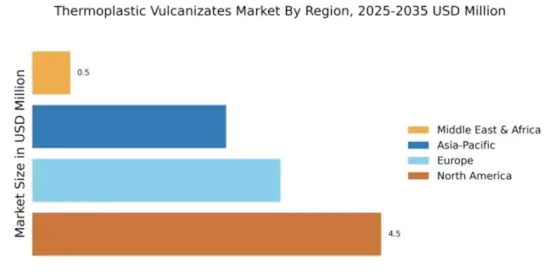
  • North America remains the largest market for thermoplastic vulcanizates, primarily due to its strong automotive sector.
  • The Asia-Pacific region is emerging as the fastest-growing market, fueled by increasing industrialization and urbanization.
  • The automotive segment dominates the market, while the medical segment is witnessing rapid growth due to rising healthcare demands.
  • Key market drivers include the rising demand in the automotive sector and an increased focus on sustainability initiatives.

Market Size & Forecast

2024 Market Size 10.69 (USD Million)
2035 Market Size 25.58 (USD Million)
CAGR (2025 - 2035) 8.26%

Major Players

Kraton Corporation (US), Mitsubishi Chemical Corporation (JP), BASF SE (DE), DuPont de Nemours, Inc. (US), LG Chem Ltd. (KR), SABIC (SA), ExxonMobil Chemical Company (US), Tosoh Corporation (JP), Kuraray Co., Ltd. (JP)

Thermoplastic Vulcanizates Market Trends

The Thermoplastic Vulcanizates Market is currently experiencing a notable evolution, driven by a confluence of factors that suggest a robust trajectory for growth. The increasing demand for lightweight materials across various industries, particularly automotive and consumer goods, appears to be a primary catalyst. This shift is likely influenced by the need for enhanced fuel efficiency and sustainability, prompting manufacturers to seek alternatives that offer both performance and environmental benefits. Furthermore, advancements in processing technologies may facilitate the production of thermoplastic vulcanizates, thereby expanding their application range and appeal. In addition to automotive applications, the Thermoplastic Vulcanizates Market is witnessing a surge in interest from the medical and packaging sectors. The versatility of thermoplastic vulcanizates, characterized by their excellent elasticity and resistance to chemicals, positions them as favorable materials for medical devices and packaging solutions. As industries increasingly prioritize safety and compliance with stringent regulations, the adoption of thermoplastic vulcanizates is likely to gain momentum. Overall, the market landscape appears poised for significant transformation, with innovation and sustainability at the forefront of its evolution.

Sustainability Initiatives

The Thermoplastic Vulcanizates Market is increasingly influenced by sustainability initiatives. Manufacturers are focusing on developing eco-friendly materials that align with global environmental goals. This trend reflects a broader commitment to reducing carbon footprints and enhancing recyclability, which may attract environmentally conscious consumers.

Technological Advancements

Technological advancements in processing techniques are reshaping the Thermoplastic Vulcanizates Market. Innovations in production methods could lead to improved material properties and cost efficiencies. This evolution may enable broader applications across diverse sectors, enhancing the overall market appeal.

Growing Automotive Applications

The automotive sector is a significant driver of the Thermoplastic Vulcanizates Market. As manufacturers seek lightweight and durable materials to improve vehicle performance, the demand for thermoplastic vulcanizates is likely to rise. This trend underscores the material's potential in enhancing fuel efficiency and reducing emissions.

Thermoplastic Vulcanizates Market Drivers

Growth in Consumer Goods Sector

The Global Thermoplastic Vulcanizates Market Industry is also benefitting from growth in the consumer goods sector. TPVs are increasingly utilized in products such as household appliances, toys, and sporting goods due to their superior elasticity and resistance to wear and tear. This versatility allows manufacturers to create durable and aesthetically pleasing products that meet consumer demands. As the consumer goods market expands, the demand for TPVs is expected to rise, contributing to the overall market growth. The anticipated increase in market value to 7.2 USD Billion by 2035 underscores the potential of TPVs in enhancing product performance and longevity.

Expansion in Automotive Applications

The Global Thermoplastic Vulcanizates Market Industry is significantly influenced by the expansion of automotive applications. TPVs are being adopted for various components, including interior and exterior parts, due to their excellent durability and flexibility. As the automotive industry evolves, manufacturers are increasingly integrating TPVs to meet stringent performance standards and consumer preferences for high-quality materials. This trend is indicative of a broader shift towards advanced materials that enhance vehicle performance. The market is anticipated to grow at a CAGR of 6.78% from 2025 to 2035, reflecting the automotive sector's commitment to innovation and efficiency.

Rising Demand for Lightweight Materials

The Global Thermoplastic Vulcanizates Market Industry is experiencing a surge in demand for lightweight materials, particularly in the automotive sector. As manufacturers strive to enhance fuel efficiency and reduce emissions, thermoplastic vulcanizates (TPVs) are increasingly favored for their lightweight properties. For instance, TPVs are utilized in automotive components such as seals and gaskets, contributing to overall weight reduction. This trend is projected to drive the market value to 3.5 USD Billion in 2024, reflecting a growing preference for materials that align with sustainability goals. The shift towards lightweight solutions is expected to continue, further propelling the market's growth trajectory.

Sustainability and Environmental Regulations

The Global Thermoplastic Vulcanizates Market Industry is increasingly influenced by sustainability and environmental regulations. Governments worldwide are implementing stricter regulations aimed at reducing plastic waste and promoting the use of recyclable materials. TPVs, being recyclable and exhibiting lower environmental impact compared to traditional materials, are well-positioned to meet these regulatory demands. This alignment with sustainability goals is likely to enhance the appeal of TPVs across various sectors, including automotive and consumer goods. As companies seek to comply with environmental standards, the demand for TPVs is expected to rise, further driving market growth.

Technological Advancements in Material Science

The Global Thermoplastic Vulcanizates Market Industry is poised for growth due to ongoing technological advancements in material science. Innovations in TPV formulations and processing techniques are enhancing the performance characteristics of these materials, making them more appealing for various applications. For example, advancements in blending technologies are enabling the production of TPVs with improved thermal stability and chemical resistance. This evolution in material capabilities is likely to attract new industries and applications, thereby expanding the market. As these technologies continue to develop, they may play a crucial role in shaping the future landscape of the TPV market.
Market Segment Insights

By Application: Automotive (Largest) vs. Medical (Fastest-Growing)

The Thermoplastic Vulcanizates (TPV) market is characterized by a diverse range of applications, with the automotive sector taking the lead in terms of market share. This sector benefits from the increasing demand for lightweight and durable materials that can withstand varying temperatures and environmental conditions. On the other hand, the medical application is emerging rapidly, driven by advancements in healthcare technologies and the need for biocompatible materials that ensure patient safety and product reliability.

Automotive: Dominant vs. Medical: Emerging

The automotive application of thermoplastic vulcanizates is the dominant segment due to the automotive industry's shift towards alternatives that offer better performance, weight reduction, and fuel efficiency. TPVs are preferred for their excellent weather resistance and flexibility, making them ideal for automotive seals, gaskets, and interior components. In contrast, the medical sector represents an emerging opportunity with growing demand for TPVs in medical devices and equipment. This segment is leveraging advanced material properties such as sterility, compliance with medical standards, and adaptability for various applications like IV bags and surgical equipment, showcasing significant growth potential as healthcare requirements evolve.

By End Use: Automotive Components (Largest) vs. Seals and Gaskets (Fastest-Growing)

The Thermoplastic Vulcanizates market has seen a diverse distribution among various end-use segments. Automotive components continue to dominate the market, reflecting the significant incorporation of thermoplastic vulcanizates due to their durability and flexibility. Seals and gaskets are emerging as a critical segment, rapidly gaining traction due to their applications in various industries, including automotive and industrial manufacturing. This distribution illustrates the strategic importance of these segments in driving the overall market growth.

Automotive Components: Dominant vs. Seals and Gaskets: Emerging

Automotive components represent a dominant force in the Thermoplastic Vulcanizates market, characterized by their essential role in the production of lightweight and energy-efficient vehicles. The versatility and high-performance qualities of thermoplastic vulcanizates make them ideal for various automotive applications, such as bumpers, trims, and interior components. Meanwhile, seals and gaskets are emerging as a fast-growing segment, propelled by increasing demand for effective sealing solutions in automotive and industrial applications. The ongoing trend towards high-performance materials is driving innovation in this area, making seals and gaskets crucial for ensuring reliability and longevity in diverse applications.

By Material Type: Polypropylene (Largest) vs. Polyamide (Fastest-Growing)

In the Thermoplastic Vulcanizates Market, Polypropylene emerges as the largest segment, showcasing significant market share due to its versatile applications across various industries. Following closely are Polyethylene and Styrene-Butadiene-Styrene, which also hold considerable positions but do not match the dominance of Polypropylene. Styrene-Ethylene-Butylene-Styrene and Polyamide, while important, contribute to a smaller portion of the overall market share, highlighting the diverse nature of material preferences in this sector. As the market evolves, Polyamide is recognized as the fastest-growing segment, driven by increasing demand in automotive and consumer goods due to its superior mechanical properties and thermal stability. Additionally, advances in manufacturing techniques and a shift towards lightweight materials are contributing to the surge in Polyamide adoption. This growth trend is indicative of changing consumer preferences towards sustainable and high-performance materials within the Thermoplastic Vulcanizates segment.

Polypropylene (Dominant) vs. Styrene-Ethylene-Butylene-Styrene (Emerging)

Polypropylene stands out as the dominant material in the Thermoplastic Vulcanizates Market, thanks to its exceptional balance of flexibility, durability, and resistance to chemicals and heat. It is widely used in automotive, electrical, and consumer products due to its cost-effectiveness and ease of processing. In contrast, Styrene-Ethylene-Butylene-Styrene, while emerging, is gaining traction rapidly because of its excellent elasticity and adaptability in diverse applications, including soft-touch components and sealants. The increasing focus on lightweight and fuel-efficient vehicles is driving interest in Styrene-Ethylene-Butylene-Styrene, positioning it well for future growth. As manufacturers seek innovative solutions to enhance performance, this material will likely see expanded use across multiple industries.

By Processing Method: Injection Molding (Largest) vs. Extrusion (Fastest-Growing)

The processing method segment in the Thermoplastic Vulcanizates Market showcases a diverse distribution among key techniques, with injection molding holding a significant share due to its efficiency and versatility in producing complex shapes. Blow molding, thermoforming, compression molding, and extrusion also contribute to the market, but their shares vary based on application requirements and manufacturing strategies. As a highly established method, injection molding remains preferred in automotive and consumer goods sectors for its cost-effectiveness and quality control, while extrusion is increasingly utilized for its capability in continuous production and customization of products.

Injection Molding (Dominant) vs. Extrusion (Emerging)

Injection molding, as the dominant processing method in the Thermoplastic Vulcanizates Market, excels in producing intricate designs with high precision and repeatability, making it favored for automotive parts and household items. Its established technology enables manufacturers to optimize production efficiency, thus reducing waste and operational costs. On the other hand, extrusion is gaining traction as an emerging method due to its capacity for continuous manufacturing processes and adaptability in producing profiles and sheets. This makes extrusion particularly appealing for industries aiming for mass production and customization. Both methods cater to specific market demands, with injection molding leading in established applications and extrusion showing potential for innovation and growth.

By Property: Thermal Stability (Largest) vs. Chemical Resistance (Fastest-Growing)

The Property segment of the Thermoplastic Vulcanizates Market is primarily dominated by Thermal Stability, which has a significant share attributed to its ability to withstand extreme temperatures and maintain performance. Chemical Resistance follows as a crucial segment, particularly in specialized applications where exposure to harsh chemicals is common. These segment values reflect the diverse applications of thermoplastic vulcanizates, including automotive, medical, and consumer goods, highlighting their essential roles in various industries.

Thermal Stability (Dominant) vs. Chemical Resistance (Emerging)

Thermal Stability is recognized as the dominant property in the Thermoplastic Vulcanizates Market, characterized by its capacity to maintain integrity under high-temperature conditions. As applications in automotive and industrial sectors expand, the demand for materials that can perform consistently under thermal stress has grown. In contrast, Chemical Resistance is emerging as a significant driver for market growth, influenced by increasing regulations on material safety and the push for longevity in product design. This property enables products to resist deterioration in the presence of diverse chemical environments, making them crucial for modern applications. Both properties exemplify the adaptability and performance expectations in thermoplastic vulcanizates.

Get more detailed insights about Thermoplastic Vulcanizates Market

Regional Insights

North America : Market Leader in Innovation

North America is poised to maintain its leadership in the Thermoplastic Vulcanizates (TPV) market, holding a significant share of 4.5 in 2024. The region's growth is driven by increasing demand in automotive, consumer goods, and healthcare sectors, alongside stringent regulations promoting sustainable materials. The focus on lightweight and durable materials is further propelling market expansion, supported by advancements in manufacturing technologies. The competitive landscape in North America is robust, featuring key players such as Kraton Corporation, DuPont de Nemours, and ExxonMobil Chemical Company. These companies are investing heavily in R&D to innovate and enhance product offerings. The U.S. remains the largest market, with Canada and Mexico also contributing to growth through increased industrial applications and collaborations in the TPV sector.

Key Players and Competitive Insights

The Thermoplastic Vulcanizates Market is currently characterized by a dynamic competitive landscape, driven by increasing demand for lightweight and durable materials across various industries, including automotive, consumer goods, and electronics. Key players such as Kraton Corporation (US), BASF SE (DE), and DuPont de Nemours, Inc. (US) are strategically positioning themselves through innovation and partnerships. For instance, Kraton Corporation (US) has focused on enhancing its product portfolio with sustainable solutions, while BASF SE (DE) emphasizes digital transformation to optimize its operations and customer engagement. These strategies collectively shape a competitive environment that is increasingly focused on sustainability and technological advancement.

In terms of business tactics, companies are localizing manufacturing to reduce lead times and enhance supply chain efficiency. The market structure appears moderately fragmented, with several key players exerting influence over their respective segments. This fragmentation allows for niche players to thrive, while larger corporations leverage their scale to optimize production and distribution networks, thereby enhancing their competitive edge.

In November 2025, DuPont de Nemours, Inc. (US) announced a strategic partnership with a leading automotive manufacturer to develop advanced thermoplastic vulcanizates tailored for electric vehicle applications. This collaboration is significant as it aligns with the growing trend towards electrification in the automotive sector, positioning DuPont as a key player in a rapidly evolving market.

In October 2025, BASF SE (DE) launched a new line of thermoplastic vulcanizates that incorporate recycled materials, reflecting a commitment to sustainability. This initiative not only addresses environmental concerns but also meets the increasing consumer demand for eco-friendly products, thereby enhancing BASF's market position.

In September 2025, Kraton Corporation (US) expanded its production capacity in Asia to meet the rising demand for thermoplastic vulcanizates in the region. This expansion is crucial as it allows Kraton to capitalize on the growing markets in Asia, particularly in automotive and consumer goods, thereby strengthening its competitive foothold.

As of December 2025, the competitive trends in the Thermoplastic Vulcanizates Market are increasingly defined by digitalization, sustainability, and the integration of advanced technologies such as AI. Strategic alliances are becoming more prevalent, enabling companies to pool resources and expertise to drive innovation. The competitive differentiation is likely to evolve from traditional price-based competition towards a focus on innovation, technology, and supply chain reliability, suggesting a transformative shift in how companies approach market challenges.

Key Companies in the Thermoplastic Vulcanizates Market market include

Industry Developments

  • Q2 2024: Celanese Announces Expansion of Thermoplastic Vulcanizate Production Capacity in China Celanese Corporation announced the opening of a new production line for thermoplastic vulcanizates at its Nanjing facility, aiming to meet rising demand in automotive and consumer goods sectors.
  • Q1 2024: Mitsui Chemicals Launches New Medical-Grade Thermoplastic Vulcanizate Mitsui Chemicals introduced a new medical-grade TPV designed for improved biocompatibility and sterilization, targeting medical device manufacturers in Asia and Europe.
  • Q2 2024: Teknor Apex Unveils Flame Retardant TPV for Automotive Applications Teknor Apex launched a new flame retardant thermoplastic vulcanizate product line, specifically engineered for automotive interior and under-the-hood components.
  • Q3 2024: Ravago Acquires TPV Manufacturing Assets from Local Competitor in Europe Ravago Group completed the acquisition of a TPV production facility in Germany, expanding its footprint and increasing supply capacity for European automotive and industrial customers.
  • Q2 2024: Dawn Polymer Opens New TPV R&D Center in Shandong Shandong Dawn Polymer Materials Co. Ltd. inaugurated a research and development center focused on advanced TPV formulations for electric vehicle and medical applications.
  • Q1 2025: Celanese Appoints New VP of Thermoplastic Elastomers Division Celanese Corporation announced the appointment of Dr. Lisa Chen as Vice President of its Thermoplastic Elastomers Division, overseeing global TPV strategy and operations.
  • Q2 2025: Mitsui Chemicals Signs Strategic Partnership with European Automotive OEM for TPV Supply Mitsui Chemicals entered a multi-year supply agreement with a major European automotive manufacturer to provide custom TPV materials for next-generation electric vehicles.
  • Q2 2024: Teknor Apex Expands TPV Production Capacity in Tennessee Teknor Apex announced the completion of a major expansion at its Tennessee plant, increasing TPV output to support growing demand in North America.
  • Q3 2024: Ravago Invests $30 Million in New TPV Manufacturing Facility in Mexico Ravago revealed plans to build a new thermoplastic vulcanizate manufacturing facility in Monterrey, Mexico, to serve automotive and industrial clients in Latin America.
  • Q1 2025: Dawn Polymer Secures Major Contract to Supply TPV for Chinese EV Manufacturer Dawn Polymer signed a multi-year contract to supply thermoplastic vulcanizates for use in sealing systems and interior components of a leading Chinese electric vehicle brand.
  • Q2 2025: Celanese Launches Bio-Based TPV for Sustainable Automotive Applications Celanese introduced a new bio-based thermoplastic vulcanizate product line, targeting automotive OEMs seeking sustainable material solutions.
  • Q1 2024: Teknor Apex Wins Supply Contract for TPV in Major US Infrastructure Project Teknor Apex secured a contract to supply thermoplastic vulcanizates for use in flexible seals and gaskets in a large-scale US infrastructure upgrade.

Intended Audience

    • Thermoplastic Vulcanizates Market Manufacturers
    • Traders and Distributors of Thermoplastic Vulcanizates Market
    • Production Process Industries
    • Potential Investors
    • Raw Material Suppliers
    • Nationalized Laboratory

Future Outlook

Thermoplastic Vulcanizates Market Future Outlook

The Thermoplastic Vulcanizates Market is poised for growth at 8.26% CAGR from 2024 to 2035, driven by increasing demand in automotive, consumer goods, and healthcare sectors.

New opportunities lie in:

  • Development of bio-based thermoplastic vulcanizates for sustainable applications.
  • Expansion into emerging markets with tailored product offerings.
  • Investment in advanced manufacturing technologies to enhance production efficiency.

By 2035, the Thermoplastic Vulcanizates Market is expected to achieve robust growth and increased market penetration.

Market Segmentation

Thermoplastic Vulcanizates Market End Use Outlook

  • Automotive Components
  • Seals and Gaskets
  • Hoses and Tubing
  • Wires and Cables
  • Adhesives

Thermoplastic Vulcanizates Market Property Outlook

  • Thermal Stability
  • Chemical Resistance
  • Mechanical Strength
  • Flexibility
  • Aging Resistance

Thermoplastic Vulcanizates Market Application Outlook

  • Automotive
  • Consumer Goods
  • Industrial
  • Medical
  • Electronics

Thermoplastic Vulcanizates Market Material Type Outlook

  • Polypropylene
  • Polyethylene
  • Styrene-Ethylene-Butylene-Styrene
  • Styrene-Butadiene-Styrene
  • Polyamide

Thermoplastic Vulcanizates Market Processing Method Outlook

  • Injection Molding
  • Blow Molding
  • Extrusion
  • Thermoforming
  • Compression Molding

Report Scope

MARKET SIZE 202410.69(USD Million)
MARKET SIZE 202511.57(USD Million)
MARKET SIZE 203525.58(USD Million)
COMPOUND ANNUAL GROWTH RATE (CAGR)8.26% (2024 - 2035)
REPORT COVERAGERevenue Forecast, Competitive Landscape, Growth Factors, and Trends
BASE YEAR2024
Market Forecast Period2025 - 2035
Historical Data2019 - 2024
Market Forecast UnitsUSD Million
Key Companies ProfiledKraton Corporation (US), Mitsubishi Chemical Corporation (JP), BASF SE (DE), DuPont de Nemours, Inc. (US), LG Chem Ltd. (KR), SABIC (SA), ExxonMobil Chemical Company (US), Tosoh Corporation (JP), Kuraray Co., Ltd. (JP)
Segments CoveredApplication, End Use, Material Type, Processing Method, Property
Key Market OpportunitiesGrowing demand for lightweight, durable materials in automotive and consumer goods drives Thermoplastic Vulcanizates Market expansion.
Key Market DynamicsRising demand for lightweight materials drives innovation and competition in the Thermoplastic Vulcanizates market.
Countries CoveredNorth America, Europe, APAC, South America, MEA

Market Highlights

Author
Chitranshi Jaiswal
Research Analyst Level I

In her 3 years of experience in the market research field, she has handled critical cross-domain projects. She has an in-depth knowledge of market estimation & analysis, problem-solving, primary as well as secondary research, and team management.She holds an engineering degree and is an MBA professional from a well-known university, capable of evaluating the market and competitive conditions. An exceptional strategist with excellent communication skills and a passion for delivering cutting-edge & practical insights for the market. Proficient in multi-tasking, and can successfully deal with competing demands, while maintaining complete confidentiality. Generated business through active client and project development, networking, and high-quality responses. Her knowledge and skills have helped in making solid business decisions, securing funding from investors, and avoiding business failures.

Leave a Comment

FAQs

What are the major application of thermoplastic vulcanizates?

Automotive, Consumer Goods, Fluid Handling, Medical, and Sports, are some of the major application areas of thermoplastic vulcanizates.

Which is the major segment in the global thermoplastic vulcanizates market?

The medical segment is the largest regiment in the global thermoplastic vulcanizates market, which is projected to witness a higher CAGR during the forecast period due to growing use of plastics in gaskets & stoppers.

Which region holds the largest share in the thermoplastic vulcanizates market?

North America holds the largest share in the global thermoplastic vulcanizates market followed by Europe and Asia Pacific, respectively.

What are the key growth strategies of players active in the thermoplastic vulcanizates market?

Strategic initiatives such as mergers & acquisitions, collaborations, expansion, and technology/ product launch are some of the growth strategies adopted by the players in the global thermoplastic vulcanizates market.

Who are the top players in the global thermoplastic vulcanizates market?

Asahi Kasei Corporation (Japan), Arkema (France), BASF SE(Germany), The Dow Chemical Company (US), BAYER AG(Germany), Dow Corning Corporation (US), Exxon Mobil Corporation (US), Eni S.p.A.(Italy), and Mitsubishi Chemical Holdings Corporation (Japan), are some of the leading players in the global thermoplastic vulcanizates market.

Download Free Sample

Kindly complete the form below to receive a free sample of this Report

Compare Licence

×
Features License Type
Single User Multiuser License Enterprise User
Price $4,950 $5,950 $7,250
Maximum User Access Limit 1 User Upto 10 Users Unrestricted Access Throughout the Organization
Free Customization
Direct Access to Analyst
Deliverable Format
Platform Access
Discount on Next Purchase 10% 15% 15%
Printable Versions