×
Request Free Sample ×

Kindly complete the form below to receive a free sample of this Report

* Please use a valid business email

Leading companies partner with us for data-driven Insights

clients tt-cursor
Hero Background

US Aircraft Insurance Market

ID: MRFR/AD/18029-HCR
100 Pages
Sejal Akre
October 2025

US Aircraft Insurance Market Research Report: By Type (Public Liability Insurance, Passenger Liability Insurance, Combined Single Limit (CSL), Ground Risk Hull (Motion) Insurance, Ground Risk Hull (Non-Motion) Insurance, Hangar And Ground Support Equipment Insurance, In-Flight Insurance, Umbrella Insurance), By Application (Commercial Aviation, Business & General Aviation) and By End User (Airlines, Airports, Aircraft Product Manufacturers, Leasing Companies, Ground Operators, Individual General Aviation Aircraft Operators, Air Taxi Ope... read more

Share:
Download PDF ×

We do not share your information with anyone. However, we may send you emails based on your report interest from time to time. You may contact us at any time to opt-out.

US Aircraft Insurance Market Infographic
Purchase Options

US Aircraft Insurance Market Summary

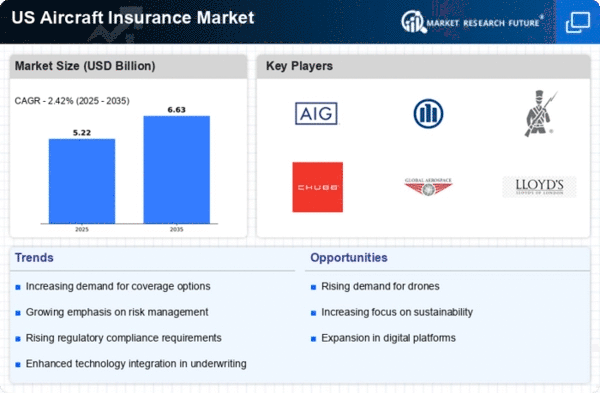
As per MRFR analysis, the US aircraft insurance market size was estimated at 5.1 USD Billion in 2024. The US aircraft insurance market is projected to grow from 5.22 USD Billion in 2025 to 6.63 USD Billion by 2035, exhibiting a compound annual growth rate (CAGR) of 2.42% during the forecast period 2025 - 2035.

Key Market Trends & Highlights

The US aircraft insurance market is experiencing a shift towards more tailored coverage options driven by technological advancements and regulatory changes.

  • The demand for customized policies is on the rise as clients seek coverage that meets their specific needs.
  • Technological integration in risk assessment is enhancing the accuracy and efficiency of underwriting processes.
  • Regulatory changes are impacting coverage options, prompting insurers to adapt their offerings accordingly.
  • Rising aircraft ownership and growing awareness of liability risks are key drivers fueling market expansion.

Market Size & Forecast

2024 Market Size 5.1 (USD Billion)
2035 Market Size 6.63 (USD Billion)
CAGR (2025 - 2035) 2.42%

Major Players

AIG (US), Allianz (DE), Berkshire Hathaway (US), Chubb (US), Global Aerospace (GB), Lloyd's of London (GB), Marsh (US), QBE Insurance (AU), Travelers (US)

US Aircraft Insurance Market Trends

As the aviation sector continues to expand, the need for comprehensive insurance solutions becomes more pronounced. Insurers are adapting to these changes by offering tailored policies that address the unique risks associated with various types of aircraft, from small private planes to large commercial jets. This adaptability is crucial, as it allows stakeholders to navigate the complexities of risk management effectively. Moreover, advancements in technology are reshaping the landscape of the aircraft insurance market. The integration of data analytics and artificial intelligence is enhancing underwriting processes, enabling insurers to assess risks with greater precision. This technological shift not only streamlines operations but also fosters a more competitive environment, as companies strive to differentiate their offerings. As the market evolves, it appears that collaboration between insurers and aviation stakeholders will be essential in developing innovative solutions that meet the changing needs of the industry.

Increased Demand for Customized Policies

There is a noticeable trend towards the demand for customized insurance policies that cater to specific aviation needs. As operators seek coverage that aligns with their unique operational profiles, insurers are responding by developing tailored solutions. This shift indicates a growing recognition of the diverse risks associated with different aircraft types and uses.

Technological Integration in Risk Assessment

The incorporation of advanced technologies, such as data analytics and machine learning, is transforming risk assessment practices within the aircraft insurance market. Insurers are leveraging these tools to enhance their underwriting processes, allowing for more accurate risk evaluations and pricing strategies. This trend suggests a move towards a more data-driven approach in the industry.

Regulatory Changes Impacting Coverage Options

Ongoing regulatory changes are influencing the types of coverage available in the aircraft insurance market. As new regulations emerge, insurers must adapt their offerings to remain compliant while also meeting the evolving needs of their clients. This trend highlights the importance of staying informed about regulatory developments to ensure adequate protection.

US Aircraft Insurance Market Drivers

Rising Aircraft Ownership

The increasing number of private and commercial aircraft ownership in the US appears to be a primary driver for the aircraft insurance market. As more individuals and businesses invest in aircraft, the demand for comprehensive insurance coverage rises. In 2025, the Federal Aviation Administration (FAA) reported a growth of approximately 5% in registered aircraft, indicating a robust market for insurance providers. This trend suggests that as ownership expands, so does the necessity for tailored insurance solutions that address specific risks associated with different types of aircraft. Consequently, insurance companies are likely to develop more specialized policies to cater to this growing clientele, thereby enhancing the overall landscape of the aircraft insurance market.

Increased Regulatory Scrutiny

The aircraft insurance market is experiencing heightened regulatory scrutiny, which could significantly impact coverage options and pricing structures. Regulatory bodies in the US are continuously updating safety standards and insurance requirements for aircraft operations. This evolving regulatory landscape may compel insurers to adjust their policies to remain compliant, potentially leading to increased costs for policyholders. Moreover, as regulations become more stringent, the demand for specialized insurance products that meet these new standards is likely to rise. Consequently, this driver may create both challenges and opportunities within the aircraft insurance market, as insurers strive to balance compliance with competitive pricing.

Expansion of Aviation Services

The expansion of aviation services, including charter flights and air taxi services, is contributing to the growth of the aircraft insurance market. As these services become more prevalent, the demand for insurance tailored to commercial operations is likely to increase. In 2025, the US aviation sector is projected to see a 10% rise in charter flight operations, which may necessitate specialized insurance products that cater to the unique risks associated with commercial aviation. This trend indicates that insurers must adapt their offerings to meet the evolving needs of the market, potentially leading to innovative policy structures that address the complexities of commercial aviation.

Growing Awareness of Liability Risks

There is a growing awareness among aircraft owners regarding the potential liability risks associated with aircraft operation. This heightened awareness is likely to drive demand for comprehensive liability coverage within the aircraft insurance market. As incidents involving aircraft accidents can lead to substantial financial repercussions, owners are increasingly recognizing the importance of adequate insurance protection. In 2025, surveys indicate that approximately 70% of aircraft owners prioritize liability coverage when selecting insurance policies. This trend suggests that insurers may need to enhance their offerings to address the specific liability concerns of their clients, thereby fostering growth in the market.

Technological Advancements in Aviation

Technological innovations in aviation, such as enhanced safety features and advanced navigation systems, are influencing the aircraft insurance market. These advancements may lead to a reduction in accident rates, which could potentially lower insurance premiums. For instance, the integration of artificial intelligence and data analytics in risk assessment allows insurers to evaluate risks more accurately, thereby optimizing policy pricing. As technology continues to evolve, the aircraft insurance market is likely to adapt, offering policies that reflect the reduced risks associated with modern aircraft. This shift may encourage more aircraft owners to seek insurance, further driving market growth.


Market Segment Insights

By Type of Insurance: Liability Insurance (Largest) vs. Hull Insurance (Fastest-Growing)

In the US aircraft insurance market, Liability Insurance holds the largest market share among the segment values, followed by Hull Insurance, Passenger Liability Insurance, and Freight Insurance. Liability Insurance is vital for protecting operators against claims arising from aircraft operations, which has led to its dominant position. Hull Insurance, while smaller in share, is gaining traction due to increasing demand for comprehensive coverage of physical aircraft damages, thus demonstrating significant market strength. The growth trends in the US aircraft insurance market for these segments show a robust upward trajectory. Factors driving this growth include heightened awareness of safety standards, a rise in aircraft usage, and an increase in flight operations. Emerging technologies and stricter regulatory frameworks are anticipated to further enhance market potential for Hull Insurance, making it the fastest-growing segment as insurers adapt to evolving risks and customer needs.

Liability Insurance: Dominant vs. Hull Insurance: Emerging

Liability Insurance stands out as the dominant segment within the US aircraft insurance market, primarily due to its comprehensive coverage against third-party claims. Operators prioritize this insurance as it safeguards against potential financial losses from legal actions. This segment benefits from strong demand stemming from regulatory requirements and increasing operational risks. Conversely, Hull Insurance is categorized as an emerging segment, reflecting its rapid growth driven by heightened concern for physical asset protection. As aircraft operations surge, demand for Hull Insurance is also on the rise. Insurers are now offering tailored policies that cater to specific aircraft types and operational contexts, further enhancing its attractiveness to aircraft operators.

By Aircraft Type: Commercial Aircraft (Largest) vs. Private Jets (Fastest-Growing)

In the US aircraft insurance market, the market share distribution is primarily dominated by commercial aircraft, which holds the largest share due to the extensive operations and high value of commercial airline fleets. Following commercial aircraft are cargo aircraft and private jets, with private jets gaining traction among affluent individuals seeking personalized travel solutions. Helicopters remain a niche segment, serving specialized applications such as medical and emergency services. Growth trends in the aircraft insurance market are significantly influenced by the increasing demand for air travel and cargo transport. The recovery from the pandemic has accelerated the need for commercial aircraft insurance, while the rising wealth and preference for luxury among individuals has resulted in a surge in the private jets segment. Additionally, advancements in helicopter technology contribute to their growing insurance needs, as more operators seek coverage for these versatile aircraft.

Commercial Aircraft: Dominant vs. Private Jets: Emerging

Commercial aircraft dominate the US aircraft insurance market, primarily due to the vast number of operational flights and the high value of the aircraft involved. Insurance policies for commercial aircraft are typically comprehensive, covering an array of risks associated with passenger transport. In contrast, private jets represent an emerging segment fueled by increasing disposable income among high-net-worth individuals. Insurance for private jets tends to be more personalized, catering to the unique requirements of individual owners. This segment is experiencing rapid growth as more affluent clients become interested in private aviation, prompting insurers to offer tailored solutions that address both the luxury and operational aspects of ownership.

By Coverage Type: Third Party Liability (Largest) vs. All Risk (Fastest-Growing)

In the US aircraft insurance market, the coverage segment is predominantly led by Third Party Liability, which captures a substantial share of the total market. This type of coverage is preferred due to its essential nature, providing critical protection for operators against claims from third parties for damages or injuries resulting from aircraft operations. Named Perils and Ground Risk coverages also play significant roles, but their shares are comparatively smaller, catering to specific needs of operators. The Fastest-Growing segment is All Risk coverage, which is gaining traction among aircraft operators seeking comprehensive protection. This trend is being driven by the increasing need for more extensive safety nets in an evolving aviation landscape, coupled with rising awareness of potential risks. As operators aim for greater peace of mind, the All Risk segment is expected to expand rapidly, attracting more customers and contributing to overall market growth.

Third Party Liability (Dominant) vs. All Risk (Emerging)

Third Party Liability coverage stands out as the dominant segment in the US aircraft insurance market, primarily because it safeguards aircraft owners against liabilities that arise from third-party claims. Its appeal lies in its simplicity and necessity, making it the go-to choice for most operators. Conversely, All Risk coverage is emerging as a significant option due to its extensive scope, covering a wide array of potential incidents that can occur during flight operations. The growing complexities and demands of the aviation sector, including regulatory requirements and operational risks, are propelling this coverage's popularity. As operators become more aware of the diverse range of risks they face, All Risk coverage is expected to see increased adoption, representing a shift towards more holistic insurance solutions.

By End-use: Commercial Aviation (Largest) vs. Cargo Transportation (Fastest-Growing)

The market share distribution within the US aircraft insurance market shows that Commercial Aviation holds the largest stake, benefiting from a wide array of flight operations and a diverse clientele. This sector encompasses airlines and large charter operators, ensuring a substantial portion of insured assets. Conversely, Cargo Transportation has emerged as a significant player, capturing attention due to the exponential growth in e-commerce and global supply chains, which has led to increased demand for cargo flights and associated insurance products. Growth trends in the US aircraft insurance market indicate that while Commercial Aviation remains dominant, the segment of Cargo Transportation is rapidly gaining traction. Key drivers for this growth include the ongoing expansion of e-commerce and logistical needs, sparking greater investments in cargo aircraft. Meanwhile, Private Aviation continues to provide steady growth, driven by elite clientele and the increasing appeal of on-demand travel, though it lags behind the other two segments in market share and growth rate.

Commercial Aviation (Dominant) vs. Cargo Transportation (Emerging)

Commercial Aviation is characterized by its established presence in the US aircraft insurance market, with major airlines and charter services relying on comprehensive coverage to safeguard their extensive operations. This sector enjoys robust regulatory support and a loyal customer base, which has helped maintain its dominance over time. Conversely, Cargo Transportation is an emerging segment, driven by the surging demand for freight services as global trade flourishes. This sector is becoming increasingly vital as businesses adapt to a fast-paced, on-demand market environment. The evolving insurance needs in both segments reveal tailored products and services aimed at addressing unique risks, allowing them to cater effectively to their distinct operational challenges.

Get more detailed insights about US Aircraft Insurance Market

Key Players and Competitive Insights

The aircraft insurance market is currently characterized by a competitive landscape that is both dynamic and multifaceted. Key growth drivers include the increasing demand for air travel, advancements in aviation technology, and a heightened focus on risk management. Major players such as AIG (US), Allianz (DE), and Berkshire Hathaway (US) are strategically positioned to leverage these trends. AIG (US) emphasizes innovation in underwriting processes, while Allianz (DE) focuses on expanding its digital capabilities to enhance customer engagement. Berkshire Hathaway (US) appears to prioritize risk diversification through its extensive portfolio, which collectively shapes a competitive environment that is increasingly reliant on technological advancements and customer-centric solutions.

In terms of business tactics, companies are adopting strategies such as localizing services and optimizing supply chains to enhance operational efficiency. The market structure is moderately fragmented, with a mix of large multinational corporations and specialized insurers. This fragmentation allows for a diverse range of offerings, yet the collective influence of key players like Chubb (US) and Global Aerospace (GB) is significant, as they drive innovation and set industry standards.

In October 2025, Chubb (US) announced a strategic partnership with a leading technology firm to develop an AI-driven risk assessment tool aimed at improving underwriting accuracy. This move is likely to enhance Chubb's competitive edge by streamlining operations and providing more tailored insurance solutions to clients. The integration of AI into their processes suggests a forward-thinking approach that aligns with current market demands for efficiency and precision.

In September 2025, Global Aerospace (GB) launched a new suite of insurance products specifically designed for unmanned aerial vehicles (UAVs). This initiative reflects a growing recognition of the UAV market's potential and positions Global Aerospace as a leader in this emerging segment. By addressing the unique risks associated with UAV operations, the company is likely to capture a significant share of this niche market, thereby reinforcing its competitive stance.

In August 2025, Allianz (DE) expanded its presence in the US market by acquiring a regional insurance provider specializing in aviation. This acquisition not only broadens Allianz's customer base but also enhances its service offerings, allowing for a more localized approach to client needs. Such strategic moves indicate a trend towards consolidation in the market, where larger players seek to strengthen their foothold through acquisitions and partnerships.

As of November 2025, current competitive trends are heavily influenced by digitalization, sustainability, and the integration of AI technologies. Strategic alliances are increasingly shaping the landscape, as companies recognize the value of collaboration in driving innovation. Looking ahead, competitive differentiation is expected to evolve, with a notable shift from price-based competition to a focus on technological innovation and supply chain reliability. This transition underscores the importance of adaptability and forward-thinking strategies in maintaining a competitive advantage in the aircraft insurance market.

Key Companies in the US Aircraft Insurance Market market include

Industry Developments

Recent developments in the US Aircraft Insurance Market indicate a notable increase in premiums, attributed to heightened risk factors in aviation, including rising costs related to maintenance and operational safety. Companies such as AIG and Zurich Insurance Group are actively adapting their policies to better cover emerging risks. In terms of mergers and acquisitions, Excess Liability Insurance Company announced a strategic acquisition of Aero Insurance in September 2023, aligning with their goal to expand their service offerings and enhance market share. Additionally, Allianz has been investing significantly in technology to streamline insurance processes and improve customer experience.

Growth in the market valuation of leading firms such as Chubb and Berkshire Hathaway reflects a robust demand for specialized coverage amid the ongoing recovery from pandemic-related disruptions. Moreover, Aviation Insurance Services reported a significant rise in claims during the past 12 months, emphasizing the evolving challenges in risk management. Over the last two to three years, the US Aircraft Insurance Market has seen fluctuations influenced by regulatory changes, with a focus on compliance and safety standards that shape underwriting practices across major players like US Specialty Insurance and Falcon Insurance.

Future Outlook

US Aircraft Insurance Market Future Outlook

The Aircraft Insurance Market is projected to grow at a 2.42% CAGR from 2024 to 2035, driven by technological advancements, increased air travel, and regulatory changes.

New opportunities lie in:

  • Development of customized insurance packages for electric aircraft.
  • Integration of AI-driven risk assessment tools for premium pricing.
  • Expansion of coverage options for drone operations in commercial sectors.

By 2035, the market is expected to achieve robust growth, adapting to emerging aviation trends.

Market Segmentation

US Aircraft Insurance Market End-use Outlook

  • Commercial Aviation
  • Private Aviation
  • Cargo Transportation

US Aircraft Insurance Market Aircraft Type Outlook

  • Commercial Aircraft
  • Cargo Aircraft
  • Private Jets
  • Helicopters

US Aircraft Insurance Market Coverage Type Outlook

  • All Risk
  • Named Perils
  • Third Party Liability
  • Ground Risk

US Aircraft Insurance Market Type of Insurance Outlook

  • Hull Insurance
  • Liability Insurance
  • Passenger Liability Insurance
  • Freight Insurance

Report Scope

MARKET SIZE 2024 5.1(USD Billion)
MARKET SIZE 2025 5.22(USD Billion)
MARKET SIZE 2035 6.63(USD Billion)
COMPOUND ANNUAL GROWTH RATE (CAGR) 2.42% (2024 - 2035)
REPORT COVERAGE Revenue Forecast, Competitive Landscape, Growth Factors, and Trends
BASE YEAR 2024
Market Forecast Period 2025 - 2035
Historical Data 2019 - 2024
Market Forecast Units USD Billion
Key Companies Profiled AIG (US), Allianz (DE), Berkshire Hathaway (US), Chubb (US), Global Aerospace (GB), Lloyd's of London (GB), Marsh (US), QBE Insurance (AU), Travelers (US)
Segments Covered Type of Insurance, Aircraft Type, Coverage Type, End-use
Key Market Opportunities Integration of advanced data analytics for risk assessment in the aircraft insurance market.
Key Market Dynamics Regulatory changes and technological advancements reshape risk assessment in the aircraft insurance market.
Countries Covered US

Leave a Comment

FAQs

What is the expected market size of the US Aircraft Insurance Market in 2024?

The US Aircraft Insurance Market is expected to be valued at 4.8 billion USD in the year 2024.

What will be the market size of the US Aircraft Insurance Market by 2035?

By the year 2035, the US Aircraft Insurance Market is projected to reach a value of 6.25 billion USD.

What is the expected CAGR for the US Aircraft Insurance Market from 2025 to 2035?

The expected CAGR for the US Aircraft Insurance Market from 2025 to 2035 is 2.427 percent.

Which segment of the US Aircraft Insurance Market is expected to have the largest market share?

The Public Liability Insurance segment is estimated to hold a significant share, valued at 1.2 billion USD in 2024.

Who are the key players in the US Aircraft Insurance Market?

Major players in the US Aircraft Insurance Market include AIG, Zurich Insurance Group, Allianz, and Berkshire Hathaway.

What is the projected market size for Passenger Liability Insurance in 2035?

The Passenger Liability Insurance segment is expected to be valued at 1.3 billion USD in 2035.

What growth rate can be expected specifically for Ground Risk Hull (Movement) Insurance from 2024 to 2035?

Ground Risk Hull (Motion) Insurance is projected to grow from 0.9 billion USD in 2024 to 1.2 billion USD in 2035.

What opportunities does the US Aircraft Insurance Market present for investors?

The US Aircraft Insurance Market presents opportunities for growth, particularly in emerging segments like Combined Single Limit Insurance.

How are current global economic conditions impacting the US Aircraft Insurance Market?

The US Aircraft Insurance Market is anticipated to be influenced by current global economic conditions, affecting pricing and underwriting strategies.

What will be the market size for Ground Risk Hull (Non-Motion) Insurance by 2035?

The Ground Risk Hull (Non-Motion) Insurance segment is projected to grow to 0.3 billion USD by the year 2035.

Download Free Sample

Kindly complete the form below to receive a free sample of this Report

Compare Licence

×
Features License Type
Single User Multiuser License Enterprise User
Price $4,950 $5,950 $7,250
Maximum User Access Limit 1 User Upto 10 Users Unrestricted Access Throughout the Organization
Free Customization
Direct Access to Analyst
Deliverable Format
Platform Access
Discount on Next Purchase 10% 15% 15%
Printable Versions