×
Request Free Sample ×

Kindly complete the form below to receive a free sample of this Report

* Please use a valid business email

Leading companies partner with us for data-driven Insights

clients tt-cursor
Hero Background

Waste Heat Recovery Market

ID: MRFR/EnP/0847-HCR
188 Pages
Chitranshi Jaiswal
February 2026

Waste Heat Recovery Market Size, Share & Growth Analysis Report By Technique (Heat Exchangers, Heat Wheels, Recuperators, Regenerators, Boilers, and Others), By Application (Temperature Control, Pre-Heating Systems, Electricity Generation, and Others), By Industries (Chemical & Petrochemical, Oil & Gas, Energy & Power, Food & Beverages, Cement, Paper & Pulp, and Others), and By Region – Trends & Industry Forecast to 2035

Share:
Download PDF ×

We do not share your information with anyone. However, we may send you emails based on your report interest from time to time. You may contact us at any time to opt-out.

Waste Heat Recovery Market Infographic
Purchase Options

Waste Heat Recovery Market Summary

As per Market Research Future analysis, The Waste Heat Recovery Market Size was estimated at 80.45 USD Billion in 2024. The Global Waste Heat Recovery industry is projected to grow from 87.11 USD Billion in 2025 to 193.18 USD Billion by 2035, exhibiting a compound annual growth rate (CAGR) of 8.2% during the forecast period 2025 - 2035

Key Market Trends & Highlights

The Waste Heat Recovery Market is poised for substantial growth driven by technological advancements and increasing industrial demand.

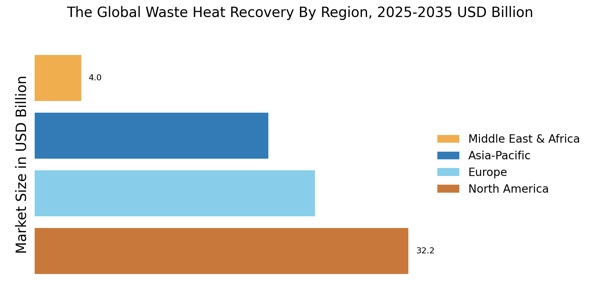
  • North America remains the largest market for waste heat recovery technologies, reflecting robust industrial activity.
  • Asia-Pacific is identified as the fastest-growing region, propelled by rapid industrialization and energy efficiency initiatives.
  • Heat exchangers dominate the market as the largest segment, while recuperators are emerging as the fastest-growing segment.
  • Key market drivers include rising energy costs and regulatory support, which are fostering investment in waste heat recovery solutions.

Market Size & Forecast

2024 Market Size 80.45 (USD Billion)
2035 Market Size 193.18 (USD Billion)
CAGR (2025 - 2035) 8.29%

Major Players

General Electric (US), Siemens (DE), Schneider Electric (FR), Mitsubishi Heavy Industries (JP), ABB (CH), Bosch (DE), Caterpillar (US), Clyde Bergemann (DE), Ceres Media (US), Ormat Technologies (US)

Our Impact
Enabled $4.3B Revenue Impact for Fortune 500 and Leading Multinationals
Partnering with 2000+ Global Organizations Each Year
30K+ Citations by Top-Tier Firms in the Industry

Waste Heat Recovery Market Trends

The Waste Heat Recovery Market is currently experiencing a notable transformation, driven by increasing energy efficiency demands and a growing emphasis on sustainability. Industries are progressively recognizing the potential of waste heat recovery systems to enhance operational efficiency while simultaneously reducing greenhouse gas emissions. This shift is not merely a trend but appears to be a fundamental change in how energy is utilized across various sectors, including manufacturing, power generation, and commercial applications. As organizations strive to meet regulatory requirements and corporate sustainability goals, the adoption of waste heat recovery technologies is likely to accelerate, fostering innovation and investment in this sector. Moreover, advancements in technology are facilitating the integration of waste heat recovery systems into existing infrastructures. The emergence of sophisticated solutions, such as organic Rankine cycle systems and heat exchangers, suggests a promising future for The Waste Heat Recovery Market. These innovations may enable industries to capture and repurpose heat that would otherwise be lost, thereby optimizing energy consumption. As the market evolves, collaboration between technology providers and end-users is expected to play a crucial role in driving growth and enhancing system efficiency, ultimately contributing to a more sustainable energy landscape.

Technological Advancements

Recent innovations in waste heat recovery technologies are reshaping the landscape of Waste Heat Recovery Market. A comprehensive waste heat recovery system market analysis indicates that the integration of Organic Rankine Cycle technology is a primary factor in capturing low-grade thermal energy from industrial exhaust.

These advancements not only improve efficiency but also broaden the applicability of waste heat recovery across various industries.

Regulatory Support and Incentives

Government policies and regulations are increasingly favoring the adoption of waste heat recovery systems. Incentives aimed at reducing carbon footprints and promoting energy efficiency are likely to encourage industries to invest in these technologies. This regulatory environment may significantly influence market dynamics and drive growth.

Growing Industrial Demand

The demand for waste heat recovery solutions is on the rise, particularly in energy-intensive sectors such as manufacturing and power generation. As industries seek to optimize energy use and reduce operational costs, The Waste Heat Recovery Market is expected to benefit from this increasing interest in sustainable practices.

Waste Heat Recovery Market Drivers

Rising Energy Costs

The rising costs of energy are a significant driver for The Global Waste Heat Recovery Industry. As energy prices continue to escalate, industries are compelled to seek alternative solutions to mitigate expenses. Waste heat recovery systems offer a viable option by allowing companies to harness and utilize excess heat that would otherwise be wasted. This not only reduces energy costs but also enhances overall operational efficiency. Market analysis suggests that the implementation of waste heat recovery technologies can lead to substantial savings, making them an attractive investment for businesses facing rising energy costs.

Growing Industrial Demand

The demand for waste heat recovery solutions is on the rise, particularly in energy-intensive industries such as manufacturing, oil and gas, and power generation. The Global Waste Heat Recovery Industry is witnessing increased interest from these sectors as they strive to enhance energy efficiency and reduce operational costs. Data indicates that industries can recover between 20 to 50% of waste heat generated during production processes. This growing industrial demand is expected to propel the market forward, as companies recognize the financial and environmental benefits associated with waste heat recovery.

Technological Advancements

The Global Waste Heat Recovery Industry is experiencing a surge in technological advancements that enhance the efficiency of heat recovery systems. Innovations such as organic Rankine cycle (ORC) technology and advanced heat exchangers are becoming increasingly prevalent. These technologies allow for the conversion of low-temperature waste heat into usable energy, thereby improving overall energy efficiency. According to recent data, the implementation of these advanced systems can lead to energy savings of up to 30% in industrial applications. As industries seek to optimize their energy consumption and reduce operational costs, the adoption of these technologies is likely to accelerate, driving growth in the market.

Regulatory Support and Incentives

Regulatory frameworks and incentives play a crucial role in shaping The Global Waste Heat Recovery Industry. Governments worldwide are implementing policies aimed at promoting energy efficiency and reducing greenhouse gas emissions. For instance, various countries have introduced tax credits, grants, and subsidies for companies that invest in waste heat recovery technologies. This regulatory support not only encourages investment but also fosters innovation within the industry. As a result, the market is projected to witness a compound annual growth rate (CAGR) of approximately 8% over the next five years, driven by favorable government policies and incentives.

Environmental Sustainability Initiatives

Environmental sustainability initiatives are becoming increasingly important in The Global Waste Heat Recovery Industry. As organizations strive to meet corporate social responsibility goals, the focus on reducing carbon footprints and enhancing energy efficiency is intensifying. Waste heat recovery systems contribute significantly to these initiatives by minimizing energy waste and lowering emissions. The market is likely to benefit from this trend, as more companies adopt sustainable practices. Furthermore, the integration of waste heat recovery technologies aligns with global efforts to combat climate change, potentially leading to increased investments in this sector.

Market Segment Insights

By Technique: Heat Exchangers (Largest) vs. Recuperators (Fastest-Growing)

In The Waste Heat Recovery Market, Heat Exchangers hold the largest market share, serving as essential components in various industrial applications. Following closely are Recuperators, which are witnessing significant growth, driven by increasing energy efficiency demands. Other notable segments include Heat Wheels and Regenerators, which contribute to diverse cooling and heating applications, enriching the overall market dynamics.

Heat Exchangers (Dominant) vs. Recuperators (Emerging)

Heat Exchangers dominate The Waste Heat Recovery Market by enabling efficient thermal energy conversion, serving industries such as chemical, manufacturing, and power generation. Their robust performance ensures effective energy use, thereby enhancing sustainability. On the other hand, Recuperators are rapidly emerging as essential technologies due to their ability to recover and reuse heat in industrial processes. This trend is fueled by stringent regulations on energy consumption and a shift towards renewable energy sources, making Recuperators vital in meeting modern energy efficiency standards.

By Application: Electricity Generation (Largest) vs. Temperature Control (Fastest-Growing)

In The Waste Heat Recovery Market, the Application segment showcases varied values, with Electricity Generation holding the largest share. This segment has established a strong foothold, leveraging the ability to convert waste heat into electrical energy, which has become increasingly pertinent in energy-intensive industries. Conversely, Temperature Control is emerging rapidly, reflecting a shift in emphasis towards maintaining optimal conditions within manufacturing processes, thus capturing a growing portion of the market share.

Temperature Control (Dominant) vs. Others (Emerging)

Temperature Control is a dominant player within the Application segment, reflecting its critical role in enhancing operational efficiency across various industrial applications. By optimizing temperatures, it helps in reducing energy costs and ensuring system reliability. In contrast, the 'Others' category, while currently emerging, indicates the potential for new technologies and innovative solutions gaining traction in the market. These may include novel applications such as waste heat recovery systems in commercial HVAC and refrigeration, suggesting a bright future as industries continue to seek effective methods for redirection and reuse of waste heat.

By Industries: Oil & Gas (Largest) vs. Energy & Power (Fastest-Growing)

The Waste Heat Recovery Market is significantly influenced by various industries, with Oil & Gas retaining the largest market share due to its intensive energy consumption and growing focus on sustainable practices. The substantial waste heat generation in oil refining and natural gas processing necessitates the integration of waste heat recovery systems to enhance energy efficiency and lower operational costs. Industries such as the Food & Beverages and Cement sectors also contribute to the market, but they trail behind the leading segments in terms of share.

Oil & Gas (Dominant) vs. Energy & Power (Emerging)

The Oil & Gas sector stands out as the dominant force in The Waste Heat Recovery Market, primarily due to the high levels of waste heat generated during the extraction and refining processes. Companies in this sector are increasingly investing in waste heat recovery systems to improve their operational efficiency and reduce environmental impact. Meanwhile, the Energy & Power sector is emerging rapidly, driven by an increasing need for energy efficiency and the integration of renewable energy sources, which are expected to amplify waste heat recovery implementations in power generation facilities. Both sectors play crucial roles in shaping the landscape of waste heat recovery technologies, with a strong push towards sustainable and economically viable solutions.

Get more detailed insights about Waste Heat Recovery Market

Regional Insights

By Region, the study provides market insights into North America, Europe, Asia-Pacific and Rest of the World. The North America Waste Heat Recovery Market accounted for USD 27.12 billion in 2021 and is expected to exhibit a significant CAGR of 43.2 percent growth during the study period. The demand for this region's waste heat recovery market has expanded due to rising onsite power generation and solid economic stability. About 4.11 trillion kilowatt-hours (kWh) of energy were produced by utility-scale electricity-producing facilities in the US in 2021, which is approximately 4,108 billion kWh.

Further, the key countries studied in the market report are The U.S, Germany, Canada, UK, France, Italy, Spain, China, Japan, India, Australia, South Korea, and Brazil.

Figure 3: Waste Heat Recovery Market Share By The Region 2021 In (%)

Europe's waste heat recovery market accounts for the second-largest market share. The European Union's measures to produce electricity from waste and the growing public awareness of waste heat recovery systems have been major waste heat recovery market growth drivers in this region. Germany's new administration, with encouragement from its coalition partner, the Greens party, toughened its climate protection law last year and has set the ambitious aim of accelerating the spread of renewable energy to 80% of electricity by 2030.

Further, the German waste heat recovery market held the largest market share, and the UK waste heat recovery market was the fastest-growing market in the European region.

The Asia-Pacific Waste Heat Recovery Market is expected to grow at the fastest CAGR from 2022 to 2030. The abundance of cement, paper and pulp, metal processing, and production sectors in this area also fuels the demand for Industrial Waste Heat Recovery Market Systems. By a wide margin, China will produce the most cement in the world in 2021, with an estimated 2.5 billion metric tonnes produced. Moreover, China's waste heat recovery market held the largest market share, and the Indian waste heat recovery market was the fastest-growing market in the Asia-Pacific region.

Waste Heat Recovery Market Regional Image

Key Players and Competitive Insights

The market will rise due to major market players investing a lot of money in R&D to broaden the range of products they provide. Along with significant market developments like introducing new products, contractual agreements, mergers and acquisitions, increased investments, and collaboration with other organizations, market participants are participating in several strategic initiatives to increase their global reach. Waste heat recovery industry rivals must provide competitively priced items to grow and remain in this increasingly competitive market.
Local production to cut operational costs is one of the main business methods manufacturers use in the global waste heat recovery industry to help customers and increase the market sector. Some of the most significant medical advances have come from the waste heat recovery industry. The waste heat recovery market major player such as, including Ormat Technologies Inc. (U.S.), Siemens AG (Germany), Thermax Limited (India), and ABB Ltd. (Switzerland), is attempting to increase market demand by funding R&D projects.
Boyd Corporation is a company that offers superior sealing, thermal management, and protection systems. Bonding, adhesive systems, extrusions, linear, gasket seals, air, conduction, liquid cooling, and related accessories are all available from the company.
In January BOYD Corporation opened a new production plant in Juarez, Mexico, to extend its North American activities. The company will manufacture thermal systems and diverse engineered materials in an automated facility fueled by renewable energy. The quality management system will be accredited for the 40,000 square-meter facility.
Also, Ormat Technologies, Inc. is a multinational corporation headquartered in Reno, Nevada. Ormat provides geothermal energy technology that is both alternative and renewable. The company has constructed over 190 power plants and installed over 3,200 MW capacity. It owned and operated 933 MW of geothermal and recovered energy-based power facilities as of January 2021.
In December Ormat Technologies Inc. finalized the acquisition of a 25-MW shovel-ready energy storage project in Upton County, Texas, from Consolidated Edison Inc. subsidiary Consolidated Edison Development Inc.
According to a Dec. 16 news release, the project is co-located with a 157-MW solar photovoltaic complex owned and operated by CED Upton County Solar LLC.

Key Companies in the Waste Heat Recovery Market include

Industry Developments

December 2022: Mutares SE & Co. KGaA has finalized the acquisition of Siemens Energy B.V.'s Heat Transfer Technology. This new platform investment will operate under NEM Energy B.V. and boost the Engineering & Technology section.

February 2021: Siemens Energy has agreed to commission an innovative waste heat-to-power pilot plant in Alberta with Canada-based TC Energy Corporation (TC Energy). The facility will transform waste heat from a gas-fired turbine at a pipeline compression station into emissions-free power.

Future Outlook

Waste Heat Recovery Market Future Outlook

The Waste Heat Recovery Market is projected to grow at an 8.29% CAGR from 2025 to 2035, driven by increasing energy efficiency regulations and rising industrial energy costs.

New opportunities lie in:

  • Development of advanced heat exchangers for industrial applications. Integration of waste heat recovery systems in renewable energy projects. Expansion of waste heat recovery solutions in urban infrastructure.

By 2035, the market is expected to be robust, driven by innovation and strategic investments.

Market Segmentation

Waste Heat Recovery Market Technique Outlook

  • Heat Exchangers
  • Heat Wheels
  • Recuperators
  • Regenerators
  • Boilers
  • Others

Waste Heat Recovery Market Industries Outlook

  • Chemical & Petrochemical
  • Oil & Gas
  • Energy & Power
  • Food & Beverages
  • Cement
  • Paper & Pulp
  • Others

Waste Heat Recovery Market Application Outlook

  • Temperature Control
  • Pre-Heating Systems
  • Electricity Generation
  • Others

Report Scope

MARKET SIZE 2024 80.45(USD Billion)
MARKET SIZE 2025 87.11(USD Billion)
MARKET SIZE 2035 193.18(USD Billion)
COMPOUND ANNUAL GROWTH RATE (CAGR) 8.29% (2025 - 2035)
REPORT COVERAGE Revenue Forecast, Competitive Landscape, Growth Factors, and Trends
BASE YEAR 2024
Market Forecast Period 2025 - 2035
Historical Data 2019 - 2024
Market Forecast Units USD Billion
Key Companies Profiled General Electric (US), Siemens (DE), Schneider Electric (FR), Mitsubishi Heavy Industries (JP), ABB (CH), Bosch (DE), Caterpillar (US), Clyde Bergemann (DE), Ceres Media (US), Ormat Technologies (US)
Segments Covered Technique, Application, Industries, Region – Market Forecast Till 2035
Key Market Opportunities Integration of advanced technologies for enhanced efficiency in The Global Waste Heat Recovery.
Key Market Dynamics Rising regulatory pressures and technological advancements drive the adoption of waste heat recovery systems across various industries.
Countries Covered North America, Europe, APAC, South America, MEA

Market Highlights

Author
Chitranshi Jaiswal
Research Analyst Level I

In her 3 years of experience in the market research field, she has handled critical cross-domain projects. She has an in-depth knowledge of market estimation & analysis, problem-solving, primary as well as secondary research, and team management.She holds an engineering degree and is an MBA professional from a well-known university, capable of evaluating the market and competitive conditions. An exceptional strategist with excellent communication skills and a passion for delivering cutting-edge & practical insights for the market. Proficient in multi-tasking, and can successfully deal with competing demands, while maintaining complete confidentiality. Generated business through active client and project development, networking, and high-quality responses. Her knowledge and skills have helped in making solid business decisions, securing funding from investors, and avoiding business failures.

Leave a Comment

FAQs

What is the projected market valuation of The Global Waste Heat Recovery by 2035?

The projected market valuation for The Global Waste Heat Recovery by 2035 is 193.18 USD Billion.

What was the market valuation of The Global Waste Heat Recovery in 2024?

The overall market valuation of The Global Waste Heat Recovery in 2024 was 80.45 USD Billion.

What is the expected CAGR for The Global Waste Heat Recovery during the forecast period 2025 - 2035?

The expected CAGR for The Global Waste Heat Recovery during the forecast period 2025 - 2035 is 8.29%.

Which companies are considered key players in The Global Waste Heat Recovery?

Key players in The Global Waste Heat Recovery include General Electric, Siemens, Schneider Electric, Mitsubishi Heavy Industries, and ABB.

What are the main segments of The Global Waste Heat Recovery?

The main segments of The Global Waste Heat Recovery include Technique, Application, and Industries.

What is the valuation range for Heat Exchangers in The Global Waste Heat Recovery?

The valuation range for Heat Exchangers in The Global Waste Heat Recovery is between 20.0 and 50.0 USD Billion.

Research Approach

Research Methodology on Waste Heat Recovery Market

Abstract

This research report seeks to identify the current trends, drivers, and opportunities in the Waste Heat Recovery Market. This report further aims to provide relevant insights into the various business tactics and strategies adopted by key industry players over the forecast period from 2023 to 2030 to further their growth and market share. In addition, the report also presents an in-depth analysis of Porter’s Five Forces model and analyzes the impact of these on the market’s competitive landscape.

Research Methodology

The research methodology adopted for this study was a combination of primary and secondary market research techniques. Primary research methods involved interviewing participants from the Energy and Utilities industry and trade organizations around the world who could provide an inside view of the market. In-depth interviews were conducted with industry experts as well as opinion leaders, industry consultants and other stakeholders to gain unique perspectives and valuable insights into the market.

Secondary sourcing and research comprised an extensive review of industry-related documents, news articles, directories, and databases. The data is then analyzed and consolidated by developing, validating and triangulating the data to formalize the market sizing and structure.

The information and data used for this study have been sourced from authoritative and reliable sources such as industry journals and magazines, websites, press releases, and official government documents and reports. The data collected from the same sources was further triangulated with external market players, contributors, and market experts.

Data Collection

Data is collected from international, national, and industry-specific sources such as experts in Waste Heat Recovery and allied stakeholders in the Energy and Utilities industry. Data and information are collected using the following approaches:

  • Primary research: To gain insights into the market, interviews were conducted with market experts and stakeholders in the Energy and Utilities industry. These interviews were conducted to gain insight into market dynamics and better understand the overall Waste Heat Recovery Market.
  • Secondary research: Extensive secondary research was conducted using trade journals, magazines, websites and government reports. This involves studying the market’s past performance and behaviour, current and future trends and regulations, as well as macro and micro-economic analysis.

Additionally, information is gathered from various relevant sources such as press releases, market reports, author articles, industry associations, organizations, and forums to provide an accurate and reliable assessment of the waste heat recovery market.

Market Estimation

The objective of the market estimates is to arrive at the size of the Waste Heat Recovery market. The market size was calculated using bottom-up and top-down approaches. Additionally, the market is estimated using regional and waste heat recovery market figures to arrive at a global market size.

The top-down approach is used to observe the overall market size based on the overall market spending and estimated secondary sources such as company reports and directories. Data triangulation is used to validate primary data and to ensure accuracy and consistency.

Data Analysis

To understand the trends and growth habits in the market, data analysis is conducted using the market-sizing model. Market sizing enables an in-depth analysis of the waste heat recovery market share and size.

Porter’s Five Forces analysis is used to study the business strategies of market players. For assessing the intensity of competition, Porter’s Five Forces Model is deployed to study market competition. This model is defined based on driving factors such as the bargaining power of buyers and suppliers, the threat of substitution, the intensity of rivalry, the threat of new entrants, and the degree of the industry’s competitiveness.

Market Validation

The market estimates are evaluated using macro and microeconomic indicators such as economic indicators, total population, economic growth rate, expenditure pattern, gross domestic product, foreign exchange rate, and industrial production. To validate the market size, on-site validation is used to gain an in-depth understanding of the demand for the Waste Heat Recovery Market in each region.

The report further attempts to assess the impact of these growth drivers and restraints on the market over the forecast period from 2023 to 2030. The report further aims to provide a comprehensive assessment of the vital elements of the market such as technological advancements, regulatory dynamics, industry trends, and market structure that are driving the Waste Heat Recovery Market.

Final Remarks

This report provides an in-depth analysis of the current trends and drivers, opportunities, and threats in the Waste Heat Recovery market. Porter’s Five Forces model was used to assess the level of competition among market players. The report additionally provides valuable insights regarding the key tactics and strategies adopted by the industry leaders to further their market share and growth.

Download Free Sample

Kindly complete the form below to receive a free sample of this Report

Compare Licence

×
Features License Type
Single User Multiuser License Enterprise User
Price $4,950 $5,950 $7,250
Maximum User Access Limit 1 User Upto 10 Users Unrestricted Access Throughout the Organization
Free Customization
Direct Access to Analyst
Deliverable Format
Platform Access
Discount on Next Purchase 10% 15% 15%
Printable Versions