Event Management Software Market (2026 - 2035)

活动管理软件市场研究报告信息按解决方案(软件和服务)、按部署(本地和云)、按应用程序(企业、政府、教育、活动组织者和策划者等)和按地区(亚太地区、北美、欧洲和世界其他地区)- 预测到 2032 年
ID: MRFR/ICT/0890-CR
110 Pages
Apoorva Priyadarshi, Shubham Munde
Last Updated: July 20, 2026
Event Management Software Market
Market Size
Forecast Period2026-2035
CAGR (2026-2035)10.62%
2025 Market SizeUSD 14.18 Billion
2035 Market SizeUSD 35.29 Billion
Key Players
Cvent
Eventbrite
Bizzabo
Hopin
Aventri
Splash
Opportunities
  • AI-Powered Revenue Attribution Platforms
  • Emerging-Market MICE Infrastructure Buildout
  • Drone-as-a-Service and Event Data Monetization

活动管理软件市场 摘要

根据市场研究未来分析,2024 年活动管理软件市场规模预计为 82 亿美元。活动管理软件行业预计将从 2025 年的 9.325 亿美元增长到 2035 年的 33.73 亿美元,在 2025 年至 2035 年的预测期内复合年增长率 (CAGR) 为 13.72%

主要市场趋势和亮点

在技​​术进步和不断变化的用户期望的推动下,事件管理软件市场正在经历强劲增长。

  • 市场越来越关注用户体验,尤其是在北美,它仍然是最大的市场。
  • 先进技术的整合正变得越来越普遍,特别是在被公认为增长最快的市场的亚太地区。
  • 混合活动解决方案正在兴起,满足企业客户和活动组织者的多样化需求。
  • 主要的市场驱动因素包括对虚拟活动的需求不断增长以及对活动技术的投资增加,这些都正在塑造该行业的未来。

市场规模与预测

2024 年市场规模 8.2 (USD Billion)
2035年市场规模 33.73 (USD Billion)
CAGR (2025 - 2035) 13.72%
2024 年最大的区域市场份额 北美

主要参与者

科文特(美国)、Eventbrite(美国)、比扎博(美国)、Aventri(美国)、Whova(美国)、Social Table(美国)、EventMobi(加拿大)、Certain(美国)、Meetup(美国)

区域洞察

北美:创新市场领导者

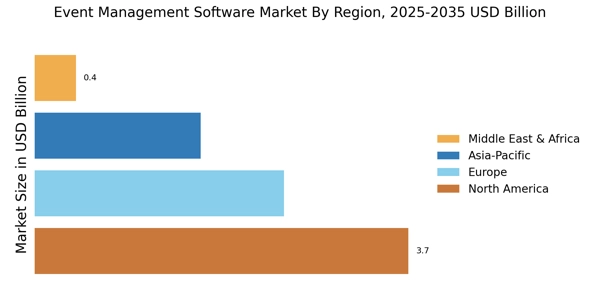
北美是活动管理软件最大的市场,约占全球市场份额的 45%。该地区的增长是由于越来越多地采用数字解决方案进行活动规划和管理,以及虚拟和混合活动的激增。对活动领域技术采用的监管支持进一步促进了这一增长,使其成为创新中心。美国是这个市场的领先国家,主要参与者有 Cvent、事件布里特,Bizzabo 总部设在这里。加拿大也做出了巨大贡献,EventMobi 等公司越来越受到关注。竞争格局的特点是老牌公司和新兴初创公司混合存在,所有这些公司都在快速发展的环境中争夺市场份额。

欧洲:具有潜力的新兴市场

欧洲的活动管理软件市场正在强劲增长,约占全球份额的 30%。企业活动和会议数量的增加以及活动策划中对可持续性的日益重视推动了该地区的需求。促进活动行业数字化转型的监管框架也是重要的增长动力。该地区的领先国家包括英国、德国和法国,这些国家的公司越来越多地采用先进的活动管理解决方案。竞争格局包括本地和国际参与者,重点是增强用户体验和整合创新技术。 Eventbrite 和 Bizzabo 等主要参与者的出现进一步增强了市场。

亚太地区:快速增长和采用

亚太地区正在迅速崛起,成为活动管理软件市场的重要参与者,占据全球市场份额的 20% 左右。该地区的增长是由城市化进程的加快、可支配收入的增加以及对企业活动和展览日益增长的兴趣推动的。旨在促进旅游业和商业活动的监管举措也有助于市场扩张。中国、印度和澳大利亚等国家处于领先地位,越来越多的初创公司和老牌公司进入市场。竞争格局多元化,本土企业与国际巨头展开竞争。 Whova 和 Sure 等主要参与者的出现凸显了该地区在活动管理解决方案方面的创新和增长潜力。

中东和非洲:尚未开发的市场机会

中东和非洲地区在活动管理软件市场中逐渐崛起,目前占据全球约5%的份额。这一增长主要是由基础设施投资的增加和商务旅游的增长推动的。对举办国际活动的监管支持也是市场增长的催化剂,为适合当地需求的软件解决方案创造了机会。阿联酋和南非等国家处于领先地位,举办的活动和会议越来越多。竞争格局仍在发展,本地和国际参与者都在争夺市场份额。新公司的进入和现有公司的扩张预示着该地区活动管理解决方案的光明前景。

活动管理软件市场 Regional Image

活动管理软件市场市场的主要公司包括

报告范围

FAQs

How do procurement teams evaluate build-versus-buy decisions for event technology?
Most enterprises find that buying a commercial event planning platform delivers ROI 3–5x faster than building in-house, primarily because commercial tools include pre-built integrations with CRM and marketing stacks [21]. Build options only make sense for organizations running 500+ proprietary events annually with unique workflow requirements.
What role does API extensibility play in selecting conference management tools?
API-first platforms allow organizers to connect event data with BI dashboards, HR systems, and finance tools without custom middleware [7]. Buyers should prioritize vendors offering RESTful APIs with documented webhook support and pre-built connectors for Salesforce, HubSpot, and Marketo.
How are event ticketing solutions adapting to dynamic pricing models?
Leading event ticketing solutions now offer algorithmic pricing that adjusts ticket costs based on demand signals, time-to-event, and historical conversion rates [8]. Dynamic pricing can lift revenue per event by 12–18% compared to fixed-tier models.
What cybersecurity certifications should buyers require from Event Management Software Market vendors?
Minimum requirements include SOC 2 Type II, ISO 27001, and GDPR compliance attestations [15]. For government or healthcare events, FedRAMP authorization or HIPAA-compliant hosting adds a critical layer of audit readiness.
How does the Event Management Software Market address accessibility compliance for hybrid events?
Vendors are embedding WCAG 2.1 AA-compliant interfaces, automated captioning in 30+ languages, and screen-reader-optimized attendee portals [16]. The European Accessibility Act makes these features regulatory requirements for EU-hosted events starting June 2025.
What integration challenges arise when deploying virtual event management alongside existing martech stacks?
The primary friction points are data-schema mismatches between event platforms and CRM systems, SSO configuration across identity providers, and real-time data-sync latency [14]. Pilot deployments of 60–90 days with a dedicated integration team reduce go-live risk significantly.
How are online event registration software platforms handling multi-currency and multi-language requirements for global events?
Top-tier platforms support 25+ currencies with real-time FX conversion and localized registration flows in 40+ languages [1]. Buyers running events across three or more regions should verify that the vendor offers in-country payment-gateway partnerships and locale-specific tax-ID collection.    
作者
Author
Author Profile
Apoorva Priyadarshi LinkedIn
Research Analyst
With 4+ years of experience in Market Intelligence and Strategic Research, Apoorv specializes in ICT, Semiconductor, and BFSI markets. Combining strong analytical capabilities with a deep understanding of technology-driven industries, he focuses on delivering data-driven insights that support strategic decision-making. With a background in technology and business research, Apoorv has contributed to numerous global market studies, competitive landscape analyses, and opportunity assessments across sectors such as semiconductors, digital banking, cybersecurity, and telecommunications.
Co-Author
Co-Author Profile
Shubham Munde LinkedIn
Team Lead - Research
Shubham brings over 7 years of expertise in Market Intelligence and Strategic Consulting, with a strong focus on the Automotive, Aerospace, and Defense sectors. Backed by a solid foundation in semiconductors, electronics, and software, he has successfully delivered high-impact syndicated and custom research on a global scale. His core strengths include market sizing, forecasting, competitive intelligence, consumer insights, and supply chain mapping. Widely recognized for developing scalable growth strategies, Shubham empowers clients to navigate complex markets and achieve a lasting competitive edge. Trusted by start-ups and Fortune 500 companies alike, he consistently converts challenges into strategic opportunities that drive sustainable growth.

Research Approach


Secondary Research

The secondary research process involved comprehensive analysis of industry databases, technology publications, government IT reports, and authoritative software industry organizations. Key sources included the US Bureau of Labor Statistics (BLS), International Data Corporation (IDC), Gartner Research, National Institute of Standards and Technology (NIST), European Commission's Digital Economy and Society Index (DESI), Software & Information Industry Association (SIIA), TechUK, National Association of Broadcasters (NAB), International Congress and Convention Association (ICCA), Events Industry Council (EIC), Meeting Professionals International (MPI), World Tourism Organization (UNWTO), International Monetary Fund (IMF) World Economic Outlook, US Census Bureau Business Patterns, EU Eurostat Digital Economy Statistics, and national IT ministry reports from key markets.

Digital adoption metrics, event industry statistics, cloud infrastructure data, corporate event spending trends, regulatory frameworks for data privacy (GDPR, CCPA), and competitive landscape analysis for event management platforms, virtual event solutions, and hybrid event technologies were all gathered from these sources.

 

Primary Research

In order to gather both qualitative and quantitative insights, supply-side and demand-side stakeholders were interviewed during the primary research process. CEOs, CTOs, VPs of Product Development, Chief Revenue Officers, and heads of Partnerships from SaaS technology firms, virtual event platform providers, and event management software suppliers were examples of supply-side sources. Chief marketing officers, corporate events directors, global meeting planners, IT directors from Fortune 1000 companies, procurement leaders from expert conference organizers, and venue technology managers from hotels and convention centers were among the demand-side sources. Primary research obtained information on procurement decision-making procedures, pricing models, and security compliance criteria; verified product roadmaps and AI integration timetables; and validated market segmentation across software vs. services, deployment models, and application verticals.

Primary Respondent Breakdown:

By Designation: C-level Primaries (40%), Director Level (32%), Others (28%)

By Region: North America (42%), Europe (25%), Asia-Pacific (23%), Rest of World (10%)


Market Size Estimation

Enterprise adoption analysis and revenue mapping were used to determine the global market valuation. The methodology comprised:

Finding more than fifty major software suppliers and service providers in North America, Europe, Asia-Pacific, and Latin America

Solution mapping between venue management software, virtual event platforms, registration and ticketing systems, analytics and engagement tools, and event management software

Examination of stated and projected yearly income for event technology portfolios

coverage of suppliers accounting for 75–80% of the world market in 2024

Extrapolation of segment-specific valuations across corporate, government, education, and third-party event organizer verticals utilizing top-down (vendor revenue validation) and bottom-up (number of events × average software spend by organization size) methods

下载免费样本

请填写以下表格以获取本报告的免费样本

Download PDF ×

We do not share your information with anyone. However, we may send you emails based on your report interest from time to time. You may contact us at any time to opt-out.