Industrial Internet Of Things Market

工业物联网市场规模、份额和研究报告:按组件(硬件、解决方案和服务)、按部署(云端、本地)、按连接性(有线和无线)、按最终用户(IT和电信、制造、医疗保健、零售、石油和天然气、汽车及其他) - 预测2034
ID: MRFR/ICT/1593-CR
100 Pages
Apoorva Priyadarshi, Shubham Munde
Last Updated: July 29, 2026
Industrial Internet Of Things Market
Market Size
Forecast Period2025 - 2035
CAGR (2025 - 2035)8.16%
2024 Market Size$ 196.4 Billion
2025 Market Size$ 212.43 Billion
2035 Market Size$ 465.45 Billion
Key Players
Siemens
General Electric
Honeywell
Cisco
Rockwell Automation
Schneider Electric
Opportunities
  • Rising Demand for Automation
  • Advancements in Sensor Technology
  • Integration of Advanced Analytics

Industrial Internet Of Things Market 摘要

根据市场研究未来的分析,工业物联网市场规模预计在2024年为1964亿美元。工业物联网行业预计将从2025年的2124.3亿美元增长到2035年的4654.5亿美元,在2025年至2035年的预测期内,年均增长率(CAGR)为8.16%。

主要市场趋势和亮点

工业物联网市场因技术进步和对自动化需求的增加而准备实现显著增长。

  • 北美仍然是工业物联网最大的市场,展现出对自动化技术的强劲投资。
  • 亚太地区正在成为增长最快的地区,受到快速工业化和数字化转型倡议的推动。
  • Wi-Fi技术继续主导市场,而BLE由于其能效正在迅速增长,成为增长最快的细分市场。
  • 对自动化的需求上升和传感器技术的进步是推动市场前进的关键驱动因素。

市场规模与预测

2024 Market Size 196.4 (USD Billion)
2035 Market Size 465.45 (USD Billion)
CAGR (2025 - 2035) 8.16%

主要参与者

西门子(德国)、通用电气(美国)、霍尼韦尔(美国)、思科(美国)、罗克韦尔自动化(美国)、施耐德电气(法国)、ABB(瑞士)、IBM(美国)、微软(美国)

Industrial Internet Of Things Market Drivers

Rising Demand for Automation

The Industrial IoT Market is experiencing a notable surge in demand for automation across various sectors. This trend is driven by the need for enhanced operational efficiency and reduced labor costs. Industries such as manufacturing and logistics are increasingly adopting IoT solutions to streamline processes and minimize human error. According to recent data, the automation segment within the Industrial IoT Market is projected to grow at a compound annual growth rate of approximately 25% over the next five years. This growth is indicative of a broader shift towards smart factories and automated supply chains, where real-time data analytics and machine-to-machine communication play pivotal roles in decision-making and operational optimization.

Advancements in Sensor Technology

Advancements in sensor technology are significantly influencing the Industrial IoT Market. The proliferation of low-cost, high-performance sensors enables industries to collect vast amounts of data in real-time, facilitating better monitoring and control of processes. These sensors are integral to applications such as predictive maintenance, where they help in identifying potential equipment failures before they occur. The market for sensors in the Industrial IoT Market is expected to reach USD 30 billion by 2026, reflecting the growing reliance on data-driven insights. As industries continue to invest in smart technologies, the integration of advanced sensors will likely enhance operational capabilities and drive further innovation.

Integration of Advanced Analytics

The integration of advanced analytics into the Industrial IoT Market is transforming how organizations interpret and utilize data. By leveraging big data analytics, companies can gain deeper insights into operational performance, customer behavior, and market trends. This capability allows for more informed decision-making and strategic planning. The analytics segment within the Industrial IoT Market is anticipated to witness substantial growth, with projections indicating a market size of USD 15 billion by 2025. As industries increasingly recognize the value of data-driven strategies, the demand for sophisticated analytics tools and platforms is likely to escalate, further propelling the evolution of the Industrial IoT landscape.

Growing Focus on Supply Chain Optimization

The Industrial IoT Market is witnessing a growing focus on supply chain optimization, driven by the need for greater visibility and efficiency. IoT technologies enable real-time tracking of goods and assets, allowing companies to respond swiftly to disruptions and enhance inventory management. This trend is particularly relevant in sectors such as retail and manufacturing, where supply chain agility is critical. Recent studies indicate that companies implementing IoT solutions for supply chain management can achieve cost reductions of up to 30%. As organizations strive to create more resilient supply chains, the adoption of IoT technologies is expected to accelerate, further shaping the future of the Industrial IoT Market.

Emphasis on Sustainability and Energy Efficiency

The Industrial IoT Market is increasingly aligning with sustainability goals, as organizations seek to reduce their carbon footprints and enhance energy efficiency. IoT solutions facilitate real-time monitoring of energy consumption, enabling companies to identify inefficiencies and implement corrective measures. This focus on sustainability is not only driven by regulatory pressures but also by consumer demand for environmentally responsible practices. The market for energy management solutions within the Industrial IoT Market is projected to grow significantly, with estimates suggesting a value of USD 20 billion by 2025. This trend indicates a shift towards greener operations, where IoT technologies play a crucial role in achieving sustainability objectives.

市场细分洞察

By Connectivity: Wi-Fi (Largest) vs. BLE (Fastest-Growing)

In the Industrial IoT market, the connectivity segment showcases a diverse array of technologies with Wi-Fi leading the pack as the largest segment. It holds a significant market share due to its widespread adoption in industrial applications, such as monitoring and control systems. Following Wi-Fi are technologies like ZWave and RF, which also contribute notably, but they have not yet reached the same scale of deployment and user acceptance as Wi-Fi. Other technologies, while present, account for a smaller portion of the overall market share, marking them as less dominant players in this space. As the industry evolves, growth trends indicate a rise in the adoption of BLE (Bluetooth Low Energy) technologies, particularly in asset tracking and smart manufacturing scenarios. The demand for low-power, efficient connectivity solutions is propelling BLE into the spotlight, exhibiting rapid growth rates. Additionally, the introduction of innovative applications in the Industrial IoT space, such as smart sensors and devices, is driving competition among connectivity technologies. Emergence of Li-Fi solutions further signifies a trend toward enhanced data transmission capabilities, aiming to meet the increasing data needs of modern industrial setups.

Connectivity: Wi-Fi (Dominant) vs. BLE (Emerging)

Wi-Fi remains the dominant choice for industrial connectivity, providing robust and high-speed data transfer essentials for various applications, from real-time monitoring to data analytics. Its ability to cover wide areas and integrate seamlessly with existing infrastructure makes it a preferred option for many organizations seeking scalability and flexibility. In contrast, BLE is emerging as a pivotal technology tailored for applications where power efficiency and low data rates are primary concerns. It is particularly suited for short-range communication, making it ideal for interconnected devices in smart factories. BLE's rapid growth stems from its capability to enhance automation by connecting numerous devices while maintaining power requirements, thereby carving out a significant niche within the Industrial IoT landscape.

By Deployment: Cloud (Largest) vs. On-Premises (Fastest-Growing)

In the Industrial IoT Market, the deployment segment is characterized by a clear division between cloud-based and on-premises solutions. Cloud deployment has emerged as the largest segment due to its scalability, cost-effectiveness, and ease of access. Many industries favor cloud solutions for their flexibility in handling large datasets and analysis in real-time, contributing to its dominant position. In contrast, on-premises deployment is gaining traction as organizations that prioritize data security and control opt for this more traditional solution. The trend towards on-premises solutions is fueled by increasing concerns over data privacy and security, prompting industries to invest in localized infrastructure. This has led to a significant growth momentum for on-premises solutions, appealing especially to sectors like manufacturing and critical infrastructure. Organizations are increasingly adopting hybrid models, combining advantages from both deployment types to leverage their respective benefits, while also enhancing system reliability and operational efficiency.

Deployment: Cloud (Dominant) vs. On-Premises (Emerging)

Cloud deployment in the Industrial IoT Market is considered a dominant force due to its ability to offer scalable solutions that cater to a myriad of industrial needs. With its inherent advantage of facilitating remote access and data storage capabilities, it enables organizations to optimize operations without heavy upfront investments in hardware. On the other hand, on-premises deployment is an emerging choice, particularly among firms that prioritize stringent control over their data and systems. This segment is characterized by tailored solutions that suit specific operational requirements, offering organizations the peace of mind that comes with managing data within their own infrastructure. As a result, on-premises systems are increasingly being viewed as integral in sectors requiring high security, making them a compelling alternative to cloud solutions.

By Components: Services (Largest) vs. Hardware (Fastest-Growing)

The Industrial IoT market is characterized by a diverse component distribution, with services leading in market share compared to hardware and software. Services encompass consulting and support, contributing significantly to overall revenue due to their critical role in deployment and maintenance. In contrast, hardware and software segments are vital, albeit to a lesser extent, reflecting the market's increasing reliance on integrated solutions and real-time data management for efficient industrial operations. Growth trends indicate that while services are proliferating due to ongoing digital transformation initiatives, hardware stands out as the fastest-growing segment. The expansion is fueled by advancements in sensor technology and edge computing. As industries seek enhanced connectivity and automation, demand for innovative hardware solutions is surging, highlighting the necessity for robust infrastructure to support IoT applications.

Services: Consulting (Dominant) vs. Hardware: Edge Devices (Emerging)

In the realm of Industrial IoT, consulting services represent a dominant value, providing essential support in strategy formulation, technology integration, and optimization. Consulting firms help manufacturers navigate the complexities of digital transformation, enabling a seamless transition to IoT-based operations. Conversely, edge devices as an emerging hardware segment are experiencing rapid growth due to their essential role in processing data closer to the source. This mitigates latency issues and enhances response times, thereby driving operational efficiencies. As companies increasingly prioritize real-time analytics, the market for edge devices is expected to witness significant innovation, making them imperative for the next phase of industrial automation.

By Organization Size: Large (Largest) vs. Small (Fastest-Growing)

The Industrial IoT market exhibits a diverse distribution across organization sizes, with large organizations commanding the highest market share due to their extensive resources and robust infrastructures. These enterprises leverage advanced IoT technology to optimize their operations and maintain a competitive edge, reflecting a significant share in the market. Conversely, small organizations, while currently representing a smaller portion of the market, are rapidly increasing their presence, driven by the ease of access to IoT solutions and the growing demand for efficiency in operations. The growth trends in the Industrial IoT sector indicate a notable rise in adoption among small-sized organizations. Historically underserved, this segment is now experiencing a surge in technological advancements allowing them to innovate and automate processes effectively. Key drivers include heightened awareness of IoT benefits, affordability of solutions, and increased customization options tailored to their unique operational needs, positioning them for significant growth in the coming years.

Large (Dominant) vs. Small (Emerging)

Large organizations in the Industrial IoT market position themselves as dominant players due to their ability to invest in large-scale IoT deployments and partnerships with leading technology providers. They typically operate with complex, integrated systems that enhance efficiency and drive innovation across their massive operations. Their established market presence allows them to leverage extensive data analytics to optimize performance further. In contrast, small organizations are emerging as crucial players within this segment, benefitting from simplified and cost-effective IoT solutions. These companies are able to implement IoT technologies that enhance operational processes without the heavy infrastructure burdens faced by larger firms, demonstrating agility and speed in adopting new technologies. As they continue to explore IoT applications, small organizations are likely to contribute significantly to the overall market growth.

By Vertical: Healthcare (Largest) vs. BFSI (Fastest-Growing)

In the Industrial IoT market, the vertical segment shows a diversified range of applications, with Healthcare capturing the largest share. It leverages IoT technology for patient monitoring, equipment tracking, and enhanced healthcare services, making it a preferred choice among industries seeking operational efficiency. Following closely, the BFSI sector is rapidly growing, utilizing IoT for security, risk management, and customer service enhancements, showcasing significant investment in smart banking solutions.

Healthcare (Dominant) vs. BFSI (Emerging)

The Healthcare sector stands as a dominant player in the Industrial IoT landscape, characterized by robust integration of IoT devices that improve patient care and streamline operations. This vertical focuses on advanced technologies such as wearables and telehealth services, fostering a patient-centric approach. In contrast, the BFSI segment, while emerging, is experiencing rapid expansion as banks and financial institutions adopt IoT solutions for real-time data analytics and cyber security measures. This growing emphasis on digital transformation positions BFSI as a crucial contender in the market.

获取关于Industrial Internet Of Things Market的更多详细见解

区域洞察

北美:创新与领导中心

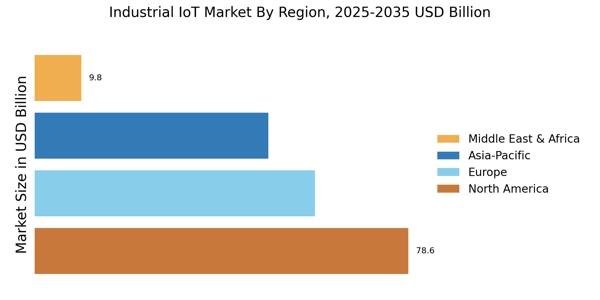
北美是工业物联网最大的市场,占全球市场份额的约40%。该地区的增长受到快速技术进步、智能制造的增加采用和政府支持举措的推动。促进数字化转型和网络安全的监管框架也是市场扩展的重要催化剂。美国在这一市场中处于领先地位,加拿大紧随其后,约占整体份额的10%。
北美的竞争格局强劲,主要参与者包括西门子、通用电气和霍尼韦尔。这些公司处于创新的前沿,提供增强运营效率的尖端解决方案。思科和IBM等主要科技公司的存在进一步加强了市场,促进了推动工业物联网行业增长和发展的协作生态系统。

欧洲:新兴工业强国

欧洲在工业物联网市场中正经历显著增长,占全球市场份额的约30%。该地区的扩展受到旨在提高工业效率和可持续性的严格法规的推动。德国和法国等国在这一领域处于领先地位,德国单独贡献了约15%的市场份额。欧盟促进制造业数字化的举措在推动物联网解决方案需求方面至关重要。
德国是欧洲最大的市场,拥有西门子和施耐德电气等主要参与者,这些公司在推动物联网技术方面发挥了重要作用。法国和英国也扮演着重要角色,越来越多的初创公司和成熟企业专注于物联网创新。竞争格局的特点是传统制造公司与科技公司之间的合作,增强了该地区在工业物联网领域的能力。

亚太地区:快速增长的市场

亚太地区正在成为工业物联网市场的重要参与者,占全球市场份额的约25%。该地区的增长受到工业自动化增加、政府推动智能城市的举措以及对实时数据分析需求上升的推动。中国和日本是最大的市场,中国单独占据约15%的市场份额,反映出其快速的工业化和技术进步。
亚太地区的竞争格局多样化,既有成熟公司,也有创新初创公司。ABB和罗克韦尔自动化等主要参与者正在扩大其市场份额,而当地公司也在物联网解决方案方面取得进展。该地区对提高制造效率和可持续性的关注正在推动工业物联网技术的采用,使其成为未来增长的活跃市场。

中东和非洲:新兴市场潜力

中东和非洲地区在工业物联网市场中逐渐崭露头角,占全球市场份额的约5%。增长主要受到基础设施投资增加和各行业数字化转型推动的影响。阿联酋和南非等国在这一趋势中处于领先地位,阿联酋约占市场份额的3%,得益于政府旨在增强技术采用的举措。
该地区的竞争格局正在演变,许多本地和国际参与者进入市场。公司专注于开发针对石油和天然气、制造和物流等行业独特需求的物联网解决方案。主要参与者的存在以及越来越多的初创公司正在促进创新,并推动该地区工业物联网技术的采用。

Industrial Internet Of Things Market Regional Image

主要参与者和竞争洞察

工业物联网市场目前的特点是动态竞争格局,受到快速技术进步和各个行业对自动化需求增加的推动。西门子(德国)、通用电气(美国)和霍尼韦尔(美国)等主要参与者通过创新和合作伙伴关系进行战略定位。西门子(德国)专注于数字化转型和智能基础设施,而通用电气(美国)强调其数字工业战略,将物联网与其广泛的工业组合整合。霍尼韦尔(美国)正在增强其运营技术能力,表明向集成解决方案的集体转变,以提高效率并降低运营成本。

市场结构似乎适度分散,既有成熟的参与者,也有新兴的初创公司。公司正在采用各种商业策略,例如本地化制造和优化供应链,以增强其竞争优势。这种分散化允许多样化的产品供应,但主要参与者的影响仍然显著,因为他们设定行业标准并通过大量的研发投资推动创新。

2025年8月,西门子(德国)宣布与一家领先的云服务提供商建立战略合作伙伴关系,以增强其物联网平台能力。这一合作旨在利用云计算改善工业环境中的数据分析和机器学习应用。这一举措的战略重要性在于西门子致力于提供可扩展和灵活的解决方案,以满足客户不断变化的需求,从而巩固其市场地位。

2025年9月,通用电气(美国)推出了一套新的基于人工智能的预测性维护工具,旨在制造行业。这一举措反映了GE利用人工智能优化设备性能和减少停机时间的重点。这些工具的引入可能会提高客户满意度和忠诚度,因为企业越来越寻求能够最小化运营中断的解决方案。

2025年7月,霍尼韦尔(美国)推出了一种新的针对工业物联网应用的网络安全框架。该框架旨在保护关键基础设施免受网络威胁,这在数字时代已成为一个日益关注的问题。通过优先考虑网络安全,霍尼韦尔不仅解决了一个紧迫的市场需求,还将自己定位为保护工业运营的领导者,从而增强其竞争差异化。

截至2025年10月,塑造竞争格局的最显著趋势包括数字化、可持续性和人工智能的整合。战略联盟正日益成为竞争战略的基石,使公司能够汇聚资源和专业知识。展望未来,竞争差异化似乎将从传统的基于价格的竞争转向关注创新、技术进步和供应链可靠性。这一转变表明,优先考虑这些要素的公司可能会在工业物联网市场中脱颖而出。

Industrial Internet Of Things Market市场的主要公司包括

行业发展

  • 2024年第二季度:西门子推出工业边缘管理系统以支持IIoT 西门子宣布推出其新的工业边缘管理系统,使制造商能够大规模管理IIoT设备和应用,提高实时数据处理和运营效率。
  • 2024年第二季度:罗克韦尔自动化收购Clearpath Robotics以扩展IIoT能力 罗克韦尔自动化完成了对Clearpath Robotics的收购,旨在将先进的自主移动机器人集成到其工业物联网组合中,以实现更智能的制造环境。
  • 2024年第二季度:ABB和微软宣布战略合作伙伴关系以开发AI驱动的IIoT解决方案 ABB和微软达成战略合作伙伴关系,共同开发以AI驱动的工业物联网解决方案,专注于预测性维护和制造客户的能源优化。
  • 2024年第二季度:霍尼韦尔在德克萨斯州推出新的IIoT工厂 霍尼韦尔在德克萨斯州开设了一家新的制造设施,配备先进的IIoT传感器和分析平台,旨在展示下一代智能工厂运营。
  • 2024年第二季度:工业物联网初创公司Tulip获得5000万美元C轮融资以扩展平台 Tulip,一家提供IIoT制造软件的公司,获得了5000万美元的C轮融资,以加速产品开发并扩大其全球客户基础。
  • 2024年第三季度:施耐德电气推出2024年EcoStruxure自动化专家以支持IIoT 施耐德电气发布了其EcoStruxure自动化专家平台的最新版本,具有增强的IIoT集成和边缘计算能力,以支持工业自动化
  • 2024年第三季度:博世与AWS合作提供基于云的IIoT分析 博世宣布与亚马逊网络服务合作,提供用于工业物联网部署的基于云的分析和机器学习服务,目标是制造和物流行业。
  • 2024年第三季度:艾默生任命新的首席数字官以领导IIoT战略 艾默生任命新的首席数字官,以领导其工业物联网战略,专注于在全球运营中扩展数字化转型举措。
  • 2024年第四季度:GE Vernova赢得1亿美元合同以进行IIoT支持的电网现代化 GE Vernova获得了一项1亿美元的合同,以部署IIoT支持的解决方案进行电网现代化,包括智能传感器和公用事业客户的预测分析。
  • 2024年第四季度:西门子和SAP宣布联合IIoT平台以支持制造 西门子和SAP推出了一种联合IIoT平台,旨在将车间数据与企业资源规划系统集成,实现制造商的无缝数字工作流程。
  • 2025年第一季度:日立在日本开设新的IIoT研发中心 日立开设了一个新的研究和开发中心,专注于工业物联网技术,旨在加速智能制造和连接基础设施的创新。
  • 2025年第一季度:工业物联网初创公司Element Analytics获得3000万美元B轮融资 Element Analytics,专注于IIoT数据集成和分析,获得了3000万美元的B轮融资,以扩展其产品供应并壮大其工程团队。

未来展望

Industrial Internet Of Things Market 未来展望

预计工业物联网市场在2024年至2035年期间将以8.16%的复合年增长率增长,受连接性、自动化和数据分析进步的推动。

到2035年,工业物联网市场预计将保持强劲,受到创新和战略投资的推动。

市场细分

Industrial Internet Of Things Market Vertical Outlook

  • Public Sector
  • Healthcare
  • BFSI
  • Government

Industrial Internet Of Things Market Components Outlook

  • Services
  • Software
  • Hardware

Industrial Internet Of Things Market Deployment Outlook

  • Cloud
  • On-Premises

Industrial Internet Of Things Market Connectivity Outlook

  • Wi-Fi
  • ZWave
  • RF
  • Li-Fi
  • LAN
  • BLE
  • Others

Industrial Internet Of Things Market Organization Size Outlook

  • Small
  • Medium
  • Large

报告范围

FAQs

What is the projected market valuation of the Industrial IoT Market by 2035?

The Industrial IoT Market is projected to reach a valuation of 465.45 USD Billion by 2035.

What was the market valuation of the Industrial IoT Market in 2024?

In 2024, the Industrial IoT Market was valued at 196.4 USD Billion.

What is the expected CAGR for the Industrial IoT Market during the forecast period 2025 - 2035?

The expected CAGR for the Industrial IoT Market during the forecast period 2025 - 2035 is 8.16%.

Which companies are considered key players in the Industrial IoT Market?

Key players in the Industrial IoT Market include Siemens, General Electric, Honeywell, Cisco, Rockwell Automation, Schneider Electric, ABB, IBM, and Microsoft.

What are the projected valuations for the connectivity segment in the Industrial IoT Market?

The connectivity segment is projected to range from 76.4 to 170.45 USD Billion.

How does the deployment segment of the Industrial IoT Market compare between cloud and on-premises solutions?

The deployment segment indicates cloud solutions may reach 186.12 USD Billion, while on-premises solutions could reach 279.33 USD Billion.

What is the expected performance of the components segment in the Industrial IoT Market?

The components segment is projected to have valuations ranging from 78.56 to 186.24 USD Billion for both software and hardware.

What are the projected valuations for the organization size segment in the Industrial IoT Market?

The organization size segment is expected to range from 39.28 to 233.7 USD Billion, depending on the size classification.

Which verticals are expected to drive growth in the Industrial IoT Market?

The verticals expected to drive growth include healthcare, BFSI, government, and the public sector, with valuations ranging from 30.0 to 175.45 USD Billion.

What does the future hold for the Industrial IoT Market in terms of growth and innovation?

The Industrial IoT Market appears poised for substantial growth, driven by technological advancements and increasing adoption across various sectors.

作者
Author
Author Profile
Apoorva Priyadarshi LinkedIn
Research Analyst
With 4+ years of experience in Market Intelligence and Strategic Research, Apoorv specializes in ICT, Semiconductor, and BFSI markets. Combining strong analytical capabilities with a deep understanding of technology-driven industries, he focuses on delivering data-driven insights that support strategic decision-making. With a background in technology and business research, Apoorv has contributed to numerous global market studies, competitive landscape analyses, and opportunity assessments across sectors such as semiconductors, digital banking, cybersecurity, and telecommunications.
Co-Author
Co-Author Profile
Shubham Munde LinkedIn
Team Lead - Research
Shubham brings over 7 years of expertise in Market Intelligence and Strategic Consulting, with a strong focus on the Automotive, Aerospace, and Defense sectors. Backed by a solid foundation in semiconductors, electronics, and software, he has successfully delivered high-impact syndicated and custom research on a global scale. His core strengths include market sizing, forecasting, competitive intelligence, consumer insights, and supply chain mapping. Widely recognized for developing scalable growth strategies, Shubham empowers clients to navigate complex markets and achieve a lasting competitive edge. Trusted by start-ups and Fortune 500 companies alike, he consistently converts challenges into strategic opportunities that drive sustainable growth.

Research Approach

Secondary Research

The secondary research process involved comprehensive analysis of industrial standards databases, government technology initiatives, peer-reviewed engineering journals, IoT industry publications, and authoritative manufacturing organizations. Key sources included the National Institute of Standards and Technology (NIST) Smart Manufacturing Systems, International Electrotechnical Commission (IEC) Industrial IoT Standards, Institute of Electrical and Electronics Engineers (IEEE) IoT Technical Community, International Society of Automation (ISA) Automation Standards, US Department of Energy Industrial Efficiency Programs, European Commission Digital Industry initiatives, Germany's Federal Ministry for Economic Affairs and Climate Action (Industry 4.0 programs), China Ministry of Industry and Information Technology (MIIT) Smart Manufacturing policies, US Bureau of Economic Analysis Manufacturing Data, International Data Corporation (IDC) Industrial IoT Trackers, GSMA Intelligence Industrial Connectivity Reports, Industrial Internet Consortium (IIC) White Papers, Platform Industrie 4.0 Germany, Manufacturing USA Institutes, US Census Bureau Annual Survey of Manufactures, Eurostat Digital Economy and Society Statistics, Japan Ministry of Economy Trade and Industry (METI) Connected Industries Initiative, and national digital transformation reports from key industrial markets. These sources were used to collect industrial automation adoption statistics, regulatory compliance frameworks, cybersecurity standards, manufacturing output trends, connectivity infrastructure deployments, and competitive landscape analysis for IoT platforms, industrial sensors, edge computing devices, and predictive analytics solutions.

Primary Research

Qualitative and quantitative insights were obtained by interviewing supply-side and demand-side stakeholders during the primary research process. The supply-side sources comprised CEOs, CTOs, VPs of IoT Product Development, heads of Industrial Automation, and commercial directors from IIoT platform providers, industrial communication vendors, sensor manufacturers, edge computing hardware companies, and cloud service providers that served industrial sectors. Demand-side sources consist of Chief Digital Officers, VP of Manufacturing Operations, Plant Directors, OT/IT Managers, and procurement representatives from discrete and process manufacturing enterprises, oil and gas operators, automotive OEMs, healthcare device manufacturers, and utility companies. The primary research validated market segmentation across hardware, software, and services layers, confirmed Industry 4.0 implementation timelines, and gathered insights on IoT adoption barriers, cybersecurity investment priorities, cloud vs. edge deployment preferences, and ROI metrics for predictive maintenance implementations.

Primary Respondent Breakdown:

By Designation: C-level Primaries (28%), Director Level (35%), Others (37%)

By Region: North America (40%), Europe (30%), Asia-Pacific (22%), Rest of World (8%)

Market Size Estimation

Global market valuation was derived through revenue mapping and industrial connectivity deployment analysis. The methodology included:

Identification of 55+ key IIoT ecosystem participants across platform providers, industrial automation vendors, cloud hyperscalers, and connectivity specialists spanning North America, Europe, Asia-Pacific, and Latin America

Product mapping across IoT platforms, industrial gateways, sensors & actuators, edge computing hardware, predictive maintenance software, and managed connectivity services

Analysis of reported and modeled annual revenues specific to industrial IoT portfolios, including automation software licenses, hardware shipments, and recurring cloud subscriptions

Coverage of manufacturers and service providers representing 75-80% of global market share in 2024

Extrapolation using bottom-up (device shipments × ASP by component category and vertical) and top-down (vendor revenue validation across platform, hardware, and services segments) approaches to derive segment-specific valuations, including separate estimations for cloud vs. on-premise deployments and wireless vs. wired connectivity technologies

下载免费样本

请填写以下表格以获取本报告的免费样本

Download PDF ×

We do not share your information with anyone. However, we may send you emails based on your report interest from time to time. You may contact us at any time to opt-out.