Reciprocating Compressor Market
往复式压缩机市场研究报告信息按类型(便携式和固定式)、按润滑(无油和充油)、按级类型(单级、多级)、按类型(单作用、双作用、隔膜)、按最终用户(石油和天然气、制药、化工厂、制冷厂、制造、汽车、其他)和按地区(北美、欧洲、亚太地区和世界其他地区)划分 - 到 2032 年的市场预测
ID: MRFR/EnP/6879-CR
155 Pages
Last Updated: July 30, 2026
Reciprocating Compressor Market
Market Size
Forecast Period2025 - 2035
CAGR (2025 - 2035)5.22%
2024 Market Size$ 4.66 Billion
2025 Market Size$ 4.9 Billion
2035 Market Size$ 8.16 Billion
Key Players
Cameron International
Atlas Copco
Ingersoll Rand
Gardner Denver
Siemens
Emerson Electric
Trends
- Technological Advancements
- Customization and Flexibility
- Sustainability Focus
Opportunities
- Rising Demand in Oil and Gas Sector
- Emerging Applications in Renewable Energy
- Regulatory Compliance and Safety Standards
市场细分洞察
按类型:便携式(最大)与固定式(增长最快)
在往复式压缩机市场中,该细分市场份额主要由便携式压缩机主导,由于其在各种应用中的多功能性和易用性,便携式压缩机占据了最大的市场份额。便携式压缩机在需要移动性和灵活性的行业中受到青睐,使其适用于汽车、建筑和能源等行业。另一方面,固定式压缩机正在迅速普及,吸引了需要更高功率输出和连续运行的行业,从而推动了其市场份额的增长。
压缩机:便携式(主导)与固定式(新兴)
便携式往复式压缩机的特点是轻量化设计和易于运输,这使得它们非常适合移动性至关重要的动态工业环境。这些压缩机广泛用于建筑、维修和其他需要紧凑解决方案的应用。相反,固定式往复式压缩机虽然新兴,但因其在固定应用中的效率和可靠性而日益得到认可。它们专为重型用途而设计,为制造和工业流程提供更大的动力和性能。随着行业的发展,对可靠和长期运行的需求推动了对固定模型的需求不断增加。
按润滑方式:无油(最大)与充油(增长最快)
往复式压缩机市场的润滑领域的特点是无油系统占据明显主导地位,该系统因其环境效益和减少维护要求而受到青睐。充油系统虽然传统上被使用,但随着行业转向更可持续和更高效的解决方案,它正在逐渐失去市场份额。对无油压缩机的偏爱体现在其在各个行业的广泛采用,巩固了其作为寻求高性能且对环境影响最小的消费者的首选地位。
润滑类型:无油(主要)与充油(新兴)
无油往复式压缩机因其清洁运行而受到认可,使其成为食品加工和制药等需要高空气质量的应用的理想选择。它们的设计旨在最大限度地减少污染风险,从而提高产品的完整性。相反,充油压缩机虽然在重型应用中因其耐用性和更高效率而受到青睐,但也面临着包括增加油维护和潜在油污染等挑战。向环保解决方案的转变正在推动无油型号的增长,使其成为市场的主导力量,并促进充油设计的创新,以满足不断变化的消费者需求。
按阶段类型:单阶段(最大)与多阶段(增长最快)
在往复式压缩机市场中,单级压缩机因其简单、紧凑的设计以及在各个行业的广泛应用而占据主导地位。该细分市场是低至中压应用的首选,在这些应用中,效率和可靠性至关重要。与此同时,多级部分虽然相对较小,但正在迅速获得关注,因为它提供更高的压力输出和更好的效率,使其适合更苛刻的应用。多级细分市场的增长是由压缩机设计的创新以及石油和天然气、发电和制冷等行业不断增长的需求推动的。此外,不断提高的能效法规正促使最终用户青睐多级压缩机,因为它在能耗和性能方面具有更大的优势。随着制造商不断改进多级装置的技术和功能,我们预计未来几年市场动态将发生重大转变,有利于这一领域。
单阶段(主导)与多阶段(新兴)
往复式压缩机市场的单级部分以其作为各种应用的可靠选择的既定地位而被认可,特别是在需要基本压缩需求的行业中。它的设计宗旨是简单性和用户友好性,通常可以降低前期成本和维护要求。相比之下,多级部分由于能够提供更高的压力和更高的效率而被视为一种快速新兴的技术。该细分市场逐渐成为需要增强性能的复杂工业应用的首选。技术进步和消费者对能源效率的认识不断提高等因素正在推动多级细分市场的发展,随着行业寻求优化性能和降低运营成本,多级细分市场有望实现大幅增长。
按类型:双作用(最大)与单作用(增长最快)
在往复式压缩机市场中,市场份额的分布反映了对不同类型压缩机的不同偏好。目前,双作用压缩机由于其效率和处理高压的能力而占据最大份额。这使它们成为各种工业应用的首选。另一方面,单作用压缩机虽然市场份额较小,但在特定领域越来越受欢迎,特别是在优先考虑简单性和成本效益的便携式和小型应用中。
压缩机类型:双作用(主导)与单作用(新兴)
双作用压缩机因其在活塞的前进和返回冲程中压缩气体的能力而受到认可,从而使它们能够实现更高的效率和输出。这一特性使它们特别适合性能至关重要的重工业应用。相反,单作用压缩机由于其设计简单且维护成本较低,在较小或更专业的应用中越来越受欢迎。随着各行业寻求经济高效且不影响可靠性的解决方案,单作用压缩机正处于增长期,代表着市场中的一个新兴细分市场。
按最终用户:石油和天然气(最大)与制药(增长最快)
在往复式压缩机市场中,石油和天然气行业由于广泛依赖压缩机进行天然气开采和加工,因此占据最大份额。该行业受益于持续投资和基础设施发展,巩固了其在市场中的主导地位。紧随其后,制药行业已成为往复式压缩机的越来越多的用户,主要用于处理各种生产过程、包装和储存所需的气体。增长趋势表明,随着监管要求和技术进步促进对专用压缩机的需求增加,制药行业出现强劲扩张。药品制造活动的增加,加上制造过程中对高效气体管理的需求等因素,使得制药行业成为增长最快的行业。此外,对可持续性的关注推动了各个领域压缩机采用更环保的技术。
石油和天然气(主导)与制药(新兴)
石油和天然气领域仍然是往复式压缩机的主要最终用户,这主要是因为其在天然气加工和原油开采中发挥着关键作用。该领域的压缩机对于维持压力、最大限度地减少气体损失和确保运行效率至关重要。另一方面,制药行业正在成为一个重要的参与者,其特点是对满足严格监管标准的可靠、高效机器的需求不断增长。制药公司越来越需要先进的压缩机来满足特定应用的需求,例如气体驱动工艺、无菌环境和精确的生产用气量。随着创新的展开,在不断变化的市场需求和技术改进的推动下,石油和天然气等成熟细分市场与制药等新兴细分市场之间的差距预计将缩小。
获取关于Reciprocating Compressor Market的更多详细见解
区域洞察
北美:创新和需求激增
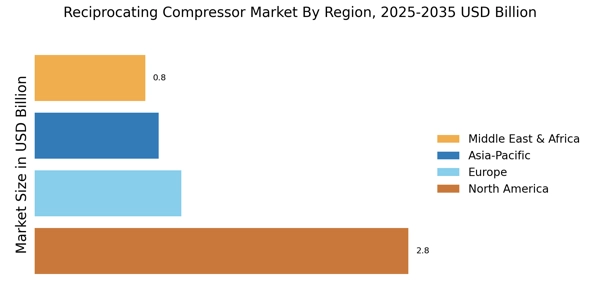
北美往复式压缩机市场是由不断增加的工业活动和严格的环境法规推动的。美国拥有最大的市场份额,约占 60%,其次是加拿大,约占 20%。在政府对可持续实践的激励措施的支持下,对节能压缩机的需求正在上升。监管框架正在推动行业采用先进技术,促进市场增长。引领市场的是英格索兰和卡梅伦国际等主要参与者,它们以创新解决方案占据主导地位。竞争格局的特点是老牌公司和新兴企业混合存在,重点关注技术进步和以客户为中心的解决方案。主要制造商的存在确保了强大的供应链,满足多样化的工业需求。
欧洲:可持续发展和创新焦点
在可持续发展和能源效率的推动下,欧洲往复式压缩机市场正在显着增长。德国和英国是最大的市场,分别占据约 35% 和 25% 的市场份额。欧洲绿色协议等监管举措正在促进环保技术的采用,增强市场活力。可再生能源领域对压缩机的需求也在上升,进一步推动了增长。西门子和博格压缩机等主要参与者处于前沿,利用创新来满足监管标准。竞争格局的特点是旨在开发先进压缩机技术的合作和伙伴关系。法国和意大利等国家也正在成为重要的参与者,为多元化和竞争性的市场环境做出了贡献。
亚太地区:快速工业化和增长
亚太往复式压缩机市场在工业化和城市化的推动下,正经历着显着的增长。中国和印度是最大的市场,分别占据约40%和25%的市场份额。对节能解决方案不断增长的需求以及政府促进制造业发展的举措是主要的增长动力。对基础设施发展的监管支持也增强了市场前景。竞争格局以神钢压缩机和阿特拉斯·科普柯等主要参与者为特色,专注于创新和客户满意度。日本和韩国等国家大量制造商的存在营造了竞争环境,鼓励技术进步。该地区多元化的工业基础进一步支持了各个行业对往复式压缩机的需求。
中东和非洲:新兴市场和机遇
在工业增长和能源部门投资的推动下,中东和非洲地区的往复式压缩机市场正在逐渐增长。阿联酋和南非是主要市场,分别占据约 30% 和 20% 的市场份额。该地区对经济多元化和增强工业能力的关注正在促进对先进压缩机技术的需求。监管框架不断发展以支持可持续实践,进一步推动市场增长。寿力和艾默生电气等主要参与者正在建立强大的影响力,专注于针对区域需求量身定制的创新解决方案。竞争格局的特点是本地和国际公司的混合,增强了市场活力。尼日利亚和沙特阿拉伯等国家也正在成为重要参与者,为该地区的增长潜力做出贡献。
市场策略
- 氢气和 CCUS 往复式压缩机市场预计将以比整体市场更快的速度增长。这是由于对氢作为清洁能源的需求不断增长,以及对 CCU 技术减少温室气体排放的需求不断增长。
- 不同地区的政府计划也支持氢气和 CCUS 往复式压缩机市场的增长。例如,欧盟设定了到2030年将温室气体排放量减少55%的目标。这一目标正在推动CCU技术在该地区的采用。
- 以下是支持氢气往复式压缩机和 CCU 市场增长的一些关键政府计划:
- 欧盟清洁能源一揽子计划:清洁能源一揽子计划是旨在减少欧盟温室气体排放的一套法规。该软件包包括许多支持 CCU 技术开发和部署的规定。
- 美国能源部的氢和燃料电池计划:氢和燃料电池计划是由美国能源部资助的一项研究和开发计划。该计划旨在开发氢和燃料电池技术并将其商业化。
- 中国氢能发展规划:氢能发展规划是旨在促进中国氢能发展的政府计划。该计划包括多项支持氢相关技术开发和部署的条款。
- 以下是氢气往复式压缩机和 CCU 市场的主要区域:
- 北美:未来几年,北美预计将成为氢气往复式压缩机和 CCU 的最大市场。这是由于该地区对氢作为清洁能源的需求不断增加。美国和加拿大是该地区最大的两个市场。
- 欧洲:未来几年,欧洲预计将成为氢气往复式压缩机和 CCU 的第二大市场。这是由于该地区对 CCU 技术的需求不断增长。德国和英国是该地区最大的两个市场。
- 亚太地区:亚太地区预计将成为未来几年氢气和 CCU 往复式压缩机增长最快的市场。这是由于该地区对氢作为清洁能源的需求不断增加。中国和日本是该地区最大的两个市场。
主要参与者和竞争洞察
往复式压缩机市场目前的特点是在技术进步、对节能解决方案日益增长的需求以及对可持续性的日益重视的推动下,竞争格局充满活力。卡梅伦国际(美国)、阿特拉斯·科普柯(瑞典)和英格索兰(美国)等主要参与者都在战略上做好了利用这些趋势的准备。卡梅伦国际(美国)专注于压缩机技术创新,特别是在石油和天然气领域,而阿特拉斯·科普柯(SE)则强调数字化转型和智能制造流程。英格索兰(美国)正在积极寻求区域扩张和合作伙伴关系,以增强其市场影响力,共同塑造越来越注重技术差异化和以客户为中心的解决方案的竞争环境。
市场内的关键业务策略包括本地化制造以降低成本和优化供应链,这在全球贸易动态的背景下尤其重要。往复式压缩机市场的竞争结构似乎较为分散,几个关键参与者对各个细分市场施加影响。这种碎片化使得利基市场参与者能够蓬勃发展,而大公司则通过战略收购和合作伙伴关系巩固其市场份额。 2025 年 8 月,卡梅伦国际(美国)宣布对新制造工厂进行重大投资,旨在增强其高效压缩机的生产能力。此举可能会加快对市场需求的响应时间并提高产品可用性,从而增强其竞争优势。这项投资的战略重要性在于其有潜力满足石油和天然气行业对节能解决方案日益增长的需求,并与全球可持续发展目标保持一致。 2025 年 9 月,阿特拉斯·科普柯 (SE) 推出了配备物联网技术的新型智能往复式压缩机系列,可实现实时监控和预测性维护。这项创新不仅提高了运营效率,而且使阿特拉斯·科普柯成为压缩机技术数字化转型的领导者。
这些智能解决方案的推出反映了将先进技术集成到传统制造工艺中的更广泛趋势,这可能会重新定义市场上的客户期望。 2025 年 7 月,英格索兰(美国)与一家领先的可再生能源公司建立战略合作伙伴关系,开发利用传统能源和可再生能源的混合压缩机系统。此次合作凸显了英格索兰对可持续发展和创新的承诺,有可能为节能压缩机解决方案树立新标准。这种伙伴关系的战略重要性在于其能够满足各种工业应用中对环保技术不断增长的需求。
截至 2025 年 10 月,往复式压缩机市场的竞争趋势日益由数字化、可持续性和人工智能集成所决定。主要参与者之间的战略联盟正在塑造格局、促进创新并增强产品供应。展望未来,竞争差异化可能会从传统的基于价格的竞争演变为关注技术创新、供应链的可靠性以及实现可持续发展目标的能力。这种转变可能会重新定义市场动态,迫使公司投资研发和合作企业以保持竞争优势。
Reciprocating Compressor Market市场的主要公司包括






未来展望
Reciprocating Compressor Market 未来展望
报告范围
市场亮点
FAQs
What is the projected market valuation of the Reciprocating Compressor Market by 2035?
The Reciprocating Compressor Market is projected to reach a valuation of 8.158 USD Billion by 2035.
What was the market valuation of the Reciprocating Compressor Market in 2024?
In 2024, the market valuation of the Reciprocating Compressor Market was 4.66 USD Billion.
What is the expected CAGR for the Reciprocating Compressor Market during the forecast period 2025 - 2035?
The expected CAGR for the Reciprocating Compressor Market during the forecast period 2025 - 2035 is 5.22%.
Which companies are considered key players in the Reciprocating Compressor Market?
Key players in the Reciprocating Compressor Market include Cameron International, Atlas Copco, Ingersoll Rand, and Gardner Denver.
What are the projected revenues for the Portable and Stationary segments by 2035?
By 2035, the Portable segment is projected to generate revenues of 2.4 USD Billion, while the Stationary segment is expected to reach 5.76 USD Billion.
How do the Oil-Free and Oil Filled lubrication segments compare in terms of projected revenue by 2035?
The Oil-Free lubrication segment is projected to reach 2.5 USD Billion, whereas the Oil Filled segment is expected to generate 5.66 USD Billion by 2035.
What is the revenue outlook for Single Stage and Multi Stage compressors by 2035?
By 2035, Single Stage compressors are projected to generate 4.5 USD Billion, while Multi Stage compressors are expected to reach 3.66 USD Billion.
What are the anticipated revenues for the Oil & Gas and Pharmaceutical end-user segments by 2035?
The Oil & Gas end-user segment is projected to reach 2.5 USD Billion, while the Pharmaceutical segment is expected to generate 0.9 USD Billion by 2035.
What is the expected revenue for Double Acting compressors by 2035?
By 2035, Double Acting compressors are projected to generate revenues of 3.5 USD Billion.
How does the revenue for the Chemical Plants segment compare to the Refrigeration Plants segment by 2035?
By 2035, the Chemical Plants segment is expected to generate 1.4 USD Billion, while the Refrigeration Plants segment is projected to reach 1.1 USD Billion.
作者
Author

Anshula Mandaokar

Research Approach
Secondary Research
The secondary research process involved comprehensive analysis of regulatory databases, industrial engineering journals, trade publications, and authoritative energy & manufacturing organizations. Key sources included the US Department of Energy (DOE) and Energy Information Administration (EIA), Environmental Protection Agency (EPA) emissions and efficiency standards, American Society of Mechanical Engineers (ASME) technical standards, American Petroleum Institute (API) energy statistics, Compressed Air & Gas Institute (CAGI) industry data, ASHRAE (American Society of Heating, Refrigerating and Air-Conditioning Engineers) standards and market studies, International Institute of Ammonia Refrigeration (IIAR), EU Eurostat Industrial Production Database, US Census Bureau Manufacturing and Construction Reports, International Energy Agency (IEA) industrial energy efficiency reports, Gas compressor Association (GCA) technical bulletins, and national industrial ministry reports from key manufacturing markets (China NBS, Japan METI, India Ministry of Heavy Industries). These sources were used to collect industrial compressor installation statistics, energy efficiency regulation impacts, manufacturing capacity utilization data, safety compliance requirements, and market landscape analysis for stationary and portable reciprocating compressors across oil-free and oil-lubricated technologies.
Primary Research
To gather both qualitative and quantitative insights, supply-side and demand-side stakeholders were interviewed during the primary research phase. Chief executives, vice presidents of manufacturing operations, chief technology officers, heads of product engineering, and directors of global sales from reciprocating compressor manufacturers, component suppliers (such as crankshafts, pistons, and valves), and aftermarket service providers were examples of supply-side sources. These demand-side sources included Chief Maintenance Engineers, Plant Operations Managers, Engineering Procurement Managers, and Reliability Engineers from petrochemical plants, automobile manufacturing facilities, cold storage and refrigeration facilities, pharmaceutical manufacturing facilities, and oil and gas upstream and downstream facilities. Primary study confirmed new product development timetables for oil-free technologies, validated market segmentation by lubrication type and stage configuration, and collected information on maintenance/replacement cycles, industry adoption patterns, and total cost of ownership considerations.
Primary Respondent Breakdown:
By Designation: C-level Primaries (32%), Director Level (30%), Others (38%)
By Region: North America (32%), Europe (30%), Asia-Pacific (28%), Rest of World (10%)
Market Size Estimation
Global market valuation was derived through revenue mapping and unit shipment analysis. The methodology included:
Identification of 50+ key manufacturers across global industrial hubs including specialized reciprocating compressor OEMs (Burckhardt Compression, Ariel, Howden), diversified industrial conglomerates (Atlas Copco, Ingersoll Rand, Siemens), and regional players in Asia-Pacific and Latin America
Product mapping across portable vs. stationary configurations, oil-free vs. oil-filled lubrication systems, single-stage vs. multi-stage compression, and single-acting vs. double-acting mechanisms
Analysis of reported and modeled annual revenues specific to reciprocating compressor portfolios, excluding centrifugal and rotary screw compressor segments
Coverage of manufacturers representing 75-80% of global market share in 2024, with particular emphasis on oil & gas sector suppliers and industrial refrigeration compressor specialists
Extrapolation using bottom-up (unit shipment volumes × Average Selling Price by country/end-use industry) and top-down (manufacturer revenue validation against industry associations data) approaches to derive segment-specific valuations for pharmaceutical-grade oil-free compressors, petrochemical high-pressure units, and commercial refrigeration applications
下载免费样本
请填写以下表格以获取本报告的免费样本
Customer Stories

“This is really good guys. Excellent work on a tight deadline. I will continue to use you going forward and recommend you to others. Nice job”

Noah Malgeri
Co-Founder

“Thanks. It’s been a pleasure working with you, please use me as reference with any other Intel employees.”

Joseph Aguayo
Sales Operations & Pricing Manager

“Thanks for sending the report it gives us a good global view of the Betaïne market.”

Peter Groot koerkamp
Account and Business Manager

“Thank you, this will be very helpful for OQS.”

La Terria Dodd
Program Support Specialist

“We found the report very insightful! we found your research firm very helpful. I'm sending this email to secure our future business.”

Younghwan Choi
Senior Retail Manager

“I am very pleased with how market segments have been defined in a relevant way for my purposes (such as "Portable Freezers & refrigerators" and "last-mile"). In general the report is well structured. Thanks very much for your efforts.”

Mark Irwin
Management Consultant

“I have been reading the first document or the study, ,the Global HVAC and FP market report 2021 till 2026. Must say, good info! I have not gone in depth at all parts, but got a good indication of the data inside!”

Rob Kooiker
Group Product Manager HVAC & Fire Protection GMA

“We got the report in time, we really thank you for your support in this process. I also thank to all of your team as they did a great job.”

Akif Moroglu
Strategy & Business Development Director

“The Automotive 48V ECU Components Procurement Intelligence Study” was a complex project, but the Market Research Future (MRFR) team handled it with quality, agility, and customer-centricity. They delivered all requested data on time and within the agreed scope. The team, including Shubhendra Anand and Rahul Gotadki, was always readily available to clarify questions and swiftly implement necessary adjustments, driving the project to a successful conclusion within a very demanding timeframe.
I would also like to specifically commend Akshay Agarwal for his responsiveness and support at every stage—from our initial inquiry on May 6th through to final delivery on June 18th. His dedication made the entire process seamless.”

Guilherme Gomes Martins
Product Management Director

案例研究
Aerospace & Defense

