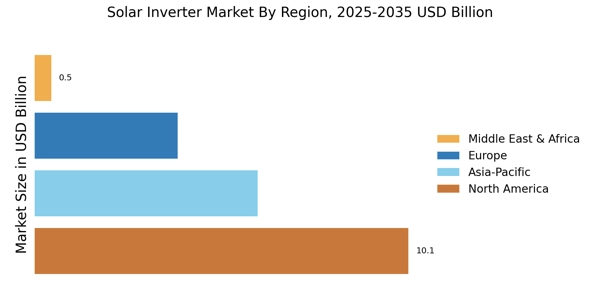
Solar Inverter Market
- Technological Advancements
- Growing Demand for Energy Storage
- Regulatory Support and Incentives
- Rising Energy Costs
- Government Policies and Incentives
- Increasing Adoption of Renewable Energy
Solar Inverter Market市场的主要公司包括
未来展望
Solar Inverter Market 未来展望
报告范围
市场亮点
FAQs
What is the projected market valuation of the Solar Inverter Market by 2035?
The Solar Inverter Market is projected to reach a valuation of 26.4 USD Billion by 2035.
What was the overall market valuation of the Solar Inverter Market in 2024?
In 2024, the overall market valuation of the Solar Inverter Market was 14.35 USD Billion.
What is the expected CAGR for the Solar Inverter Market during the forecast period 2025 - 2035?
The expected CAGR for the Solar Inverter Market during the forecast period 2025 - 2035 is 5.7%.
Which companies are considered key players in the Solar Inverter Market?
Key players in the Solar Inverter Market include SMA Solar Technology AG, Fronius International GmbH, SolarEdge Technologies Inc, and Enphase Energy Inc.
What are the projected valuations for different types of solar inverters by 2035?
By 2035, Central Inverters are projected to reach 10.0 USD Billion, Micro Inverters 5.5 USD Billion, and String Inverters 10.9 USD Billion.
How does the market for on-grid solar inverters compare to off-grid systems by 2035?
By 2035, the market for on-grid solar inverters is projected to reach 15.12 USD Billion, while off-grid systems may reach 11.28 USD Billion.
What are the anticipated valuations for residential, commercial, and utility applications by 2035?
By 2035, residential applications are expected to reach 10.5 USD Billion, commercial applications 8.5 USD Billion, and utility applications 7.4 USD Billion.
What is the projected market size for single-phase and three-phase solar inverters by 2035?
By 2035, single-phase solar inverters are projected to reach 15.12 USD Billion, while three-phase inverters may reach 11.28 USD Billion.
How did the market for solar inverters perform in 2024 across different applications?
In 2024, the market for residential applications was valued at 5.5 USD Billion, commercial at 4.5 USD Billion, and utilities at 4.35 USD Billion.
What trends are influencing the growth of the Solar Inverter Market?
The growth of the Solar Inverter Market appears to be influenced by increasing demand for renewable energy solutions and advancements in inverter technology.
Research Approach
Secondary Research
The secondary research process involved comprehensive analysis of energy regulatory databases, peer-reviewed engineering journals, industry publications, and authoritative renewable energy organizations. Key sources included the International Energy Agency (IEA), International Renewable Energy Agency (IRENA), US Energy Information Administration (EIA), National Renewable Energy Laboratory (NREL), European Photovoltaic Industry Association (EPIA/SolarPower Europe), German Solar Association (BSW-Solar), China Photovoltaic Industry Association (CPIA), Japan Photovoltaic Energy Association (JPEA), Smart Electric Power Alliance (SEPA), Institute of Electrical and Electronics Engineers (IEEE), World Bank Energy Data Portal, BloombergNEF (BNEF), Global Solar Council (GSC), Solar Energy Industries Association (SEIA), Wood Mackenzie Power & Renewables, Power Conversion Intelligence (PCS), Intergovernmental Panel on Climate Change (IPCC) Energy Reports, and national energy ministry statistics from key markets (US Department of Energy, India's Ministry of New and Renewable Energy, China's National Energy Administration). These sources were used to collect installation capacity statistics, grid integration data, efficiency performance studies, policy framework analysis, and market landscape evaluation for central inverters, string inverters, micro inverters, and hybrid/storage-ready inverter technologies across on-grid and off-grid applications.
Primary Research
To gather both qualitative and quantitative insights, supply-side and demand-side stakeholders were interviewed during the primary research phase. CEOs, VPs of Product Development, CTOs, heads of regulatory compliance, and commercial directors from suppliers of semiconductor components, power electronics OEMs, and solar inverter makers were examples of supply-side sources. Chief engineers from utility-scale solar developers, EPC contractors, project finance directors from renewable energy investment funds, grid integration experts from electric utilities, procurement leads from commercial and industrial solar installers, and residential solar contractors were examples of demand-side sources. In addition to confirming product development roadmaps and validating technology adoption curves, primary research also provided insights into pricing erosion dynamics, grid-code compliance patterns, and trends in energy storage integration.
Primary Respondent Breakdown:
By Designation: C-level Primaries (28%), Director Level (42%), Others (30%)
By Region: North America (32%), Europe (22%), Asia-Pacific (38%), Rest of World (8%)
By Value Chain Position: Inverter Manufacturers (45%), Component Suppliers (20%), EPC/Developers (22%), Utilities/Grid Operators (13%)
Market Size Estimation
Global market valuation was derived through revenue mapping and installation capacity analysis. The methodology included:
Identification of 50+ key manufacturers across North America, Europe, Asia-Pacific, Latin America, and Middle East & Africa
Product mapping across central inverters, string inverters, micro inverters, and hybrid/storage inverters
System-type segmentation across on-grid, off-grid, and hybrid configurations
Application mapping across residential, commercial, and utility-scale installations
Analysis of reported and modeled annual revenues specific to inverter product portfolios
Coverage of manufacturers representing 75-80% of global market share in 2024
Extrapolation using bottom-up (installation capacity × ASP by country/segment) and top-down (manufacturer revenue validation) approaches to derive segment-specific valuations
Cross-validation with PV installation forecasts from IEA, IRENA, and national renewable energy targets to ensure alignment with macro deployment trends
请填写以下表格以获取本报告的免费样本
Customer Stories
“This is really good guys. Excellent work on a tight deadline. I will continue to use you going forward and recommend you to others. Nice job”
“Thanks. It’s been a pleasure working with you, please use me as reference with any other Intel employees.”
“Thanks for sending the report it gives us a good global view of the Betaïne market.”
“Thank you, this will be very helpful for OQS.”
“We found the report very insightful! we found your research firm very helpful. I'm sending this email to secure our future business.”
“I am very pleased with how market segments have been defined in a relevant way for my purposes (such as "Portable Freezers & refrigerators" and "last-mile"). In general the report is well structured. Thanks very much for your efforts.”
“I have been reading the first document or the study, ,the Global HVAC and FP market report 2021 till 2026. Must say, good info! I have not gone in depth at all parts, but got a good indication of the data inside!”
“We got the report in time, we really thank you for your support in this process. I also thank to all of your team as they did a great job.”
“The Automotive 48V ECU Components Procurement Intelligence Study” was a complex project, but the Market Research Future (MRFR) team handled it with quality, agility, and customer-centricity. They delivered all requested data on time and within the agreed scope. The team, including Shubhendra Anand and Rahul Gotadki, was always readily available to clarify questions and swiftly implement necessary adjustments, driving the project to a successful conclusion within a very demanding timeframe.
I would also like to specifically commend Akshay Agarwal for his responsiveness and support at every stage—from our initial inquiry on May 6th through to final delivery on June 18th. His dedication made the entire process seamless.”