In Vitro Diagnostics Market Summary
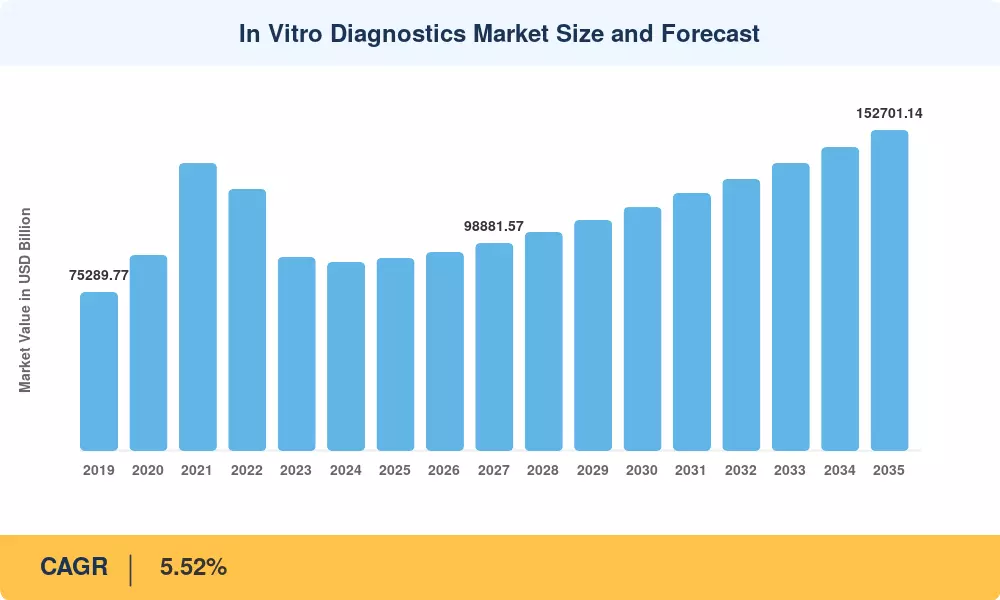
The global in-vitro diagnostics (IVD) market was valued at USD 91.45 billion in 2025, with the forecast period beginning at USD 94.35 billion in 2026 and projected to reach USD 152.70 billion by 2035, expanding at a compound annual growth rate (CAGR) of 5.52% during 2026–2035. The market's sustained expansion is underpinned by the rising prevalence of chronic and allergy-related diseases worldwide, with the World Health Organization estimating that non-communicable diseases account for approximately 74% of all deaths globally, driving persistent demand for diagnostic screening and monitoring [2]. In parallel, the increasing adoption of point-of-care testing (POCT) is decentralizing laboratory workflows and enabling rapid diagnostic results at the patient's bedside, contributing meaningfully to volume growth across both developed and emerging healthcare systems [3]. The in-vitro diagnostics (IVD) market convergence of these structural demand drivers, alongside a growing emphasis on early disease detection and preventive healthcare strategies adopted by governments and insurers, is providing a stable long-term growth foundation for the IVD industry.
The global in-vitro diagnostics (IVD) market is undergoing a significant product and technology transition. By product category, Reagents & Kits represented the dominant segment in 2025, commanding USD 60.96 billion and exhibiting a robust CAGR of 6.14%, reflecting the recurring consumable revenue model that underpins laboratory throughput. Among technology platforms, Molecular Diagnostics registered the fastest growth trajectory at a CAGR of 7.15%, while Immunoassay/Immunochemistry remained the largest technology segment at USD 26.14 billion in 2025 [5]. The DNA Sequencing and Next-Generation Sequencing (NGS) sub-segment within molecular diagnostics posted the highest type-level CAGR of 8.55%, signaling accelerating clinical adoption for oncology, infectious disease, and genetic disorder applications. Recent key developments reinforce this momentum: DiaSorin secured FDA De Novo authorization for the first fully automated Hepatitis Delta Virus diagnostic test in January 2026, while QIAGEN achieved full CE-IVDR certification for its syndromic testing portfolio in September 2025, underscoring the expanding clinical utility of molecular platforms [6][7].
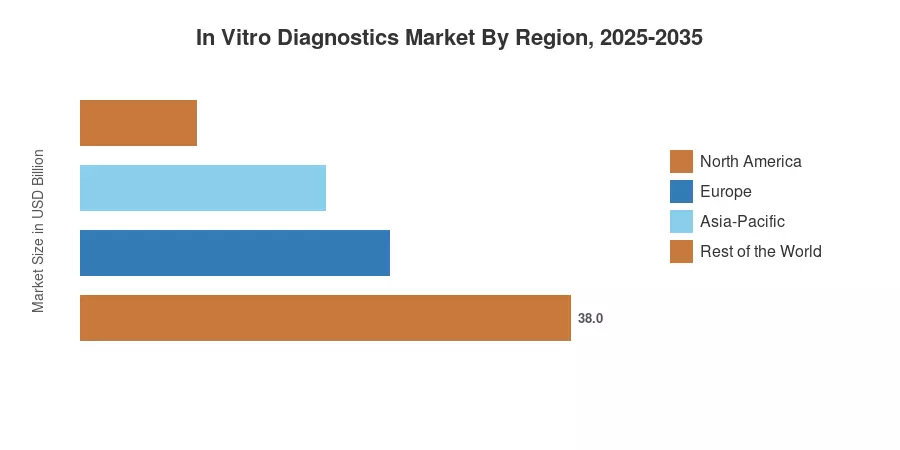
From a in-vitro diagnostics (IVD) market regional perspective, Europe in-vitro diagnostics (IVD) market held the dominant position in the global IVD market, supported by its established laboratory infrastructure, universal healthcare coverage, and the regulatory momentum generated by the EU IVDR framework that is reshaping competitive dynamics across the continent [8]. North America was identified as the fastest-growing region, driven by strong investment in precision medicine, a favorable reimbursement landscape for novel diagnostics, and robust POCT adoption across ambulatory care settings. Asia-Pacific also emerged as a high-growth region with a CAGR of 6.95%, buoyed by expanding healthcare access in China, India, and Southeast Asia, government-backed disease surveillance programs, and a growing middle-class population increasingly demanding preventive health screening [9]. Looking ahead, the global IVD market is expected to benefit from the convergence of artificial intelligence, digital diagnostics, and molecular testing technologies, which together are poised to redefine the speed, accuracy, and accessibility of diagnostic care worldwide.
Key Report Takeaways
| Segment Dimension | Key Metric | Notes |
| By Product — Dominant | Reagents & Kits: USD 60,962.87 Mn (2025) | Accounts for the majority of market revenue due to recurring consumable demand |
| By Product — Fastest Growing | Reagents & Kits: 6.14% CAGR | Driven by expanding test menus and installed analyzer base |
| By Type — Dominant | Fully Automated Instruments: USD 14,235.83 Mn (2025) | Reflects laboratory preference for high-throughput, walkaway systems |
| By Type — Fastest Growing | DNA Sequencing & NGS: 8.55% CAGR | Propelled by oncology companion diagnostics and genetic screening |
| By Technology — Dominant | Immunoassay/Immunochemistry: USD 26,141.10 Mn (2025) | Cornerstone platform for hormone, cardiac, infectious disease, and allergy testing |
| By Technology — Fastest Growing | Molecular Diagnostics: 7.15% CAGR | Accelerated by PCR, NGS, and syndromic testing panel adoption |
| By Application — Fastest Growing | Others (incl. Infectious Diseases, Oncology): 5.86% CAGR | Broad-based application growth beyond allergy and autoimmune indications |
| By End User — Dominant | Hospitals: USD 35,663.30 Mn (2025) | Largest institutional buyer; central lab consolidation drives volume |
| By End User — Fastest Growing | Point-of-Care Testing: 7.18% CAGR | Rapid expansion in emergency, ambulatory, and home-based testing settings |
| By Region — Dominant | Europe: USD 24,854.86 Mn (2025) | Regulatory leadership through EU IVDR and universal coverage models |
| By Region — Fastest Growing | North America: 4.66% CAGR | Precision medicine investment and POCT adoption driving expansion |
| By Region — Highest CAGR | Asia-Pacific: 6.95% CAGR | Government-backed diagnostics programs and rising healthcare expenditure |
Market Size and Forecast (2019–2035)
Market Research Future's market sizing methodology combines top-down and bottom-up approaches, integrating company revenue disclosures, product segment analysis, disease prevalence epidemiology, and technology adoption curves across more than 25 countries. Historical values (2019–2024) are derived from verified financial filings, trade association data, and government health expenditure records. The base year (2025) is anchored on the most recent full-year data available, while the forecast period (2026–2035) employs a proprietary econometric model incorporating macroeconomic indicators, regulatory milestone timelines, pipeline maturity assessments, and regional healthcare infrastructure investment plans.





















.webp?v=1787739882)
