Automotive Fuel Filter Market
- Emission Control and Filtration Technologies
- Advanced Materials and Smart Filters
- Sustainable Mobility and Market Evolution
- Increasing Vehicle Production
Automotive Fuel Filter Market Tendencias
Actualmente se están observando tendencias esenciales en el mercado de filtros de combustible para automóviles, que están impulsadas principalmente por el deseo de mejorar el rendimiento del vehículo y la eficiencia del combustible. El marco regulatorio que se centra cada vez más en la sostenibilidad ambiental y el control de emisiones es un importante impulsor del mercado.
Tecnologías de filtración y control de emisiones
Los fabricantes de automóviles se ven obligados a implementar tecnologías de filtración sofisticadas que satisfagan los estándares de emisiones cada vez más estrictos que imponen los gobiernos de todo el mundo.
Además, existe una creciente conciencia de los consumidores sobre la importancia de utilizar filtros de gasolina de alta calidad para garantizar un rendimiento óptimo y extender la vida útil de sus motores, lo que ha resultado en un mercado mejor informado.
Materiales avanzados y filtros inteligentes
La integración de materiales y tecnologías innovadores, como la nanotecnología y los medios sintéticos, está surgiendo como un desarrollo clave dentro de las tendencias actuales del mercado de filtros de combustible para automóviles que están mejorando la capacidad de filtración y la eficiencia de los filtros de gasolina y presenta una oportunidad para ser investigada.
En el sector automotriz, recientemente se ha puesto énfasis en la digitalización y la tecnología. Esto incluye la creación de filtros inteligentes que puedan monitorear su desempeño y alertar a los usuarios sobre los requisitos de mantenimiento. Esto es consistente con la tendencia más amplia de una mayor conectividad en los automóviles.
Movilidad sostenible y evolución del mercado
Además, la tendencia global hacia alternativas ambientalmente favorables ha resultado en un aumento en la adopción de vehículos eléctricos e híbridos, presentando nuevas oportunidades dentro del mercado de filtros de combustible para automóviles.
El mercado automotriz mundial se está adaptando a los cambios en las preferencias de los consumidores, que incluyen la necesidad de componentes más confiables y eficientes para facilitar la transición hacia soluciones de movilidad sostenible. En última instancia, esto está influyendo en el futuro de la industria de filtros de gasolina para automóviles a escala mundial.
Las empresas clave en el mercado Automotive Fuel Filter Market incluyen
Perspectivas futuras
Automotive Fuel Filter Market Perspectivas futuras
Alcance del informe
Aspectos destacados del mercado
FAQs
What is the anticipated market size of the Automotive Fuel Filter Market in 2024?
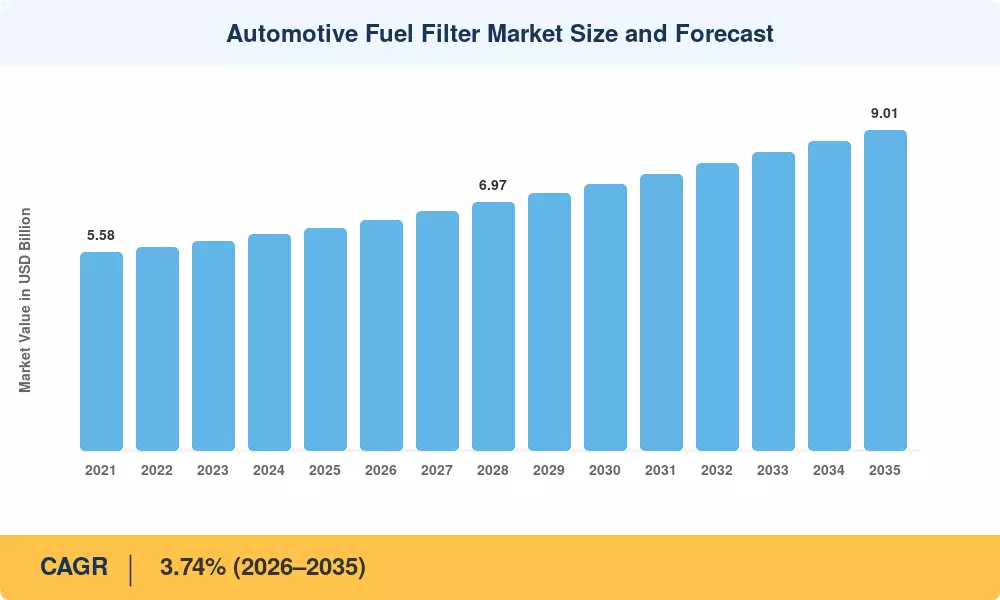
What will be the market value of the Automotive Fuel Filter Market by 2035?
What is the expected compound annual growth rate (CAGR) for the Automotive Fuel Filter Market from 2025 to 2035?
Which segment is expected to dominate the market for Automotive Fuel Filters by application in 2024?
What is the projected market size for Commercial Vehicles applications by 2035?
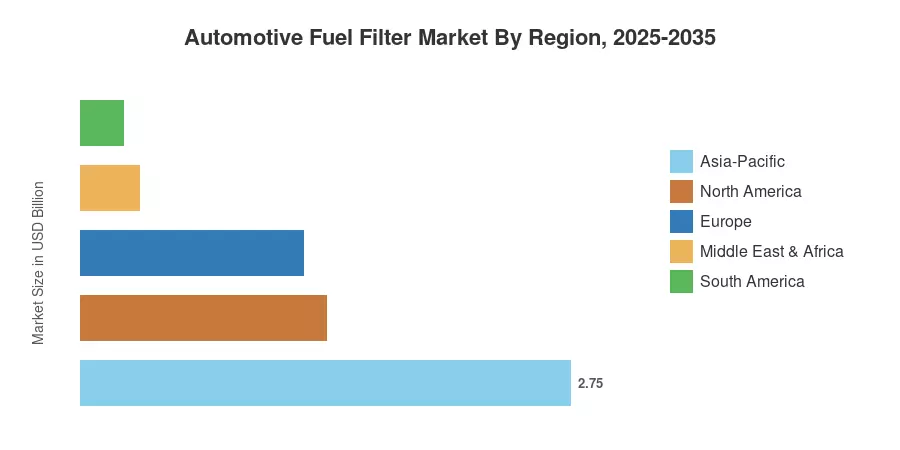
Which region is expected to have the largest market share in 2024?
How much is the Asia Pacific region projected to be valued at in 2035?
Who are some of the key players in the Automotive Fuel Filter Market?
What will be the value for Heavy-Duty Trucks segment in 2024?
What challenges might the Automotive Fuel Filter Market face in the upcoming years?
Research Approach
Secondary Research
The secondary research process involved comprehensive analysis of regulatory databases, automotive industry publications, technical standards repositories, and authoritative transportation organizations. Key sources included the US Environmental Protection Agency (EPA), National Highway Traffic Safety Administration (NHTSA), European Environment Agency (EEA), European Automobile Manufacturers Association (ACEA), International Organization of Motor Vehicle Manufacturers (OICA), Society of Automotive Engineers (SAE) International, International Agency for Research on Cancer (IARC) - Diesel Emissions working group, US Department of Energy (DOE) Clean Cities Program, California Air Resources Board (CARB), International Council on Clean Transportation (ICCT), US Bureau of Transportation Statistics (BTS), EU Eurostat Transport Database, country-specific automotive ministries (China MIIT, Japan MLIT, India MoRTH), and OEM technical specification databases (Ford Fleet Technical Resources, GM Service Information, VW Technical Bulletins). These sources were utilized to collect vehicle production statistics, emissions regulation compliance data, filtration efficiency standards, recall databases, material safety specifications, and aftermarket sales trends for in-line fuel filters, cartridge filters, mesh filters, and emerging synthetic filtration media across gasoline, diesel, and alternative fuel vehicle platforms.
Primary Research
During the primary research process, both supply-side and demand-side stakeholders were interviewed to gather both qualitative and quantitative data. Tier 1 and tier 2 automotive component manufacturers, filter media producers, and OEM suppliers provided supply-side sources. These included CEOs, VPs of Manufacturing, Chief Technology Officers, and heads of thermal management and filtration divisions. Demand-side sources included procurement directors from major automotive OEMs (passenger car and commercial vehicle divisions), fleet management operators, heavy-duty truck maintenance heads, motorcycle OEM technical directors, aftermarket distributor chain executives, and performance automotive engineers from specialty vehicle manufacturers. Primary research confirmed market segmentation across fuel types (gasoline, diesel, CNG, alternative fuels), confirmed product development pipelines for synthetic and metal filter media, and gathered insights on OEM vs. aftermarket channel dynamics, pricing strategies, inventory management practices, and compliance with evolving emissions standards (Euro 7, EPA Tier 3, China VI).
Primary Respondent Breakdown:
• By Designation: C-level Primaries (28%), Director Level (41%), Others (31%)
• By Region: North America (31%), Europe (32%), Asia-Pacific (24%), Rest of World (13%)
Market Size Estimation
Global market valuation was derived through revenue mapping and production volume analysis. The methodology included:
• Identification of 60+ key manufacturers across North America, Europe, Asia-Pacific, Latin America, and Middle East & Africa
• Product mapping across in-line fuel filters, cartridge filters, mesh filters, and specialty performance filters
• Material-type segmentation analysis covering cellulose paper, synthetic microfiber, and stainless steel mesh configurations
• Sales channel differentiation between OEM fitments (passenger cars, commercial vehicles, heavy-duty trucks) and aftermarket (OES and independent)
• Analysis of reported and modeled annual revenues specific to automotive fuel filter portfolios
• Coverage of manufacturers representing 75-80% of global market share in 2024
• Extrapolation using bottom-up (automotive production volumes × filter content per vehicle × ASP by filter type and region) and top-down (manufacturer revenue validation, tier-1 supplier financial segment reporting) approaches to derive segment-specific valuations by fuel type, application, and material composition
Complete el formulario a continuación para recibir una muestra gratuita de este informe
Customer Stories
“This is really good guys. Excellent work on a tight deadline. I will continue to use you going forward and recommend you to others. Nice job”
“Thanks. It’s been a pleasure working with you, please use me as reference with any other Intel employees.”
“Thanks for sending the report it gives us a good global view of the Betaïne market.”
“Thank you, this will be very helpful for OQS.”
“We found the report very insightful! we found your research firm very helpful. I'm sending this email to secure our future business.”
“I am very pleased with how market segments have been defined in a relevant way for my purposes (such as "Portable Freezers & refrigerators" and "last-mile"). In general the report is well structured. Thanks very much for your efforts.”
“I have been reading the first document or the study, ,the Global HVAC and FP market report 2021 till 2026. Must say, good info! I have not gone in depth at all parts, but got a good indication of the data inside!”
“We got the report in time, we really thank you for your support in this process. I also thank to all of your team as they did a great job.”
“The Automotive 48V ECU Components Procurement Intelligence Study” was a complex project, but the Market Research Future (MRFR) team handled it with quality, agility, and customer-centricity. They delivered all requested data on time and within the agreed scope. The team, including Shubhendra Anand and Rahul Gotadki, was always readily available to clarify questions and swiftly implement necessary adjustments, driving the project to a successful conclusion within a very demanding timeframe.
I would also like to specifically commend Akshay Agarwal for his responsiveness and support at every stage—from our initial inquiry on May 6th through to final delivery on June 18th. His dedication made the entire process seamless.”