Automotive Fuel Filter Market
- Emission Control and Filtration Technologies
- Advanced Materials and Smart Filters
- Sustainable Mobility and Market Evolution
- Increasing Vehicle Production
Automotive Fuel Filter Market 동향
현재 자동차 연료 필터 시장에서는 차량 성능과 연료 효율성을 개선하려는 욕구에 의해 주도되는 필수적인 추세가 관찰되고 있습니다. 환경 지속 가능성과 배출 제어에 점점 더 초점을 맞추고 있는 규제 프레임워크는 중요한 시장 동인입니다.
배출 제어 및 여과 기술
자동차 제조업체는 전 세계 정부에서 시행하는 점점 더 엄격해지는 배기가스 배출 표준을 충족하는 정교한 여과 기술을 구현해야 합니다.
또한, 최적의 성능을 보장하고 엔진 수명을 연장하기 위해 고품질 가솔린 필터를 사용하는 것의 중요성에 대한 소비자 인식이 증가하고 있으며, 이로 인해 시장에 대한 정보가 더욱 풍부해졌습니다.
고급 소재 및 스마트 필터
나노기술 및 합성 매체와 같은 혁신적인 재료와 기술의 통합은 가솔린 필터의 여과 용량과 효율성을 향상시키는 현재 자동차 연료 필터 시장 동향에서 핵심 개발로 떠오르고 있으며 조사할 수 있는 기회를 제공합니다.
최근 자동차 분야에서는 디지털화와 기술이 강조되고 있습니다. 여기에는 성능을 모니터링하고 사용자에게 유지 관리 요구 사항을 경고할 수 있는 스마트 필터 생성이 포함됩니다. 이는 자동차의 연결성이 향상되는 광범위한 추세와 일치합니다.
지속 가능한 이동성과 시장 진화
또한 환경 친화적인 대안을 향한 세계적인 추세로 인해 전기 자동차 및 하이브리드 자동차의 채택이 증가하여 자동차 연료 필터 시장에 새로운 기회가 제시되었습니다.
글로벌 자동차 시장은 지속 가능한 모빌리티 솔루션으로의 전환을 촉진하기 위해 보다 신뢰할 수 있고 효율적인 구성 요소에 대한 필요성을 포함하는 소비자 선호도의 변화에 적응하고 있습니다. 궁극적으로 이는 전 세계적으로 자동차 가솔린 필터 산업의 미래에 영향을 미치고 있습니다.
Automotive Fuel Filter Market 시장의 주요 기업은 다음과 같습니다
향후 전망
Automotive Fuel Filter Market 향후 전망
보고서 범위
시장 하이라이트
FAQs
What is the anticipated market size of the Automotive Fuel Filter Market in 2024?
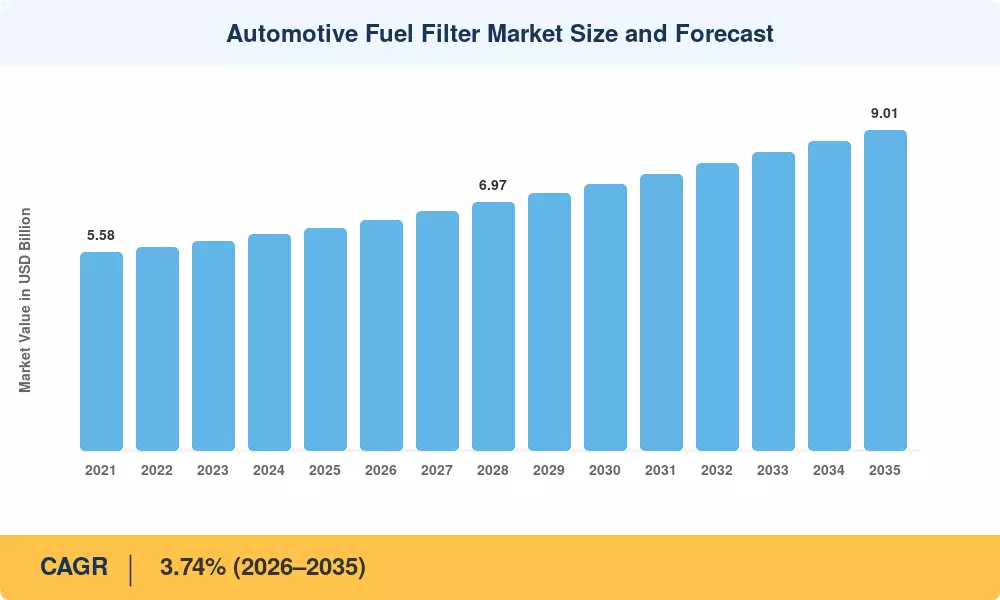
What will be the market value of the Automotive Fuel Filter Market by 2035?
What is the expected compound annual growth rate (CAGR) for the Automotive Fuel Filter Market from 2025 to 2035?
Which segment is expected to dominate the market for Automotive Fuel Filters by application in 2024?
What is the projected market size for Commercial Vehicles applications by 2035?
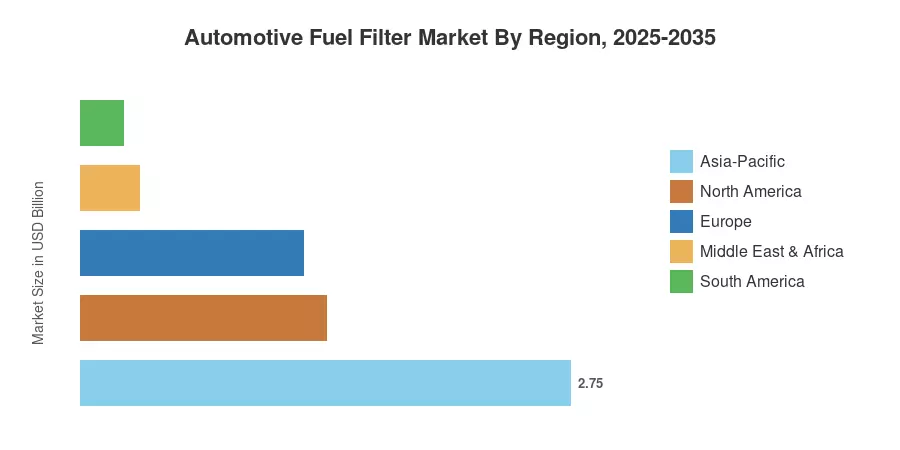
Which region is expected to have the largest market share in 2024?
How much is the Asia Pacific region projected to be valued at in 2035?
Who are some of the key players in the Automotive Fuel Filter Market?
What will be the value for Heavy-Duty Trucks segment in 2024?
What challenges might the Automotive Fuel Filter Market face in the upcoming years?
Research Approach
Secondary Research
The secondary research process involved comprehensive analysis of regulatory databases, automotive industry publications, technical standards repositories, and authoritative transportation organizations. Key sources included the US Environmental Protection Agency (EPA), National Highway Traffic Safety Administration (NHTSA), European Environment Agency (EEA), European Automobile Manufacturers Association (ACEA), International Organization of Motor Vehicle Manufacturers (OICA), Society of Automotive Engineers (SAE) International, International Agency for Research on Cancer (IARC) - Diesel Emissions working group, US Department of Energy (DOE) Clean Cities Program, California Air Resources Board (CARB), International Council on Clean Transportation (ICCT), US Bureau of Transportation Statistics (BTS), EU Eurostat Transport Database, country-specific automotive ministries (China MIIT, Japan MLIT, India MoRTH), and OEM technical specification databases (Ford Fleet Technical Resources, GM Service Information, VW Technical Bulletins). These sources were utilized to collect vehicle production statistics, emissions regulation compliance data, filtration efficiency standards, recall databases, material safety specifications, and aftermarket sales trends for in-line fuel filters, cartridge filters, mesh filters, and emerging synthetic filtration media across gasoline, diesel, and alternative fuel vehicle platforms.
Primary Research
During the primary research process, both supply-side and demand-side stakeholders were interviewed to gather both qualitative and quantitative data. Tier 1 and tier 2 automotive component manufacturers, filter media producers, and OEM suppliers provided supply-side sources. These included CEOs, VPs of Manufacturing, Chief Technology Officers, and heads of thermal management and filtration divisions. Demand-side sources included procurement directors from major automotive OEMs (passenger car and commercial vehicle divisions), fleet management operators, heavy-duty truck maintenance heads, motorcycle OEM technical directors, aftermarket distributor chain executives, and performance automotive engineers from specialty vehicle manufacturers. Primary research confirmed market segmentation across fuel types (gasoline, diesel, CNG, alternative fuels), confirmed product development pipelines for synthetic and metal filter media, and gathered insights on OEM vs. aftermarket channel dynamics, pricing strategies, inventory management practices, and compliance with evolving emissions standards (Euro 7, EPA Tier 3, China VI).
Primary Respondent Breakdown:
• By Designation: C-level Primaries (28%), Director Level (41%), Others (31%)
• By Region: North America (31%), Europe (32%), Asia-Pacific (24%), Rest of World (13%)
Market Size Estimation
Global market valuation was derived through revenue mapping and production volume analysis. The methodology included:
• Identification of 60+ key manufacturers across North America, Europe, Asia-Pacific, Latin America, and Middle East & Africa
• Product mapping across in-line fuel filters, cartridge filters, mesh filters, and specialty performance filters
• Material-type segmentation analysis covering cellulose paper, synthetic microfiber, and stainless steel mesh configurations
• Sales channel differentiation between OEM fitments (passenger cars, commercial vehicles, heavy-duty trucks) and aftermarket (OES and independent)
• Analysis of reported and modeled annual revenues specific to automotive fuel filter portfolios
• Coverage of manufacturers representing 75-80% of global market share in 2024
• Extrapolation using bottom-up (automotive production volumes × filter content per vehicle × ASP by filter type and region) and top-down (manufacturer revenue validation, tier-1 supplier financial segment reporting) approaches to derive segment-specific valuations by fuel type, application, and material composition
이 보고서의 무료 샘플을 받으려면 아래 양식을 작성하십시오
Customer Stories
“This is really good guys. Excellent work on a tight deadline. I will continue to use you going forward and recommend you to others. Nice job”
“Thanks. It’s been a pleasure working with you, please use me as reference with any other Intel employees.”
“Thanks for sending the report it gives us a good global view of the Betaïne market.”
“Thank you, this will be very helpful for OQS.”
“We found the report very insightful! we found your research firm very helpful. I'm sending this email to secure our future business.”
“I am very pleased with how market segments have been defined in a relevant way for my purposes (such as "Portable Freezers & refrigerators" and "last-mile"). In general the report is well structured. Thanks very much for your efforts.”
“I have been reading the first document or the study, ,the Global HVAC and FP market report 2021 till 2026. Must say, good info! I have not gone in depth at all parts, but got a good indication of the data inside!”
“We got the report in time, we really thank you for your support in this process. I also thank to all of your team as they did a great job.”
“The Automotive 48V ECU Components Procurement Intelligence Study” was a complex project, but the Market Research Future (MRFR) team handled it with quality, agility, and customer-centricity. They delivered all requested data on time and within the agreed scope. The team, including Shubhendra Anand and Rahul Gotadki, was always readily available to clarify questions and swiftly implement necessary adjustments, driving the project to a successful conclusion within a very demanding timeframe.
I would also like to specifically commend Akshay Agarwal for his responsiveness and support at every stage—from our initial inquiry on May 6th through to final delivery on June 18th. His dedication made the entire process seamless.”