Request Free Sample ×

Kindly complete the form below to receive a free sample of this Report

* Please use a valid business email

Leading companies partner with us for data-driven Insights

clients tt-cursor
Hero Background

Carbon Capture Storage Market

ID: MRFR/EnP/1330-HCR
128 Pages
Chitranshi Jaiswal
Last Updated: May 27, 2026
Informe de investigación de mercado sobre captura y almacenamiento de carbono: pronóstico hasta 2032
Download PDF ×

We do not share your information with anyone. However, we may send you emails based on your report interest from time to time. You may contact us at any time to opt-out.

⚠ STRAIT OF HORMUZ CRISIS ALERT
13 Million Barrels/Day at Risk | 31% of Global Seaborne Oil Flow | Qatar LNG Halted — Oil, Natural Gas, Power Generation & Energy Security Markets Disrupted, Insurance Withdrawn, $80–100+ Price Scenarios Active | Get Crisis-Adjusted Production, Pricing & Security Analysis

Carbon Capture Storage Market Resumen

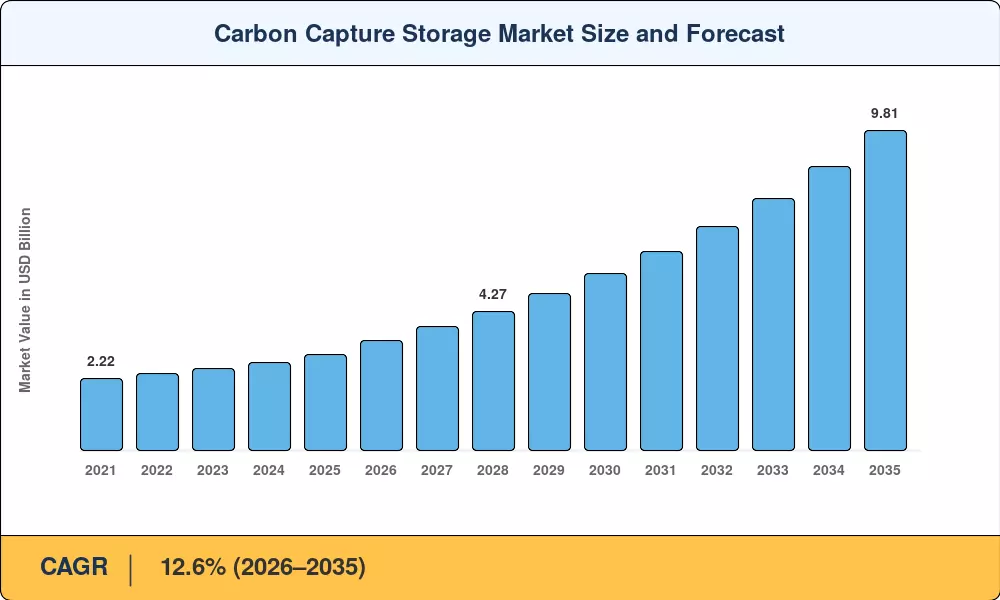
Según el análisis de Market Research Future, el mercado de captura y almacenamiento de carbono se estimó en 7,01 mil millones de dólares en 2024. Se proyecta que la industria de captura y almacenamiento de carbono crecerá de 7,776 mil millones de dólares en 2025 a 21,95 mil millones de dólares en 2035, exhibiendo una tasa de crecimiento anual compuesta (CAGR) del 10,93% durante el período previsto 2025 - 2035.

Tendencias clave del mercado y aspectos destacados

El mercado de captura y almacenamiento de carbono está preparado para un crecimiento sustancial impulsado por los avances tecnológicos y el apoyo regulatorio.

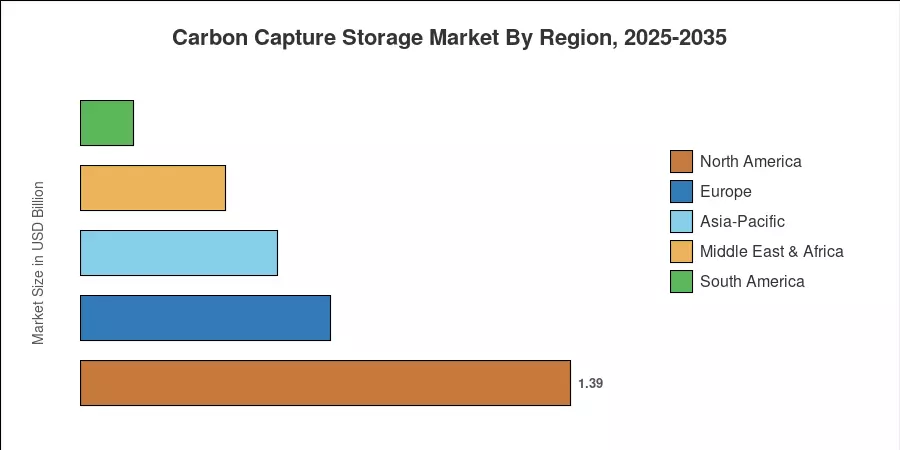
  • América del Norte sigue siendo el mayor mercado de tecnologías de captura y almacenamiento de carbono, lo que refleja una sólida inversión e infraestructura.
  • Asia-Pacífico está emergiendo como la región de más rápido crecimiento, impulsada por una creciente industrialización y conciencia ambiental.
  • La captura poscombustión continúa dominando el mercado, mientras que la captura directa de aire está ganando terreno rápidamente como solución viable.
  • Los impulsores clave del mercado incluyen el aumento de las regulaciones ambientales y las iniciativas de sostenibilidad corporativa, que están dando forma a la dinámica de la industria.

Tamaño del mercado y previsión

Tamaño del mercado en 2024 7.01 (USD Billion)
Tamaño del mercado en 2035 21.95 (USD Billion)
CAGR (2025 - 2035) 10.93%
Mayor cuota de mercado regional en 2024 América del norte

Principales jugadores

ExxonMobil (EE.UU.), Shell (GB),Energías Totales(FR), Chevron (EE.UU.), BP (GB), Equinor (NO), Occidental Petroleum (EE.UU.), Carbon Clean Solutions (GB), Aker Solutions (NO), Global CCS Institute (AU)

Our Impact
Enabled $4.3B Revenue Impact for Fortune 500 and Leading Multinationals
Partnering with 2000+ Global Organizations Each Year
30K+ Citations by Top-Tier Firms in the Industry

Las empresas clave en el mercado Carbon Capture Storage Market incluyen

Alcance del informe

MARKET SIZE 2024 7.01(USD Billion)
MARKET SIZE 2025 7.776(USD Billion)
MARKET SIZE 2035 21.95(USD Billion)
COMPOUND ANNUAL GROWTH RATE (CAGR) 10.93% (2025 - 2035)
REPORT COVERAGE Revenue Forecast, Competitive Landscape, Growth Factors, and Trends
BASE YEAR 2024
Market Forecast Period 2025 - 2035
Historical Data 2019 - 2024
Market Forecast Units USD Billion
Key Companies Profiled ExxonMobil (US), Shell (GB), TotalEnergies (FR), Chevron (US), BP (GB), Equinor (NO), Occidental Petroleum (US), Carbon Clean Solutions (GB), Aker Solutions (NO), Global CCS Institute (AU)
Segments Covered Technology, Application, End Use, Method, Regional - Forecast to 2035
Key Market Opportunities Advancements in direct air capture technologies enhance potential in the Carbon Capture and Storage Market.
Key Market Dynamics Rising regulatory pressures and technological advancements drive innovation and investment in the Carbon Capture and Storage Market.
Countries Covered North America, Europe, APAC, South America, MEA

FAQs

What is the projected market valuation of the Carbon Capture and Storage Market by 2035?

The projected market valuation for the Carbon Capture and Storage Market is 21.95 USD Billion by 2035.

What was the market valuation of the Carbon Capture and Storage Market in 2024?

The overall market valuation was 7.01 USD Billion in 2024.

What is the expected CAGR for the Carbon Capture and Storage Market during the forecast period 2025 - 2035?

The expected CAGR for the Carbon Capture and Storage Market during the forecast period 2025 - 2035 is 10.93%.

Which technology segment is anticipated to have the highest valuation by 2035?

The Direct Air Capture technology segment is anticipated to reach 7.95 USD Billion by 2035.

What are the key applications driving the Carbon Capture and Storage Market?

Key applications include Power Generation, Industrial Processes, Natural Gas Processing, and Transport and Storage.

Which end-use sector is projected to grow significantly in the Carbon Capture and Storage Market?

The Chemical Sector is projected to grow significantly, reaching 6.0 USD Billion by 2035.

Who are the leading players in the Carbon Capture and Storage Market?

Leading players include ExxonMobil, Shell, TotalEnergies, Chevron, BP, Equinor, and Occidental Petroleum.

What is the expected valuation of the Enhanced Oil Recovery method by 2035?

The Enhanced Oil Recovery method is expected to reach a valuation of 9.0 USD Billion by 2035.

How does the market for Bioenergy with Carbon Capture and Storage compare to other methods?

Bioenergy with Carbon Capture and Storage is projected to reach 5.5 USD Billion by 2035, indicating strong growth.

What trends are influencing the growth of the Carbon Capture and Storage Market?

Trends include increasing regulatory support, technological advancements, and rising demand for sustainable energy solutions.

Autor
Author
Author Profile
Chitranshi Jaiswal LinkedIn
Team Lead - Research
Chitranshi is a Team Leader in the Chemicals & Materials (CnM) and Energy & Power (EnP) domains, with 6+ years of experience in market research. She leads and mentors teams to deliver cross-domain projects that equip clients with actionable insights and growth strategies. She is skilled in market estimation, forecasting, competitive benchmarking, and both primary & secondary research, enabling her to turn complex data into decision-ready insights. An engineer and MBA professional, she combines technical expertise with strategic acumen to solve dynamic market challenges. Chitranshi has successfully managed projects that support market entry, investment planning, and competitive positioning, while building strong client relationships. Certified in Advanced Excel & Power BI she leverages data-driven approaches to ensure accuracy, clarity, and impactful outcomes.
Deja un comentario

Research Approach


Secondary Research

The secondary research process involved comprehensive analysis of environmental regulatory databases, peer-reviewed energy journals, technical engineering publications, and authoritative climate organizations. Key sources included the US Environmental Protection Agency (EPA), US Department of Energy (DOE), International Energy Agency (IEA), Global CCS Institute (GCCSI), Intergovernmental Panel on Climate Change (IPCC), European Commission Directorate-General for Climate Action, European Environment Agency (EEA), International Association of Oil & Gas Producers (IOGP), Carbon Capture Coalition, World Business Council for Sustainable Development (WBCSD), International Journal of Greenhouse Gas Control, Energy & Environmental Science Journal, National Center for Biotechnology Information (NCBI/PubMed) for environmental health studies, World Bank Carbon Pricing Dashboard, OECD Environment Statistics, and national energy ministry reports from key markets including Norway, UK, Canada, Australia, China, and Japan. These sources were used to collect carbon pricing data, CCS project pipeline statistics, storage capacity assessments, regulatory policy frameworks, emission reduction targets, and technology cost curves for post-combustion capture, pre-combustion systems, direct air capture, bioenergy with carbon capture and storage (BECCS), and enhanced oil recovery (EOR) applications.


Primary Research

To gather both qualitative and quantitative insights, supply-side and demand-side stakeholders were interviewed during the primary research phase. Commercial leads from oil and gas majors, industrial gas providers, technology licensors, and engineering procurement construction (EPC) firms were among the supply-side sources, along with CEOs, CTOs of Carbon Capture Technologies, Heads of CCS Project Development, and regulatory affairs directors. Demand-side sources included procurement leads from energy-intensive sectors implementing CCS solutions, process engineers from chemical refineries, facility directors from power generation utilities, plant managers from cement and steel production, and carbon storage site operators. Primary study verified CO₂ storage site development pipelines, validated technology adoption timetables, and collected information on project funding methods, 45Q tax credit utilization, and carbon credit monetization tactics.

Primary Respondent Breakdown:

By Designation: C-level Primaries (28%), Director Level (42%), Others (30%)

By Region: North America (32%), Europe (35%), Asia-Pacific (25%), Rest of World (8%)


Market Size Estimation

Global market valuation was derived through project pipeline valuation and capture capacity analysis. The methodology included:

Identification of 60+ key technology providers and project developers across North America, Europe, Asia-Pacific, and Middle East

Technology mapping across post-combustion capture, pre-combustion capture, oxy-fuel combustion, direct air capture, BECCS, and geological storage methods

Analysis of announced and under-construction project capacities with associated capital expenditure (CAPEX) and operational expenditure (OPEX) modeling

Coverage of developers and operators representing 75-80% of global operational and under-development CCS capacity in 2024

Extrapolation using bottom-up (cumulative capture capacity × unit cost by technology type and region) and top-down (major player revenue validation and government funding allocation analysis) approaches to derive segment-specific valuations for capture equipment, transportation infrastructure, and storage site development

Descargar muestra gratis

Complete el formulario a continuación para recibir una muestra gratuita de este informe