Adaptateurs de flacons pour le marché des médicaments de reconstitution (2026 - 2035)
Rapport d'étude de marché sur les adaptateurs de flacons pour la reconstitution de médicaments par application (Oncologie, Maladies auto-immunes, Maladies infectieuses, Troubles génétiques, Remplacement hormonal), par type de matériau (Plastique, Verre, Caoutchouc, Silicone, Métal), par type de produit (Adaptateurs de flacons à usage unique, Adaptateurs de flacons réutilisables, Adaptateurs de flacons personnalisés), par utilisation finale (Entreprises pharmaceutiques, Organisations de fabrication sous contrat, Institutions de recherche, Hôpitaux, Pharmacies de détail) et par région (Amérique du Nord, Europe, Amérique du Sud, Asie-Pacifique, Moyen-Orient et Afrique) - Prévisions jusqu'en 2035.
Adaptateurs de flacons pour le marché des médicaments de reconstitution Résumé
Selon l'analyse de MRFR, le marché des adaptateurs de flacons pour la reconstitution des médicaments était estimé à 1,443 milliards USD en 2024. L'industrie des adaptateurs de flacons devrait croître de 1,561 en 2025 à 3,428 d'ici 2035, affichant un taux de croissance annuel composé (CAGR) de 8,18 pendant la période de prévision 2025 - 2035.
Principales tendances et faits saillants du marché
Le marché des adaptateurs de flacons pour la reconstitution des médicaments est prêt à croître, soutenu par les avancées technologiques et la demande croissante de produits biologiques.
Les avancées technologiques améliorent l'efficacité et la sécurité des adaptateurs de flacons dans la reconstitution des médicaments. L'Amérique du Nord reste le plus grand marché, tandis que la région Asie-Pacifique émerge comme la zone à la croissance la plus rapide pour les adaptateurs de flacons. Le segment oncologique domine le marché, tandis que le segment des maladies auto-immunes connaît une croissance rapide. Les principaux moteurs du marché incluent la demande croissante pour les biologiques et le soutien réglementaire pour des solutions innovantes.
Taille du marché et prévisions
2024 Market Size
1,443 (milliards USD)
2035 Market Size
3,428 (milliards USD)
CAGR (2025 - 2035)
8,18 %
Principaux acteurs
West Pharmaceutical Services (États-Unis), Becton Dickinson and Company (États-Unis), Medtronic (États-Unis), Terumo Corporation (Japon), Schott AG (Allemagne), Sartorius AG (Allemagne), Vetter Pharma-Fertigung GmbH & Co. KG (Allemagne), AptarGroup, Inc. (États-Unis), Nipro Corporation (Japon)
Our Impact
Enabled $4.3B Revenue Impact for Fortune 500 and Leading Multinationals
Partnering with 2000+ Global Organizations Each Year
30K+ Citations by Top-Tier Firms in the Industry
Adaptateurs de flacons pour le marché des médicaments de reconstitution Tendances
Le marché des adaptateurs de flacons pour la reconstitution des médicaments connaît actuellement une croissance notable, alimentée par la demande croissante de systèmes de livraison de médicaments efficaces. Ces adaptateurs facilitent la reconstitution des médicaments lyophilisés, garantissant que les professionnels de la santé peuvent préparer les médicaments rapidement et en toute sécurité. L'augmentation des maladies chroniques et le besoin de biologiques sont des facteurs contributifs, car ces traitements nécessitent souvent une reconstitution avant administration. De plus, les avancées technologiques améliorent la conception et la fonctionnalité de ces adaptateurs, les rendant plus conviviaux et fiables. À mesure que le paysage de la santé évolue, l'accent mis sur la sécurité des patients et la facilité d'utilisation reste primordial, influençant le développement de solutions innovantes dans ce secteur. En outre, les organismes de réglementation soulignent l'importance des normes de sécurité dans les systèmes de livraison de médicaments, ce qui devrait propulser l'adoption d'adaptateurs de flacons de haute qualité. Le marché semble se diriger vers des pratiques plus durables, les fabricants explorant des matériaux écologiques pour la production. Cette tendance s'inscrit dans le mouvement plus large vers la durabilité dans le secteur de la santé, suggérant que le marché des adaptateurs de flacons pour la reconstitution des médicaments continuera de s'adapter aux préférences changeantes des consommateurs et aux exigences réglementaires. Dans l'ensemble, l'avenir de ce marché semble prometteur, avec des innovations continues et un engagement à améliorer les résultats pour les patients qui en conduisent l'évolution.
Avancées Technologiques
Le marché des adaptateurs de flacons pour la reconstitution des médicaments connaît une montée des innovations technologiques. Les fabricants développent des adaptateurs qui améliorent l'utilisabilité et la sécurité, intégrant des caractéristiques telles que des filtres intégrés et des conceptions ergonomiques. Ces avancées visent à rationaliser le processus de reconstitution, réduisant le risque de contamination et améliorant l'efficacité.
Conformité Réglementaire
Il y a une emphase croissante sur la conformité réglementaire au sein du marché des adaptateurs de flacons pour la reconstitution des médicaments. Les agences réglementaires établissent des directives strictes pour garantir la sécurité et l'efficacité des systèmes de livraison de médicaments. Cette tendance pousse les fabricants à investir dans l'assurance qualité et à respecter les meilleures pratiques, améliorant ainsi la fiabilité des produits.
Initiatives de Durabilité
La durabilité devient un point focal dans le marché des adaptateurs de flacons pour la reconstitution des médicaments. Les entreprises explorent de plus en plus des matériaux et des méthodes de production écologiques pour minimiser l'impact environnemental. Ce changement répond non seulement à la demande des consommateurs pour des produits durables, mais s'aligne également sur les efforts mondiaux pour promouvoir des pratiques respectueuses de l'environnement dans le secteur de la santé.
Adaptateurs de flacons pour le marché des médicaments de reconstitution conducteurs
Demande croissante de biologiques
La demande croissante pour les biologiques est un moteur essentiel du marché des adaptateurs de flacons pour la reconstitution des médicaments. Comme les biologiques nécessitent souvent une reconstitution avant administration, le besoin de systèmes de livraison efficaces et sûrs est primordial. Selon des données récentes, le marché des biologiques devrait atteindre environ 500 milliards USD d'ici 2026, indiquant une trajectoire de croissance robuste. Cette augmentation nécessite l'adoption d'adaptateurs de flacons qui facilitent le processus de reconstitution, garantissant que les prestataires de soins de santé peuvent administrer ces médicaments complexes de manière efficace. De plus, la prévalence croissante des maladies chroniques, qui nécessitent souvent des thérapies biologiques, amplifie encore la demande pour les adaptateurs de flacons, renforçant ainsi leur présence sur le marché.
Expansion des services de soins à domicile
L'expansion des services de santé à domicile émerge comme un moteur vital pour le marché des adaptateurs de flacons pour la reconstitution des médicaments. À mesure que de plus en plus de patients reçoivent des traitements à domicile, le besoin de méthodes de reconstitution conviviales et sûres devient de plus en plus important. Les adaptateurs de flacons qui simplifient le processus de reconstitution sont essentiels pour garantir que les patients peuvent gérer efficacement leurs médicaments dans un cadre domestique. Le marché des soins de santé à domicile devrait connaître une croissance significative, avec des estimations suggérant qu'il pourrait atteindre plus de 300 milliards USD d'ici 2027. Cette tendance indique une opportunité substantielle pour les fabricants d'adaptateurs de flacons de répondre aux besoins évolutifs des prestataires de soins de santé à domicile et des patients.
Accent croissant sur la sécurité des patients
L'accent croissant mis sur la sécurité des patients est un moteur significatif pour le marché des adaptateurs de flacons pour la reconstitution des médicaments. Les prestataires de soins de santé prennent de plus en plus conscience des risques associés à une reconstitution incorrecte des médicaments, ce qui peut entraîner des résultats indésirables pour les patients. Par conséquent, la demande d'adaptateurs de flacons qui minimisent ces risques est en augmentation. Le marché connaît un changement vers des produits offrant des caractéristiques de sécurité améliorées, telles que la reconstitution automatique et la prévention de la contamination. Cette tendance devrait se poursuivre, alors que les organismes de réglementation plaident de plus en plus pour des méthodes de délivrance de médicaments plus sûres, propulsant ainsi la croissance du marché des adaptateurs de flacons.
Soutien réglementaire pour des solutions innovantes
Le soutien réglementaire pour les solutions innovantes de délivrance de médicaments est un moteur clé du marché des adaptateurs de flacons pour la reconstitution des médicaments. Les agences réglementaires reconnaissent de plus en plus l'importance des méthodes de reconstitution efficaces pour garantir la sécurité et l'efficacité des médicaments. Cela a conduit à des processus d'approbation simplifiés pour les nouvelles technologies d'adaptateurs de flacons, encourageant les fabricants à investir dans la recherche et le développement. En conséquence, le marché devrait connaître une augmentation des produits innovants qui répondent aux normes réglementaires tout en répondant aux besoins des prestataires de soins de santé. Cet environnement réglementaire favorable est susceptible de favoriser la croissance et l'innovation au sein du marché des adaptateurs de flacons.
Innovations technologiques dans l'administration des médicaments
Les innovations technologiques jouent un rôle crucial dans la définition du marché des adaptateurs de flacons pour la reconstitution des médicaments. Les avancées en science des matériaux et en ingénierie ont conduit au développement d'adaptateurs de flacons plus efficaces et conviviaux. Ces innovations améliorent non seulement le processus de reconstitution, mais renforcent également la sécurité et réduisent le risque de contamination. Par exemple, l'introduction de systèmes sans aiguille et de caractéristiques de sécurité intégrées a été bien accueillie sur le marché. À mesure que l'industrie évolue, il est prévu que le marché des adaptateurs de flacons s'élargisse, poussé par le besoin de systèmes de livraison de médicaments plus sophistiqués qui s'alignent sur les pratiques de santé modernes.
Aperçu des segments de marché
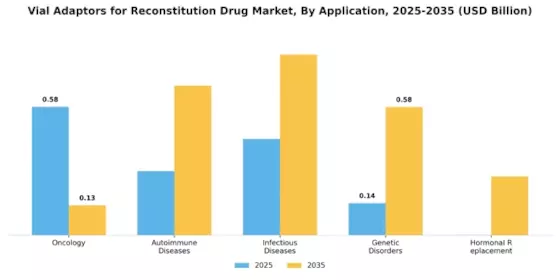
Par application : oncologie (la plus grande) contre les maladies auto-immunes (la plus rapide en croissance)
Dans le marché des adaptateurs de vial pour la reconstitution des médicaments, le segment d'application est dominé par l'oncologie, qui détient la plus grande part de marché. Cela est principalement dû à la prévalence croissante du cancer et à la demande croissante de thérapies ciblées, nécessitant une reconstitution efficace de formulations médicamenteuses complexes. Les maladies auto-immunes suivent comme le segment à la croissance la plus rapide, avec une sensibilisation croissante et des avancées dans les traitements renforçant sa présence sur le marché.
Oncologie (Dominant) vs. Maladies Auto-immunes (Émergentes)
L'oncologie est une application dominante sur le marché des adaptateurs de flacons pour la reconstitution des médicaments, soutenue par l'augmentation de l'incidence du cancer et l'introduction de biologiques innovants et de thérapies personnalisées nécessitant une reconstitution précise des médicaments. Avec un soutien réglementaire renforcé pour les produits oncologiques, le marché continue de prospérer. En revanche, les maladies auto-immunes représentent un segment émergent, alimenté par une augmentation des diagnostics auto-immuns et l'introduction de nouvelles thérapies. Cette croissance est soutenue par une recherche accrue en immunologie, entraînant une demande de solutions de reconstitution efficaces, garantissant ainsi que les patients reçoivent un traitement optimal tout en respectant des normes de sécurité strictes.
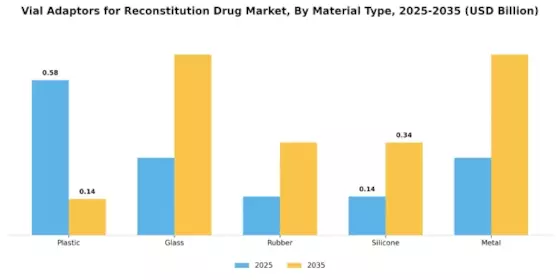
Par type de matériau : Plastique (le plus grand) contre Verre (le plus en croissance)
Dans le marché des adaptateurs de flacons pour la reconstitution des médicaments, le plastique est devenu le plus grand segment, représentant une part significative en raison de sa polyvalence, de son rapport coût-efficacité et de sa facilité de fabrication. Les matériaux plastiques, y compris divers polymères, sont largement adoptés pour leurs propriétés légères et leur résistance aux réactions chimiques, ce qui les rend idéaux pour les applications pharmaceutiques. D'autre part, le verre connaît une croissance rapide en tant que segment. Ses attributs, tels que l'inertie et la qualité premium, font des adaptateurs en verre un choix de plus en plus privilégié pour les matériaux biologiques sensibles nécessitant une plus grande stabilité.
Plastique (Dominant) vs. Verre (Émergent)
Le segment plastique est la force dominante sur le marché des adaptateurs de flacons pour la reconstitution des médicaments, tirant parti de sa praticité et de son utilisation étendue dans diverses applications. Les adaptateurs en plastique, généralement fabriqués à partir de matériaux tels que le polypropylène et le polyéthylène, offrent des avantages tels que des coûts de production inférieurs et un poids réduit, qui sont essentiels pour la logistique de distribution des médicaments. En revanche, le segment en verre émerge rapidement, favorisé pour sa résistance chimique supérieure et sa durabilité. Sa capacité à maintenir l'intégrité des médicaments sensibles a galvanisé son adoption dans des formulations médicales de grande valeur, stimulant l'innovation et augmentant la demande dans des secteurs qui privilégient la sécurité et l'efficacité.
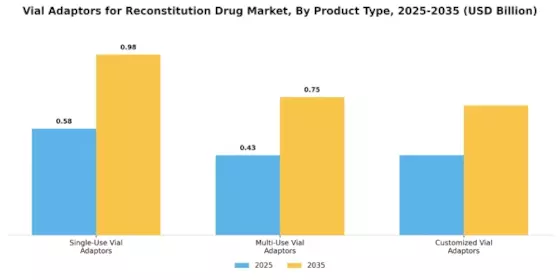
Par type de produit : adaptateurs de flacons à usage unique (les plus grands) contre adaptateurs de flacons à usage multiple (à la croissance la plus rapide)
Dans le marché des adaptateurs de flacons pour la reconstitution des médicaments, les adaptateurs de flacons à usage unique détiennent la plus grande part, en raison de leur commodité et de leur stérilité, ce qui en fait le choix privilégié des prestataires de soins de santé à la recherche de fiabilité. Les adaptateurs de flacons réutilisables sont également répandus, attirant les établissements qui privilégient la rentabilité sur le cycle de vie du produit. Les adaptateurs de flacons personnalisés, bien qu'importants pour des besoins de niche, représentent une part plus petite du marché car ils répondent spécifiquement aux besoins individuels des clients. Les tendances de croissance dans ce segment révèlent une forte demande pour les adaptateurs de flacons à usage unique, alimentée par des réglementations strictes concernant la sécurité et l'hygiène dans l'administration des médicaments. Pendant ce temps, les adaptateurs de flacons réutilisables émergent rapidement alors que les hôpitaux et les cliniques recherchent des options durables qui réduisent les déchets. Les adaptateurs de flacons personnalisés gagnent en popularité en raison de la demande croissante pour la médecine personnalisée, permettant des solutions de reconstitution de médicaments sur mesure qui répondent aux exigences spécifiques des patients.
Adaptateurs de flacons à usage unique (Dominant) vs. Adaptateurs de flacons personnalisés (Émergent)
Les adaptateurs de flacons à usage unique sont le type de produit dominant sur le marché des adaptateurs de flacons pour la reconstitution des médicaments. Leur standardisation et leur conformité réglementaire garantissent qu'ils sont préférés dans divers milieux de soins de santé, en particulier dans les situations où la stérilité est primordiale. Ces adaptateurs facilitent la reconstitution rapide et sûre des médicaments, ce qui conduit à leur acceptation généralisée. En revanche, les adaptateurs de flacons personnalisés émergent, répondant aux besoins spécifiques de certaines thérapies ou groupes de patients. Ils offrent flexibilité et innovation, ce qui devient de plus en plus attrayant à mesure que la médecine personnalisée se généralise. Bien qu'ils ne soient pas aussi largement utilisés que les options à usage unique, l'essor des adaptateurs de flacons personnalisés indique un changement dans la dynamique du marché vers des solutions plus adaptées et centrées sur le patient.
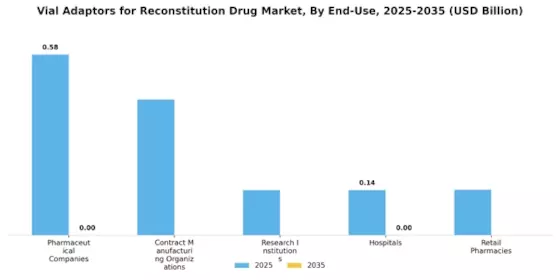
Par utilisation finale : entreprises pharmaceutiques (les plus grandes) contre organisations de fabrication sous contrat (les plus en croissance)
Le marché des adaptateurs de flacons pour la reconstitution des médicaments présente une répartition variée de la part de marché à travers différents segments d'utilisation finale. Les entreprises pharmaceutiques détiennent la plus grande part, tirant parti de leurs investissements significatifs dans le développement de médicaments et les technologies de reconstitution. Leurs gammes de produits étendues et leurs réseaux de distribution établis facilitent l'utilisation large des adaptateurs de flacons. En revanche, les organisations de fabrication sous contrat gagnent en traction, s'adressant à une clientèle diversifiée, y compris de plus petites entreprises pharmaceutiques qui nécessitent des solutions de production flexibles et efficaces, augmentant ainsi leur présence globale sur le marché.
Entreprises pharmaceutiques (dominantes) vs. Institutions de recherche (émergentes)
Les entreprises pharmaceutiques dominent le marché des adaptateurs de flacons pour la reconstitution des médicaments en raison de leur volume élevé de production de médicaments et de la nécessité de solutions de reconstitution avancées pour garantir l'efficacité des médicaments. Ces entreprises sont souvent à la pointe de l'innovation et améliorent continuellement leurs capacités technologiques. D'autre part, les institutions de recherche, bien qu'elles soient actuellement un segment émergent, adoptent de plus en plus les adaptateurs de flacons alors qu'elles s'engagent dans des essais cliniques et des recherches pour de nouvelles formulations. Leur attention croissante sur les thérapies médicamenteuses innovantes nécessite des méthodes de reconstitution fiables, les plaçant dans une position stratégique pour influencer les tendances de la demande future.
Obtenez des informations plus détaillées sur Adaptateurs de flacons pour le marché des médicaments de reconstitutionDemander un échantillon gratuit
Aperçu régional
Amérique du Nord : Innovation et Leadership sur le Marché
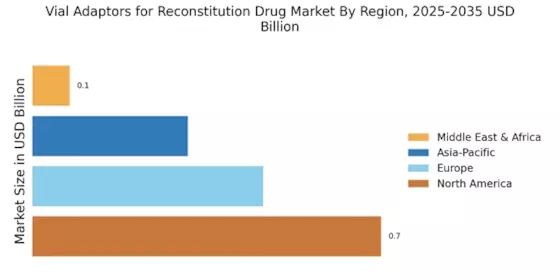
L'Amérique du Nord est le plus grand marché pour les adaptateurs de flacons pour les médicaments de reconstitution, détenant environ 45 % de la part de marché mondiale. La croissance de la région est alimentée par l'augmentation des dépenses de santé, une industrie pharmaceutique robuste et des cadres réglementaires stricts qui garantissent la sécurité et l'efficacité des produits. La demande pour des systèmes de livraison de médicaments avancés est également en hausse, alimentée par la prévalence croissante des maladies chroniques et le besoin d'une administration efficace des médicaments. Les États-Unis sont le pays leader sur ce marché, soutenu par des acteurs clés tels que West Pharmaceutical Services et Becton Dickinson. Le paysage concurrentiel est caractérisé par une innovation continue et des partenariats stratégiques entre les grandes entreprises. Le Canada joue également un rôle significatif, contribuant au marché avec son infrastructure de santé en expansion et l'adoption croissante de technologies médicales avancées.
Europe : Cadre Réglementaire et Croissance
L'Europe est le deuxième plus grand marché pour les adaptateurs de flacons, représentant environ 30 % de la part mondiale. La région bénéficie d'un système de santé bien établi et d'un accent croissant sur la sécurité des patients et la qualité des produits. Les organismes réglementaires comme l'Agence européenne des médicaments (EMA) jouent un rôle crucial dans l'assurance de la conformité aux réglementations strictes, ce qui stimule l'innovation et la croissance du marché. La demande croissante pour les biologiques et les biosimilaires est également un moteur de croissance significatif dans cette région. L'Allemagne, la France et le Royaume-Uni sont les pays leaders sur le marché européen, avec une forte présence d'acteurs clés tels que Schott AG et Sartorius AG. Le paysage concurrentiel est marqué par des collaborations et des fusions entre les entreprises pour améliorer l'offre de produits et étendre la portée du marché. L'accent mis sur des systèmes de livraison de médicaments durables et efficaces façonne l'avenir du marché en Europe.
Asie-Pacifique : Potentiel de Marché Émergent
La région Asie-Pacifique connaît une croissance rapide sur le marché des adaptateurs de flacons, alimentée par l'augmentation des investissements dans la santé et une population en hausse. Cette région détient environ 20 % de la part de marché mondiale, avec des pays comme le Japon et la Chine en tête. La prévalence croissante des maladies chroniques et la demande pour des systèmes de livraison de médicaments avancés sont des facteurs significatifs contribuant à cette croissance. De plus, les initiatives gouvernementales favorables et les investissements dans l'infrastructure de santé propulsent encore l'expansion du marché. Le Japon est un acteur clé sur ce marché, avec des entreprises majeures comme Terumo Corporation et Nipro Corporation activement impliquées. Le paysage concurrentiel évolue, avec l'émergence de fabricants locaux pour répondre à la demande croissante. L'accent mis sur l'innovation et l'adoption de technologies dans la région devrait considérablement améliorer le marché des adaptateurs de flacons dans les années à venir.
Moyen-Orient et Afrique : Opportunités de Marché Inexplorées
La région du Moyen-Orient et de l'Afrique présente des opportunités inexploitées sur le marché des adaptateurs de flacons, détenant environ 5 % de la part mondiale. La croissance est alimentée par l'augmentation des investissements dans la santé, la sensibilisation croissante aux systèmes de livraison de médicaments avancés et une population en hausse. Les pays de cette région se concentrent sur l'amélioration de l'infrastructure de santé et l'accès aux médicaments, ce qui devrait stimuler la demande pour les adaptateurs de flacons dans les années à venir. L'Afrique du Sud et les Émirats Arabes Unis sont les pays leaders sur ce marché, avec une présence croissante d'acteurs internationaux. Le paysage concurrentiel est caractérisé par un mélange de fabricants locaux et la présence d'adaptateurs de flacons. Le potentiel de croissance de la région est significatif, car les gouvernements priorisent de plus en plus les améliorations de la santé et les cadres réglementaires pour soutenir le développement du marché.
Acteurs clés et aperçu concurrentiel
Le marché des adaptateurs de flacons pour la reconstitution des médicaments se caractérise par un paysage concurrentiel dynamique, alimenté par une demande croissante de systèmes de livraison de médicaments efficaces et la prévalence croissante des biologiques. Des acteurs clés tels que West Pharmaceutical Services (États-Unis), Becton Dickinson and Company (États-Unis) et Terumo Corporation (Japon) sont à l'avant-garde, chacun adoptant des stratégies distinctes pour améliorer leur position sur le marché. West Pharmaceutical Services (États-Unis) met l'accent sur l'innovation dans la conception des produits et les processus de fabrication, en se concentrant sur le développement d'adaptateurs de flacons avancés qui améliorent la sécurité et l'utilisabilité. Pendant ce temps, Becton Dickinson and Company (États-Unis) tire parti de son vaste réseau de distribution pour étendre sa portée mondiale, tandis que Terumo Corporation (Japon) se concentre sur l'expansion régionale en Asie, capitalisant sur l'augmentation des investissements dans la santé dans les marchés émergents. Collectivement, ces stratégies contribuent à un environnement concurrentiel de plus en plus axé sur l'avancement technologique et la pénétration du marché.
En termes de tactiques commerciales, les entreprises localisent de plus en plus la fabrication pour réduire les délais de livraison et améliorer l'efficacité de la chaîne d'approvisionnement. Cette approche semble être une réponse au besoin croissant d'agilité dans la production et la distribution, en particulier dans les régions où la demande en soins de santé est en forte croissance. La structure du marché est modérément fragmentée, avec plusieurs acteurs clés détenant des parts de marché substantielles, mais de nombreuses petites entreprises contribuant également à l'innovation et à la concurrence. L'influence collective de ces acteurs favorise une atmosphère concurrentielle où la différenciation est cruciale pour le succès.
En août 2025, West Pharmaceutical Services (États-Unis) a annoncé le lancement d'une nouvelle gamme d'adaptateurs de flacons conçus spécifiquement pour les médicaments à haute viscosité. Ce mouvement stratégique est significatif car il répond à un besoin critique sur le marché, permettant aux prestataires de soins de santé d'administrer des biologiques complexes plus efficacement. L'introduction de ces adaptateurs améliore non seulement la sécurité des patients, mais positionne également West Pharmaceutical Services comme un leader en innovation dans le secteur.
En septembre 2025, Becton Dickinson and Company (États-Unis) a conclu un partenariat stratégique avec une entreprise biopharmaceutique de premier plan pour co-développer un nouveau système de reconstitution intégrant des capacités de surveillance numérique. Cette collaboration est indicative d'une tendance plus large vers la numérisation dans le secteur de la santé, suggérant que Becton Dickinson est désireux de tirer parti de la technologie pour améliorer l'expérience utilisateur et les résultats pour les patients. De tels partenariats peuvent également faciliter des cycles de développement de produits plus rapides et une plus grande réactivité sur le marché.
En juillet 2025, Terumo Corporation (Japon) a élargi ses capacités de fabrication en Asie du Sud-Est en établissant une nouvelle installation dédiée à la production d'adaptateurs de flacons. Cette expansion est stratégiquement importante car elle augmente non seulement la capacité de production de Terumo, mais positionne également l'entreprise pour mieux servir le marché asiatique en forte croissance. En améliorant son empreinte de fabrication locale, Terumo est susceptible d'améliorer la fiabilité de sa chaîne d'approvisionnement et sa réactivité aux demandes régionales.
À partir d'octobre 2025, les tendances concurrentielles sur le marché des adaptateurs de flacons pour la reconstitution des médicaments sont de plus en plus définies par la numérisation, la durabilité et l'intégration de l'intelligence artificielle dans les processus de fabrication. Les alliances stratégiques deviennent plus fréquentes, alors que les entreprises reconnaissent la valeur de la collaboration pour stimuler l'innovation et améliorer les offres de produits. En regardant vers l'avenir, il est prévu que la différenciation concurrentielle évolue, passant d'une concurrence traditionnelle basée sur les prix à un accent sur les avancées technologiques, les solutions innovantes et une gestion robuste de la chaîne d'approvisionnement. Cette transition souligne l'importance de l'adaptabilité et des stratégies tournées vers l'avenir pour maintenir un avantage concurrentiel sur le marché.
Les principales entreprises du marché Adaptateurs de flacons pour le marché des médicaments de reconstitution incluent
Développements de l'industrie
Les développements récents sur le marché des adaptateurs de flacons pour la reconstitution des médicaments ont été notables, en particulier alors que des entreprises comme Medtronic, Johnson & Johnson et GlaxoSmithKline continuent d'innover et d'élargir leur gamme de produits. Eagle Pharmaceuticals et Cardinal Health se concentrent sur l'amélioration de la sécurité et de l'efficacité des processus de reconstitution des médicaments, reflétant l'engagement continu de l'industrie envers la qualité et les soins aux patients. AbbVie et West Pharmaceutical Services investissent également dans des technologies avancées pour rationaliser la fabrication et améliorer la fiabilité des adaptateurs de flacons.
En termes de fusions et d'acquisitions, des entreprises telles que Stryker Corporation et Baxter International ont effectué des mouvements stratégiques significatifs pour renforcer leurs portefeuilles dans le secteur des dispositifs médicaux, qui inclut les adaptateurs de flacons. Pendant ce temps, des sociétés comme Pfizer et Roche augmentent leur présence sur le marché grâce à des collaborations et des partenariats visant à intégrer de nouvelles technologies qui améliorent les systèmes de délivrance de médicaments. La demande croissante pour une administration efficace des médicaments devrait augmenter la valorisation du marché pour ces entreprises, avec un accent sur la recherche et le développement stimulant les innovations dans les adaptateurs de flacons.
En conséquence, ce marché continue d'évoluer, répondant aux besoins de santé et aux exigences réglementaires.
Perspectives d'avenir
Adaptateurs de flacons pour le marché des médicaments de reconstitution Perspectives d'avenir
Le marché des adaptateurs de flacons pour la reconstitution des médicaments devrait croître à un TCAC de 8,18 % de 2024 à 2035, soutenu par une demande croissante de systèmes de livraison de médicaments efficaces et des avancées technologiques.
De nouvelles opportunités résident dans :
Développement d'adaptateurs de flacons intelligents avec capteurs intégrés pour une surveillance en temps réel.
Expansion sur les marchés émergents avec des offres de produits sur mesure.
Partenariats avec des entreprises pharmaceutiques pour le co-développement de solutions innovantes de reconstitution.
D'ici 2035, le marché devrait connaître une croissance substantielle, consolidant sa position dans le secteur de la santé.
Segmentation du marché
Adaptateurs de flacons pour le marché des médicaments de reconstitution Perspectives d'application
Oncologie
Maladies Auto-immunes
Maladies Infectieuses
Troubles Génétiques
Remplacement Hormonal
Adaptateurs de flacons pour le marché des médicaments de reconstitution Type de matériel Perspectives
Plastique
Verre
Caoutchouc
Silicone
Métal
Adaptateurs de flacons pour le marché des médicaments de reconstitution Perspectives de type de produit
Adaptateurs de flacons à usage unique
Adaptateurs de flacons à usage multiple
Adaptateurs de flacons personnalisés
Adaptateurs de flacons pour le marché des médicaments de reconstitution Perspectives d'utilisation finale
Entreprises pharmaceutiques
Organisations de fabrication sous contrat
Institutions de recherche
Hôpitaux
Pharmacies de détail
Portée du rapport
TAILLE DU MARCHÉ 2024
1,443 (milliards USD)
TAILLE DU MARCHÉ 2025
1,561 (milliards USD)
TAILLE DU MARCHÉ 2035
3,428 (milliards USD)
TAUX DE CROISSANCE ANNUEL COMPOSÉ (CAGR)
8,18 % (2024 - 2035)
COUVERTURE DU RAPPORT
Prévisions de revenus, paysage concurrentiel, facteurs de croissance et tendances
ANNÉE DE BASE
2024
Période de prévision du marché
2025 - 2035
Données historiques
2019 - 2024
Unités de prévision du marché
milliards USD
Principales entreprises profilées
Analyse de marché en cours
Segments couverts
Analyse de segmentation du marché en cours
Principales opportunités de marché
Les avancées dans les biopharmaceutiques stimulent la demande pour des solutions innovantes d'adaptateurs de flacons pour le marché des médicaments de reconstitution.
Dynamique clé du marché
La demande croissante pour des systèmes de livraison de médicaments efficaces stimule l'innovation dans les adaptateurs de flacons pour reconstitution.
Pays couverts
Amérique du Nord, Europe, APAC, Amérique du Sud, MEA
FAQs
Quelle est la valorisation actuelle du marché des adaptateurs Vial pour la reconstitution des médicaments ?
La valorisation du marché était de 1,443 milliard USD en 2024.
Quelle est la taille de marché projetée pour le marché des adaptateurs de flacons pour la reconstitution des médicaments d'ici 2035 ?
La taille du marché projetée devrait atteindre 3,428 milliards USD d'ici 2035.
Quel est le CAGR attendu pour le marché des adaptateurs de flacons pour la reconstitution des médicaments pendant la période de prévision ?
Le CAGR attendu pour le marché de 2025 à 2035 est de 8,18 %.
Quel segment d'application avait la plus haute valorisation en 2024 ?
Le segment des applications en oncologie avait la plus haute valorisation à 0,577 milliard USD en 2024.
Quels sont les principaux matériaux utilisés dans le marché des adaptateurs de flacons pour la reconstitution des médicaments ?
Les matériaux clés comprennent le plastique, le verre, le caoutchouc, le silicone et le métal, le plastique étant évalué à 0,577 milliard USD en 2024.
Quel type de produit devrait dominer le marché d'ici 2035 ?
Les adaptateurs de flacons à usage unique devraient dominer le marché, avec une valorisation de 0,577 milliard USD en 2024.
Qui sont les entreprises leaders sur le marché des adaptateurs de vial pour la reconstitution des médicaments ?
Les acteurs clés incluent West Pharmaceutical Services, Becton Dickinson and Company, et Medtronic, entre autres.
Quel segment d'utilisation finale devrait connaître une croissance significative sur le marché des adaptateurs de flacons ?
Les entreprises pharmaceutiques devraient connaître une croissance significative, avec une valorisation de 0,577 milliard USD en 2024.
Comment le marché des adaptateurs de flacons multi-usages se compare-t-il à celui des adaptateurs de flacons à usage unique ?
En 2024, les adaptateurs de flacons multi-usages étaient évalués à 0,433 milliard USD, contre 0,577 milliard USD pour les flacons à usage unique.
Quelles tendances influencent la croissance du marché des adaptateurs de flacons pour la reconstitution des médicaments ?
Les tendances incluent une demande croissante pour des solutions personnalisées et des avancées dans la technologie des matériaux.
Auteur
Author
Rahul Gotadki
Research Manager
He holds an experience of about 9+ years in Market Research and Business Consulting, working under the spectrum of Life Sciences and Healthcare domains. Rahul conceptualizes and implements a scalable business strategy and provides strategic leadership to the clients. His expertise lies in market estimation, competitive intelligence, pipeline analysis, customer assessment, etc.
read more
Co-Author
Kinjoll Dey
Senior Research Analyst
He is an extremely curious individual currently working in Healthcare and Medical Devices Domain. Kinjoll is comfortably versed in data centric research backed by healthcare educational background. He leverages extensive data mining and analytics tools such as Primary and Secondary Research, Statistical Analysis, Machine Learning, Data Modelling. His key role also involves Technical Sales Support, Client Interaction and Project management within the Healthcare team. Lastly, he showcases extensive affinity towards learning new skills and remain fascinated in implementing them.
The secondary research process involved comprehensive analysis of regulatory databases, peer-reviewed pharmaceutical journals, clinical publications, and authoritative healthcare organizations. Key sources included the US Food & Drug Administration (FDA), European Medicines Agency (EMA), International Council for Harmonisation of Technical Requirements for Pharmaceuticals for Human Use (ICH), US Pharmacopeia (USP), International Organization for Standardization (ISO), Parenteral Drug Association (PDA), International Society for Pharmaceutical Engineering (ISPE), Pharmaceutical Research and Manufacturers of America (PhRMA), European Federation of Pharmaceutical Industries and Associations (EFPIA), Biotechnology Innovation Organization (BIO), National Institutes of Health (NIH), National Center for Biotechnology Information (NCBI/PubMed), Centers for Disease Control and Prevention (CDC), World Health Organization (WHO) Prequalification Programme, Organisation for Economic Co-operation and Development (OECD) Health Statistics, EU Eurostat Healthcare Database, and national health ministry reports from key markets including Japan's Ministry of Health, Labour and Welfare (MHLW), China's National Medical Products Administration (NMPA), and India's Central Drugs Standard Control Organization (CDSCO). These sources were used to collect drug approval statistics, regulatory compliance data, biologics market trends, manufacturing standards, patient safety studies, and market landscape analysis for single-use vial adaptors, multi-use vial adaptors, and customized vial adaptors across plastic, glass, rubber, silicone, and metal material types.
Primary Research
In order to gather both qualitative and quantitative insights, supply-side and demand-side stakeholders were interviewed during the primary research process. CEOs, VPs of Manufacturing, heads of regulatory affairs, and commercial directors from pharmaceutical packaging firms, medical device OEMs, and vial adaptor makers were examples of supply-side sources. Procurement heads from pharmaceutical corporations, supply chain directors from contract manufacturing organizations (CMOs), hospital pharmacy directors, research scientists from research institutes, and retail pharmacy managers were examples of demand-side suppliers. Market segmentation, product pipeline timings, manufacturing adoption trends, price strategies, material preferences, and regulatory compliance dynamics were all confirmed by primary research.
Primary Respondent Breakdown:
By Designation: C-level Primaries (32%), Director Level (31%), Others (37%)
By Region: North America (38%), Europe (29%), Asia-Pacific (25%), Rest of World (8%)
Market Size Estimation
Global market valuation was derived through revenue mapping and product volume analysis. The methodology included:
Identification of 40+ key manufacturers across North America, Europe, Asia-Pacific, and Latin America
Product mapping across single-use vial adaptors, multi-use vial adaptors, and customized vial adaptors
Material segmentation analysis across plastic, glass, rubber, silicone, and metal categories
Application mapping across oncology, autoimmune diseases, infectious diseases, genetic disorders, and hormonal replacement therapies
End-use analysis covering pharmaceutical companies, contract manufacturing organizations, research institutions, hospitals, and retail pharmacies
Analysis of reported and modeled annual revenues specific to vial adaptor portfolios
Coverage of manufacturers representing 72-78% of global market share in 2024
Extrapolation using bottom-up (product volume × ASP by country/region) and top-down (manufacturer revenue validation) approaches to derive segment-specific valuations
Aucun rapport spécifique au pays disponible pour ce marché.
Customer Stories
“This is really good guys. Excellent work on a tight deadline. I will continue to use you going forward and recommend you to others. Nice job”
Noah MalgeriCo-Founder
“Thanks. It’s been a pleasure working with you, please use me as reference with any other Intel employees.”
Joseph AguayoSales Operations & Pricing Manager
“Thanks for sending the report it gives us a good global view of the Betaïne market.”
Peter Groot koerkampAccount and Business Manager
“Thank you, this will be very helpful for OQS.”
La Terria DoddProgram Support Specialist
“We found the report very insightful! we found your research firm very helpful. I'm sending this email to secure our future business.”
Younghwan ChoiSenior Retail Manager
“I am very pleased with how market segments have been defined in a relevant way for my purposes (such as "Portable Freezers & refrigerators" and "last-mile").
In general the report is well structured. Thanks very much for your efforts.”
Mark IrwinManagement Consultant
“I have been reading the first document or the study, ,the Global HVAC and FP market report 2021 till 2026. Must say, good info! I have not gone in depth at all parts, but got a good indication of the data inside!”
Rob KooikerGroup Product Manager HVAC & Fire Protection GMA
“We got the report in time, we really thank you for your support in this process. I also thank to all of your team as they did a great job.”
Akif MorogluStrategy & Business Development Director
“The Automotive 48V ECU Components Procurement Intelligence Study” was a complex project, but the Market Research Future (MRFR) team handled it with quality, agility, and customer-centricity. They delivered all requested data on time and within the agreed scope. The team, including Shubhendra Anand and Rahul Gotadki, was always readily available to clarify questions and swiftly implement necessary adjustments, driving the project to a successful conclusion within a very demanding timeframe.
I would also like to specifically commend Akshay Agarwal for his responsiveness and support at every stage—from our initial inquiry on May 6th through to final delivery on June 18th. His dedication made the entire process seamless.”
Guilherme Gomes MartinsProduct Management Director