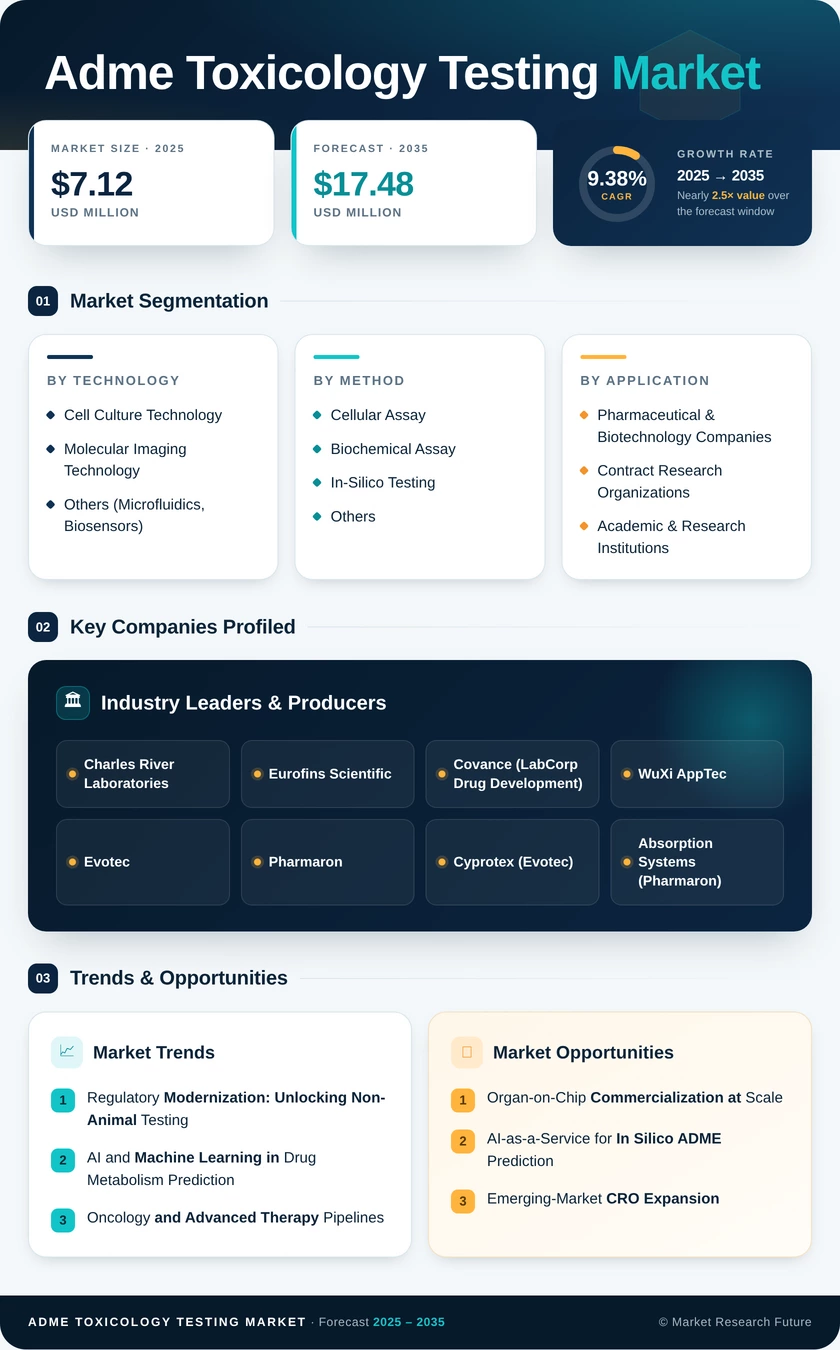
Segmentation Quick Reference
| Dimension | Sub-Segments | Dominant Segment | Fastest Growing Segment |
| By Technology | Cell Culture Technology, Molecular Imaging Technology, Others | Cell Culture Technology | Molecular Imaging Technology |
| By Method | Cellular Assay, Biochemical Assay, In-Silico Testing, Others | Cellular Assay | In-Silico Testing |
| By Application | Systemic Toxicity Testing, Renal Toxicity Testing, Others | Systemic Toxicity Testing | Renal Toxicity Testing |
| By End User | ADME Toxicology Testing Market & Biotechnology Companies, Contract Research Organizations, Academic & Research Institutions | ADME Toxicology Testing Market & Biotechnology Companies | Contract Research Organizations |
Market Segmentation Overview
By Technology
| Sub-Segment | Key Trend |
| Cell Culture Technology | Shift from 2D monolayers to 3D organoids and organ-on-chip platforms for physiologically relevant ADME profiling. |
| Molecular Imaging Technology | Adoption of PET/SPECT and fluorescence imaging for non-invasive real-time biodistribution and metabolism tracking |
| Others (Microfluidics, Biosensors) | Miniaturized high-throughput devices enabling rapid parallel screening with reduced reagent consumption |
Cell Culture Technology maintains its leadership position through continuous innovation in three-dimensional tissue models that better replicate human drug metabolism pathways, while molecular imaging is gaining preference among sponsors seeking to bridge preclinical-to-clinical translation gaps.
By Method
| Sub-Segment | Key Trend |
| Cellular Assay | Automation of hepatocyte and Caco-2 assays to scale routine metabolic clearance and permeability testing |
| Biochemical Assay | Expanded CYP reaction phenotyping and UGT conjugation panels for comprehensive enzyme mapping |
| In-Silico Testing | AI-powered PBPK and QSAR modeling replacing early-stage wet-lab screens for candidate prioritization |
| Others | Emerging bioanalytical techniques, including LC-MS/MS, high-resolution metabolite identification |
Cellular Assay methods remain foundational for regulatory submissions, while In-Silico Testing is transforming early discovery by enabling rapid virtual screening of compound libraries before committing to laboratory resources.
By Application
| Sub-Segment | Key Trend |
| Systemic Toxicity Testing | Universal regulatory requirement driving consistent demand across all therapeutic pipelines |
| Renal Toxicity Testing | Growing focus on nephrotoxicity biomarkers for oncology compounds, particularly ADCs and platinum agents |
| Others (Cardiotoxicity, Neurotoxicity) | Expanded safety pharmacology panels driven by regulatory expectations for biologics and CNS-targeting drugs |
Systemic Toxicity Testing remains the bedrock application due to its non-negotiable regulatory status, while renal and cardiac safety assessments are expanding in scope as novel therapeutic modalities introduce new risk profiles.
By End User
| Sub-Segment | Key Trend |
| ADME Toxicology Testing Market & Biotechnology Companies | Increasing internalization of high-value ADME studies alongside strategic outsourcing of routine assays |
| Contract Research Organizations | Capacity expansion and technology platform investment to capture outsourcing demand from mid-tier sponsors |
| Academic & Research Institutions | Grant-funded research driving adoption of novel in vitro and computational ADME models |
ADME Toxicology Testing Market sponsors continue to balance internal capabilities with CRO partnerships, while academic institutions increasingly serve as incubators for next-generation testing approaches that eventually transfer to commercial applications.