Request Free Sample ×

Kindly complete the form below to receive a free sample of this Report

* Please use a valid business email

Leading companies partner with us for data-driven Insights

clients tt-cursor
Hero Background

Agricultural Biologicals Market

ID: MRFR/Agri/5166-CR
200 Pages
Snehal Singh
Last Updated: May 28, 2026
Agricultural Biologicals Market Research Report Information By Function (Crop Nutrition, Crop Protection), By Crop Type (Row Crops, Horticultural Crops, Cash Crops), By Geography (North America, Europe, Asia-Pacific, South America, Middle East & Africa) - Forecast to 2035
Download PDF ×

We do not share your information with anyone. However, we may send you emails based on your report interest from time to time. You may contact us at any time to opt-out.

  1. 1 Market Overview |
    1. 1.1 Study Assumptions & Market Definition |
    2. 1.2 Scope of the Study |
    3. 1.3 Research Methodology
  2. 2 Market Summary & Key Takeaways
  3. 3 Market Dynamics |
    1. 3.1 Market Drivers Analysis | |
      1. 3.1.1 Tightening Maximum Residue Limits | |
      2. 3.1.2 Global Organic Acreage Expansion | |
      3. 3.1.3 Streamlined Registration Pathways | |
      4. 3.1.4 Retailer-Led Sustainability Mandates | |
      5. 3.1.5 Advances in Microbial Fermentation Technology | |
      6. 3.1.6 Precision Agriculture and Digital Integration | |
      7. 3.1.7 Government Subsidy Programs for Biological Inputs |
    2. 3.2 Market Restraints Analysis | |
      1. 3.2.1 Cold-Chain Logistics and Shelf-Life Constraints | |
      2. 3.2.2 Feedstock and Fermentation Cost Volatility | |
      3. 3.2.3 Field Efficacy Perception Gaps | |
      4. 3.2.4 Limited Shelf-Life of Microbial Products | |
      5. 3.2.5 Fragmented Regulatory Standards Across Markets |
    3. 3.3 Market Opportunity Analysis | |
      1. 3.3.1 Precision Biologicals and Digital Agronomy Integration | |
      2. 3.3.2 RNA-Based Next-Generation Biopesticides | |
      3. 3.3.3 Emerging Market Subsidy Expansion | |
      4. 3.3.4 Biological Data Monetization and Subscription Models | |
      5. 3.3.5 Biofungicide Expansion in Post-Harvest Applications |
    4. 3.4 Industry Value Chain Analysis |
    5. 3.5 Porter's Five Forces Analysis
  4. 4 Agricultural Biologicals Market Size & Forecast (2021–2035) |
    1. 4.1 Historical Market Size (2021–2025) |
    2. 4.2 Current & Forecast Market Size (2026–2035) |
    3. 4.3 Market Size by Revenue (USD Billion) |
    4. 4.4 Year-over-Year Growth Analysis
  5. 5 Segmentation Analysis |
    1. 5.1 By Function | |
      1. 5.1.1 Crop Nutrition | |
      2. 5.1.2 Crop Protection |
    2. 5.2 By Crop Type | |
      1. 5.2.1 Row Crops | |
      2. 5.2.2 Horticultural Crops | |
      3. 5.2.3 Cash Crops
  6. 6 Regional Analysis |
    1. 6.1 North America | |
      1. 6.1.1 United States | |
      2. 6.1.2 Canada | |
      3. 6.1.3 Mexico |
    2. 6.2 Europe | |
      1. 6.2.1 Germany | |
      2. 6.2.2 United Kingdom | |
      3. 6.2.3 France | |
      4. 6.2.4 Italy | |
      5. 6.2.5 Spain | |
      6. 6.2.6 Nordic Countries | |
      7. 6.2.7 Russia | |
      8. 6.2.8 Rest of Europe |
    3. 6.3 Asia-Pacific | |
      1. 6.3.1 China | |
      2. 6.3.2 India | |
      3. 6.3.3 Japan | |
      4. 6.3.4 South Korea | |
      5. 6.3.5 ASEAN | |
      6. 6.3.6 Rest of Asia-Pacific |
    4. 6.4 South America | |
      1. 6.4.1 Brazil | |
      2. 6.4.2 Argentina | |
      3. 6.4.3 Rest of South America |
    5. 6.5 Middle East & Africa | |
      1. 6.5.1 Saudi Arabia | |
      2. 6.5.2 UAE | |
      3. 6.5.3 South Africa | |
      4. 6.5.4 Egypt | |
      5. 6.5.5 Rest of MEA
  7. 7 Competitive Landscape |
    1. 7.1 Market Share Analysis (2025) |
    2. 7.2 Competitive Benchmarking Matrix |
    3. 7.3 Company Profiles | |
      1. 7.3.1 BASF SE | |
      2. 7.3.2 Bayer AG | |
      3. 7.3.3 Corteva Agriscience | |
      4. 7.3.4 Syngenta Group | |
      5. 7.3.5 UPL Ltd. | |
      6. 7.3.6 FMC Corporation | |
      7. 7.3.7 Novonesis (formerly Novozymes) | |
      8. 7.3.8 Marrone Bio Innovations | |
      9. 7.3.9 Koppert Biological Systems | |
      10. 7.3.10 Valagro (Syngenta)
  8. 8 Future Outlook & Strategic Recommendations (2026–2035) |
    1. 8.1 AI-Driven Precision Biological Application |
    2. 8.2 Fermentation Technology Scale-Up |
    3. 8.3 ESG Reporting and Carbon Credit Integration |
    4. 8.4 Regulatory Convergence and Mutual Recognition
  9. 9 Recent Developments & News
  10. 10 Frequently Asked Questions (FAQs)
  11. 11 Report Scope & Methodology |
    1. 11.1 Study Period & Base Year |
    2. 11.2 Data Sources & Citations |
    3. 11.3 Abbreviations
  12. 12 LIST OF TABLES |
  13. TABLE 1 Agricultural Biologicals Market Size & Forecast, by Revenue (USD Billion), 2021–2035 |
  14. TABLE 2 Agricultural Biologicals Market – Year-over-Year Growth Analysis, 2021–2035 |
  15. TABLE 3 Agricultural Biologicals Market – Driver Impact Analysis |
  16. TABLE 4 Agricultural Biologicals Market – Restraint Impact Analysis |
  17. TABLE 5 Agricultural Biologicals Market Size, by Function, 2021–2035 (USD Billion) |
  18. TABLE 6 Agricultural Biologicals Market Size, by Crop Type, 2021–2035 (USD Billion) |
  19. TABLE 7 Agricultural Biologicals Market Size, by Region, 2021–2035 (USD Billion) |
  20. TABLE 8 North America Agricultural Biologicals Market Size, by Country, 2021–2035 (USD Billion) |
  21. TABLE 9 Europe Agricultural Biologicals Market Size, by Country, 2021–2035 (USD Billion) |
  22. TABLE 10 Asia-Pacific Agricultural Biologicals Market Size, by Country, 2021–2035 (USD Billion) |
  23. TABLE 11 South America Agricultural Biologicals Market Size, by Country, 2021–2035 (USD Billion) |
  24. TABLE 12 Middle East & Africa Agricultural Biologicals Market Size, by Country, 2021–2035 (USD Billion) |
  25. TABLE 13 Competitive Benchmarking Matrix – Agricultural Biologicals Market, 2025 |
  26. TABLE 14 Company Profiles – Key Players, Agricultural Biologicals Market |
  27. TABLE 15 Recent Developments & Strategic Announcements, 2023–2025 |
  28. TABLE 16 North America Agricultural Biologicals Market Size, by Function, 2021–2035 (USD Billion) |
  29. TABLE 17 North America Agricultural Biologicals Market Size, by Crop Type, 2021–2035 (USD Billion) |
  30. TABLE 18 Europe Agricultural Biologicals Market Size, by Function, 2021–2035 (USD Billion) |
  31. TABLE 19 Europe Agricultural Biologicals Market Size, by Crop Type, 2021–2035 (USD Billion) |
  32. TABLE 20 Asia-Pacific Agricultural Biologicals Market Size, by Function, 2021–2035 (USD Billion) |
  33. TABLE 21 Asia-Pacific Agricultural Biologicals Market Size, by Crop Type, 2021–2035 (USD Billion) |
  34. TABLE 22 South America Agricultural Biologicals Market Size, by Function, 2021–2035 (USD Billion) |
  35. TABLE 23 South America Agricultural Biologicals Market Size, by Crop Type, 2021–2035 (USD Billion) |
  36. TABLE 24 Middle East & Africa Agricultural Biologicals Market Size, by Function, 2021–2035 (USD Billion) |
  37. TABLE 25 Middle East & Africa Agricultural Biologicals Market Size, by Crop Type, 2021–2035 (USD Billion) |
  38. TABLE 26 Report Scope & Methodology Summary
  39. 13 LIST OF FIGURES |
  40. FIGURE 1 Agricultural Biologicals Market Dynamics Overview (Drivers, Restraints, Opportunities) |
  41. FIGURE 2 Industry Value Chain Analysis — Agricultural Biologicals Market |
  42. FIGURE 3 Porter's Five Forces Analysis — Agricultural Biologicals Market |
  43. FIGURE 4 Agricultural Biologicals Market Size Trend & Forecast, 2021–2035 (USD Billion) |
  44. FIGURE 5 Agricultural Biologicals Market Share, by Function, 2025 (%) |
  45. FIGURE 6 Agricultural Biologicals Market Share, by Crop Type, 2025 (%) |
  46. FIGURE 7 Agricultural Biologicals Market Share, by Region, 2025 (%) |
  47. FIGURE 8 North America Agricultural Biologicals Market Size, by Country, 2021–2035 (USD Billion) |
  48. FIGURE 9 Europe Agricultural Biologicals Market Size, by Country, 2021–2035 (USD Billion) |
  49. FIGURE 10 Asia-Pacific Agricultural Biologicals Market Size, by Country, 2021–2035 (USD Billion) |
  50. FIGURE 11 South America Agricultural Biologicals Market Size, by Country, 2021–2035 (USD Billion) |
  51. FIGURE 12 Middle East & Africa Agricultural Biologicals Market Size, by Country, 2021–2035 (USD Billion) |
  52. FIGURE 13 Competitive Landscape — Market Share Analysis, Agricultural Biologicals Market, 2025

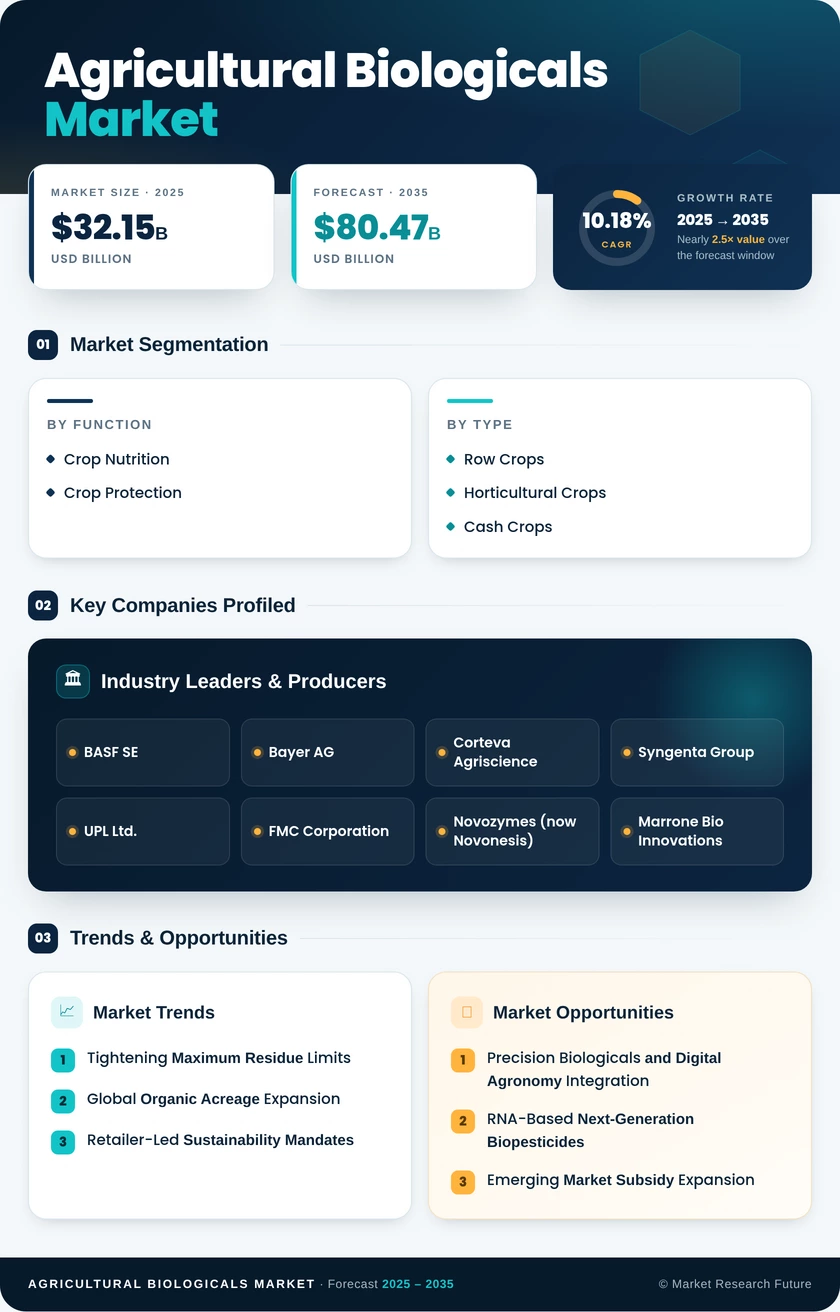
Segmentation Quick Reference

DimensionSub-SegmentsDominant SegmentFastest Growing Segment
By FunctionCrop Nutrition, Crop ProtectionCrop NutritionCrop Protection
By Crop TypeRow Crops, Horticultural Crops, Cash CropsRow CropsHorticultural Crops
By GeographyNorth America, Europe, Asia-Pacific, South America, Middle East & AfricaEuropeNorth America


Market Segmentation Overview

By Function

Sub-SegmentKey Trend
Crop NutritionBiostimulant and biofertilizer integration into conventional fertilization programs is accelerating globally.
Crop ProtectionBioinsecticide, biofungicide, and RNA-based biopesticide registrations are expanding rapidly across all regions.


The function segmentation reflects a structural shift from supplemental biological use to core-program integration. Crop nutrition products dominate revenue today, while crop protection biologicals are closing the gap as regulatory restrictions on synthetic active ingredients intensify across the EU, North America, and key Asian export markets.

By Crop Type

Sub-SegmentKey Trend
Row CropsSeed-applied microbial inoculants and biological soil treatments are becoming standard practice on corn and soybean acres.
Horticultural CropsExport-driven residue-free mandates compelling adoption of biofungicide and bioinsecticide solutions.
Cash CropsSustainability certifications for coffee, cocoa, and cotton are driving biological input integration


Row crops account for the largest volume share due to the scale of global corn, soybean, wheat, and rice acreage. Horticultural crops are the fastest-growing crop type segment as importing-country MRL thresholds tighten and consumers increasingly demand residue-free fresh produce. Cash crops represent a steady-growth niche anchored by sustainability certification programs in export-oriented tropical commodities.