×
Request Free Sample ×

Kindly complete the form below to receive a free sample of this Report

* Please use a valid business email

Leading companies partner with us for data-driven Insights

clients tt-cursor
Hero Background

Busbar Systems Market

ID: MRFR/EnP/0653-HCR
188 Pages
Snehal Singh
October 2025

Busbar Systems Market Research Report Information By Conductor (Copper and Aluminum), By Power Rating (Low, Medium, and High), By End-Use Industry (Residential, Industrial, and Commercial), And By Region (North America, Europe, Asia-Pacific, And Rest Of The World) –Market Forecast Till 2035

Share:
Download PDF ×

We do not share your information with anyone. However, we may send you emails based on your report interest from time to time. You may contact us at any time to opt-out.

Busbar Systems Market Infographic
Purchase Options

Busbar Systems Market Summary

As per Market Research Future analysis, the Busbar Systems Market Size was estimated at 17.22 USD Billion in 2024. The Busbar Systems industry is projected to grow from 20.31 USD Billion in 2025 to 105.69 USD Billion by 2035, exhibiting a compound annual growth rate (CAGR) of 17.93% during the forecast period 2025 - 2035.

Key Market Trends & Highlights

The Busbar Systems Market is poised for substantial growth driven by technological advancements and increasing demand for renewable energy.

  • Technological advancements are enhancing the efficiency and reliability of busbar systems, particularly in North America.
  • Customization and modularity are becoming essential features, catering to the diverse needs of the industrial and commercial segments.
  • A strong focus on sustainability is influencing market dynamics, especially in the rapidly growing Asia-Pacific region.
  • The increasing demand for renewable energy and urbanization are key drivers propelling the market forward.

Market Size & Forecast

2024 Market Size 17.22 (USD Billion)
2035 Market Size 105.69 (USD Billion)
CAGR (2025 - 2035) 17.93%

Major Players

Schneider Electric (FR), Siemens (DE), ABB (CH), Eaton (US), General Electric (US), Mitsubishi Electric (JP), Legrand (FR), Crompton Greaves (IN), Rittal (DE)

Busbar Systems Market Trends

The Busbar Systems Market is currently experiencing a transformative phase, driven by the increasing demand for efficient power distribution solutions across various sectors. This market encompasses a range of products designed to facilitate the safe and effective transmission of electrical power. As industries evolve, the need for reliable and high-capacity systems becomes paramount. The integration of advanced technologies, such as smart grids and automation, appears to be reshaping the landscape, enhancing operational efficiency and reliability. Furthermore, the growing emphasis on renewable energy sources is likely to propel the adoption of busbar systems, as they are essential for connecting various energy generation methods to the grid. In addition, the Busbar Systems Market is witnessing a shift towards modular and customizable solutions. This trend suggests that manufacturers are increasingly focusing on providing tailored products that meet specific customer requirements. The rise of urbanization and infrastructure development is also contributing to the expansion of this market, as new construction projects necessitate robust electrical systems. Overall, the Busbar Systems Market seems poised for growth, driven by technological advancements and changing consumer preferences, which may lead to innovative solutions in the near future.

Technological Advancements

The Busbar Systems Market is influenced by ongoing technological innovations that enhance system performance and reliability. Manufacturers are integrating smart technologies, which facilitate real-time monitoring and control, thereby improving efficiency.

Customization and Modularity

There is a noticeable trend towards modular designs in the Busbar Systems Market. This approach allows for greater flexibility and customization, enabling clients to adapt systems to their specific needs and operational requirements.

Sustainability Focus

The increasing emphasis on sustainability is shaping the Busbar Systems Market. As industries seek to reduce their carbon footprint, the demand for energy-efficient solutions is rising, prompting manufacturers to develop eco-friendly busbar systems.

Busbar Systems Market Drivers

Rising Demand for Energy Efficiency

The Global Busbar Systems Market Industry is experiencing a surge in demand driven by the increasing emphasis on energy efficiency across various sectors. As industries strive to reduce operational costs and minimize energy consumption, busbar systems, known for their high conductivity and compact design, are becoming increasingly popular. In 2024, the market is projected to reach 17.2 USD Billion, reflecting a growing recognition of the advantages that busbar systems offer over traditional wiring methods. This trend is particularly evident in sectors such as manufacturing and commercial buildings, where energy-efficient solutions are prioritized.

Market Segment Insights

By Application: Power Distribution (Largest) vs. Renewable Energy Integration (Fastest-Growing)

The Busbar Systems Market is classified into five primary applications: Power Distribution, Renewable Energy Integration, Industrial Automation, Transportation, and Data Centers. Power Distribution holds the largest share in this segment due to the ongoing demands for reliable and efficient electricity transmission. Renewable Energy Integration, on the other hand, is rapidly gaining traction largely because of the global shift towards sustainable energy solutions, making it a significant part of the market landscape.

Renewable Energy Integration (Emerging) vs. Industrial Automation (Dominant)

As a prominent application in the Busbar Systems Market, Industrial Automation emphasizes the essential role of busbar systems in enhancing operational efficiency and reducing downtime in manufacturing processes. It has a well-established market presence, driven by increasing investments in automated systems. Conversely, Renewable Energy Integration, while emerging, showcases remarkable potential, propelled by technological innovations and supportive government policies. Its growth is largely fueled by the increasing integration of renewable sources like solar and wind energy into existing grids, creating a more versatile and resilient power distribution framework.

By End Use: Industrial (Largest) vs. Commercial (Fastest-Growing)

The Busbar Systems Market is distinctly segmented by end use, where the industrial sector holds the largest market share, benefiting from extensive utility installations and the rise in automation in processing and manufacturing facilities. The commercial segment, on the other hand, is experiencing a rapid rise, fueled by the growing demand for energy-efficient solutions in office spaces and commercial buildings, leading to increased installations of busbar systems that ensure seamless power distribution.

Commercial (Fastest-Growing) vs. Utility (Dominant)

The commercial sector is currently recognized as the fastest-growing segment in the Busbar Systems Market, driven by the increasing emphasis on energy efficiency and reduction of operational costs in commercial establishments. Businesses are adopting busbar systems for their ability to provide a flexible and modular electrical distribution network. In contrast, the utility sector remains a dominant force, heavily reliant on busbar systems for stable power delivery in electrical grids. Utilities are transitioning towards modernized infrastructures, necessitating robust busbar solutions that can support high voltage demands and enhanced reliability.

By Material Type: Copper (Largest) vs. Aluminum (Fastest-Growing)

In the Busbar Systems Market, the material type segment showcases a diverse distribution with Copper being the largest contributor to market share, renowned for its superior conductivity and durability. Aluminum follows, gaining significant traction due to its lightweight nature and cost-effectiveness, appealing to a broader range of applications. Alloy materials also play a substantial role, combining the strengths of both Copper and Aluminum to offer solutions tailored to specific performance requirements, while insulated and bare types cater to niche needs and particular safety standards.

Material: Copper (Dominant) vs. Aluminum (Emerging)

Copper remains the dominant material in busbar systems owing to its excellent electrical conductivity, thermal properties, and long-term reliability, making it a preferred choice for high-performance electrical applications. However, Aluminum is emerging rapidly due to its lightweight nature, which promotes ease of installation and transport, alongside competitive pricing that makes it an attractive alternative for various sectors. As businesses seek more sustainable solutions, advancements in Aluminum technology, including improved efficiency in power delivery, are driving its adoption. The emerging trend indicates a shift towards hybrid solutions incorporating alloys, which blend properties of both metals, meeting specific end-user requirements while balancing cost and performance.

By Voltage Rating: Low Voltage (Largest) vs. Medium Voltage (Fastest-Growing)

The Busbar Systems Market exhibits significant distribution across various voltage ratings, with the Low Voltage segment commanding the largest share due to its vast applications in residential and commercial infrastructures. Following closely, the Medium Voltage segment is gaining momentum as industries shift towards energy-efficient solutions, leading to a balanced market distribution in terms of both revenue and adoption rates. Stakeholders are increasingly expanding their portfolios to include innovative Low and Medium Voltage offerings, capturing larger market segments and addressing evolving consumer needs.

Voltage Ratings: Low Voltage (Dominant) vs. Medium Voltage (Emerging)

The Low Voltage segment has solidified its dominant position in the Busbar Systems Market, primarily driven by its extensive utilization in low-voltage applications, including residential wiring and small commercial infrastructure. Its reliability and cost-effectiveness make it a preferred choice among end-users. Conversely, the Medium Voltage segment is emerging as a vital player, experiencing rapid growth due to the increasing demand for efficient power distribution in industrial settings. As companies transition towards automation and smart electrical systems, the Medium Voltage offerings are expected to see significant innovations and enhancements, making them an attractive option for future investments in the market.

By Form Factor: Busbar Ducts (Largest) vs. Busbar Trunking System (Fastest-Growing)

In the Busbar Systems Market, the distribution of market share is notably influenced by the form factors comprising primarily Busbar Ducts, Busbar Trunking Systems, Busbar Supports, and Busbar Connectors. Among these, Busbar Ducts command the largest share, establishing their dominance in the construction and industrial segments where high current capacities are vital. Busbar Trunking Systems, while currently smaller in market share, are experiencing fast growth due to increasing demand for efficient power distribution in commercial buildings.

Busbar Ducts (Dominant) vs. Busbar Trunking Systems (Emerging)

Busbar Ducts are characterized by their robust design suitable for heavy-duty applications, making them the preferred choice for commercial and industrial installations. Their ability to handle high current loads and provide flexibility in installation further solidifies their dominant position in the market. In contrast, Busbar Trunking Systems are emerging as a significant player due to their advantages in efficiency and ease of installation. These systems are increasingly favored for modern construction projects, as they enable streamlined power distribution, reduce installation times, and enhance overall operational efficiency. The synergy between their growing adoption and technological advancements positions Busbar Trunking Systems as an innovative solution appealing to developers and industry leaders.

Get more detailed insights about Busbar Systems Market

Regional Insights

North America : Market Leader in Busbar Systems

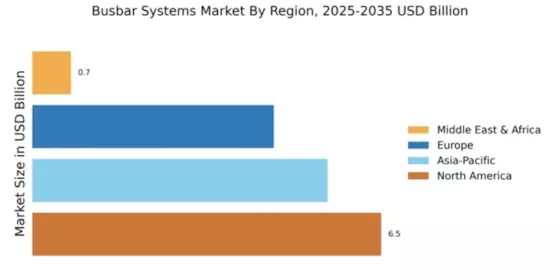
North America is poised to maintain its leadership in the Busbar Systems Market, holding a significant market share of 7.0 in 2024. The region's growth is driven by increasing demand for efficient power distribution systems, stringent regulatory standards, and a shift towards renewable energy sources. The adoption of smart grid technologies and investments in infrastructure further catalyze market expansion, making it a hub for innovation and development in electrical systems. The competitive landscape in North America is characterized by the presence of major players such as Schneider Electric, Eaton, and General Electric. These companies are leveraging advanced technologies to enhance product offerings and meet the growing demand for energy-efficient solutions. The U.S. and Canada are leading markets, supported by government initiatives aimed at modernizing electrical infrastructure and promoting sustainable energy practices.

Europe : Emerging Market with Growth Potential

Europe's Busbar Systems Market is projected to grow significantly, with a market size of 4.5 by 2025. The region benefits from robust regulatory frameworks promoting energy efficiency and sustainability, driving demand for advanced busbar solutions. The European Union's commitment to reducing carbon emissions and enhancing energy security is a key catalyst for market growth, encouraging investments in modern electrical infrastructure and smart technologies. Leading countries in this region include Germany, France, and the UK, where major players like Siemens and ABB are actively innovating to capture market share. The competitive landscape is marked by a focus on sustainability and technological advancements, with companies investing in R&D to develop eco-friendly solutions. The European market is characterized by a strong emphasis on compliance with stringent regulations, ensuring high standards in product quality and performance.

Asia-Pacific : Rapid Growth and Urbanization

The Asia-Pacific region is witnessing rapid growth in the Busbar Systems Market, with a projected size of 4.0 by 2025. This growth is fueled by urbanization, industrialization, and increasing energy demands in countries like China and India. Government initiatives aimed at enhancing power infrastructure and promoting renewable energy sources are significant drivers of market expansion, creating a favorable environment for busbar system adoption. China and India are the leading markets in this region, with key players such as Mitsubishi Electric and Crompton Greaves actively participating in the competitive landscape. The presence of these companies is bolstered by strategic partnerships and collaborations aimed at enhancing product offerings. The region's focus on modernizing electrical grids and improving energy efficiency is expected to further accelerate market growth, positioning Asia-Pacific as a vital player in The Busbar Systems.

Middle East and Africa : Emerging Market with Challenges

The Middle East and Africa region is gradually emerging in the Busbar Systems Market, with a market size of 1.72 by 2025. The growth is primarily driven by increasing investments in infrastructure development and a rising demand for reliable power distribution systems. However, challenges such as political instability and economic fluctuations may hinder market progress. Regulatory frameworks are evolving to support energy efficiency and sustainability, which could catalyze future growth in the sector. Countries like South Africa and the UAE are leading the market, with key players such as Rittal and Schneider Electric focusing on expanding their presence. The competitive landscape is characterized by a mix of local and international companies striving to meet the growing demand for energy-efficient solutions. As the region continues to develop its electrical infrastructure, the busbar systems market is expected to gain traction, albeit at a slower pace compared to other regions.

Key Players and Competitive Insights

The Busbar Systems Market is currently characterized by a dynamic competitive landscape, driven by increasing demand for efficient power distribution and the growing emphasis on renewable energy sources. Major players such as Schneider Electric (France), Siemens (Germany), and ABB (Switzerland) are strategically positioned to leverage innovation and technological advancements. Schneider Electric (France) focuses on digital transformation and sustainability, aiming to enhance energy efficiency through smart solutions. Siemens (Germany) emphasizes regional expansion and partnerships, particularly in emerging markets, to strengthen its market presence. ABB (Switzerland) is heavily investing in research and development to innovate its product offerings, thereby shaping a competitive environment that prioritizes technological superiority and sustainability.

Key business tactics within the Busbar Systems Market include localizing manufacturing and optimizing supply chains to enhance operational efficiency. The market structure appears moderately fragmented, with several key players exerting considerable influence. This fragmentation allows for a diverse range of products and solutions, catering to various customer needs while fostering competition among established and emerging companies.

In November 2025, Schneider Electric (France) announced a strategic partnership with a leading renewable energy firm to develop integrated busbar systems that support solar and wind energy projects. This collaboration is likely to enhance Schneider's portfolio, positioning it as a leader in sustainable energy solutions. The strategic importance of this partnership lies in its potential to address the growing demand for renewable energy infrastructure, aligning with global sustainability goals.

In October 2025, Siemens (Germany) launched a new range of modular busbar systems designed for industrial applications, which are expected to improve installation efficiency and reduce costs. This product launch reflects Siemens' commitment to innovation and its strategy to capture a larger share of the industrial market. The introduction of modular systems may also facilitate quicker project timelines, appealing to customers seeking rapid deployment.

In September 2025, ABB (Switzerland) completed the acquisition of a regional busbar manufacturer, enhancing its capabilities in the Asia-Pacific market. This acquisition is significant as it allows ABB to expand its footprint in a rapidly growing region, tapping into the increasing demand for advanced electrical distribution solutions. The move is indicative of ABB's strategy to consolidate its market position through targeted acquisitions, thereby strengthening its competitive edge.

As of December 2025, current trends in the Busbar Systems Market include a pronounced shift towards digitalization, sustainability, and the integration of AI technologies. Strategic alliances are increasingly shaping the competitive landscape, enabling companies to pool resources and expertise to innovate more effectively. Looking ahead, competitive differentiation is likely to evolve from traditional price-based competition to a focus on innovation, technological advancements, and supply chain reliability. This shift underscores the importance of adaptability and forward-thinking strategies in maintaining a competitive advantage.

Key Companies in the Busbar Systems Market market include

Industry Developments

January 2023:The American government committed USD 2.7 billion to improving and expanding the nation's rural power infrastructure. The strategy is predicted to increase grid security, upgrade and develop the country's rural electric system, contributing to industry growth.

September 2021:The largest manufacturer of busbar systems in the G.C.C., E&I Engineering Ireland, and its UAE-based affiliate, Powerbar Gulf, will be acquired by Vertiv Holdings Company for USD 1.8 billion in advance consideration plus the possibility of up to USD 200 million in cash. Vertiv Holdings Company provides vital digital infrastructure and continuity solutions globally.

March 2020:ABB Ltd.'s electrification business unit purchased a sizable stake in Shanghai Charge Dot New Energy Technology Co., Ltd.

January 2020:A Redditch-based producer of automotive technology awarded Samuel Taylor Limited a contract to help develop E.V.s. The first company will manufacture parts and bi-metals to develop battery busbar technology.

For example, one of the power transmission developers, Sterlite Power, ended its fiscal year (FY24) in April 2024 by getting orders worth Rs. 2,500 Cr for high-performance conductors, which accounted for as much as its Global Products and Services (GPS) business unit in Q4.

April 2024: Referro Systems is a distributor of Rockwell Automation products authorized by Rockwell Automation Company in South Africa, and they have launched Cu-Flex flexible copper busbars.

In April 2024, for instance, Legrand said that its track busway system provides flexibility that traditional power distribution systems do not have.

Pickering Interfaces is an industry-leading modular simulation and signal-switching product provider designed specifically for electronic testing and verification. In this regard, the company came up in April 2024 with high-density PXIe and PXI multiplexer (MUX) modules targeting high-voltage applications. Moreover, the adoption of electric busways is further accelerated by continuous improvements in the industrial sector. These use busbars to distribute electricity in large structures such as factories efficiently. They are also made up of conductive bars that typically contain aluminum or copper materials to safely carry high-current electricity.

Signal Hound is an example of a manufacturer of precision test equipment that announced the addition of RFS44 into their product range in April 2024. In line with this development was Schneider Electric’s announcement of EasySet MV air-insulated indoor switchgear at some time after April 2024 as well. This environmentally friendly and original switchgear will facilitate easy operation and maintenance during the delivery of electrical services to boost revenues from the busbar market.

March 2024: ABB has introduced FlexLine – new generation modular protection devices specifically designed for quick installation at residential buildings or small commercial facilities. The series includes residual current devices (RCD), miniature circuit breakers (MCB), and arc fault detection devices (AFDD), all with push-in technology that can be combined in any required configuration on one single busbar type.

February 2024: Since acquiring PowerBar Gulf and E&I Engineering switchgear, busway, and IMS business in 2021, Vertiv’s busway, switch gear, and integrated modular solutions (IMS) business has grown by over 100%. The company plans to continue adding capacity through expansions through the end of 2025.

February 2024: A group of researchers from Spain led by the Centre for Energy, Environmental and Technological Research (CIEMAT) have come up with a number of ways to repair ribbon busbar interruptions in photovoltaic panels.
Future Outlook

Busbar Systems Market Future Outlook

The Busbar Systems Market is projected to grow at a 17.93% CAGR from 2024 to 2035, driven by increasing demand for efficient power distribution and renewable energy integration.

New opportunities lie in:

  • Expansion into smart grid technologies for enhanced energy management.
  • Development of modular busbar systems for rapid deployment in construction.
  • Partnerships with renewable energy firms to provide integrated solutions.

By 2035, the Busbar Systems Market is expected to achieve substantial growth, reflecting evolving energy demands.

Market Segmentation

Busbar Systems Market End Use Outlook

  • Commercial
  • Residential
  • Industrial
  • Utility
  • Transportation

Busbar Systems Market Application Outlook

  • Power Distribution
  • Renewable Energy Integration
  • Industrial Automation
  • Transportation
  • Data Centers

Busbar Systems Market Form Factor Outlook

  • Busbar Trunking System
  • Busbar Ducts
  • Busbar Supports
  • Busbar Connectors

Busbar Systems Market Material Type Outlook

  • Copper
  • Aluminum
  • Alloy
  • Insulated
  • Bare

Busbar Systems Market Voltage Rating Outlook

  • Low Voltage
  • Medium Voltage
  • High Voltage
  • Extra High Voltage

Report Scope

MARKET SIZE 2024 17.22(USD Billion)
MARKET SIZE 2025 20.31(USD Billion)
MARKET SIZE 2035 105.69(USD Billion)
COMPOUND ANNUAL GROWTH RATE (CAGR) 17.93% (2024 - 2035)
REPORT COVERAGE Revenue Forecast, Competitive Landscape, Growth Factors, and Trends
BASE YEAR 2024
Market Forecast Period 2025 - 2035
Historical Data 2019 - 2024
Market Forecast Units USD Billion
Key Companies Profiled Schneider Electric (FR), Siemens (DE), ABB (CH), Eaton (US), General Electric (US), Mitsubishi Electric (JP), Legrand (FR), Crompton Greaves (IN), Rittal (DE)
Segments Covered Application, End Use, Material Type, Voltage Rating, Form Factor
Key Market Opportunities Integration of smart grid technologies enhances efficiency in the Busbar Systems Market.
Key Market Dynamics Rising demand for energy efficiency drives innovation and competition in the Busbar Systems market.
Countries Covered North America, Europe, APAC, South America, MEA

Market Highlights

Author
Snehal Singh
Assistant Manager - Research

High acumen in analyzing complex macro & micro markets with more than 6 years of work experience in the field of market research. By implementing her analytical skills in forecasting and estimation into market research reports, she has expertise in Packaging, Construction, and Equipment domains. She handles a team size of 20-25 resources and ensures smooth running of the projects, associated marketing activities, and client servicing.

Leave a Comment

FAQs

How much is the Busbar Systems market?

The global Busbar Systems market size was valued at USD 17.22 Billion in 2024.

What is the growth rate of the Busbar Systems market?

The global market will likely grow at a CAGR of 17.93% from 2025 to 2034.

Which region held the key market share in the Busbar Systems market?

North America had the major share of the global market.

Who are the key players in the Busbar Systems market?

The significant players in the market are ABB Ltd. (Switzerland), A.R.J. Group (U.A.E.), Busbar Services (South Africa), C&S Electric Ltd. (India), E.A.E EleKTrik A.S. (Turkey), Eaton Corporation, P.L.C., (Republic of Ireland), Entraco Power (India), General Electric Company. (U.S.), Gersan EleKTrikAS. (Turkey), Godrej & Boyce Manufacturing Company Ltd. (India), Graziadio & C. S.P.A. (Italy), IBAR (EMEA) Ltd. (Kendal, UK), KGS Engineering Ltd. (Chennai, India), Schneider Electric Co. (France), Larsen & Toubro. (India), Legrand. (France), and Megabarre Group. (Italy).

Which Conductor led the Busbar Systems market?

The copper category dominated the global market in 2022.

Which Power Rating had the largest market share in the Busbar Systems market?

The high-power rating had the largest share in the global Busbar Systems market.

Download Free Sample

Kindly complete the form below to receive a free sample of this Report

Compare Licence

×
Features License Type
Single User Multiuser License Enterprise User
Price $4,950 $5,950 $7,250
Maximum User Access Limit 1 User Upto 10 Users Unrestricted Access Throughout the Organization
Free Customization
Direct Access to Analyst
Deliverable Format
Platform Access
Discount on Next Purchase 10% 15% 15%
Printable Versions