Request Free Sample ×

Kindly complete the form below to receive a free sample of this Report

* Please use a valid business email

Leading companies partner with us for data-driven Insights

clients tt-cursor
Hero Background

Citric Acid Market

ID: MRFR/FnB/1211-CR
132 Pages
Snehal Singh
Last Updated: May 28, 2026
Citric Acid Market Size, Share, Industry Trend & Analysis Research Report Information By Form (Anhydrous, Liquid), By Application (Food & Beverages, Pharmaceuticals, Personal Care & Cosmetics, Detergents & Household Cleaners, Others), By Sub-Application (F&B) (Bakery, Confectionery, Dairy, Beverages, Savory & Snacks, Others), By Geography (North America, Europe, Asia-Pacific, South America, Middle East & Africa) - Forecast Till 2035
Download PDF ×

We do not share your information with anyone. However, we may send you emails based on your report interest from time to time. You may contact us at any time to opt-out.

  1. 1 Market Overview |
    1. 1.1 Study Assumptions & Market Definition |
    2. 1.2 Scope of the Study |
    3. 1.3 Research Methodology
  2. 2 Market Summary & Key Takeaways
  3. 3 Market Dynamics |
    1. 3.1 Market Drivers Analysis | |
      1. 3.1.1 Clean-Label Food Reformulation Mandates | |
      2. 3.1.2 Phosphate Restrictions in Detergent Chemistry | |
      3. 3.1.3 Asian Fermentation Capacity Scale-Up | |
      4. 3.1.4 Pharmaceutical Excipient Demand Growth | |
      5. 3.1.5 Beverage Sector Expansion in MEA | |
      6. 3.1.6 Biodegradable Chelant Adoption in Water Treatment | |
      7. 3.1.7 Personal-Care Formulation Premiumization |
    2. 3.2 Market Restraints Analysis | |
      1. 3.2.1 Substrate Price Volatility (Corn, Molasses) | |
      2. 3.2.2 Trade Tariffs on Chinese Citric Acid Exports | |
      3. 3.2.3 Environmental Discharge Regulations on Fermentation Effluent | |
      4. 3.2.4 Competition from Alternative Acidulants | |
      5. 3.2.5 Currency Fluctuation in Export-Dependent Markets |
    3. 3.3 Market Opportunity Analysis | |
      1. 3.3.1 Water Treatment and Industrial Descaling | |
      2. 3.3.2 Pharmaceutical and Nutraceutical Effervescent Formats | |
      3. 3.3.3 Green Cleaning and Household Products in Emerging Markets | |
      4. 3.3.4 Bio-Based and Circular-Economy Fermentation Platforms | |
      5. 3.3.5 Data-Driven Supply-Chain Monetization |
    4. 3.4 Industry Value Chain Analysis |
    5. 3.5 Porter's Five Forces Analysis
  4. 4 Global Citric Acid Market Size & Forecast (2021–2035) |
    1. 4.1 Historical Market Size (2021–2025) |
    2. 4.2 Current & Forecast Market Size (2026–2035) |
    3. 4.3 Market Size by Revenue (USD Billion) |
    4. 4.4 Year-over-Year Growth Analysis
  5. 5 Segmentation Analysis |
    1. 5.1 By Form | |
      1. 5.1.1 Anhydrous | |
      2. 5.1.2 Liquid |
    2. 5.2 By Application | |
      1. 5.2.1 Food & Beverages | |
      2. 5.2.2 Pharmaceuticals | |
      3. 5.2.3 Personal Care & Cosmetics | |
      4. 5.2.4 Detergents & Household Cleaners | |
      5. 5.2.5 Others |
    3. 5.3 By Sub-Application (Food & Beverages) | |
      1. 5.3.1 Bakery | |
      2. 5.3.2 Confectionery | |
      3. 5.3.3 Dairy | |
      4. 5.3.4 Beverages | |
      5. 5.3.5 Savory & Snacks | |
      6. 5.3.6 Others
  6. 6 Regional Analysis |
    1. 6.1 North America | |
      1. 6.1.1 United States | |
      2. 6.1.2 Canada | |
      3. 6.1.3 Mexico |
    2. 6.2 Europe | |
      1. 6.2.1 Germany | |
      2. 6.2.2 United Kingdom | |
      3. 6.2.3 France | |
      4. 6.2.4 Italy | |
      5. 6.2.5 Spain | |
      6. 6.2.6 Nordic Countries | |
      7. 6.2.7 Russia | |
      8. 6.2.8 Rest of Europe |
    3. 6.3 Asia-Pacific | |
      1. 6.3.1 China | |
      2. 6.3.2 India | |
      3. 6.3.3 Japan | |
      4. 6.3.4 South Korea | |
      5. 6.3.5 ASEAN | |
      6. 6.3.6 Rest of Asia-Pacific |
    4. 6.4 South America | |
      1. 6.4.1 Brazil | |
      2. 6.4.2 Argentina | |
      3. 6.4.3 Rest of South America |
    5. 6.5 Middle East & Africa | |
      1. 6.5.1 Saudi Arabia | |
      2. 6.5.2 UAE | |
      3. 6.5.3 South Africa | |
      4. 6.5.4 Egypt | |
      5. 6.5.5 Rest of MEA
  7. 7 Competitive Landscape |
    1. 7.1 Market Share Analysis (2025) |
    2. 7.2 Competitive Benchmarking Matrix |
    3. 7.3 Company Profiles | |
      1. 7.3.1 Weifang Ensign Industry Co., Ltd. | |
      2. 7.3.2 Archer Daniels Midland (ADM) | |
      3. 7.3.3 Cargill, Inc. | |
      4. 7.3.4 Tate & Lyle PLC | |
      5. 7.3.5 Jungbunzlauer Suisse AG | |
      6. 7.3.6 COFCO Biochemical (Anhui) Co. | |
      7. 7.3.7 Gadot Biochemical Industries Ltd. | |
      8. 7.3.8 Citrique Belge | |
      9. 7.3.9 RZBC Group Co. Ltd. | |
      10. 7.3.10 Huangshi Xinghua Biochemical Co., Ltd.
  8. 8 Future Outlook & Strategic Recommendations (2026–2035) |
    1. 8.1 Precision Fermentation and Bioprocess Optimization |
    2. 8.2 Sustainability Reporting and ESG-Driven Procurement |
    3. 8.3 Regulatory Harmonization Across Emerging Markets |
    4. 8.4 Circular-Economy Integration and Waste Valorization
  9. 9 Recent Developments & News
  10. 10 Frequently Asked Questions (FAQs)
  11. 11 Report Scope & Methodology |
    1. 11.1 Study Period & Base Year |
    2. 11.2 Data Sources & Citations |
    3. 11.3 Abbreviations
  12. 1 LIST OF TABLES
  13. 2 LIST OF FIGURES

Segmentation Quick Reference

DimensionSub-SegmentsDominant SegmentFastest Growing Segment
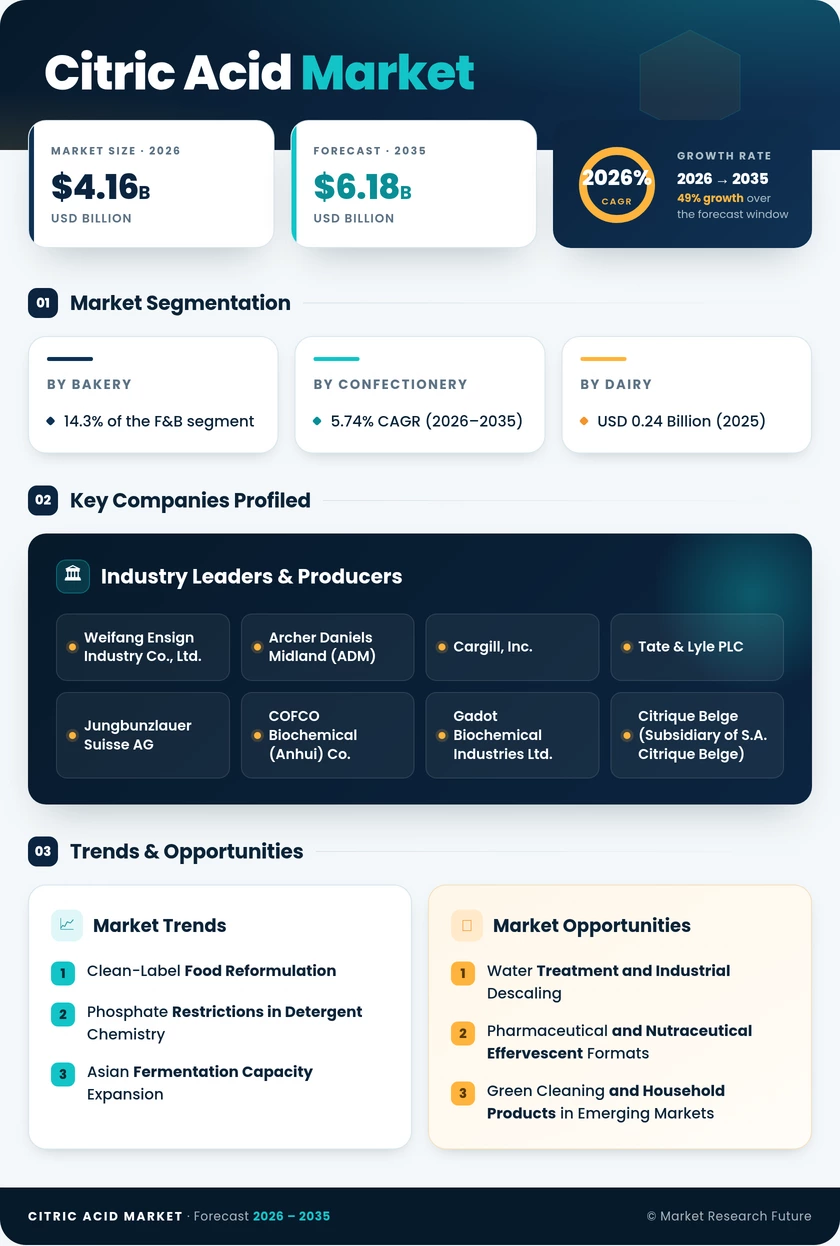
By FormAnhydrous, LiquidAnhydrous (58.9% share, 2025)Liquid (6.28% CAGR)
By ApplicationFood & Beverages, Pharmaceuticals, Personal Care & Cosmetics, Detergents & Household Cleaners, OthersFood & Beverages (USD 1.97B, 2025)Detergents & Household Cleaners (6.52% CAGR)
By Sub-Application (F&B)Bakery, Confectionery, Dairy, Beverages, Savory & Snacks, OthersBeverages (38.2% of F&B)Confectionery (5.74% CAGR)
By GeographyNorth America, Europe, Asia-Pacific, South America, Middle East & AfricaAsia-Pacific (37.8% share, 2025)Middle East & Africa (7.12% CAGR)


Market Segmentation Overview

By Form

Sub-SegmentKey Trend
AnhydrousRemains the industry standard for dry-mix food, pharmaceutical tableting, and powdered beverage applications due to superior stability and lower logistics costs.
LiquidGrowing adoption in ready-to-use cleaning sprays, liquid personal-care formulations, and industrial CIP (clean-in-place) protocols, where pre-dissolved convenience reduces processing time.


The form dimension reflects a structural split between cost-optimized dry-format supply chains and convenience-driven liquid applications. Anhydrous grade will retain volume dominance, but liquid citric acid's faster growth rate signals shifting end-user preferences toward formulation-ready ingredients.

By Application

Sub-SegmentKey Trend
Food & BeveragesClean-label reformulation and acidulation demand across bakery, beverage, dairy, confectionery, and snack segments drive the largest revenue contribution.
PharmaceuticalsExpanding biologics pipelines and effervescent dosage formats increase demand for USP/EP-grade citric acid as a buffering and pH-regulation excipient.
Personal Care & CosmeticsAlpha-hydroxy acid (AHA) skincare trends and sulfate-free hair-care formulations incorporate citric acid for pH adjustment and chelation.
Detergents & Household CleanersPhosphate-restriction legislation in Europe and North America accelerates the adoption of citric acid as a biodegradable chelating builder.
OthersWater treatment, construction admixtures, and animal-feed acidification represent emerging demand pockets.


Application-level segmentation reveals that food-grade citric acid remains the revenue anchor. Still, the fastest incremental growth is shifting toward industrial and household cleaning applications where regulatory mandates create non-discretionary demand.

By Sub-Application (Food & Beverages)

Sub-SegmentKey Trend
BakeryCitric acid serves as a leavening acid in baking powders and extends shelf life through pH-dependent microbial inhibition.
ConfectionerySour-candy and coated-confectionery producers rely on citric acid for flavor profiling and surface-coating crystallization.
DairyCheese and yogurt manufacturers use citric acid for pH regulation during coagulation and fermentation processes.
BeveragesCarbonated drinks, juices, and sports beverages represent the largest single consumption pool for food-grade citric acid.
Savory & SnacksSeasoning blends and processed snack coatings incorporate citric acid for flavor enhancement and preservation.
OthersSauces, dressings, and processed-food applications use citric acid as a multi-functional ingredient.


The food and beverage sub-application landscape underscores beverages as the dominant consumption channel. At the same time, confectionery and savory snacks represent above-average growth vectors driven by flavor-innovation trends in emerging markets.